Table of Contents
- The short version
- The history: from Kahn via the Polar Explorer to Aurora
- Polar modulation: the heart of Aurora
- Efficiency in numbers
- Heat, fans and key-down operation
- The four Aurora models
- AU-510 or AU-520?
- Key specifications
- Transmitter
- Receiver
- Connectors
- Chassis and power
- SmartSDR, SmartLink and MultiFlex
- The most sensitive point: SWR
- No external amplifier, in either direction
- No VHF and UHF, but transverter ports
- Comparison with conventional transceivers
- Availability and prices in Europe
- From practical use
- Who is Aurora for?
- Tips for switching to Aurora
- Where the name comes from
- Conclusion
- Sources
- Image credits
- Update notice
- Transparency Notice
FlexRadio Systems has built a transceiver that amateur radio is talking about. The Aurora series is the first commercial amateur transceiver to use a polar modulation transmitter. Peak efficiency is around 80 per cent, where conventional LDMOS linear amplifiers manage 40 to 60 per cent. The result is 500 watts PEP on HF in an eight kilogram box with a built-in power supply and antenna tuner. Since October 2026 the series has also been available from European dealers. Time for a close look: what is behind the technology, where are the limits, and who should consider the investment?
The short version
- 500 W PEP on HF (160 to 10 m), 200 W on 6 m, from a single 8 kg unit with a built-in wide-range power supply.
- Polar modulation instead of linear amplification: a class D amplifier whose supply voltage tracks the envelope. Peak efficiency up to 80 per cent.
- 125 watts of waste heat instead of 750 watts for the same output power. That is the real lever behind the compact chassis.
- Four models: AU-510 and AU-520, each optionally with a built-in Maestro touchscreen as the M variant.
- The catches: sensitive SWR management from 1.7:1 upwards, an ICAS rating of 25 to 50 per cent duty cycle, no external amplifier in either direction, no VHF or UHF without a transverter, and an entry price of just under 7,000 euros.
The history: from Kahn via the Polar Explorer to Aurora
The principle is a great deal older than the product. Leonard Kahn described the technique of splitting a transmitter signal into an amplitude and a phase component back in 1952. It became known as Envelope Elimination and Restoration. What was missing was the digital signal processing needed to recombine both paths cleanly enough.
The modern line starts with Tony Brock-Fisher, K1KP. The idea of a highly efficient transmitter for amateur radio grew out of a lunchtime conversation with Brian Machesney, K1LI. In the March/April 2017 issue of QEX, K1KP published "The Polar Explorer", describing the principles and a working prototype. FlexRadio adopted the design, Brock-Fisher became lead design engineer for the project, and the result is Aurora.
FlexRadio's own history reads like a textbook of SDR development:
- 2003, SDR-1000: the first commercially available SDR transceiver for radio amateurs. All signal processing ran on the attached PC.
- 2007, FLEX-5000: improved hardware with FireWire, still PC dependent but considerably more capable.
- 2012, FLEX-6000: the breakthrough. Direct sampling, standalone hardware with Ethernet, and SmartSDR as the software ecosystem.
- 2023, FLEX-8000: the high-end platform with 16-bit direct sampling and wideband dynamic range above 155 dB in the FLEX-8600. It supplies the receiver section of Aurora.
- 2025, Aurora: the FLEX-8000 receiver platform combined with the polar modulation transmitter, introduced at Hamvention 2025.
If you are interested in the fundamentals of software defined radio, our SDR comparison gives an overview of the technology.
Polar modulation: the heart of Aurora
In a conventional transmitter the complete modulated signal, amplitude and phase together, is amplified by a linear stage. The problem is inherent in the design: linear amplifiers have to operate well below their maximum output to avoid distortion. Efficiency is typically 40 to 60 per cent and the rest becomes heat. That is why many transceivers need large heatsinks and noisy fans.
Polar modulation takes a different route and splits the signal into two components:
- The phase component carries frequency and phase information. It has a constant envelope and can therefore be handled by a switching amplifier that only knows two states, fully on or fully off. FlexRadio uses a class D stage for this.
- The amplitude component carries the envelope. It drives a fast switching regulator that modulates the supply voltage of the amplifier in step with the modulation.
Only both paths together reconstitute the complete SSB signal. The gain comes from switching operation: a transistor that is either fully on or fully off dissipates almost nothing. The diagram below shows the core of the idea.
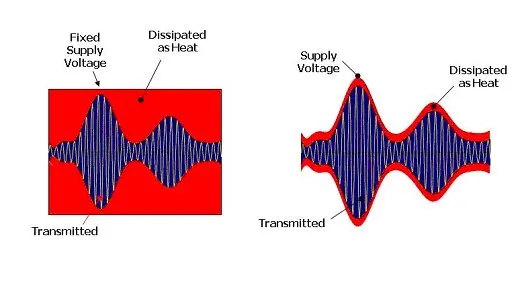
The price of that efficiency is complexity. Both paths have to line up to within nanoseconds, otherwise phase noise and higher order intermodulation products appear, which is exactly the splatter nobody wants on the band. FlexRadio handles this with SmartSignal, an adaptive predistortion system that continuously measures the transmitter and corrects it. The manual is unambiguous: the function is to remain enabled at all times in normal operation. For this architecture it is not a convenience feature but a precondition for a clean signal.
Video tip: Steve Hicks, N5AC, chief technology officer at FlexRadio, explains the architecture in detail on Ham Radio Workbench, without the marketing gloss.
Worth noting: polar modulation is not restricted to this price bracket. The QMX from QRP Labs uses the same principle in its EER form for five watts and costs under 200 dollars. Anyone who wants to try the technique on a small scale does not have to spend five figures. Our article on QRP operation with five watts is a good companion piece.
Efficiency in numbers
The difference between 40 and 80 per cent sounds like "twice as good". For waste heat the effect is far larger, because only the loss portion counts. FlexRadio does the arithmetic in the manual:
| Configuration | Output | Efficiency | Input power | Waste heat |
|---|---|---|---|---|
| Classic 100 W transceiver | 100 W | 40 % | 250 W | 150 W |
| 100 W transceiver plus 500 W amplifier | 500 W | 40 % | 1,250 W | 750 W |
| Aurora | 500 W | 80 % | 625 W | 125 W |
So instead of 750 watts of waste heat there are 125 watts, one sixth. That is precisely why a 500 watt amplifier fits into the chassis of an ordinary 100 watt transceiver: it gets by with the heatsink FlexRadio would otherwise have fitted for 100 watts. For portable operation on a generator or solar panel the required input power halves, which has an immediate effect on self-sufficient power supply.
Heat, fans and key-down operation
A clarification is worthwhile here, because the internet often describes Aurora as a fanless radio. It is not. Aurora uses active cooling with variable-speed fans. FlexRadio does not promise silence, it promises quieter fans and a smaller heatsink than is usual at this power level. The manual gives a heatsink temperature below 35 degrees Celsius in normal operation and a thermal shutdown at 70 degrees.
The much quoted Hamvention demonstration was a brick-on-key test, a continuous carrier into a dummy load. Two hours in, the dummy load was at 91 degrees Celsius, the Aurora itself at 37 degrees, and the case was still cool to the touch. That is impressive, but it is a demonstration under controlled conditions and not a licence for unlimited continuous operation.
Aurora is rated for ICAS, intermittent commercial and amateur service, at 25 to 50 per cent duty cycle. FlexRadio explicitly recommends not exceeding five minutes of continuous key-down at full power. For FT8, RTTY and other digital modes that is sufficient at full power with a 50 per cent duty cycle. Anyone planning to run a beacon flat out for hours has the wrong radio. SmartSDR shows the PA temperature in real time and reduces power automatically when needed.
The four Aurora models
FlexRadio offers Aurora in four variants. The transmitter is identical in all four; the differences are in the receiver section and the operating concept:
| Model | SCUs | Slices / panadapters | Dynamic range | Preselectors | RX ports / transverter | Display | Price (WiMo, incl. VAT) |
|---|---|---|---|---|---|---|---|
| AU-510 | 1 | 2 / 2 | > 145 dB | 3rd order | 1 / 1 | none | €6,949 |
| AU-510M | 1 | 2 / 2 | > 145 dB | 3rd order | 1 / 1 | 8" Maestro | €8,090 |
| AU-520 | 2 | 4 / 4 | > 155 dB | 7th order plus contest filters | 2 / 2 | none | €9,438 |
| AU-520M | 2 | 4 / 4 | > 155 dB | 7th order plus contest filters | 2 / 2 | 8" Maestro | €10,500 |
AU-510 or AU-520?
The essential difference is the number of Spectral Capture Units, the independent receiver chains:
- AU-510: one SCU, two slice receivers, two panadapters, third order preselectors, dynamic range above 145 dB. Already a very good receiver that outperforms most conventional transceivers.
- AU-520: two SCUs, four slice receivers, seventh order preselectors with contest band filters offering more than 50 dB of rejection, true diversity reception, dynamic range above 155 dB and SO2R capability. Ten decibels more dynamic range means strong adjacent signals are handled better and weak signals stay audible.
For ragchewing, digital modes and occasional DX the AU-510 is plenty. If you run contests seriously, want to work two bands at once, or chase DX among closely spaced signals, you buy the AU-520 for the second SCU and the sharper filters.
The M variants add a built-in 8 inch touchscreen with 1920 × 1200 pixels, full Maestro front panel controls and an HDMI output. That makes the transceiver fully operable without a computer. Without the M variant Aurora is a box with no front panel and requires a client at all times.
Video tip: a compact first look at both ranges straight from the Hamvention booth.
Key specifications
Transmitter
- Output power: 1 to 500 W PEP on 160 to 10 m, 1 to 200 W on 6 m, 125 W AM on HF and 50 W AM on 6 m
- Technique: polar modulation with a class D amplifier and adaptive predistortion (SmartSignal)
- Efficiency: up to 80 per cent peak
- Duty cycle: ICAS, 25 to 50 per cent, maximum five minutes of continuous key-down at full power
- Harmonic suppression: 60 dBc or better
- Modes: SSB, CW, AM, SAM, FM, RTTY and digital modes, plus CESSB for up to 3 dB more effective talk power
- Transmit coverage: amateur bands only, 160 m to 6 m
Receiver
- Architecture: 16-bit direct sampling with no mixer and no intermediate frequency
- Receive coverage: 30 kHz to 54 MHz continuous
- RMDR: 110 dB at 1 kHz, 115 dB at 2 kHz spacing
- Dynamic range: above 145 dB (AU-510) and above 155 dB (AU-520)
- Spectrum bandwidth: up to 7 MHz (AU-510) and up to 14 MHz (AU-520), resolution down to 5.85 Hz per pixel and 1.46 Hz per pixel respectively
The sources disagree on the sampling rate: the product page quotes 245.76 Msps for the AU-520, while the receiver table in the manual lists 122.88 Msps for both ranges. In practice the dynamic range figures and the preselectors are the more meaningful numbers anyway.
Connectors
- ANT1 and ANT2: transmit and receive ports, both rated for the full 500 W, UHF sockets (SO-239)
- RX1 (AU-510) or RX1 and RX2 (AU-520): receive-only inputs, for a Beverage or a loop for example
- XVTR: one transverter output on the AU-510, two on the AU-520, 0 to +10 dBm, IF coverage 100 kHz to 54 MHz
- Network: gigabit Ethernet, plus a GNSS receiver for time synchronisation and an optional GPSDO for frequency accuracy
Chassis and power
- Dimensions: 171 × 356 × 337 mm (H × W × D)
- Weight: 8 kg
- Power supply: built in, 80 to 264 VAC at 47 to 63 Hz, auto-sensing, power factor above 0.94
- Consumption: 35 W on receive, 675 W transmitting at full power
- No 13.8 V DC operation: Aurora runs on mains AC only. Portable operation requires an inverter or a generator.
- Cooling: active with variable-speed fans, heatsink below 35 °C in normal operation, shutdown at 70 °C
SmartSDR, SmartLink and MultiFlex
As with every FlexRadio product the software is a central part of the operating concept. SmartSDR controls Aurora and sets the Flex approach apart from classic transceivers with knobs and menus:
- SmartSDR for Windows: the full version with waterfall, panadapter, audio settings, memory management and DAX for logging and digital mode software
- SmartSDR for macOS and iOS: native versions for Mac, iPad and iPhone, functionally a little leaner
- Maestro: FlexRadio's own touchscreen control panel, built into the M variants and available separately
With SmartLink the transceiver connects through FlexRadio's servers, and the operator can connect from anywhere without a VPN and without port forwarding. For anyone interested in remote shack operation that is one of the most elegant solutions on the market. How to do it with other hardware is covered in our article on remote operation with Tailscale.
MultiFlex allows two clients at once. One operator works locally through Maestro while a second controls another slice receiver over SmartSDR on a remote computer. For club stations and training that is an excellent feature. Connecting logging software such as Wavelog works over the usual interfaces.
The most sensitive point: SWR
This is where Aurora behaves differently from any transceiver you are used to, and it is the single most important point before buying. Switching operation reacts far more sensitively to mismatch than a linear amplifier. FlexRadio specifies three thresholds:
| Parameter | Value | What happens |
|---|---|---|
| SWR foldback | 1.7:1 | The radio begins reducing output power automatically. |
| SWR fault | 2.5:1 | Transmission stops and a fault is raised. |
| Tuner matching range | up to 3:1 | The built-in ATU is rated for full power up to 3:1. |
In practice that means the internal tuner should always be in circuit, because it is what brings the load into the range where the transmitter delivers full power. Above 3:1 the ATU can often still find a match but is no longer rated for full power, and output has to be reduced manually. A well matched antenna is therefore no longer a recommendation but an operating requirement. If you work with broadband wire antennas, measure the SWR on all bands first. Our articles on antenna tuners and on baluns and ununs will help you prepare.
No external amplifier, in either direction
This point is easily overlooked. Aurora cannot be combined with an external amplifier, and it cannot be used as an amplifier for another radio either.
Driving an amplifier fails on power: most amateur amplifiers are built for no more than 100 watts of drive. 500 watts into the input destroys the input stage. FlexRadio warns against it explicitly in the manual and gives a concrete example: the PGXL only handles 200 watts in bypass, so Aurora's 500 watts would damage it. Anyone who still wants to connect an amplifier must check how much power it tolerates in bypass. Background in our article on amplifiers, safety and grounding.
Being driven fails on architecture: a polar modulation amplifier needs the separate amplitude and phase signals from the signal generation stage. An ordinary transceiver only supplies the finished RF signal. FlexRadio has therefore stated that the technology will not be offered as an amplifier for third-party exciters.
In Austria that fixes Aurora at 500 watts. The Austrian amateur radio regulation permits up to 1,000 watts PEP in the highest power class D. Anyone who wants that headroom needs a different solution. What else applies is covered in our overview of amateur radio legislation in Austria.
No VHF and UHF, but transverter ports
Aurora covers HF and 6 m. The 2 m and 70 cm bands are not included. Unlike earlier reporting suggested, that is not a hard stop: every model has at least one transverter output at 0 to +10 dBm, the AU-520 has two. VHF, UHF and microwave transverters attach exactly as they would to a FLEX-6000 or FLEX-8000. Together with full duplex operation that also makes satellite work possible. If you are thinking in that direction, our article on the 23 cm band and above is the place to start.
Comparison with conventional transceivers
| Feature | Aurora AU-520 | Icom IC-7610 | Yaesu FTDX101D | Elecraft K4 |
|---|---|---|---|---|
| Architecture | Direct sampling | Direct sampling | Hybrid SDR and superhet | Direct sampling |
| Output power | 500 W PEP | 100 W | 100 W | 100 W |
| Transmitter type | Polar modulation, class D | LDMOS linear | LDMOS linear | LDMOS linear |
| Transmitter efficiency | up to 80 % | around 50 % | around 50 % | around 50 % |
| Built-in power supply | yes | no | yes | no |
| Built-in tuner | yes, to 3:1 | yes | yes | optional |
| Slice receivers | 4 | 2 | 2 | 2 to 4 |
| External amplifier | not possible | yes | yes | yes |
| Remote operation | SmartLink over the internet | RS-BA1 over LAN/VPN | SCU-LAN10 over LAN | Ethernet over LAN |
| Operating concept | Software or Maestro | Front panel plus software | Front panel | Front panel plus software |
| Weight | 8 kg | 10.8 kg plus PSU | 21.4 kg | 7.3 kg plus PSU |
| Price (indicative) | around €9,400 | around €3,500 | around €5,500 | around €5,800 |
The prices of the comparison radios are indicative for October 2026 and vary by dealer and configuration. Aurora is considerably more expensive, but it also brings 500 watts without an external amplifier, a built-in power supply and the most efficient transmitter in amateur radio. If you have been running a 100 watt transceiver plus an amplifier plus two power supplies, you get all of it in one box. If you already own an amplifier and want to keep it, that option disappears entirely.
Availability and prices in Europe
Deliveries in the USA began in December 2025. In Europe the picture cleared up during 2026: WiMo in Germany stocks all four models, the AU-510M is in stock, and the AU-510, AU-520 and AU-520M are available from 9 October 2026. PileupDX and Astroradio also list the series at nearly identical prices.
- AU-510: €6,949 at WiMo, list price 6,199 USD
- AU-510M: €8,090 at WiMo, list price 7,349 USD
- AU-520: €9,438 at WiMo, list price 8,599 USD
- AU-520M: €10,500 at WiMo, list price 9,599 USD
All euro prices include VAT and are current as of October 2026. For Austrian radio amateurs WiMo is the nearest authorised dealer. A GPSDO costs an extra 749 USD from FlexRadio.
From practical use
Steve Zwirn, K9ZW, received his AU-520M in January 2026 and reported back after roughly 300 QSOs. His verdict is positive: very good integration, a transmitter that matches the already excellent receiver, and the sense of being able to build a complete station around a single box. Two observations from his report matter in practice:
- The software was still alpha grade at the time of delivery. Error messages from the new subsystems did not yet surface fully in SmartSDR, and the documentation lagged behind the radio.
- The sliders for transmit power and tune power are percentages, not absolute watts. Setting tune power to 10 does not give ten watts, it gives ten per cent of 500 watts, that is 50 watts. That difference can ruin a sensitive antenna system's day.
Some early units can also be recalibrated to widen the tuner's matching range slightly.
Video tip: a field report after real operating, not from the trade show floor.
Who is Aurora for?
- Remote operators: if you want to control your transceiver remotely, SmartLink and the Ethernet connection are the most convenient solution on the market.
- DX chasers and contesters: 500 watts from one box, an excellent receiver, four slice receivers and SO2R capability on the AU-520.
- Space savers: a complete 500 watt setup in one chassis, one mains plug, one coax run.
- Noise sensitive environments: far less waste heat means quieter fans, an argument for a shack in the living area.
- Digital mode enthusiasts: DAX and the software integration make FT8 and friends straightforward, and the 50 per cent duty cycle suits them.
- Portable operation on generator or solar: half the input power for the same output.
Aurora is less suitable for anyone who wants to keep using an existing amplifier or go to 1,000 watts, who prefers a classic transceiver with knobs, who works with antennas that are hard to match, or who needs VHF and UHF without a transverter.
Tips for switching to Aurora
- Antenna first: measure the SWR on all bands you use before buying. Anything above 1.7:1 costs power, anything above 2.5:1 aborts the transmission.
- Prepare the network: Aurora connects over gigabit Ethernet, not USB. A switch near the radio belongs in the plan.
- Check the mains: 675 watts from the wall when transmitting. No 13.8 V operation, so portable work needs an inverter or a generator.
- Check the computer: SmartSDR runs on Windows 10 and 11 and likes a dedicated graphics card for the waterfall. Mac and iOS versions are available but functionally leaner. A Raspberry Pi in the shack does not replace the client but can be useful around it.
- Weigh up Maestro: if you want to use the radio occasionally without a computer, during a power cut or for quick operating, take the M variant or budget for a separate Maestro.
- Remember the percentage sliders: power and tune power are percentages. Set them deliberately low before the first tune-up.
Where the name comes from

For radio amateurs the name has a double meaning. Aurora is not only a transceiver but also a propagation mode: during strong geomagnetic disturbances the auroral zone reflects VHF signals and enables contacts that would otherwise be impossible. How it works and what to listen for is in our article on aurora propagation on 2 m, with the fundamentals in understanding propagation conditions.
Conclusion
The FlexRadio Aurora is not an evolutionary step. The polar modulation transmitter sets new standards for efficiency and thermal design, and integrating transceiver, amplifier, power supply and tuner into eight kilograms is unprecedented in amateur radio. Add a receiver from the FLEX-8000 platform and a software ecosystem that makes remote operation easier than anything else on the market.
The limits, however, are sharper than the press releases suggest. The SWR sensitivity is real and starts at 1.7:1. The duty cycle is limited. An external amplifier is ruled out in both directions. The radio runs on mains only, not on 13.8 volts. And the software was not finished at launch. If you accept that and already work SDR-controlled, you currently get the most technically interesting radio on the market. If you run a classic station with an amplifier, knobs and difficult antennas, you get a lot of restrictions for a lot of money.
Whether polar modulation becomes the future of transmitter design remains to be seen. That it works, FlexRadio has proved. And that it works outside the premium class is shown by the QRP Labs QMX for under 200 dollars. There is evidently still room for genuine innovation in amateur radio.
73 – your oeradio.at editorial team
Sources
- FlexRadio: Aurora User Guide (PDF), authoritative for all technical figures in this article
- FlexRadio: Aurora AU-520 product page and AU-510
- WiMo: FlexRadio Aurora, prices and availability in Europe
- PileupDX: FlexRadio Aurora FAQ
- Tony Brock-Fisher, K1KP: "The Polar Explorer", QEX March/April 2017 (PDF)
- EI7GL: A very basic overview of polar modulation
- K9ZW: Initial FlexRadio Aurora AU-520M impressions
- Ham Radio Workbench 248: Polar modulation with Tony, K1KP
- RIS: Austrian amateur radio regulation, power classes
Image credits
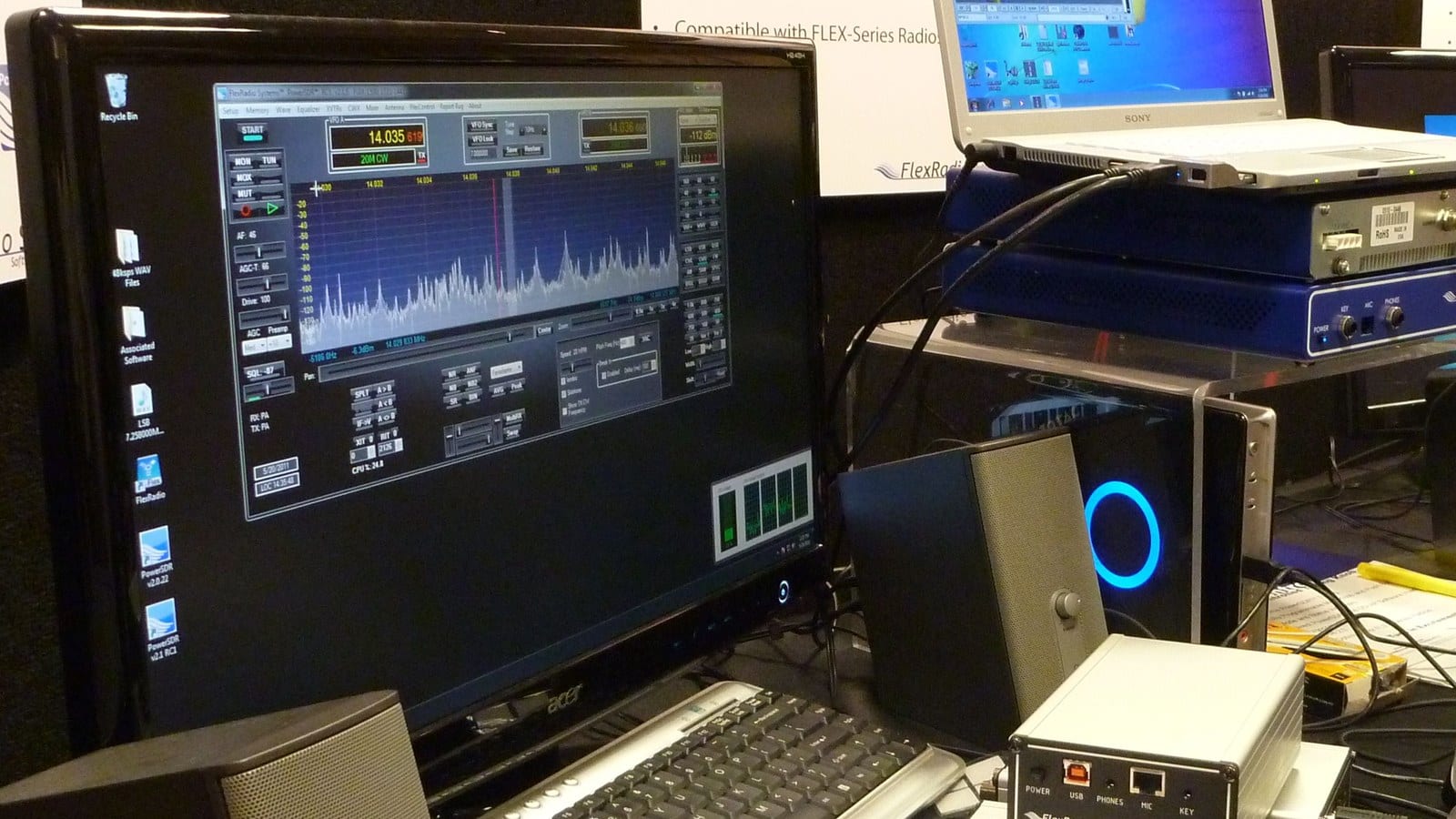
Title image and the photo in the company history section: FlexRadio booth at Hamvention, Dave Clausen, CC BY 2.0, Wikimedia Commons, cropped. The photo shows earlier FLEX models, not the Aurora. No freely licensed photo of the Aurora currently exists.
Envelope diagram: Nujira, CC BY 3.0, Wikimedia Commons.
Aurora over Lake Mývatn: Giles Laurent, CC BY-SA 4.0, Wikimedia Commons.
Videos: Ham Radio Workbench, Ham Radio Prep, G3LRC's Ham Radio. Also worth watching: DX Engineering with the development team, DX Engineering from Hamvention and Ham Smarter with VE6LK. Embedded via YouTube, rights remain with the respective channels.
Update notice
Updated 8 October 2026. The first version of this article dated from spring 2026 and was outdated or incorrect on several points. Among the corrections: Aurora uses a class D amplifier, not class E or F. The figure 1.7:1 is the threshold at which power is folded back, the tuner is rated to 3:1, and transmission stops at 2.5:1. The radio is not fanless but has variable-speed fans; the much quoted Hamvention endurance test ran for two hours, not eight, with the radio at 37 °C. Newly added: the ICAS rating of 25 to 50 per cent duty cycle, the absence of 13.8 V operation, the transverter ports as the route to VHF and UHF, SmartSignal and CESSB, GNSS and GPSDO, the connector layout, and the fact that Aurora works neither with nor as an external amplifier. The CE question has been settled: the series has been listed by European dealers since October 2026 and prices have been brought up to date. The AI-generated title image has been replaced with a freely licensed photo.
Transparency Notice
This article was researched and written with the assistance of AI (Claude, Anthropic). The editorial team has reviewed and edited all content. Despite careful review, occasional inaccuracies may occur — we welcome corrections via email to [email protected].