The 23 cm band (1240–1300 MHz) and the bands above it are the part of amateur radio where you still aim antennas by hand and where one extra decibel makes a noticeable difference. They offer room for experimentation, for satellite work and for DX by scattering off the atmosphere. They are also the area where the legal situation has changed most in recent years — and that is where this article starts, because otherwise half the equipment list misses reality.
First things first: what applies on 23 cm in Austria
With the amended Frequency Utilisation Ordinance (BGBl. II No. 61/2023, in force since March 2023) the 23 cm band was cut back substantially in Austria in order to protect receivers of the Galileo satellite navigation system — see our summary of the ordinance:
- Maximum 10 watts across the whole 1240–1300 MHz band (previously up to 200 W)
- Maximum 16 kHz bandwidth per transmission
- Repeaters wider than 16 kHz had to cease operation by 31 December 2024
In practice: ATV on 23 cm is finished in Austria, and EME on 1296 MHz is no longer a realistic goal with 10 watts. Anyone coming to the microwave bands for moonbounce and wideband applications has to move higher up. For narrowband work — CW, SSB, digital modes — the band remains perfectly usable, just with far less power than before.
And what CEPT decided in 2025
At European level the matter has been formally settled since 2025. ECC Decision (25)01, in force since 27 June 2025 with a preferred implementation date of 27 December 2025, defines protection measures for the Galileo frequencies in the 23 cm band. Two points matter in practice:
- The measures apply only to 1258–1300 MHz. There are no additional constraints on 1240–1258 MHz — that part stays usable exactly as before.
- Implementation is a national matter. Each administration decides whether and how to apply the Decision; transition periods are possible.
IARU Region 1 calculates that if all measures were applied in full, less than half of the spectrum in use today would remain practically viable, with the 1296–1300 MHz segment particularly constrained by power limits. The main casualties would be narrowband voice repeaters with outputs between 1258 and 1300 MHz, ATV stations and the amateur-satellite uplink — which sits at 1260–1270 MHz, right in the protected range. The IARU is working on a revised band plan.
For Austria this changes little in the short term, because the national 10 W limit is already stricter than much of what the Decision foresees. But anyone operating across borders or planning a repeater should know where things stand.
The bands at a glance
- 23 cm: 1240–1300 MHz — in Austria 10 W, max. 16 kHz bandwidth
- 13 cm: 2300–2450 MHz — among other things the QO-100 uplink
- 9 cm: 3400–3475 MHz
- 6 cm: 5650–5850 MHz
- 3 cm: 10–10.5 GHz — the classic microwave contest band and the QO-100 downlink
- Higher: 24 GHz, 47 GHz, 76 GHz and above
On the higher bands the Austrian ordinance generally allows class 1 licensees up to 200 W. The exception is the segment 10.368–10.370 GHz with a maximum of 40 dBW EIRP; on 24 GHz the amateur service now holds secondary status only.
Characteristics: Microwaves behave much like light. Line of sight is the rule, there is hardly any diffraction around obstacles, and every metre of coax costs noticeable signal. Site selection here does what propagation conditions do on HF — see also our article on alpine propagation.
The easiest way in today: QO-100
Anyone getting into microwaves in 2026 will find it easiest to start not on 23 cm but via the geostationary amateur satellite QO-100. The uplink is on 13 cm (2400 MHz), the downlink on 3 cm (10489 MHz) — so you work two microwave bands at once, without a mountain top and without waiting for a lift weekend.
For pure listening, a 60 cm offset dish, an ordinary universal LNB, a bias tee and an SDR stick are enough — a low three-figure sum in total. For transmitting, add a dish from around 75–90 cm, a 2.4 GHz transmit chain and a suitable feed. The details are in our article QO-100: getting started with the geostationary amateur satellite.
The learning curve is the same as for terrestrial microwave work: aiming antennas, understanding LNB drift, dealing with loss over short cable runs. Just without the frustration of the other station not being on a summit right now.
Equipment
Ready-made radios:
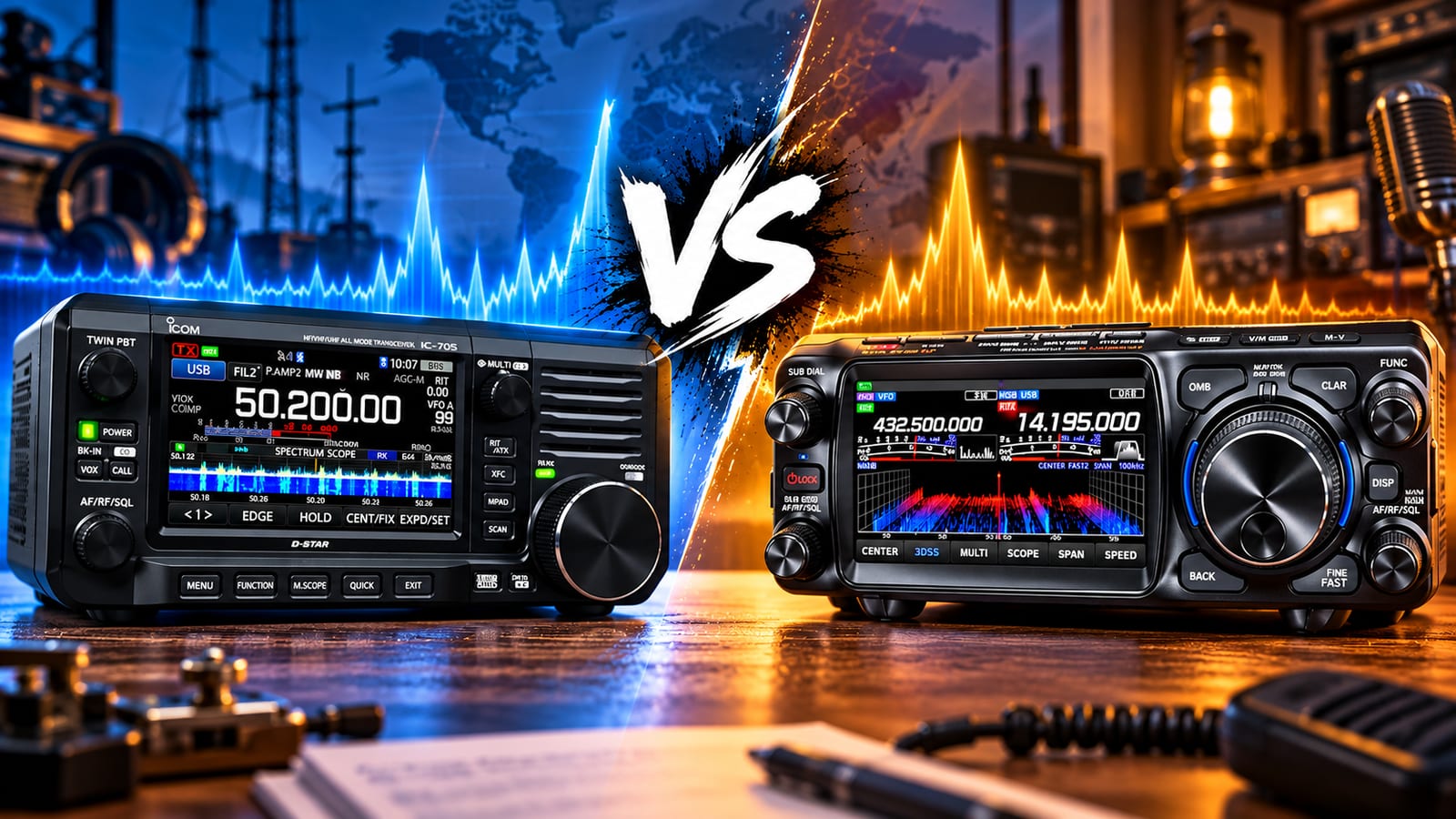
- Icom IC-9700: all-mode for 2 m, 70 cm and 23 cm — still the usual entry point if 1296 MHz is the goal
- Icom IC-905: covers 144, 432, 1296, 2400 and 5600 MHz, and 10 GHz with an optional transverter. Output: 10 W on 144/430/1200 MHz, 2 W on 2.4 and 5.6 GHz, 0.5 W on 10 GHz. The RF unit sits directly at the antenna, which avoids cable loss — technically the most interesting development in years, though considerably more expensive than the IC-9700
- Icom IC-910H: older model, still common on the used market
Transverters: For anything above 23 cm the usual route is a transverter that converts a 2 m or 70 cm radio to the target band. Kuhne Electronic (DB6NT) is the best-known supplier in the German-speaking world, alongside a lively home-brew scene — the GHz conference in Dorsten is its annual meeting point.
Antennas:
- Yagi: 19–55 elements on 23 cm (roughly 10–17 dBd), still manageable boom lengths
- Parabolic dish: 60–120 cm diameter; on 10 GHz even a small dish gives high gain
- Helical: circularly polarised, for satellite work
Cable: Ecoflex 15, LMR-400 and similar — and in short lengths. Loss at 1296 MHz is high; at 10 GHz coax becomes practically unusable. That is why preamplifiers belong at the mast and the transmit chain as close to the antenna as possible.
Operating techniques
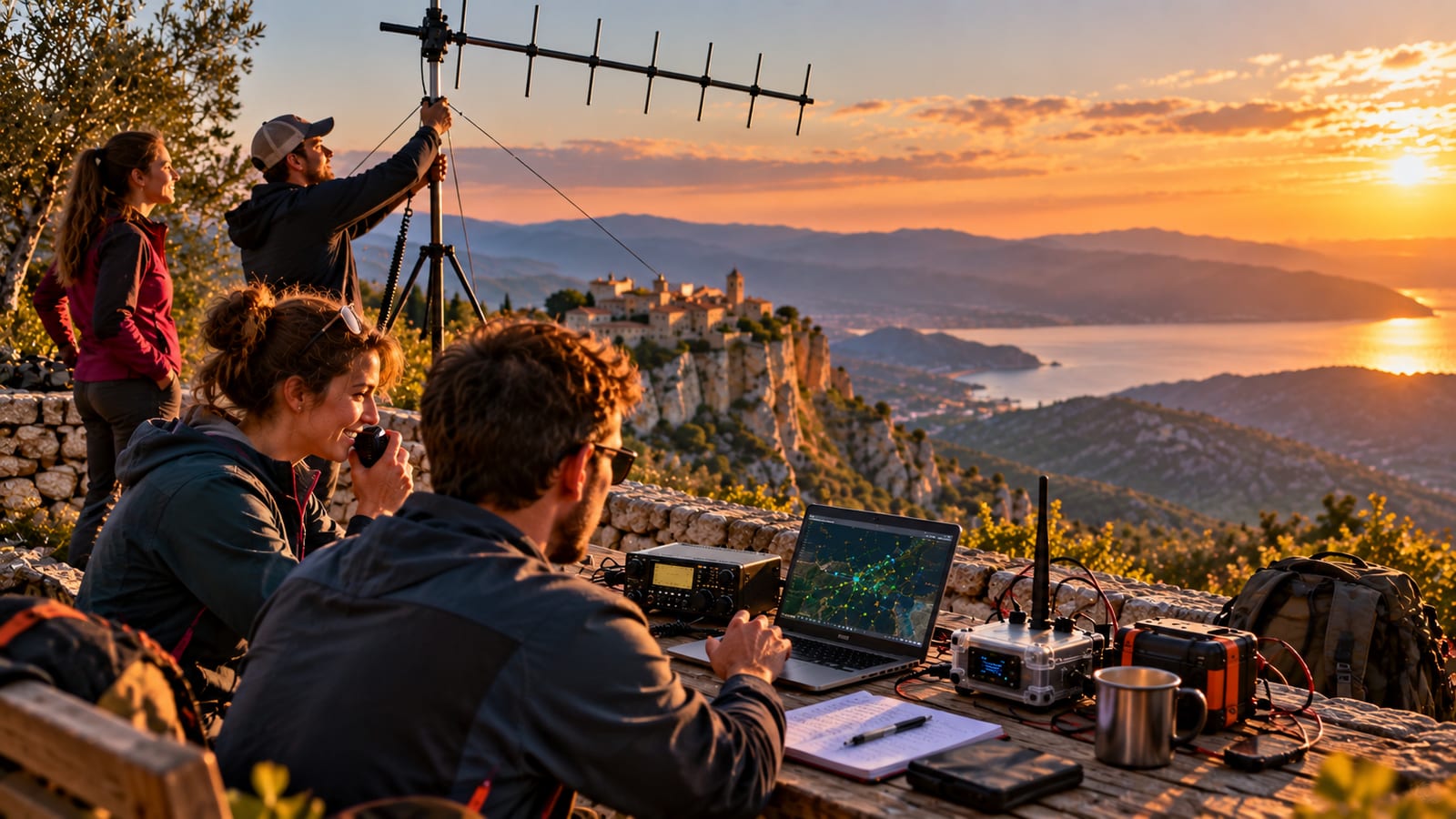
Line of sight: Site selection decides almost everything. Summits, towers and exposed slopes beat any power increase — which, at 10 W on 23 cm, is the only remaining variable anyway.
Troposcatter: Under high-pressure inversions signals carry far beyond the optical horizon. On microwaves this is the single most important DX mode.
Rain scatter: Reflection off rain cells, especially productive on 10 GHz. A thunderstorm 100 km away is a reflector there, not interference. We cover both in more detail in troposcatter and rain scatter.
Aircraft scatter: Reflection off aircraft, with short windows and clear Doppler — plannable with flight radar apps.
EME: No longer sensible on 23 cm in Austria at 10 W, but still a premier discipline on higher bands and abroad. The basics are in our article on EME on 2 m and 70 cm.
Activity in Austria
The Alps provide sites half of Europe envies. They are used above all in the ÖVSV VHF/UHF/microwave activity contest, run by the microwave department (Fred Kuneth, OE8FNK):
- When: every third Sunday of the month, 07:00–13:00 UTC (until 15:00 UTC in June)
- SSB calling frequencies: 23 cm 1296.100–1296.300 MHz, 13 cm 2320.100–2320.300 MHz, 3 cm 10368.100–10368.300 MHz
Add to that the Alpe-Adria UHF/SHF Contest on the third full weekend in June, run jointly by the national societies of Austria, Croatia, Italy and Slovenia — for microwave newcomers the best chance of finding anyone to work at all.
Beacons on 23 cm and 10 GHz serve propagation monitoring and are invaluable for aligning your own antenna. Current lists are maintained by the ÖVSV VHF department and IARU Region 1 — beacon frequencies change, particularly now during the 23 cm replanning, which is why no individual frequencies are quoted here.
Conclusion
In Austria the 23 cm band is no longer a band you work with power, but one you work with location and antenna. That is less bad than it sounds: 10 W taken up a good summit beats 200 W from the valley every time. If you want the full microwave playground, go to 3 cm — or take QO-100 and get both in a single afternoon.
73 – your oeradio.at editorial team
Transparency Notice
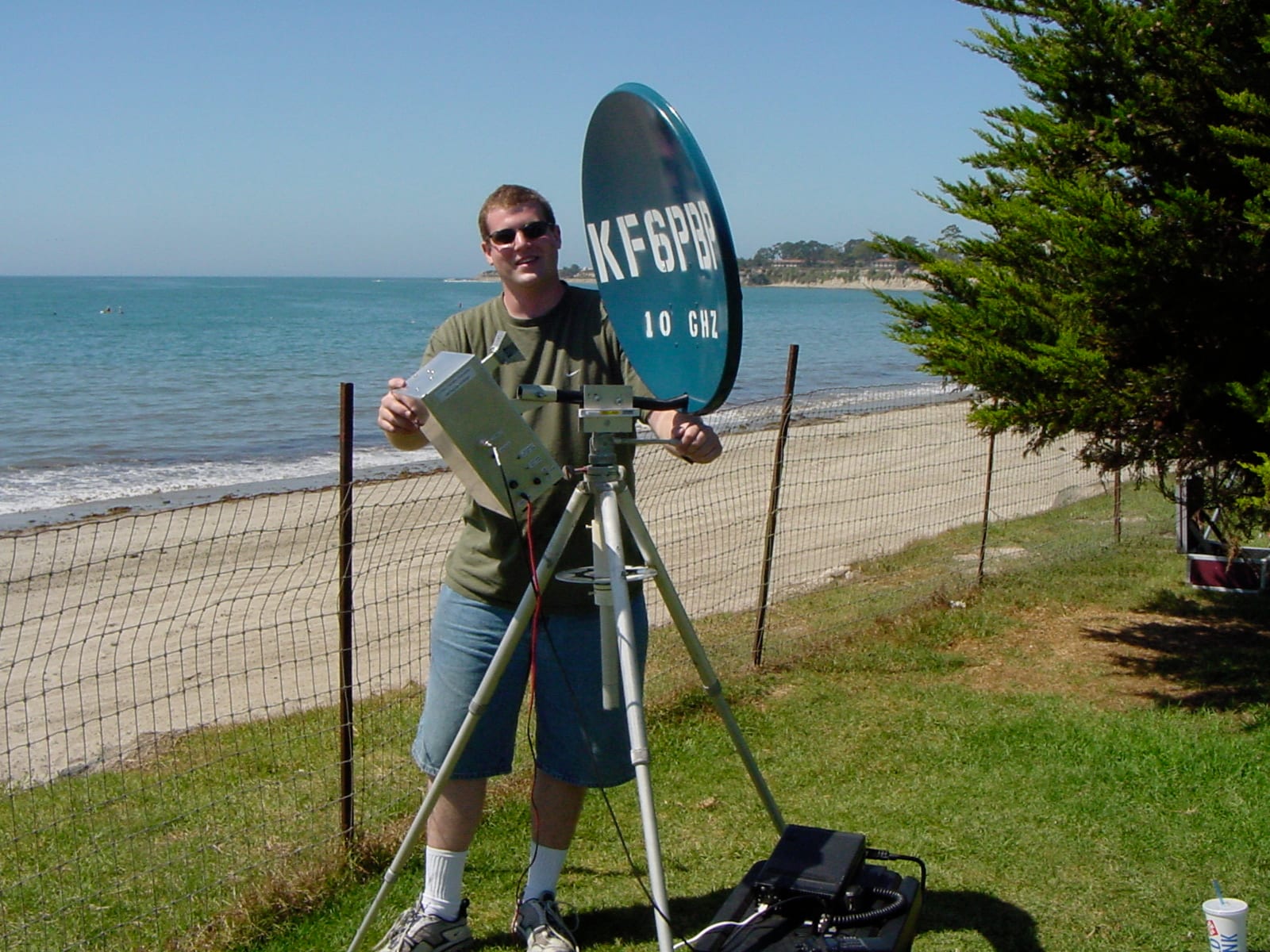
Information as of August 2026. The Austrian limits come from the Frequency Utilisation Ordinance (BGBl. II No. 61/2023, Annex 4), the European rules from ECC Decision (25)01 and the accompanying IARU Region 1 support paper; contest dates and calling frequencies from the ÖVSV. The binding text is always the current version of the ordinance in the Austrian legal information system (RIS); this article is not legal advice. The title picture shows a portable 10 GHz station with a home-built transverter, photo: Jeff Keyzer, CC BY-SA 2.0, via Wikimedia Commons. The embedded videos are third-party content; the respective channels are responsible for them. This article was researched and written with the support of AI (Claude, Anthropic) and reviewed by the oeradio.at editorial team. Corrections are welcome at [email protected].