Table of Contents
- What the IC-SAT100 is, and what it is not
- The Iridium network: 66 satellites, six orbital planes, a mesh in orbit
- LEO versus GEO: the comparison with QO-100
- The radio in detail
- Specifications
- Distinctive features
- PTT over satellite: how it works in practice
- Talkgroups: a radio cell you draw on the map
- Operating practice: what Iridium teaches its users
- VE-PG4: the bridge to conventional radio
- IC-SAT100M: the version for vehicles and buildings
- Cost: the sobering part
- From the field: three documented deployments
- Japan-Palau Goodwill Yacht Race
- Mountain running events in Wales
- Yamaha Motor
- Comparison with other satellite devices
- What has changed since 2019
- Relevance for amateur radio
- A supplement in emergency communications
- Safety on expedition
- Technical inspiration
- Legal situation
- Strengths and weaknesses at a glance
- Conclusion
- Sources
- Image credits
- Transparency Notice
A handheld radio that works anywhere on Earth: on the open ocean, in the desert, at the North Pole, deep in the jungle. No repeater required, no terrestrial network. Just press PTT and talk. What sounds like science fiction has been commercially available since 17 June 2019, the day Icom and Iridium jointly launched the IC-SAT100, the world's first handheld built exclusively as a push-to-talk radio over a satellite network.
For radio amateurs the device is both fascinating and odd, because it is not an amateur radio. It still deserves our attention, because it combines concepts that matter in emergency communications, on expeditions and in blackout preparedness. And because the operating practice Iridium teaches its users is remarkably close to what we have been practising on the local repeater for decades.
What the IC-SAT100 is, and what it is not
First the boundaries, because a lot gets confused here. The IC-SAT100 is not a satellite phone. It cannot make calls, send SMS, carry data or dial a number. It knows exactly one mode: half-duplex group voice, triggered by the PTT key.
It is not an amateur radio either. It works in the Iridium L band between 1616 and 1626.5 MHz, needs a commercial service contract and cannot be reprogrammed to amateur bands. Without an active contract it is an expensive piece of electronics with no function.
What it is: a commercial radio in which the role of the repeater is played by a constellation of 66 satellites. Anyone who has used DMR with talkgroups will understand the operating concept in two minutes. The difference is coverage: the talkgroup does not end at the next repeater site, it ends where the operator drew it on the map.
The Iridium network: 66 satellites, six orbital planes, a mesh in orbit
To understand the IC-SAT100 you first have to understand the Iridium network. Most communications satellites, including QO-100 as used by radio amateurs, sit in geostationary orbit at roughly 36,000 kilometres. Iridium takes a completely different approach.
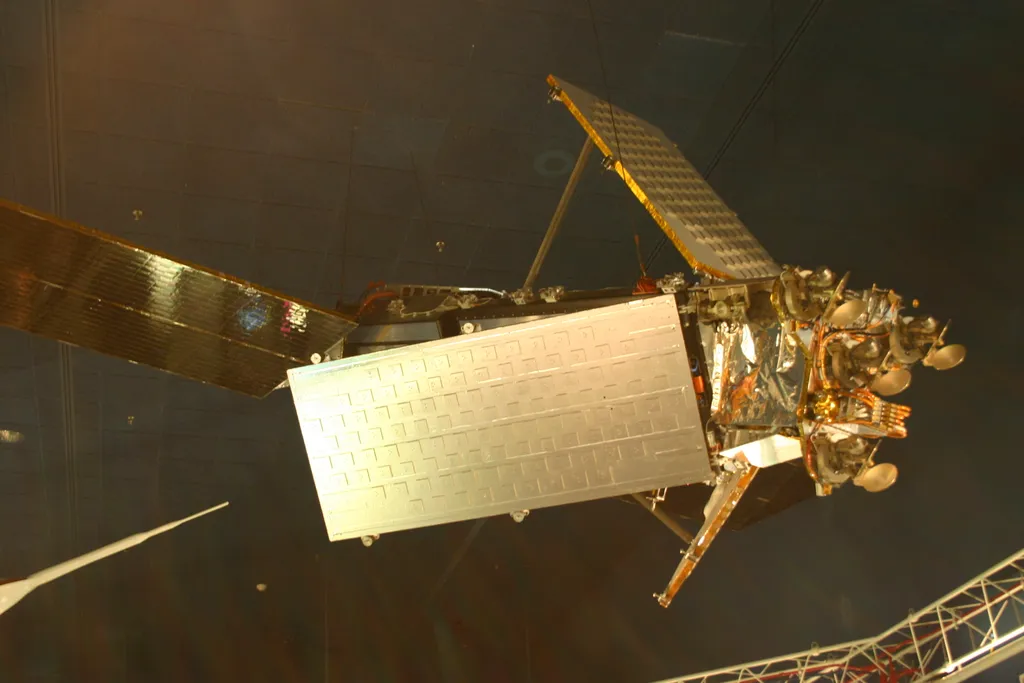
The key figures of the constellation:
| Parameter | Value |
|---|---|
| Active satellites | 66 (plus in-orbit spares) |
| Orbital altitude | about 780 km (LEO) |
| Inclination | 86.4 degrees, near polar |
| Orbital planes | 6 planes with 11 satellites each |
| Orbital period | about 101 minutes |
| Orbital speed | about 27,000 km/h |
| Crosslinks | each satellite to 4 neighbours |
The low orbit brings three decisive advantages:
- Short propagation delay: 780 kilometres instead of 36,000 means a much shorter signal path. That is the basis for natural voice traffic without awkward pauses.
- Complete coverage: The orbits run almost over the poles and converge there. Every point on the surface is covered, including the polar regions that a geostationary satellite never sees.
- Small terminals: Because the satellites are close, a short whip antenna and low transmit power are enough. That is precisely why a handheld is possible at all.
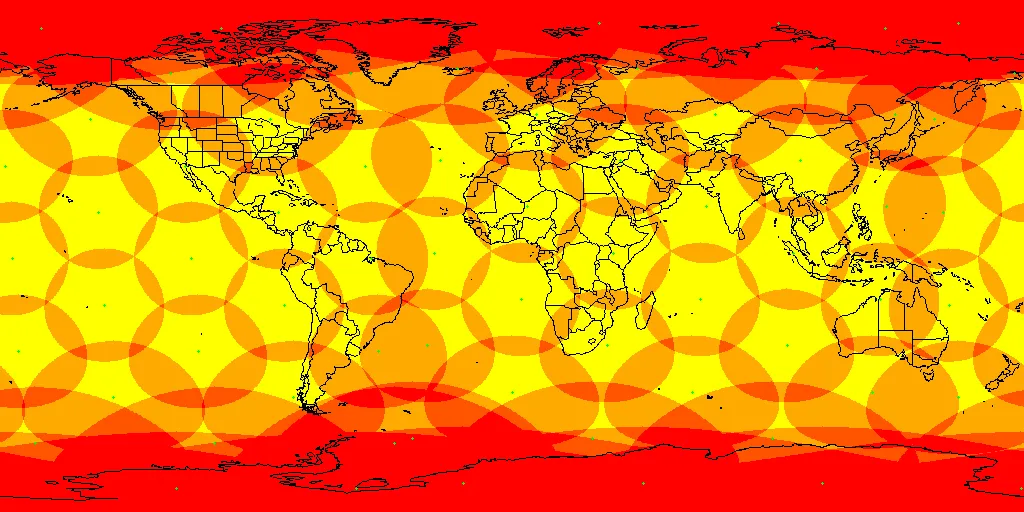
The real trick is in the crosslinks. Each satellite talks not only to the ground stations but also to four neighbouring satellites, two in its own plane and two in the adjacent ones. This creates a mesh network in space that can hand a conversation across the globe without a ground station anywhere along the path. For hams working with MeshCom or HAMNET, that is a familiar principle on a very large scale.
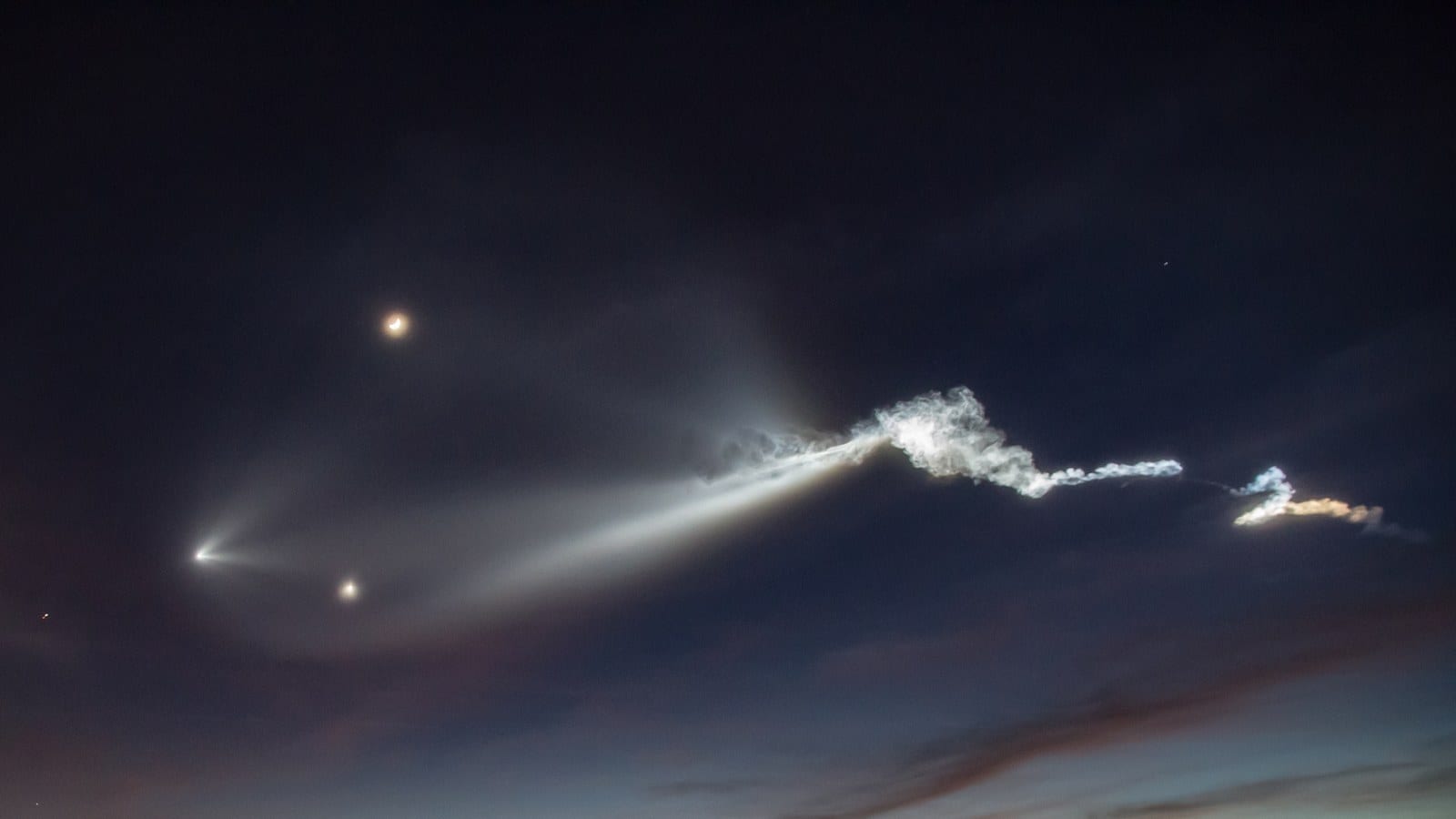
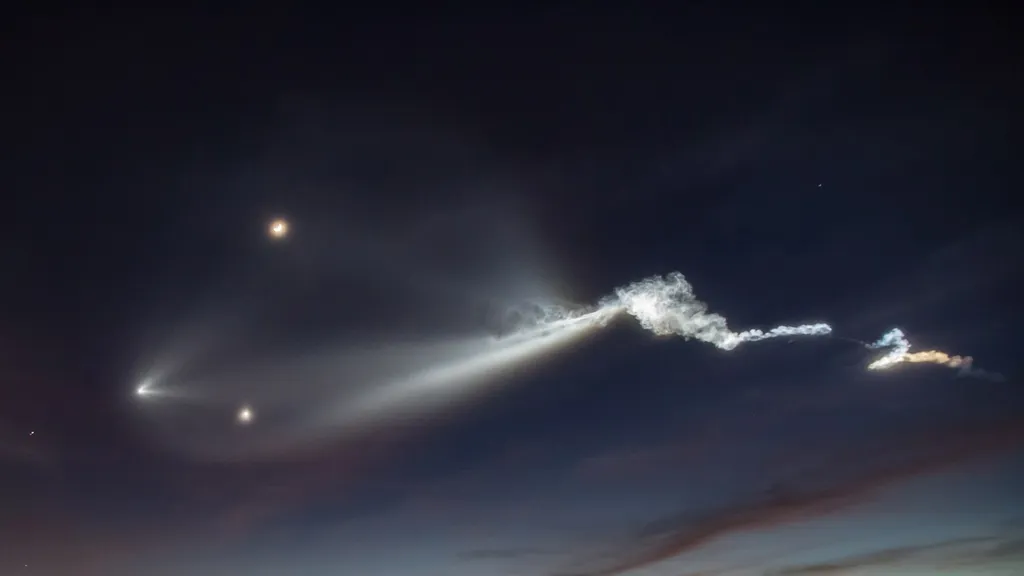
Today's constellation is called Iridium NEXT and replaces the original 1990s fleet. Between January 2017 and January 2019 SpaceX launched a total of 75 satellites in eight Falcon 9 missions, 66 active and nine spares. The title image of this article shows one of those launches.
LEO versus GEO: the comparison with QO-100
The difference from what hams know from QO-100 is fundamental:
| Feature | Iridium (LEO) | QO-100 (GEO) |
|---|---|---|
| Orbital altitude | 780 km | 35,786 km |
| Number of satellites | 66 active | 1 |
| Position in the sky | constantly moving | fixed, apparently stationary |
| Antenna tracking | not required | align once, then fixed |
| Coverage | global including the poles | about one third of the globe, Brazil to Thailand |
| Round-trip delay | a few milliseconds | about 250 milliseconds |
| Access | commercial contract | amateur licence |
With QO-100 you align the dish once and you are done, but you live with the delay and the limited visibility. With Iridium it is the other way round: no alignment, no noticeable delay, but the satellite crosses the sky within minutes and signal strength varies with your location. If you want to know what comes after QO-100, see our article on FutureGEO.
The radio in detail
Icom did not position the IC-SAT100 as a consumer product but as a tool for harsh conditions: rescue services, mining, maritime, security companies, expedition teams, forestry.
Specifications
| Property | IC-SAT100 |
|---|---|
| Frequency range | 1616 to 1626.5 MHz (Iridium L band) |
| Mode | half duplex PTT, group call |
| Dimensions | 57.8 × 135 × 32.8 mm (without antenna and knobs) |
| Weight | 360 g with BP-300 battery and antenna |
| Display | LCD, 33 × 27 mm viewing area, backlit |
| Ingress protection | IP67, 1 m water depth for 30 minutes |
| Military standard | MIL-STD-810G (shock, vibration, temperature) |
| Operating temperature | -30 °C to +60 °C |
| Encryption | AES 256 bit |
| Battery life | 14.5 hours at 5 : 5 : 90 (TX : RX : standby) |
| Talkgroups | up to 15, positions 1 to 15 on the radio |
| Audio output | 1500 mW internal, 1000 mW external |
| GPS | built in |
| Bluetooth | built in, for speaker microphone and headset |
| Antenna connector | SMA |
| Emergency key | orange, on the top panel |
Two figures in this table are regularly misquoted online. According to Icom the dimensions exclude the antenna and all projecting controls, so the radio is noticeably longer in the hand. And the 14.5 hours are not continuous transmission but a duty cycle of 5 percent transmit, 5 percent receive and 90 percent standby.
Distinctive features
- AquaQuake: A function that shakes water out of the speaker. After submersion you activate AquaQuake and a low-frequency vibration drives the water out of the speaker chamber. Audio is immediately clear again. Icom has been building this into its marine radios for years.
- Emergency key: A dedicated orange key on the top panel, operable with gloves. It triggers a predefined emergency call to stored recipients, including the GPS position of the radio.
- Position reporting: The radio can report its GPS position at configurable intervals. Incident command sees every team member on a map.
- Volume: 1500 mW into the internal speaker is far more than a typical handheld delivers. That is not marketing but a necessity on construction sites, on deck in a gale or next to a running helicopter.
Icom UK presents the radio and demonstrates it in the hand, including talkgroup selection and the emergency key.
PTT over satellite: how it works in practice
The basic principle is familiar to every radio amateur. Press PTT, speak, release. The difference is the path the signal takes: up to the nearest visible Iridium satellite, through the constellation via the crosslinks and back down to every radio in the talkgroup.
The latency figures are remarkable for a satellite system:
- First PTT press: under 2 seconds until the voice session is established across the group
- Every subsequent press within the same session: under 500 milliseconds
From those numbers follows the single most important operating rule: press PTT, wait briefly for the acknowledgement beep, only then speak. Start talking immediately and you lose the first syllables. Anyone who has used a DMR repeater on the Brandmeister network knows exactly this effect.
Three more quirks that are not on the data sheet:
- 40 seconds per talk session. After that the session ends. For longer overs you simply press again. A built-in incentive to be brief that some net controllers could use.
- No SIM card. Iridium PTT identifies the radio by its IMEI. There is nothing to lose or mix up.
- Up to 10,000 radios per talkgroup. PTT runs as a broadcast service across the network, not as a sum of individual calls. That is why it scales so far.
Talkgroups: a radio cell you draw on the map
This is where it gets genuinely interesting for radio amateurs. An Iridium talkgroup is not a frequency and not a code, it is a geographic area. The operator draws it in the Iridium PTT Command Center as a circle, square or rectangle on a map. The assigned radios only work inside that area.
| Talkgroup size | Area | Roughly equivalent to | Diameter as a circle |
|---|---|---|---|
| Small | 100,000 km² | Iceland, South Korea | about 360 km |
| Medium | 300,000 km² | Italy, Poland | about 620 km |
| Large | 750,000 km² | Turkey, Chile | about 980 km |
| X-Large | 1,500,000 km² | Mongolia | about 1,380 km |
| Super / Jumbo | 2,250,000 km² | Greenland | about 1,690 km |
For comparison: Austria covers 83,879 km². The smallest talkgroup already covers the entire country with room for the neighbours. An area can also be split into up to ten separate regions, five at the smallest size. You can therefore combine Klagenfurt, Vienna and Innsbruck in one talkgroup without paying for the terrain in between. The smallest permitted region is a circle of 75 km radius or a square of 150 × 150 km.
Each radio holds up to 15 such talkgroups in positions 1 to 15. One of them can be defined as the priority talkgroup, which interrupts ongoing traffic on all others. Assignments can be changed over the air in real time without collecting the radios. Anyone who has ever reprogrammed 30 DMR radios before an exercise knows what that is worth.
Icom UK explains in under two minutes how talkgroups, the Command Center and the radios fit together.
Operating practice: what Iridium teaches its users
The Australian Iridium partner GlobalSat publishes a best practice guide for the IC-SAT100. Read it as a radio amateur and almost every line feels familiar:
- Think about your message before you press. While one station transmits, nobody else gets through.
- Identify yourself and your intended recipient at the start.
- Keep it short, clear and factual.
- After pressing, wait one to two seconds for the beep.
- Hold the radio about 10 cm from your mouth, antenna extended and vertical.
- Be patient, the other station may be busy.
- Use standard prowords: "Over" for end of transmission, "Say again" for a repeat, "Stand-by" for received but unable to respond, "Roger" for understood, "Out" for conversation finished.
That is operating practice exactly as emergency communications has always taught it. The difference: Iridium has to hand out a training sheet, because its users come from the mobile phone world and do not know these rules. We learned them in the licence course anyway. For the regulatory background, see our article on ITU-R Recommendation M.1042-4.
One more practical point is the view of the sky. The satellites cross overhead at around 27,000 km/h, so signal strength fluctuates constantly. Clear all-round visibility is ideal; tree canopy, rock faces, vehicles and buildings attenuate noticeably. If the signal gets weak, a few steps sideways often help, or simply waiting until the next satellite comes closer. For use in a vehicle or a building there are external antennas, such as the passive AH-38, the combined satellite and GPS antenna AH-40 with magnetic mount, and the active antenna system AH-41.
VE-PG4: the bridge to conventional radio
Of particular interest to emergency communications groups is the optional Icom VE-PG4 RoIP gateway. Radio over IP here means the unit couples the IC-SAT100 to conventional radio systems, to IP phones and to IP networks. A local UHF or VHF network can thus be linked to a distant control room over satellite.
One scenario: after an earthquake in an alpine valley the terrestrial infrastructure is destroyed. An emergency go-box with a VHF repeater covers the valley locally. Through the VE-PG4 that local network hangs off incident command in the provincial capital via Iridium. The result is a continuous chain from the disaster area to headquarters without a single terrestrial line in between.
That combination is the real reason this radio appears in an amateur radio magazine. You buy the long-haul leg and build the local coverage yourself.
IC-SAT100M: the version for vehicles and buildings
Alongside the handheld there is the IC-SAT100M, a mobile version with the same functionality:
| Property | IC-SAT100M |
|---|---|
| Frequency range | 1616 to 1626.5 MHz |
| Main unit dimensions | 125 × 29 × 156.5 mm |
| Antenna unit | 76.8 × 200 × 76.8 mm, IP67 |
| Weight | about 1200 g including microphone |
| Power supply | 13.2 V / 26.4 V DC, 10.5 to 32 V permissible |
| Link to the antenna | LAN cable with Power over Ethernet, up to 100 m |
| Operating temperature | -30 °C to +60 °C |
The decisive difference is the antenna concept. The antenna unit contains the RF section and connects to the main unit by network cable, up to 100 metres away and powered over PoE. The antenna goes on the roof, the control head into the operations room, and what runs between them is a patch cable instead of lossy coax. For a fixed emergency communications centre that is the clean solution.
Cost: the sobering part
The IC-SAT100 is not a radio you buy to try it out. The purchase is the smaller item.
| Cost item | Amount |
|---|---|
| IC-SAT100 radio (European dealers) | roughly €1,050 to €1,200 |
| Handset fee, Global plan, 12-month term | 82 US dollars per radio per month |
| Handset fee, Global plan, 3-month term | 122 US dollars per radio per month |
| Talkgroup Small or Medium | 80 US dollars per month |
| Talkgroup Large | 480 US dollars per month |
| Talkgroup X-Large | 1,150 US dollars per month |
| Talkgroup Super | 2,500 US dollars per month |
The handset fee includes unlimited talk time, there is no per-minute billing. The figures come from the tariff sheet of a German Iridium partner dated late 2024, are quoted in US dollars and vary by provider and region.
A worked example for an emergency communications group with ten radios and one Medium talkgroup covering all of Austria and the neighbouring regions: 10 × 82 dollars plus 80 dollars comes to 900 US dollars per month, around 10,800 dollars a year, plus roughly €11,000 once for the hardware. For a mining company or a rescue service that is defensible. For a local club it is not.
From the field: three documented deployments
Japan-Palau Goodwill Yacht Race
The best documented deployment is an offshore race. From 29 December 2019 to 20 January 2020, seven yachts sailed 1,726 nautical miles, about 3,200 kilometres, from Yokohama to Palau. Ten IC-SAT100 were in use: one on each of the seven yachts, one on the escort vessel and two at race control in Yokohama, one of them as a spare.
A roll call ran twice a day in which every yacht reported position, weather and condition. Previously race control had used satellite phones, with two problems: the antenna had to be aimed at a geostationary satellite, which is awkward on a heeling yacht, and every connection was a one-to-one call. The group call cut the roll call time dramatically, storm warnings reached everyone at once, and because every station saw the talker's position data on the display, the crews could follow the standings live.
Icom Japan interviewed the race organisers about it, the video has English subtitles.
Mountain running events in Wales
The British organiser Ourea Events runs multi-day mountain races in remote terrain, among them the Welsh mountains. The problem was classic: widely dispersed safety teams, no mobile coverage, no time to build a repeater chain. With the IC-SAT100 the marshals report incidents straight to race control over a talkgroup covering the entire course area. For hams familiar with SOTA and POTA activations, that is exactly the terrain where terrestrial radio turns into work.
Yamaha Motor
Yamaha Motor built a three-tier disaster preparedness concept: IP502H IP radios over the cellular network, licence-free IC-DU65B handhelds for gathering the local picture, and the IC-SAT100 for the case where cellular and internet fail. Around 18,000 people at 18 sites take part in the monthly exercise. The trigger was mundane: during exercises with conventional radios, intermodulation and desensitisation kept causing dropouts because too many rooftop antennas were operating at once. A problem every ham knows who has ever run two stations on one roof.
Comparison with other satellite devices
The IC-SAT100 is often described as the only device offering group calls over satellite. That is not accurate. Iridium also offers PTT on the Iridium Extreme 9575 PTT satellite phone, which switches between phone mode and PTT mode. The correct statement is: the IC-SAT100 is the first and so far only device built exclusively as a radio, with the controls, ruggedness and volume of a commercial handheld rather than those of a phone.
| Feature | Icom IC-SAT100 | Iridium Extreme 9575 PTT | Garmin inReach Messenger Plus | Thuraya XT-PRO |
|---|---|---|---|---|
| Form factor | radio | satellite phone with PTT mode | messenger | satellite phone |
| Group call via PTT | yes, up to 15 talkgroups | yes, talkgroups | no | no |
| Telephony | no | yes | no | yes |
| Text and data | no | SMS and email | text, voice notes up to 30 s, photos | SMS |
| Network | Iridium (LEO) | Iridium (LEO) | Iridium (LEO) | Thuraya (GEO) |
| Coverage including poles | yes | yes | yes | no |
| Encryption | AES 256 | AES 256 in PTT mode | no | no |
| Battery life | 14.5 h (5:5:90) | PTT: 16.5 h standby, 5 h talk | several days | up to 9 h talk |
| Device price (indicative) | about €1,050 to €1,200 | about €1,300 | about €400 | about €800 |
| Use case | group coordination in the field | telephony plus group call | safety backup for individuals | telephony, regionally limited |
For an individual radio amateur looking for a safety backup on a mountain trip or a DX expedition, the inReach Messenger Plus is the far more sensible choice. The IC-SAT100 only plays to its strength once several people have to be coordinated.
What has changed since 2019
The IC-SAT100 reached the market in 2019, and the landscape has moved since. Three developments matter for radio amateurs:
- Iridium Messaging Transport: Iridium has supplemented the old Short Burst Data service with a protocol carrying far larger payloads. Garmin uses it in the inReach Messenger Plus for messages up to 1,600 characters, photos and voice notes up to 30 seconds. Voice over Iridium is no longer tied to specialist hardware, even if it arrives as a recording rather than a conversation.
- Iridium NTN Direct: Iridium is building a 3GPP standards-based NB-IoT over satellite service, meaning links to standard devices without special hardware. In September 2026 Iridium, Deutsche Telekom IoT and Toyota jointly demonstrated voice messaging over this path; commercial availability for Telekom business customers is announced for the fourth quarter of 2026.
- Direct-to-device from the competition: Starlink, AST SpaceMobile and Amazon are working on connecting ordinary mobile phones directly by satellite. For emergency calls and short messages that will change the picture over the next few years. A group call with guaranteed coverage and encryption is not on offer there yet.
The radio itself remains unchanged in Icom's lineup after seven years, and there is no successor.
Relevance for amateur radio
A supplement in emergency communications
Emergency communications is not about purism, it is about reliable communication when it counts. The IC-SAT100 can carry the long-haul leg when HAMNET or Winlink fail, for example during a wide-area power outage that also takes out the HAMNET nodes. The division of labour is obvious: amateur radio for local coverage, Iridium for the link to the outside world, the VE-PG4 as the coupling in between.
Safety on expedition
Anyone planning a DX expedition into remote areas knows the problem: in many regions there is simply no cellular coverage. A satellite device as a safety backup ensures that an emergency call can be made if it comes to that. For a team spread over a larger area, the group call is worth more than any individual connection.
Technical inspiration
The architecture of the Iridium network, LEO satellites with inter-satellite links forming a mesh in orbit, has surprisingly many parallels to concepts discussed and built in amateur radio. Anyone working with MeshCom and Meshtastic or with CubeSats will find the same questions answered at industrial scale: routing between moving nodes, handover of live connections, redundancy when a node fails.
Legal situation
In Austria and the EU operation is unproblematic. The device is CE compliant, it transmits in a mobile satellite service band, and usage is governed by the commercial Iridium contract. An amateur licence is neither required nor useful, and no separate authorisation is needed.
The legal situation does matter when travelling. Satellite devices are not permitted everywhere:
- India: Iridium and Thuraya devices are prohibited without special authorisation, and importing one is prosecuted.
- China: Satellite phones have been heavily restricted for years.
- Embargoed countries: Iridium may not supply products or services to Taliban-controlled Afghanistan, Cuba, Iran, North Korea, Syria and Sudan.
- Customs: Even where satellite devices are legal, many states require a declaration on entry or registration with the telecommunications regulator.
Before a DX expedition the same rule applies as for the amateur licence: check the destination country's regulations in advance.
Strengths and weaknesses at a glance
Strengths:
- First and only pure handheld radio with PTT over satellite
- Group voice with worldwide reach, up to 10,000 radios per talkgroup
- Talkgroups defined on a map and changeable over the air in real time
- Very rugged: MIL-STD-810G, IP67, -30 to +60 °C
- AES 256 bit, so secure against eavesdropping
- Low latency: under 2 seconds on the first press, under 500 milliseconds afterwards
- 1500 mW audio, AquaQuake, emergency key, GPS position reporting
- VE-PG4 as a bridge to conventional radio and IP telephony
Weaknesses:
- High running costs, the handset fee applies per radio per month
- Voice only, no text, no data, no telephony
- Half duplex with a 40-second talk session limit
- Needs a clear view of the sky, indoor use only with an external antenna
- Completely dependent on the commercial service, useless without a contract
- Not an amateur radio and not convertible
Conclusion
The Icom IC-SAT100 is not a radio for the typical amateur on the way home from the club meeting. It is a specialist tool for organisations that need group communication anywhere on Earth and are prepared to pay four figures a month for it.
It is interesting for us anyway, for three reasons. First, it shows how far a repeater concept can be pushed when the repeater flies 780 kilometres up. Second, in emergency communications it is the most honest answer to the question of what happens when your own infrastructure fails too. And third, its operating guide proves that the rules we learn in the licence course still apply when there is a satellite constellation between two operators.
Anyone excited by QO-100, ISS contacts or satellite reception will find the IC-SAT100 fascinating as well. Even though it will never transmit on an amateur band.
73 – your oeradio.at editorial team
Sources
- Icom America: IC-SAT100 specifications, authoritative for all device figures in this article
- Icom America: IC-SAT100M, data for the mobile version
- Iridium: World's First Truly Global Handheld Satellite PTT Radio Makes Commercial Debut, launch on 17 June 2019
- GlobalSat: IC-SAT100 Iridium PTT Best Practice Guide (PDF), source for operating practice, the 40-second limit and talkgroup setup
- m-cramer Satellitenservices: Iridium PTT tariff overview (PDF, 12/2024), source for talkgroup sizes and prices
- Icom Japan: case study, Japan-Palau Goodwill Yacht Race 2019/2020
- Icom Japan: case study, Yamaha Motor
- Global Telesat Communications: case study, Ourea Events
- eoPortal: Iridium NEXT, orbital parameters and launch chronology
- SatNews: Iridium, Deutsche Telekom IoT and Toyota demonstrate satellite voice messaging via Iridium NTN Direct (September 2026)
- OSAC: Satellite Phones, Critical or Contraband?, country restrictions
Image credits
Title image: Falcon 9 exhaust plume during the Iridium-4 launch, Kevin Gill, CC BY 2.0, Wikimedia Commons, cropped.
Iridium satellite: ideonexus, CC BY-SA 2.0, Wikimedia Commons. Shown is a first-generation satellite at the National Air and Space Museum.
Coverage map: GrandDixence, public domain, Wikimedia Commons, single frame from the animation.
Hoist exercise: Bundesheer Fotos, CC BY-SA 2.0, Wikimedia Commons.
No freely licensed photo of the IC-SAT100 itself exists; all available product photos are copyrighted. The embedded videos show what the radio looks like and how it is operated.
Videos: Icom UK, product presentation, Icom UK, Satellite PTT System Explained, Icom Inc., yacht race case study. Further material worth watching: Icom UK, short introduction, Globalsat Group, in-vehicle test and Satellite Phone Store, How does it work. Embedded via YouTube, rights remain with the respective channels.
Transparency Notice
This article was researched and written with the assistance of AI (Claude, Anthropic). The editorial team has reviewed and edited all content. Despite careful review, occasional inaccuracies may occur — we welcome corrections via email to [email protected].