Table of Contents
- The Contenders at a Glance
- Yaesu FTX-1 Field
- Icom IC-705
- Detailed Comparison
- 1. Transmit Power and Battery Life
- 2. Dimensions and Weight
- 3. SDR Reception and Bandwidth
- 4. Connectivity: GPS, Bluetooth, Wi-Fi
- 5. Operation and User Interface
- 6. The Antenna Tuner Neither Radio Has
- 7. Digital Operating Modes
- 8. Price and Value for Money
- Alternatives: Elecraft, Xiegu, Lab599
- Conclusion: Which Transceiver for Whom?
- Choose the IC-705 if...
- Choose the FTX-1 Field if...
- Choose the FTX-1 Optima if...
- Sources and Further Reading
- Image Credits
- Correction Notice
- Transparency Notice
Two SDR transceivers are competing for the favor of portable radio amateurs: the Yaesu FTX-1 Field and the Icom IC-705. Both offer touchscreen operation, SDR reception, and QRP operation with around 5 to 10 watts. Both cost between EUR 1,200 and 1,700. But the differences lie in the details — and they determine which transceiver better suits your operating needs. This comparison shows the strengths and weaknesses of both devices for SOTA, POTA, and stationary operation.
The Contenders at a Glance
Yaesu FTX-1 Field
The FTX-1 Field is Yaesu's answer to the IC-705 — with one crucial difference: it's also available as an "Optima" variant with a docking station (SPA-1) that transforms the 10-watt portable radio into a full-fledged 100-watt shack transceiver. The concept: one device for portable and home use.
- Frequency range: 160 m to 70 cm (HF + 6 m + 2 m + 70 cm)
- Transmit power: 6 W from battery, 10 W with external power (FTX-1 Field); 100 W HF / 50 W VHF/UHF (FTX-1 Optima with SPA-1 dock)
- Display: 4.3" TFT touchscreen, 800×480 pixels
- Battery: removable SBR-52LI, Li-Ion, 10.8 V / 6400 mAh, about 69 Wh. Charged over USB-C on the pack itself. Yaesu quotes up to 9 hours on HF in SSB
- Weight: approx. 1.25 kg (Field), approx. 3.9 kg (Optima with dock)
- Dimensions: 213 × 89 × 55 mm (W × H × D), with SPA-1 dock 213 × 89 × 240 mm
- SDR: Yes, direct sampling on HF
- Dual Watch: Two independent receivers
- Digital modes: C4FM (System Fusion)
- Antenna connector: BNC (50 ohm)
- Antenna tuner: not built in. Optional FC-80, which fits inside the radio alongside the battery
- GPS, Bluetooth: not built in, available as the Yaesu option units FGPS-5 and BU-6. There is no Wi-Fi
- Price: approx. EUR 1,449 (Field), approx. EUR 1,810–2,049 (Optima with SPA-1), as of October 2026
Icom IC-705
The IC-705 has been the gold standard among portable SDR transceivers since 2020. Lightweight, efficient, with integrated GPS, Bluetooth, and Wi-Fi — and a huge community sharing accessories, software solutions, and experience reports.
- Frequency range: 160 m to 70 cm (HF + 6 m + 2 m + 70 cm)
- Transmit power: 5 W from battery, 10 W with external power
- Display: 4.3" TFT touchscreen, 800×480 pixels
- Battery: removable; the BP-272 at 7.4 V / 2000 mAh ships as standard, about 15 Wh. The BP-307 at 7.2 V / 3150 mAh, about 23 Wh, is optional. Charged over Micro-USB on the radio
- Weight: approx. 1.1 kg including the BP-272
- Dimensions: 200 × 83.5 × 82 mm (W × H × D, projections not included)
- SDR: Yes, RF Direct Sampling
- GPS: Integrated
- Bluetooth / Wi-Fi: Integrated
- Digital modes: D-STAR
- Antenna connector: BNC (50 ohm)
- Antenna tuner: not built in. Optional AH-705 as an external tuner
- Price: approx. EUR 1,239–1,299, as of October 2026
Video tip: a detailed head-to-head of the two radios.
Detailed Comparison
1. Transmit Power and Battery Life
On paper, both radios are evenly matched: the IC-705 delivers 5 W from the battery, the FTX-1 Field 6 W. With external 13.8 V power supply, both increase to 10 W.
For battery life it pays to count in watt-hours rather than milliamp-hours. The bare mAh figures mislead, because the two packs run at different voltages:
- IC-705: the standard BP-272 at 7.4 V and 2000 mAh, about 15 Wh, or about 23 Wh with the optional BP-307. Receive current roughly 260 to 320 mA
- FTX-1: SBR-52LI at 10.8 V and 6400 mAh, about 69 Wh, roughly four and a half times what the standard IC-705 pack holds. Receive current roughly 600 to 900 mA
The IC-705 is more frugal per watt, while the FTX-1 carries far more energy. In practice both last a long day in the field: Yaesu quotes up to nine hours on HF in SSB for the FTX-1, and the IC-705 sits in the same range. The claim that one "lasts significantly longer" does not hold; the real difference is weight and recharging.
One practical point matters more: both packs stay below 100 Wh and may therefore go into cabin baggage without asking, should you take them on a radio trip.
Those who need more power should consider the FTX-1 Optima with SPA-1 docking station: it delivers 100 W on HF and 50 W on VHF/UHF — including built-in ATU and speaker. The IC-705 remains a pure QRP radio; for more power, an external amplifier is required.
2. Dimensions and Weight
On paper the two sit close together; in a backpack it feels different. The manufacturers' figures:
- IC-705: 200 × 83.5 × 82 mm, about 1.1 kg with the standard BP-272. That works out to roughly 1.37 litres of volume
- FTX-1 Field: 213 × 89 × 55 mm, about 1.25 kg. That is roughly 1.04 litres, around a quarter less volume than the IC-705
- FTX-1 Optima: with the SPA-1 dock 213 × 89 × 240 mm and about 3.9 kg, clearly a shack radio
The FTX-1 Field is wider but much flatter. It slides into a side pocket, whereas the IC-705 is a block because of its depth. In return the FTX-1 weighs some 150 grams more, mostly down to the much larger battery. Upgrade the IC-705 to the optional BP-307 and the weights move closer together anyway.
One figure is fuzzy: Icom states the 1.1 kg explicitly as including the battery, while Yaesu does not say whether the 1.25 kg counts the SBR-52LI. We assume it does, since the pack sits firmly on the back of the radio.
3. SDR Reception and Bandwidth
Both transceivers use SDR technology with direct sampling — meaning no intermediate frequency, but digital signal processing directly from the antenna. This enables features like spectrum analysis, waterfall display, and digital filters.
The FTX-1 offers two independent receivers (Dual Watch) that can simultaneously monitor different frequencies — ideal for contest operation or monitoring two bands.
The IC-705 has only one receiver, but with a proven SDR implementation highly valued by the community. The spectrum scope function is fast and practical.
4. Connectivity: GPS, Bluetooth, Wi-Fi
Here the IC-705 clearly leads:
- GPS: Integrated — important for APRS, SOTA/POTA logging, and position reporting
- Bluetooth: Integrated — for wireless headsets and external speakers
- Wi-Fi: Integrated — for remote operation with smartphone or tablet via RS-BA1 app
The FTX-1 has none of this out of the box. GPS and Bluetooth can be retrofitted as Yaesu option units called FGPS-5 and BU-6. These are not USB dongles but modules installed inside the radio. The FTX-1 has no Wi-Fi at all, not even as an option.
For SOTA/POTA operation where you want to run the radio with FT8 or PSK31 via smartphone, the IC-705 is the better choice: establish Wi-Fi connection, start app, operate — without cables.
5. Operation and User Interface
Both radios use touchscreen operation, supplemented by physical knobs and buttons.
The IC-705 has a proven Icom user interface reminiscent of larger radios like the IC-7300. The menus are deeply nested but logically structured. Anyone familiar with an Icom will immediately feel at home.
The FTX-1 brings a modern, graphically clean-looking interface — but the operating logic is sometimes counterintuitive. Some users report software bugs and missing features that had to be added later through firmware updates.
One criticism of the FTX-1: AM broadcast interference on 80 m. Users report strong interference from medium-wave broadcasters that significantly impair reception on the 3.5 MHz band. Yaesu has confirmed the problem but hasn't yet offered a hardware solution. The IC-705 is not affected by this issue.
6. The Antenna Tuner Neither Radio Has
One point that data sheets like to bury and that hits you within minutes in the field: neither the IC-705 nor the FTX-1 Field has a built-in antenna tuner. Anyone working an EFHW or a wire up a mast needs something extra.
- IC-705: the external AH-705, a box of its own with its own cable and its own battery
- FTX-1 Field: the optional FC-80, which installs inside the radio alongside the battery. The tidier solution, because nothing dangles
- FTX-1 Optima: tuner already included in the SPA-1 dock
For the backpack maths this is not a detail. The IC-705 plus AH-705 adds some 500 grams and another cable; on the FTX-1 everything stays in one housing.
Video tip: Waters and Stanton take on exactly this question.
7. Digital Operating Modes
The IC-705 natively supports D-STAR — Icom's digital voice protocol for VHF/UHF. For many radio amateurs in Europe and North America, this is an important feature for accessing D-STAR repeaters.
The FTX-1 uses C4FM (System Fusion) — Yaesu's digital protocol. In Austria, there are significantly fewer Fusion repeaters than D-STAR repeaters, which limits its utility.
For HF data modes like FT8, PSK31, or RTTY, both radios need a computer or smartphone with appropriate software. Here the IC-705 scores again with its Wi-Fi interface.
8. Price and Value for Money
The IC-705 currently costs around EUR 1,239 to 1,299 and brings GPS, Bluetooth, Wi-Fi, D-STAR and firmware matured over five years. Value for money remains its strongest argument.
The FTX-1 Field sits at roughly EUR 1,449, only some 150 to 200 euros above it. The gap has shrunk considerably since launch. In return you get several times the energy on board, Dual Watch, and the option to upgrade later to the Optima set with its 100 W dock.
The FTX-1 Optima with SPA-1 dock runs between EUR 1,810 and 2,049 depending on dealer, making it a full shack transceiver with a detachable portable unit and a tuner included. For anyone wanting one radio for the field and for home, it is the most elegant answer on the market.
All prices are German and Austrian dealer prices as of early October 2026. Yaesu runs cashback promotions from time to time, which shifts the gap further.
Video tip: a German-language head-to-head of the two.
Alternatives: Elecraft, Xiegu, Lab599
Besides the IC-705 and FTX-1, there are other QRP transceivers worth considering:
- Elecraft KX2: HF-only (160 m to 10 m), 10 W, internal ATU, 370 g (!), approx. EUR 1,200. The classic for ultralight mountain radio.
- Elecraft KX3: HF + 6 m, 10 W (15 W with KXPA100 amp), 680 g, internal ATU, approx. EUR 1,400. Smaller than the IC-705 but without VHF/UHF.
- Xiegu X6200: HF + 6 m, 5 W, SDR, 4" touchscreen, internal battery, approx. EUR 882. Budget entry point but fewer features.
- Xiegu G90: HF, 20 W, internal ATU, no SDR, approx. EUR 450. Budget tip for stationary QRP operation.
- Lab599 TX-500: HF, 10 W, ultra-compact, internal battery, approx. EUR 1,100. Even smaller than the KX2 but without display.
Conclusion: Which Transceiver for Whom?
Choose the IC-705 if...
- You primarily do SOTA, POTA, or portable operation
- You value battery life and low weight
- You need GPS, Bluetooth, and Wi-Fi (e.g., for wireless FT8 operation via smartphone)
- You want to use D-STAR
- You're looking for a mature, proven radio with a large community
- You want to save money (about 300 euros cheaper than the FTX-1)
Choose the FTX-1 Field if...
- You need Dual Watch (two independent receivers)
- You want to use C4FM / System Fusion
- You prefer a bigger energy reserve on board
- You're willing to spend more money
Choose the FTX-1 Optima if...
- You want an all-in-one radio for portable AND stationary use
- You need 100 W on HF in the shack but want to take the same radio up the mountain
- You are willing to invest around EUR 2,000
- You appreciate the modular approach (portable + dock)
For most SOTA/POTA operators in Austria, the IC-705 is the better choice: lighter, more efficient, better connected, more mature — and cheaper. The FTX-1 Optima is an interesting option for radio amateurs seeking one radio for all purposes and willing to pay more for it.
Those wanting to go ultralight should also consider the Elecraft KX2: at 370 grams, it's only one-third the weight of the IC-705 — albeit without VHF/UHF and without a touchscreen. A matter of priorities.
73 – your oeradio.at editorial team
Sources and Further Reading
- Yaesu: FTX-1 Series Operation Manual (PDF)
- WiMo: overview of FTX-1 Field and Optima
- WiMo: Icom IC-705, specifications and price
- Yaesu SBR-52LI: 10.8 V / 6400 mAh Li-Ion for the FTX-1
- Ham Radio Store: the FTX-1 after twelve months in use
- Wikipedia: Icom IC-705
Image Credits
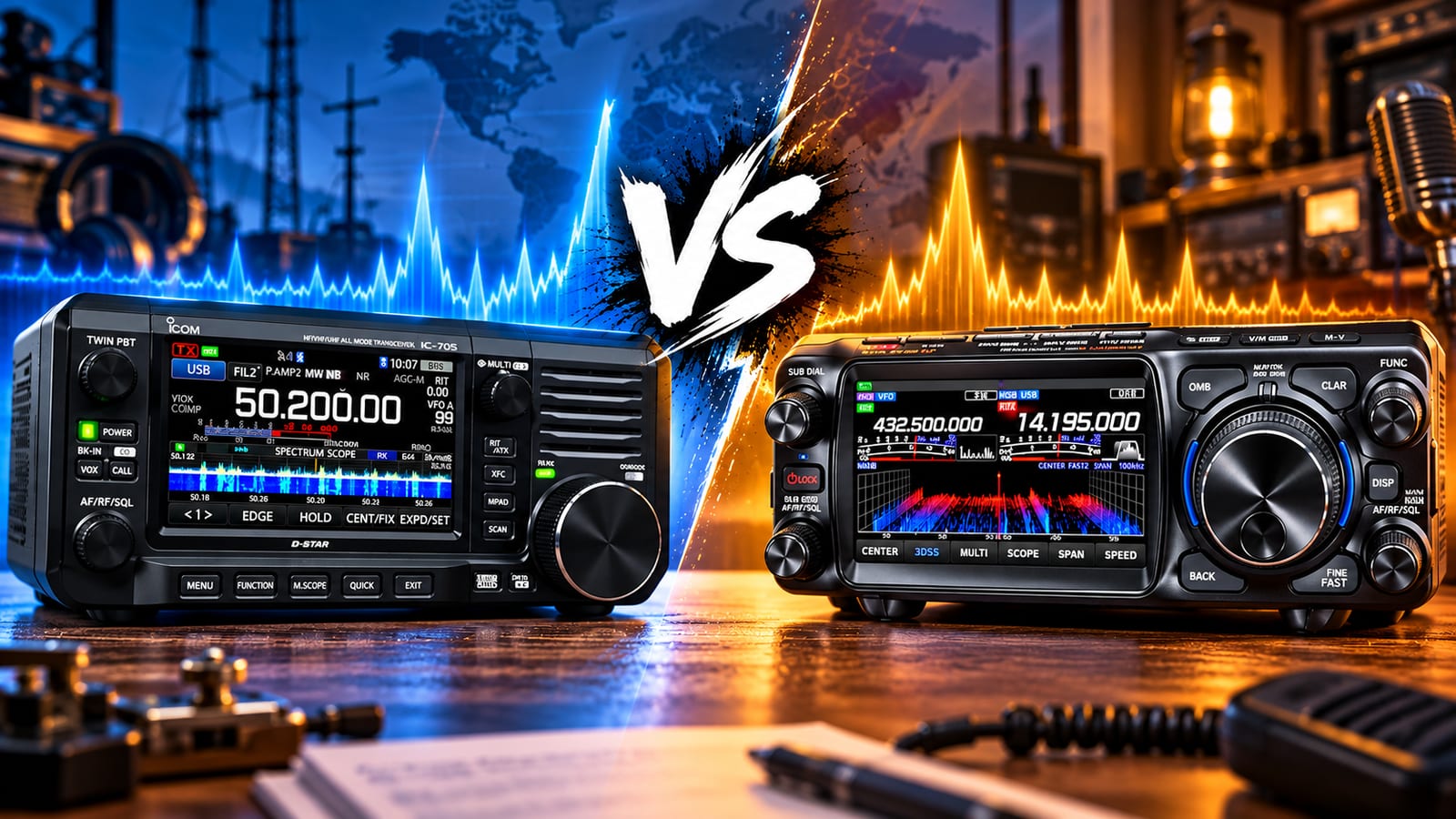
Title image: AI-generated illustration (ChatGPT, OpenAI). It depicts the two radios in stylised form and is not a product photo; the lettering and details on the cases do not match the real models.
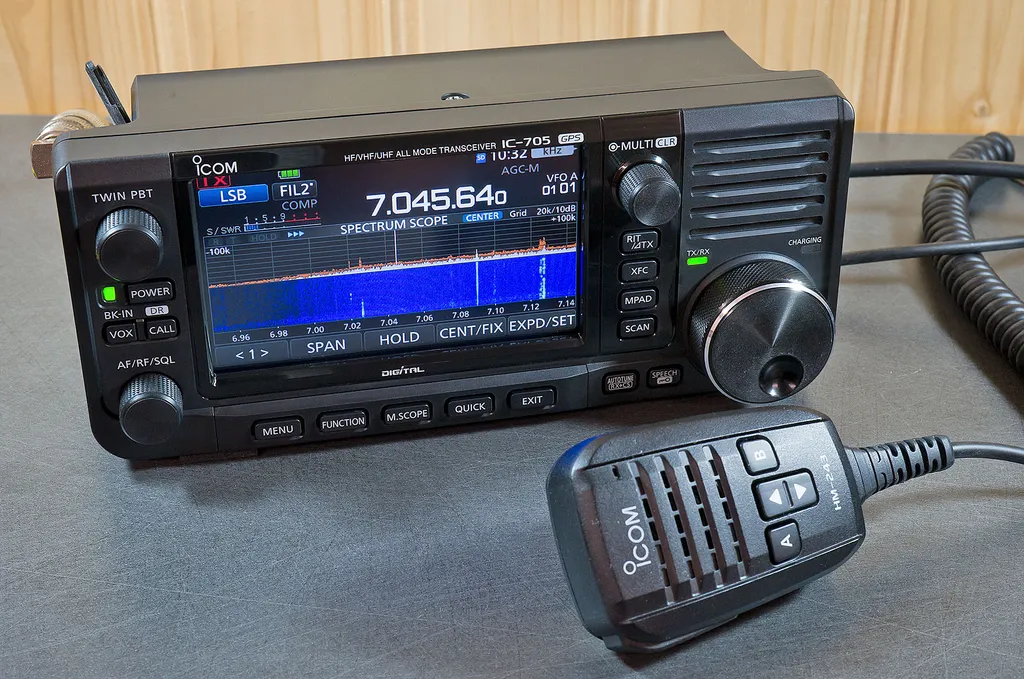
Icom IC-705: Batchman99, CC BY-SA 4.0, Wikimedia Commons. No freely licensed photo of the Yaesu FTX-1 exists at present, which is why the article shows only one of the two radios.
Videos: Ham Radio Crash Course, Waters and Stanton, AFU Chris. Embedded via YouTube; rights remain with the respective channels.
Correction Notice
Addendum of 5 October 2026: Peter pointed out two things, for which our thanks. First, the IC-705 has no USB-C port but Micro-USB; an earlier version of this article claimed otherwise. Second, dimensions and weight were missing and now have a section of their own. Checking those, we found a third error: the IC-705 ships as standard with the BP-272 at 2000 mAh, not the BP-307. The gap in energy on board is therefore wider than previously described.
Update of 5 October 2026: the first version described the FTX-1 battery as LiFePO4; the SBR-52LI is in fact a Li-Ion pack at 10.8 V. The runtime claim that the IC-705 lasts "significantly longer" rested on milliamp-hours and overlooked the different voltages: in watt-hours the FTX-1 carries several times the energy, and both run a long day on the air. Prices have also been corrected, having fallen considerably since the FTX-1 launch, as has the note on retrofitting: GPS and Bluetooth come as the FGPS-5 and BU-6 install modules, not USB dongles, and Wi-Fi is not available at all. The section on the missing antenna tuner, which affects both portables, is new.
Transparency Notice
This article was researched and written with the assistance of AI (Claude, Anthropic). The editorial team has reviewed and edited all content. Despite careful review, occasional inaccuracies may occur — we welcome corrections via email to [email protected].