Week 41 / 2026 | 5 to 11 October | SFI currently 93 | NOAA 27-day 91 to 100 | SSN 53, X-ray flux at background | Kp peak 5.00 on 4 October (G1), running a-index up to 48 | Solar wind 608 km/s, Bz +4 nT, Bt 7 nT | Proton flux at background | Source: NOAA SWPC, as of 4 October 18:30 UTC
Summary
This week reads easily, because it runs in one direction: it starts disturbed and gets better every day.
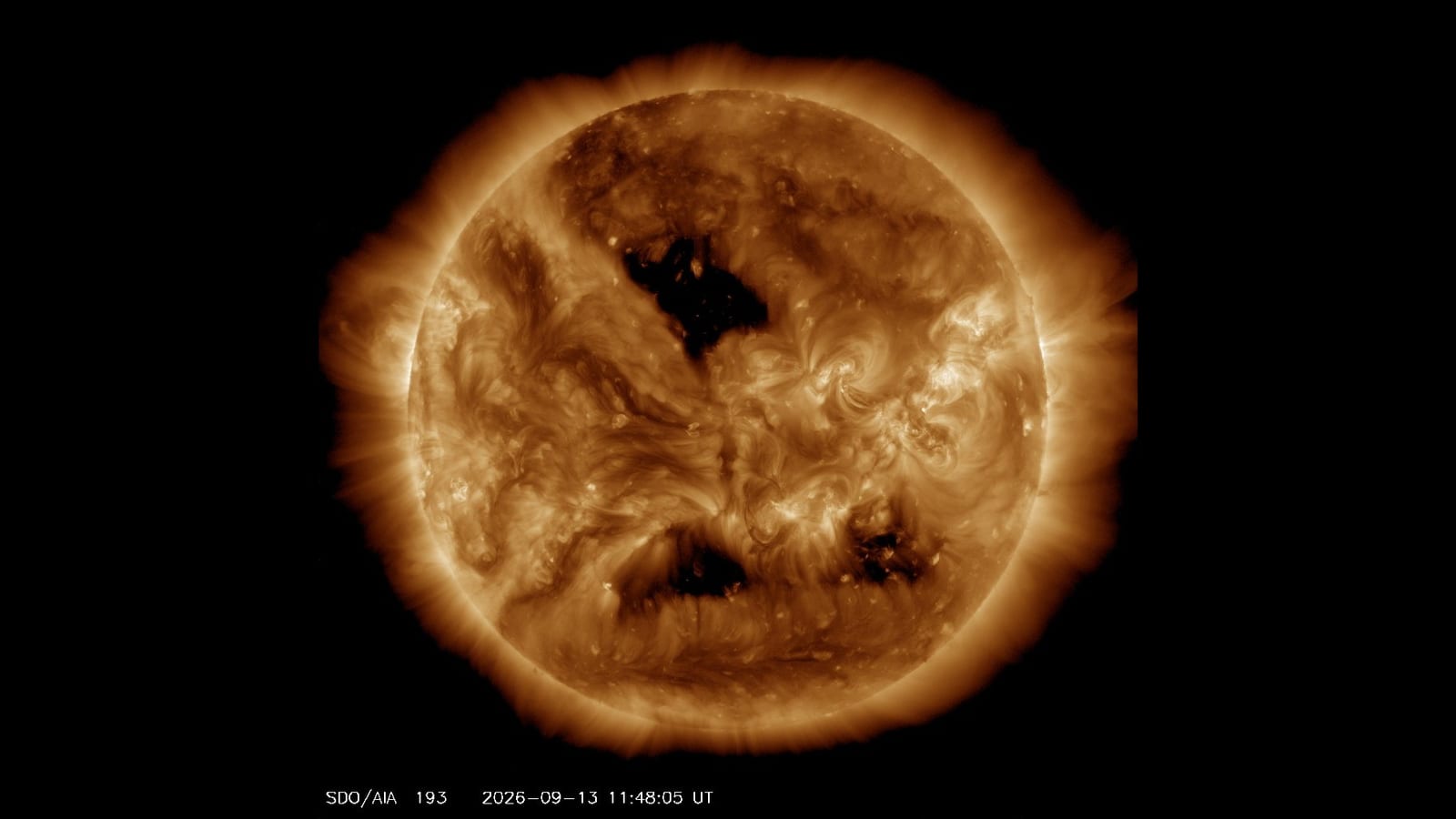
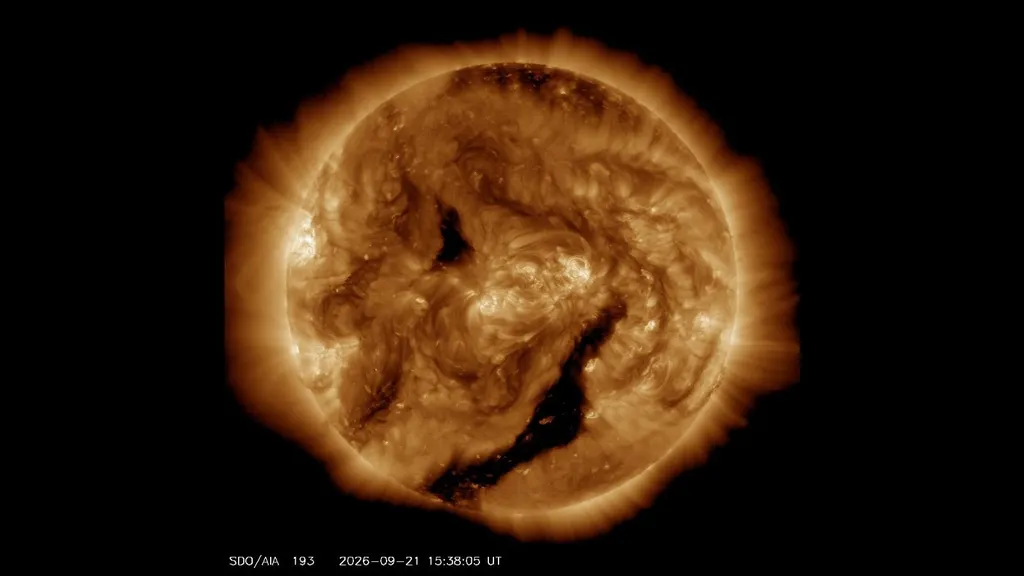
Saturday set the tone. Between 09 and 12 UTC the planetary Kp index reached 5.00, which is G1 on the NOAA scale, and in the afternoon it touched 4.67 again. The solar wind is currently running at 608 km/s, well above the quiet baseline of around 350. SWPC names the cause explicitly in its rationale for the three-day forecast: a positive polarity coronal hole.
The evidence for that sits in the calendar, and we come back to it below. For planning, the shape is what matters: the stream fades through Monday and Tuesday, Wednesday brings a noticeable calm, and from Friday the field is practically featureless.
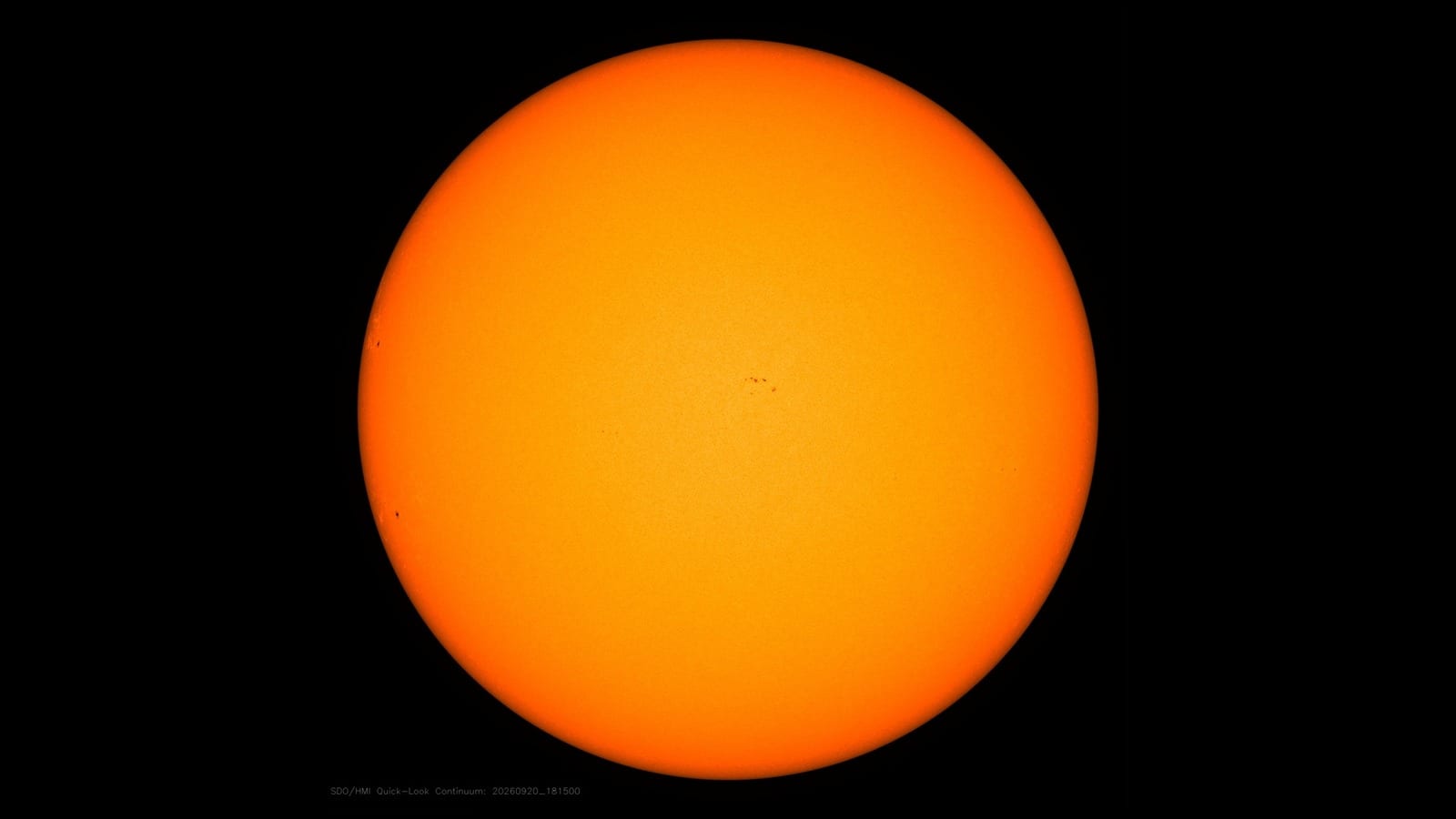
The flux stands at 93, which marks the end of a remarkable slide. On 23 September the sunspot number was 142 and the flux 121. Both have fallen since, to 53 and 93. What rotated in back then is now rotating off the west limb.
Five numbered regions are on the disc, 4544 to 4548. None of them is large: the biggest, 4548, carries 60 millionths of hemispheric area with a single spot, while 4547 and 4545 have seven and six spots at 20 millionths. These are regions that hold the flux up, not ones that drive it.
The NOAA table nevertheless sees the flux rising through the week, from 91 on Monday to 100 on Sunday. That is not a forecast of new activity but an expectation that something follows from the east limb. Our corridor: 89 to 96 from Monday to Wednesday, 92 to 104 from Thursday to Sunday. We sit slightly below NOAA because twice in the past four weeks we have watched how quickly a stock of small groups falls apart.
Band forecast
10 and 12 metres: at a flux around 93, ten metres stays what it has been for weeks: a band for the patient. The geomagnetic disturbance in the first half of the week makes it worse, because it damps the upper bands specifically. It becomes realistic from Friday, around local noon towards the south. Twelve metres is a notch better off and opens briefly to Africa and South America on the quiet days.
15 and 17 metres: at this flux seventeen is the more reliable of the two and stays that way all week. Fifteen needs the quiet days: from Thursday the attempt pays off, before that it costs time. October favours both bands, the north-south paths are seasonally good right now.
20 metres: the workhorse, as usual. Usable even on the disturbed days early in the week, though with damped northern paths. From Wednesday it is the obvious round-the-clock choice again.
30 and 40 metres: the steadier option for Monday and Tuesday. While the disturbance presses on the bands above, the lower ones carry further. Forty in the evening is noticeably better than it was in September; the nights are now longer than the days.
80 and 160 metres: the season is starting. The noise floor drops every week and thunderstorm activity in Europe has become rare. Early in the week the northern paths are still damped by an A index around 15; by the weekend that should be gone. Anyone with a wire antenna project for the low bands has picked the right month.
VHF: sporadic E is history. Aurora is not entirely ruled out in the first half of the week, but Kp 4 rarely reaches our latitudes. If you want to try, do it Monday evening on 6 and 2 metres towards the north.
Geomagnetic forecast
The NOAA table of 28 September gives these values for the week:
- Monday 5 October: SFI 91, A 15, Kp up to 4
- Tuesday 6 October: SFI 91, A 12, Kp up to 4
- Wednesday 7 October: SFI 92, A 10, Kp up to 3
- Thursday 8 October: SFI 93, A 8, Kp up to 3
- Friday 9 October: SFI 95, A 5, Kp up to 2
- Saturday 10 October: SFI 98, A 5, Kp up to 2
- Sunday 11 October: SFI 100, A 9, Kp up to 3
That is a clean decay curve: A falls from 15 to 5 and only edges back up to 9 on Sunday. The three-day forecast of 4 October, 12:30 UTC, agrees. It gives Monday Kp values between 1.67 and 4.33, with the maximum in the early morning hours, and Tuesday between 1.67 and 3.67. The storm is therefore fading on Sunday, not building.
No proton event is expected; SWPC gives one per cent for S1 or greater and the flux above 10 MeV is at background. Little is to be expected from flares with the present spot inventory: on 3 October not a single C-class flare was logged, only one optical subflare.
The planning window this week runs Thursday to Saturday. Three days with A below 10 and a rising flux at the same time is a decent combination at this point in the cycle.
The 27-day beat, checked
In the week 39 edition we explained why SWPC can forecast disturbances without seeing anything: as viewed from Earth the Sun turns once on its axis in a good 27 days, and coronal holes often survive several rotations. This time the arithmetic can be checked twice, and it works both ways.
First test, backwards. Subtract 27 days from the storm on 4 October and you land on 7 September. The archive of daily geomagnetic indices shows planetary A values of 19 on the 7th and 29 on the 8th of September, embedded in a week with values between 5 and 12. That was the same stream, one rotation earlier. The disturbance now fading was predictable in timing.
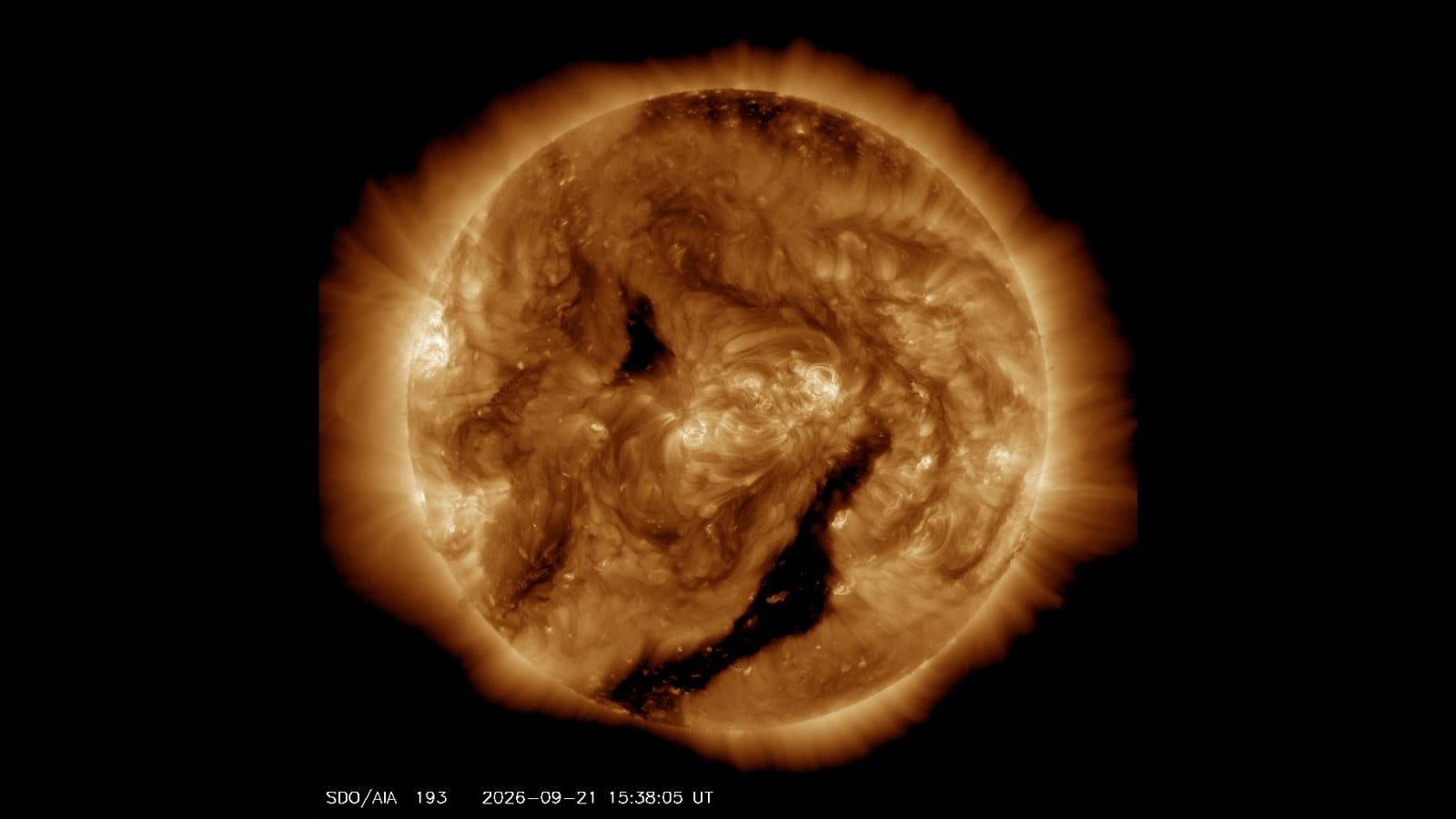
Second test, forwards. The coronal hole that caused the disturbance from 24 to 27 September would be due again after a further rotation around 21 to 24 October. That is exactly where the NOAA table shows A 15, 20, 15 and 12, with Kp up to 5. It is still far out and a pure recurrence forecast, but anyone planning something for late October should keep those four days in mind.
The caveat stays the same as always: coronal holes shrink between rotations, drift in latitude or dissolve. The timing forecast is good, the strength forecast is not. If you are operating on Monday anyway, check Sunday evening's three-day forecast rather than this article.
Recommendations for the coming week
- Monday and Tuesday: move down. 30, 40 and 80 metres carry while the disturbance presses from above. If you insist on DX on twenty, try the southern and eastern paths; the northern ones are damped.
- Wednesday: transition day. From the afternoon the field calms noticeably and 17 and 20 metres become reliable again.
- Thursday to Saturday: the window. A below 10, flux rising. This is where the plans belong that need a quiet ionosphere: chasing DXpeditions, difficult headings, a serious attempt on fifteen.
- Sunday: slightly less quiet at A 9, but the highest flux of the week. Still a good day for the upper bands.
- In general: the low band season is beginning. Anyone planning antenna work for 80 or 160 metres has four to five usable months ahead.
Review of weeks 39 and 40
First, on our own account: no edition appeared for week 40. That was not a decision but a failure. We are therefore catching up on the review for both weeks.
On the flux we sat clearly too low. For week 39 we gave a corridor of 95 to 105 for Monday to Wednesday and 98 to 112 for the weekend. Measured were 104, 118, 121, 112, 105, 101 and 97. Monday was inside the corridor; Tuesday and Wednesday shot out of the top, by 13 and 16 points respectively. The NOAA table saw 100 to 110 and was therefore also too low, but less so.
We had written the reason ourselves. We pointed at the region behind the east limb that sent a C3.3 flare over the edge on 19 September, and concluded: "Anyone producing flares over the limb is usually not a small region." That was right. We still drew the consequence too timidly. The sunspot number rose from 0 on 18 September to 142 on 23 September, from nothing to the highest value in weeks within five days. Anyone who sees a spotless day tends to calculate the following week too pessimistically. That is what happened to us.
On the magnetic field we were right, cleanly this time. We forecast three quiet days from Monday to Wednesday and from Thursday a disturbance from the recurrent coronal hole of 28 August. Observed were planetary A values of 3, 3 and 4 for Monday to Wednesday and 16, 20, 13 and 9 from Thursday. The recurrence forecast worked, in timing and in order of magnitude.
The band forecast was consequently too cautious. We called ten metres a lottery at a flux below 100. At 118 and 121 on Tuesday and Wednesday it was not a lottery; more was on offer than we announced. Anyone who followed our advice and left the upper bands alone missed two good days. We are sorry about that.
And the week after passed without surprises: flux from 95 to 92 and back to 93, A values between 3 and 7, until the new stream began on 3 October. A quiet, undramatic week in which an edition would hardly have been missed. It is missing all the same.
vy 73 and gud DX — your DX Weather Desk
Transparency notice
This outlook was produced with the assistance of AI (Claude, Anthropic) on the basis of public space weather data: the NOAA SWPC 27-day outlook (table of 28 September), the three-day forecast of 4 October 12:30 UTC, the daily solar and geomagnetic indices through 3 October, the planetary Kp series through 4 October 15:00 UTC, the region list of 4 October, and the real-time solar wind and magnetic field values of 4 October 18:26 UTC. The 27-day recurrence arithmetic draws on the SWPC archive series of planetary A indices. The title image comes from NASA/SDO (AIA 193) and is in the public domain. The content was checked by the oeradio.at editorial team. Comments and corrections are welcome at [email protected].