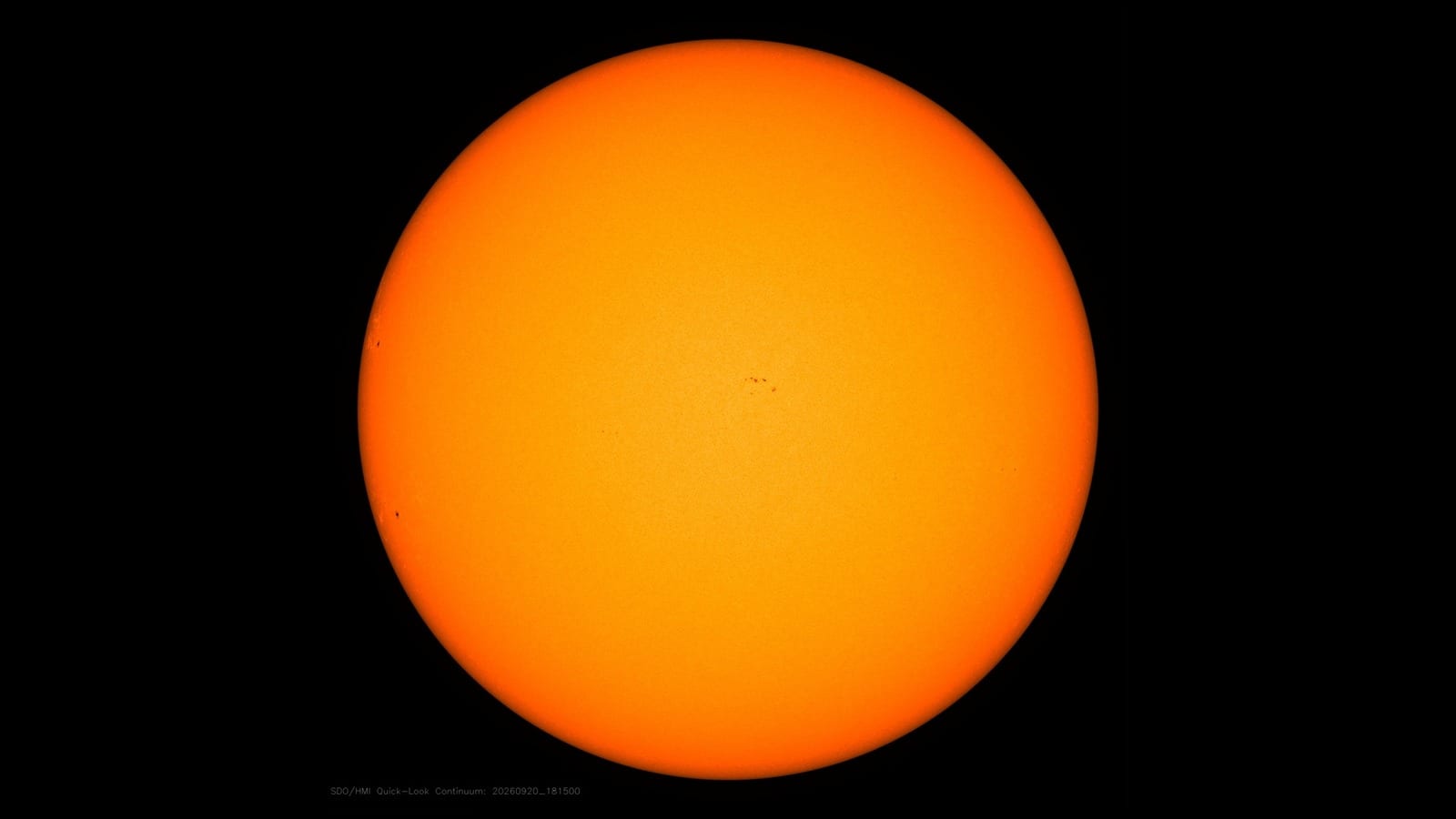
Week 39 / 2026 | 21 to 27 September | SFI now 97 | NOAA 27-day 100 to 110 | SSN 51 after a daily low of 0 on 18 September, X-ray background B3.2 | A 6, Kp up to 3.00, quiet | Solar wind 374 km/s, Bz +3 nT | Proton flux at background | Source: NOAA SWPC, as of 20 September 18:30 UTC
Summary
Last week we wrote that the regions carrying the flux were at the west limb and about to rotate away. That happened, rather more thoroughly than we would have liked.
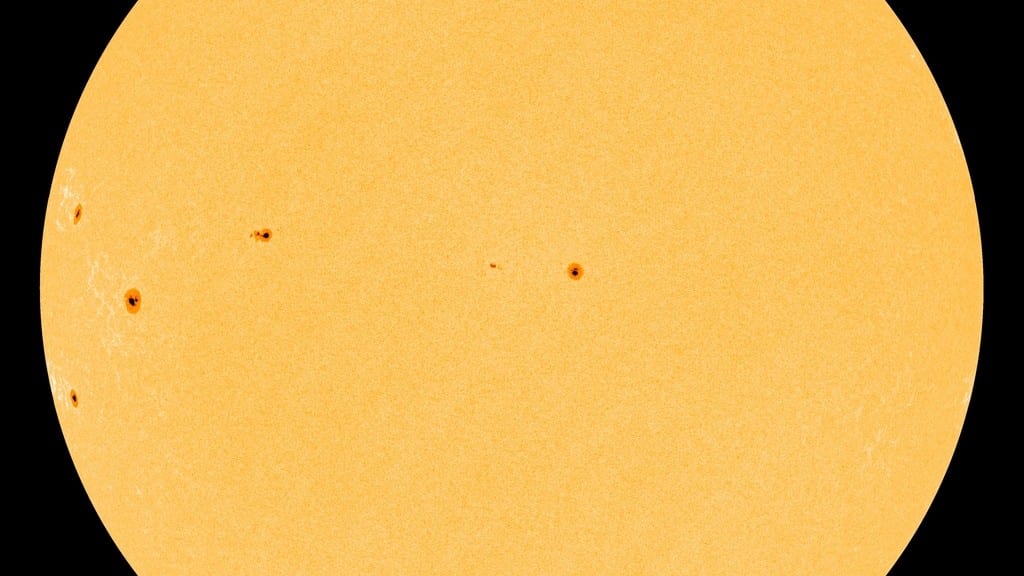
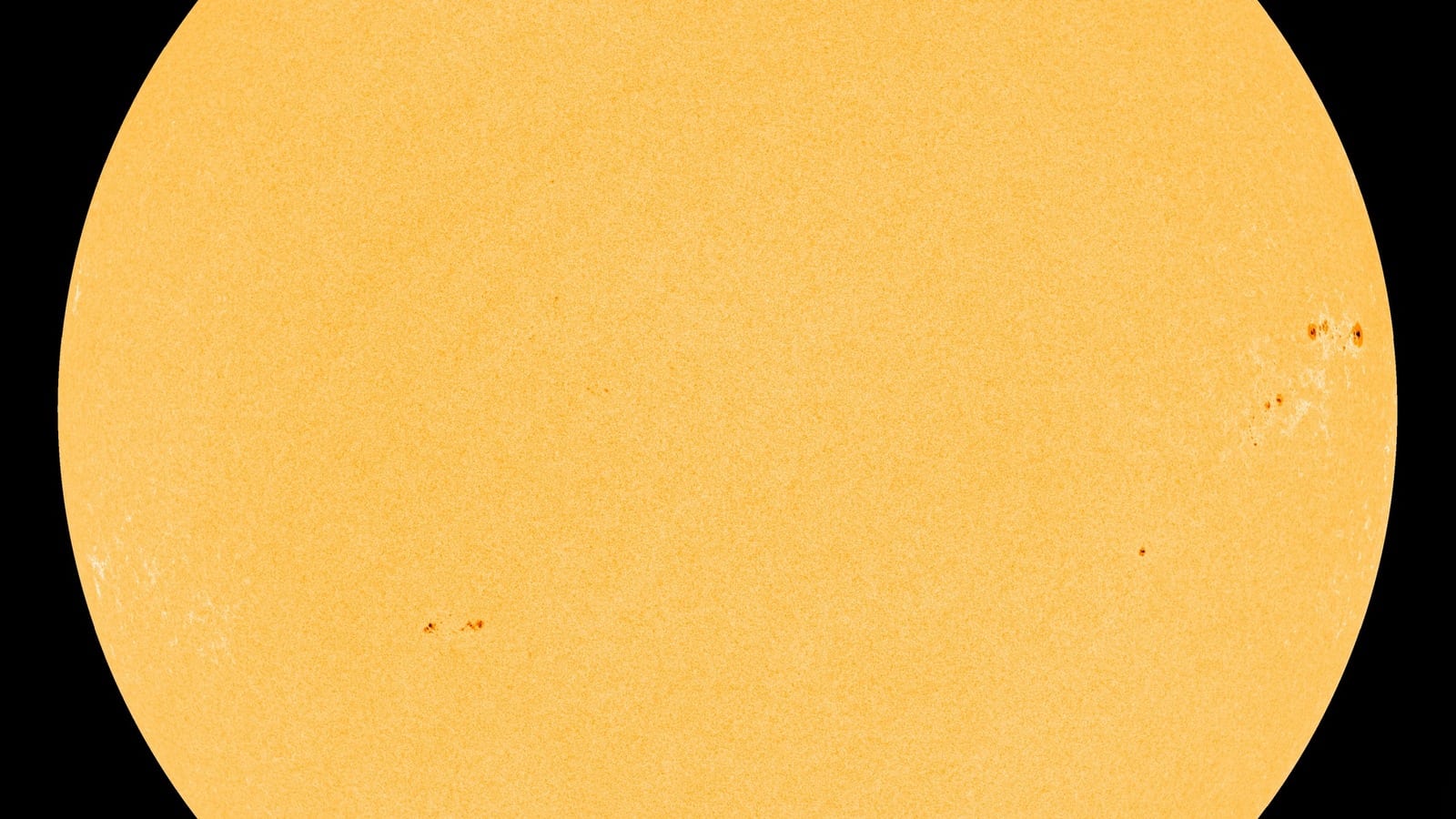
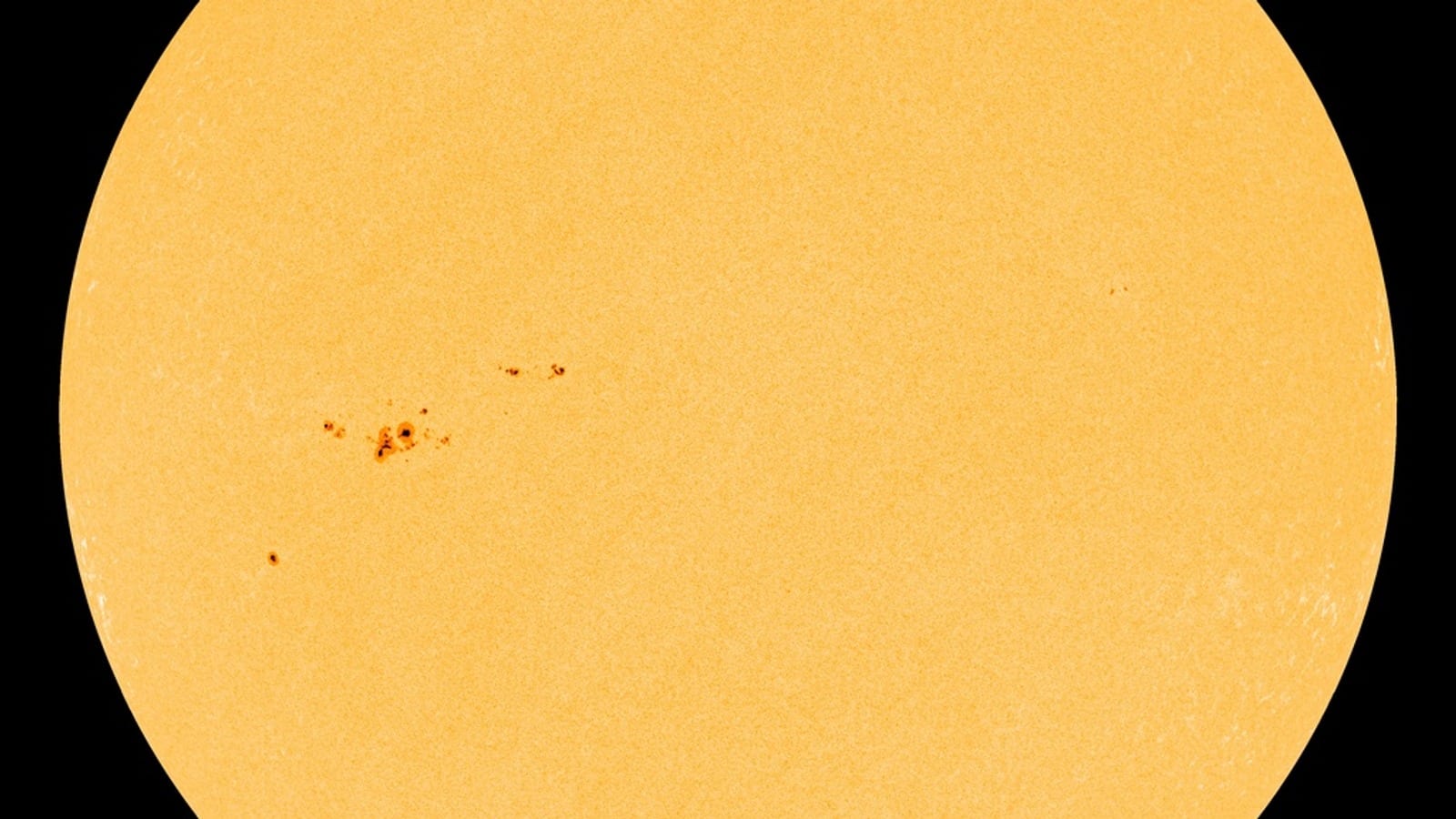
The sunspot number fell from 87 to zero in five days. On 18 September SWPC reported a sunspot number of 0 and a spot area of 0, a completely spotless day, in a year whose monthly mean was 76 not long ago. For context: the international reference series from the Uccle observatory, which counts slightly differently and is published with a delay, lists 11 December 2021 as its last spotless day, that is during the rise of the current cycle. Whether 18 September will also be carried as a zero there we will know in October. As a snapshot it remains remarkable either way.
Flux went with it and now stands at 97. The low point was 96 on 18 September.
The good news is at the east limb. Two new regions have been numbered since Saturday, 4533 in the south and 4535 in the north, both just rotated on and both still small. More interesting is a third one that has no number yet because it is too severely foreshortened: a C3.3 flare came from its direction at 18:17 UTC on 19 September, still behind the limb. Anything that produces flares over the limb is usually not a small area. Our corridor for the week: 95 to 105 from Monday to Wednesday, 98 to 112 from Thursday to Sunday. The NOAA table sees 100 to 110 and therefore assumes the region behind the east limb delivers. Last week the table was right and we were not, which is only fair to mention.
Then there are two dates. The equinox falls in the early hours of Wednesday, and from Thursday SWPC expects a geomagnetic disturbance we have met before. Together they make this a week you can plan around, provided you pick the right half.
Band forecast
10 and 12 metres: With flux below 100, 10 metres is a lottery even at the equinox. The summer sporadic-E season is over and there is simply not enough ionisation for reliable F2. If you try anyway, do it around local noon towards the south, with Africa and South America the realistic targets. 12 metres is a shade better off and will open briefly but usefully on the quiet days.
15 and 17 metres: The honest workhorses this week, with 17 metres the more reliable of the pair at this flux level. Both benefit strongly from the equinox: openings start earlier in the morning and hold longer into the evening, and north-south paths are as good as they get all year. 15 metres takes patience and a look at the Bandblick dashboard before you spend an hour calling into nothing.
20 metres: The band of the week. Usable around the clock, long by day, still open at night. On the three quiet days at the start of the week it is the obvious choice for anything that matters.
30 and 40 metres: Nights are now exactly as long as days, and you can hear it. 40 metres carries considerably further in the evening than it did in August, 30 metres remains the quiet alternative without the crowding. On the disturbed days from Thursday both are the steadier choice compared with the upper bands.
80 and 160 metres: Season start. The noise floor drops week by week and thunderstorms are getting rarer. With an A index around 18 at the weekend the northern paths will be damped, which comes with the territory.
VHF: Sporadic-E is history and aurora is currently closed. That may change from Thursday, see below.
Geomagnetic forecast
The week again splits into two halves, but the other way round from last time: quiet first, unsettled later.
Monday to Wednesday, 21 to 23 September: Quiet. The 3-day forecast issued on 20 September gives a greatest expected Kp of 3.00 and explicitly states that no significant transient or recurrent solar wind features are forecast. The 27-day outlook sees A 5, 4 and 4. The field is entirely unremarkable at present, total field strength averaged 5 nT and the solar wind has eased from 440 to 400 km/s. These three days are the window.
Thursday to Sunday, 24 to 27 September: This is where it gets interesting. The NOAA table jumps to A 18 and Kp 5 for Thursday, Friday and Saturday, and to A 15 and Kp 4 for Sunday. Kp 5 would be G1, a minor geomagnetic storm.
That forecast is not an observation but a recurrence prediction, and you can work out what it rests on. Seen from Earth the Sun takes a good 27 days to turn once. Count 27 days back from 24 September and you land on 28 August, and the archive holds a disturbed spell right there: on 28, 29, 30 and 31 August the planetary A index was 15, 17, 15 and 12, after a week of values between 3 and 6. That was a fast stream from a coronal hole, and coronal holes often survive several rotations. SWPC expects the same hole to come back into an Earth-facing position now.
That is a well founded expectation, but it remains statistics. Coronal holes shrink between rotations, migrate in latitude or dissolve. So if you are planning something for Thursday anyway, check the current 3-day forecast on Wednesday evening rather than this article.
No proton event is expected, the flux above 10 MeV is at background and SWPC puts S1 or greater at one percent. The electron flux above 2 MeV is likely to reach high levels, which matters to satellite operators rather than to us. On flares SWPC expects very low activity from Monday to Wednesday, which is no surprise given the current spot inventory.
The equinox, to the minute
Last week we wrote that the equinox was on 22 September. That was two hours off. It is exactly on 23 September at 00:05 UTC, which here means the early hours of Wednesday at 02:05 summer time.
Why that is more than a calendar entry for us we described in detail last week: northern and southern hemispheres are lit equally, the ionosphere is similarly ionised along the whole path, and north-south routes across half the globe live on exactly that. At the same time geomagnetic disturbances cluster around the equinoxes, because the Earth's field is then oriented more favourably to the solar wind and takes up more energy.
This week demonstrates precisely that. First three days with the best geometry of the year and a quiet field. Then, less than twenty-four hours after the equinox, the stream from the coronal hole. You could hardly ask for a cleaner demonstration.
There is a practical point on top: the CQ WW RTTY DX Contest runs on 26 and 27 September, traditionally the last full weekend of September. That places it squarely inside the expected disturbance. If you take part, expect damped northern paths and a noisier band, and shift weight from 15 metres to 20 and 40. If you skip the contest weekend, Monday to Wednesday gives you the better conditions anyway.
Recommendations for the coming week
- The first half of the week is the good one. Monday to Wednesday, quiet field, equinox. Everything that matters belongs on those three days. That is the reverse of last week, so please do not push things to the weekend out of habit.
- 17 metres rather than 15. Below flux 100, 17 metres is the more dependable band and it is considerably less crowded. An afternoon there beats three hours of calling into nothing on 15.
- Listen on VHF from Thursday. If the stream arrives as expected and Kp really does reach 5, that is the most realistic aurora chance in weeks. 144.300 MHz SSB, antenna north, and listen for the characteristic rough note.
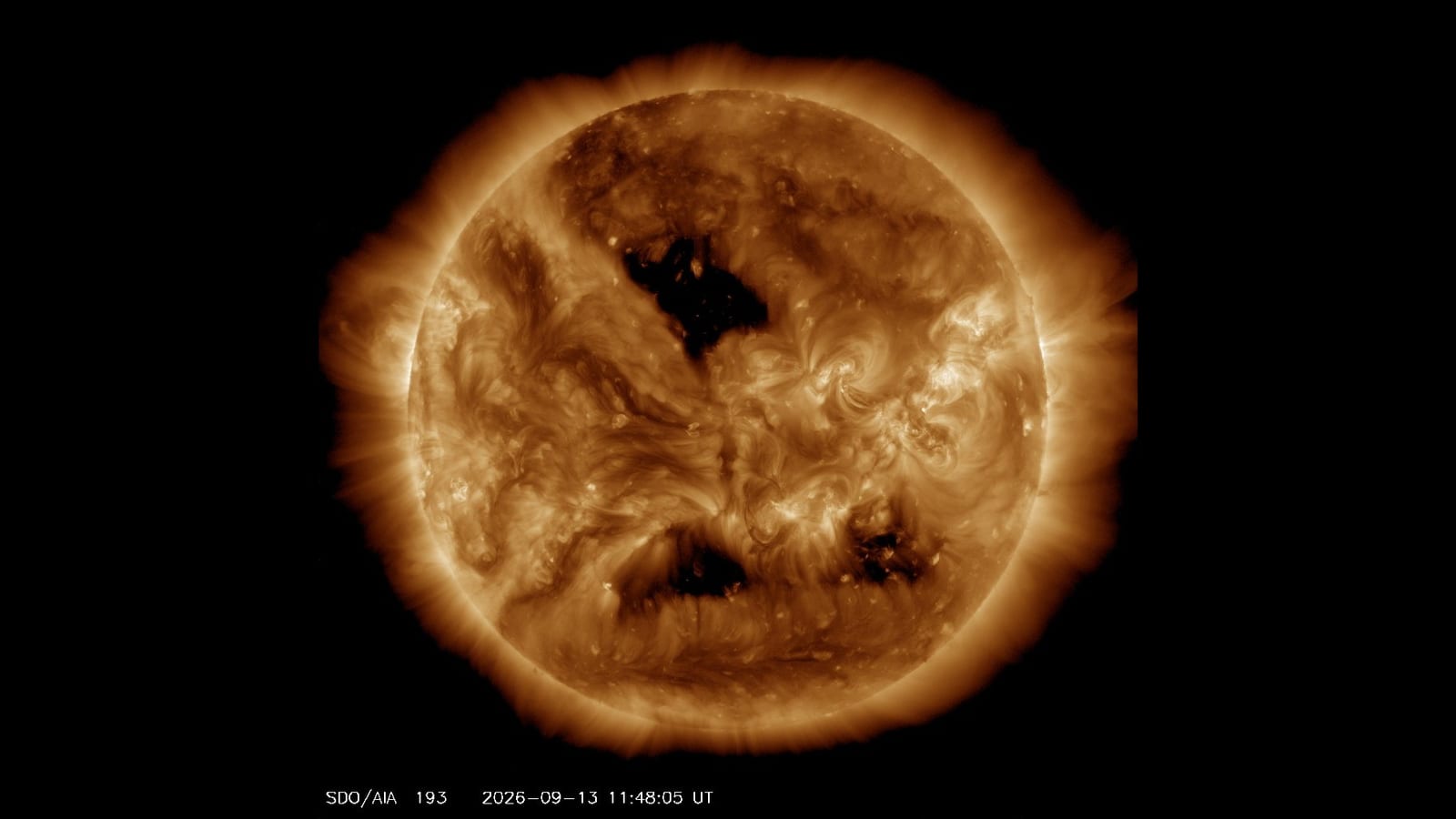
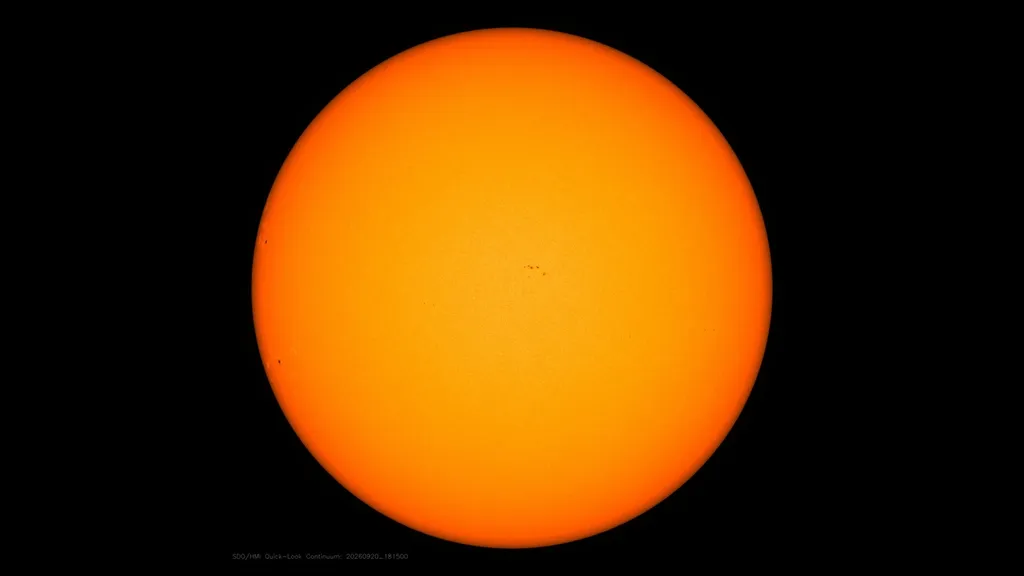
- Watch the east limb. Whether 97 turns back into 110 is down to the still unnumbered region that flared over the limb on 19 September. A look at the current SDO image takes thirty seconds.
- Get the low band antenna ready. From this week on the nights are longer than the days. If you have plans for 80 or 160 metres, build now, while you can still work on the mast without gloves. On field power supply see Akkublick.
- Test the RTTY setup, if you are contesting. Before Thursday, not at 00:00 UTC on Saturday.
Review of week 38
On flux we lost, and clearly. We called 103 to 112 for Monday to Thursday and 105 to 118 for the weekend. Measured were 104, 107, 100, 97, 96, 97 and 97 today. The first two days sat inside the corridor, after that we fell out of the bottom. The NOAA table issued on 14 September saw 105, 100, 95, 93, 90, 90 and 95 and hit it almost exactly. In the last edition we criticised the older table of 7 September, which saw 105 to 115. The difference is that NOAA corrected downwards within a day and we did not.
We did not call the collapse in sunspot number at all. We wrote that all seven numbered regions were stable or in mild decay. That was right for the moment and wrong for the week: 87 became 51, 23, 23, 11 and finally 0. Decay ran faster than assumed and nothing followed until Friday. If you want a lesson here: with a small spot inventory the decay rate matters more than the level.
On the magnetic field we were right, one day out. We called three unsettled days from Monday to Wednesday and quiet conditions with A around 5 from Thursday. Observed planetary A values for Monday to Wednesday were 11, 8 and 9, with a peak Kp of 4.00 on Monday afternoon, so a touch stronger in Kp and milder in A than forecast. The calm did not arrive on Thursday but on Friday: Thursday still ran A 9 and Kp 3.00, Friday then A 5. Our planning window was a day too generous.
The 12 metre tip was more optimistic than it should have been given the flux that actually materialised. The band did open, but shorter and less often than what we wrote at 110.
vy 73 and gud DX — your DX Weather Desk
Transparency notice
This outlook was researched and written with AI support (Claude, Anthropic) on the basis of public space weather data: the NOAA SWPC 27-day outlook (table of 14 September), the 3-day forecast and Forecast Discussion (both 20 September, 12:30 UTC), the daily solar and geomagnetic indices through 19 September, the solar region list of 20 September, and the current figures from hamqsl.com (20 September, 18:42 UTC). The statement about the last spotless day comes from the daily sunspot series of SILSO, Royal Observatory of Belgium. The time of the equinox was computed using the method of Meeus. The title image is from NASA/SDO and is in the public domain. The content was checked by the oeradio.at editorial team. Corrections and comments are welcome at [email protected].