Week 45 / 2026 | 2 to 8 November | SFI currently 90 (30 October), 90-day mean 110 | SSN 36, spot area 100 millionths (30 October) | Kp most recently 3 (31 October, 17:57 UTC), 4 at most in the last 24 hours | Solar wind up to 440 km/s, Bt up to 11 nT, Bz down to −10 nT | Last M-class flare on 19 October, only B- and C-class since | G1 window per NOAA for 31 October to 1 November | Source: NOAA SWPC, as of 31 October 18:00 UTC
Summary
The Sun is quiet, the wind not quite, and the week belongs to the low bands.
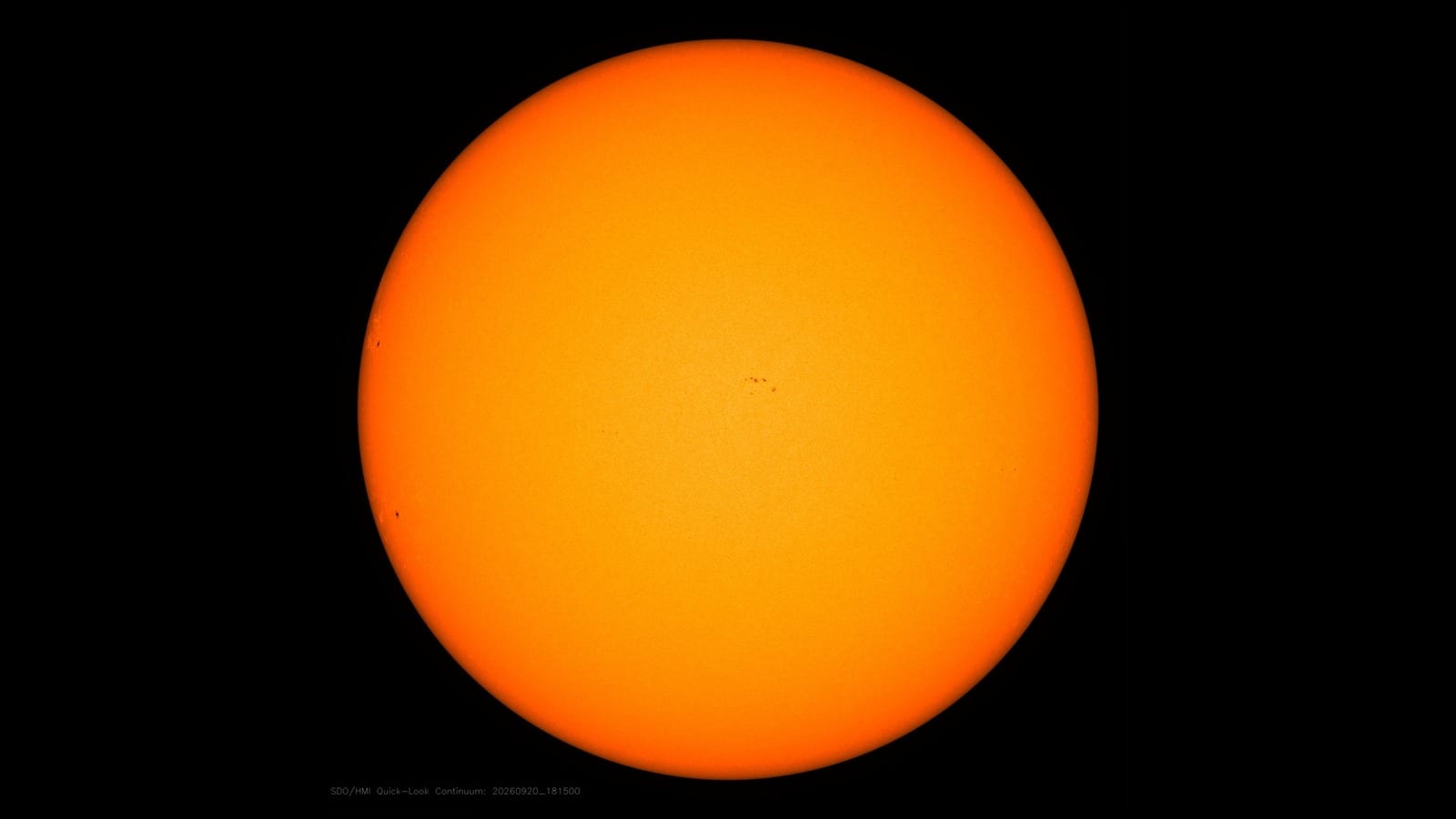
The flux stays flat. From 26 to 30 October we measured 91, 89, 93, 89 and 90, and the 90-day mean stands at 110. The sunspot number varied between 12 and 36, the spot area between 10 and 100 millionths. There has been no M-class flare since 19 October, only the odd C-class flare lately. NOAA expects a few C-class flares through 2 November, with the M-class chance at 1 per cent per day. Three numbered regions are on the disc, and none of them is large: 4562 is a plage region without spots near the centre, while 4564 (Dro, three spots) and 4565 (Hsx, one spot) are just coming over the east limb. According to the NOAA list they stand about 45 and 65 degrees east of the central meridian. At roughly 13 degrees of rotation per day, 4564 reaches the middle of the disc on Tuesday and 4565 on Wednesday or Thursday. That is an impulse, but not a big one: both are small.
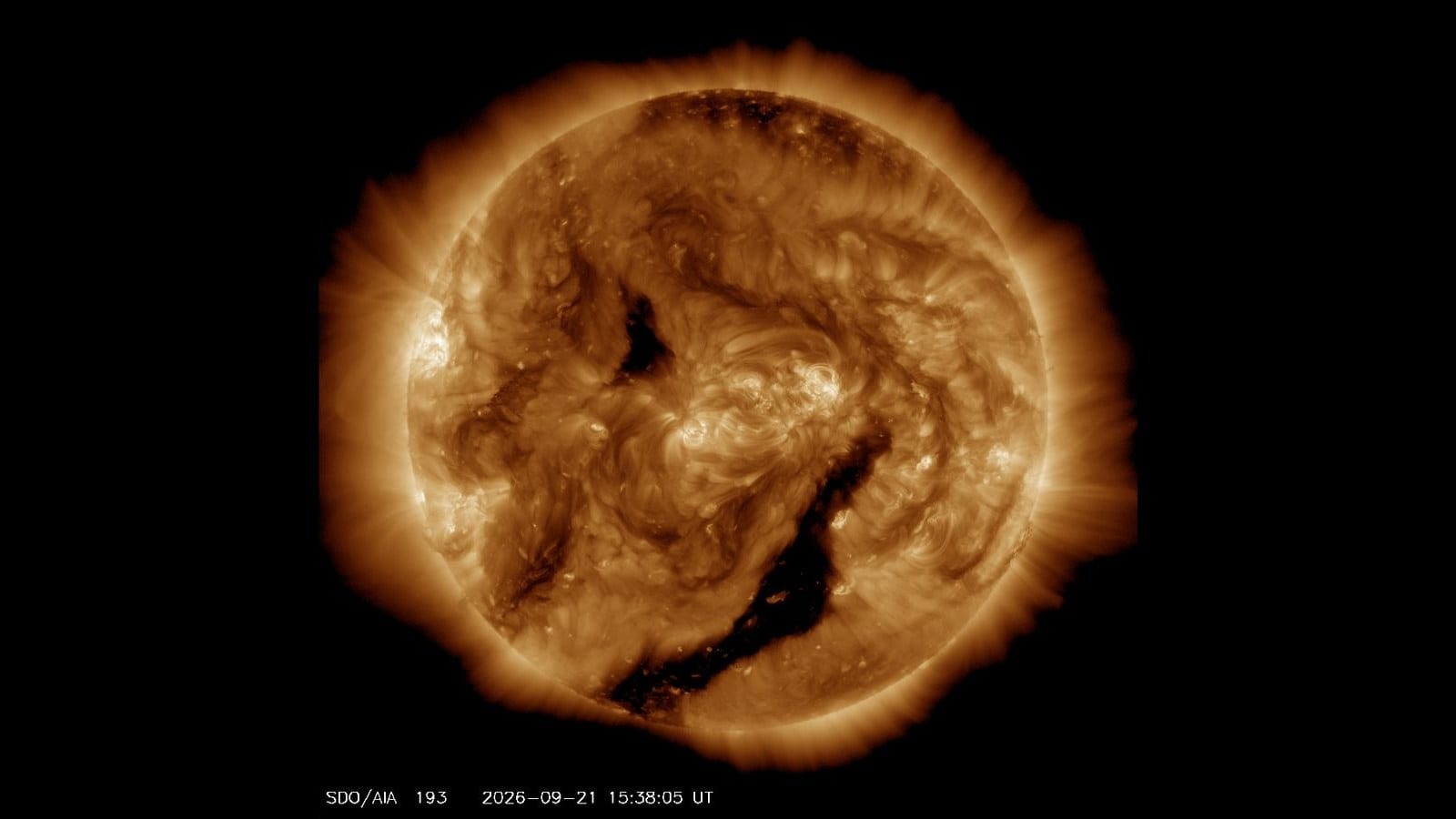
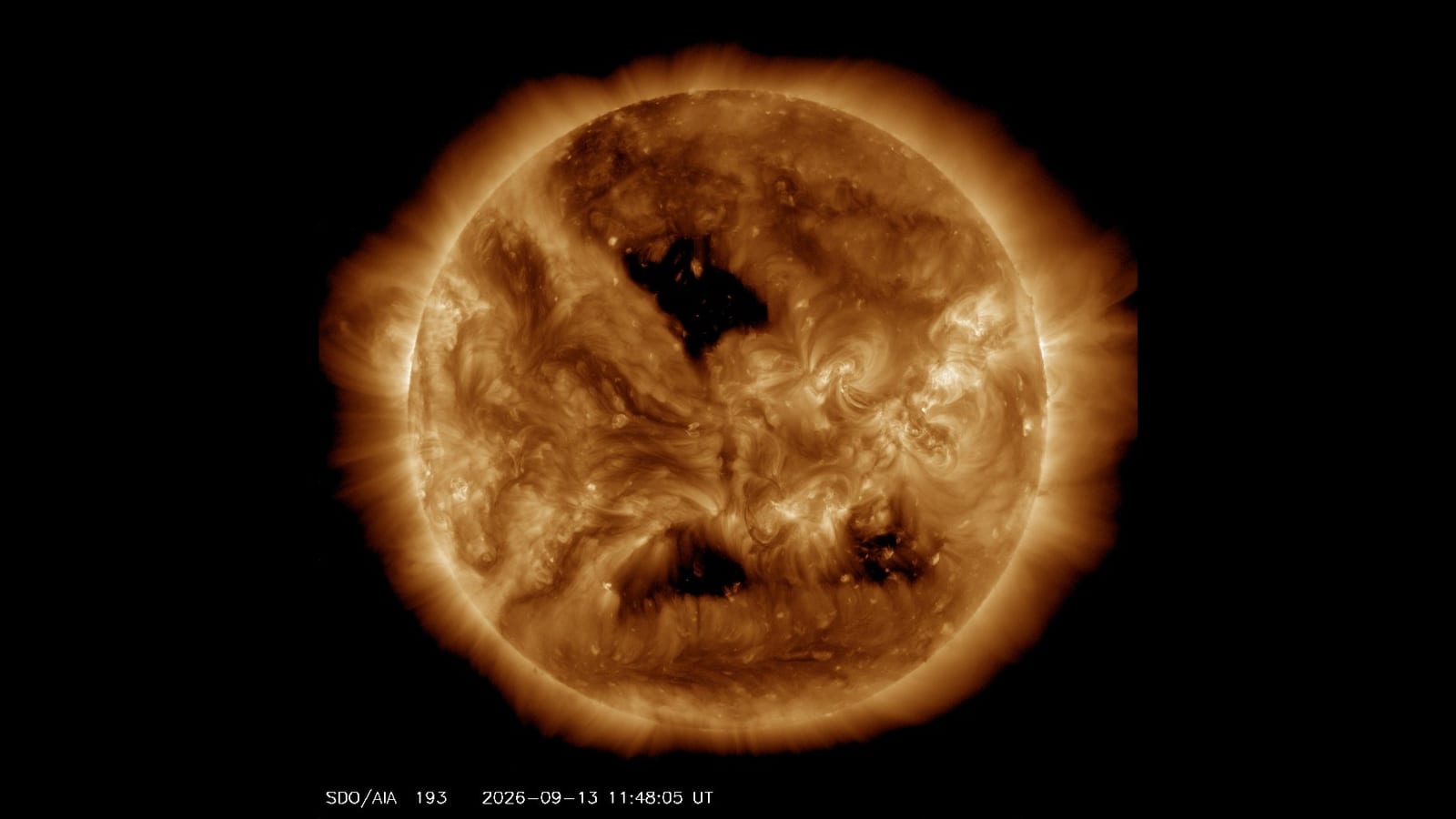
The Halloween window had not opened by Saturday evening. In the last edition we expected the solar wind stream from the coronal hole on 31 October and 1 November, exactly 27 days after the storm of 4 October. The solar wind has arrived in the meantime: peak 440 km/s, the total field reached 11 nT, Bz went down to −10 nT. The geomagnetic index followed only hesitantly: late Friday evening brought Kp 4, and today up to 15 UTC it reached Kp 3.33 at most. NOAA keeps G1 (Kp 4.67) open for today 21 to 24 UTC and for the night into Sunday (03 to 06 UTC). After that it fades: for Monday NOAA expects only quiet to unsettled conditions, Kp 2.67 at most.
From Monday it is pleasantly quiet for this time of year. The 27-day table has A 5 for Tuesday and Wednesday, A 10 for Thursday to Saturday and A 5 again for Sunday. The next date is already on the horizon: NOAA names Monday 9 November as a day with active conditions (A 15, Kp 4), followed by 17 and 18 November.
On the calendar: there is no public holiday, but there is a contest weekend, and since 25 October standard time has applied (CET, UTC+1).
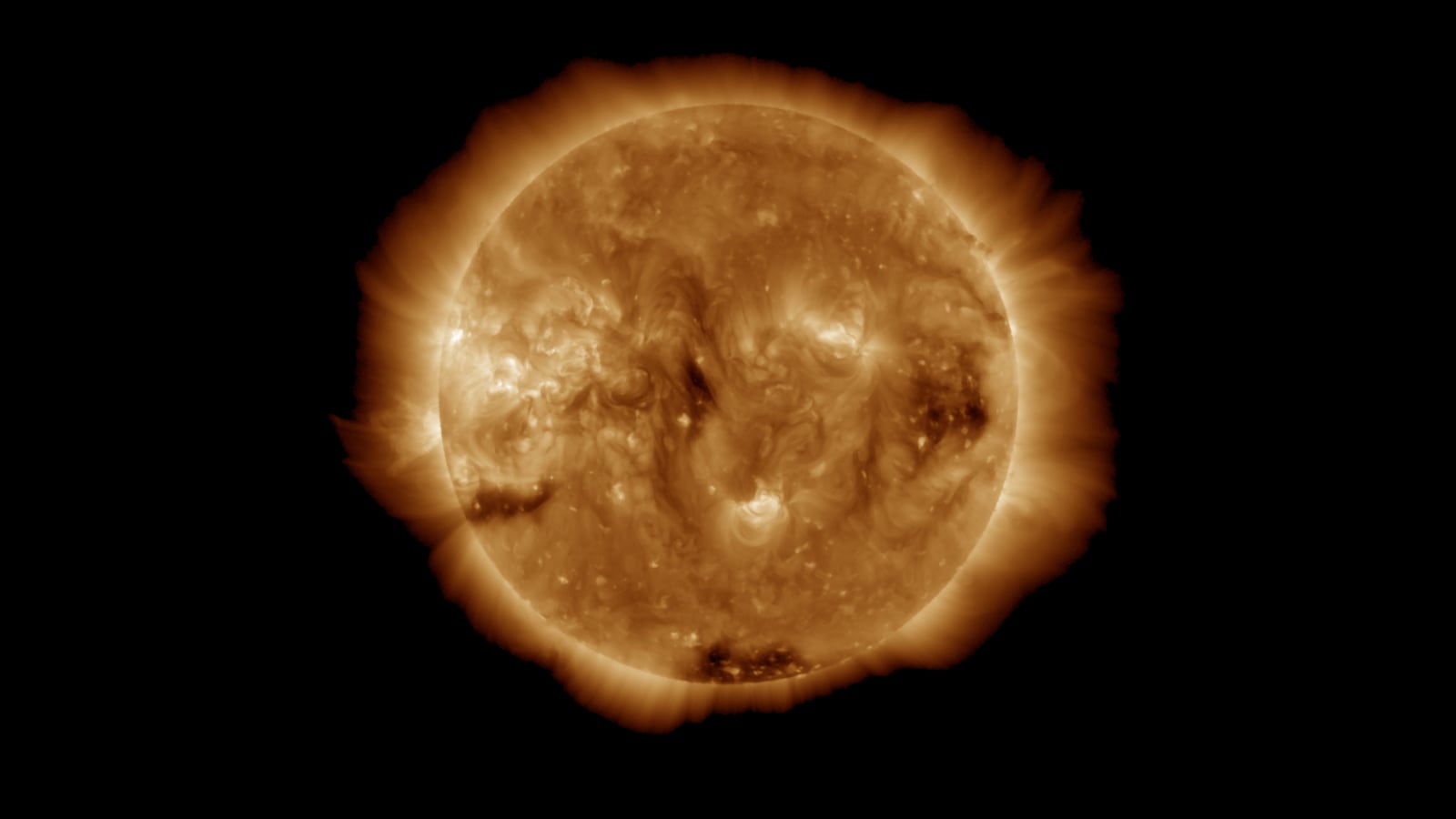
The spot inventory: small and new
NOAA lists three regions for the weekend:
- 4562 (S17W15) is a plage region without spots and contributes practically nothing to the flux.
- 4564 (N04, Dro, beta, three spots, 30 millionths) is growing slowly. NOAA reports “minor growth”.
- 4565 (N13, Hsx, alpha, one spot, 80 millionths) is stable.
The probability of major flares is low: M-class 1 per cent per day, X 1 per cent, radio blackouts R1 to R2 and R3 or higher at 1 per cent each. Proton events (S1 or greater) are likewise at 1 per cent. According to NOAA, electron fluxes above 2 MeV at geostationary orbit are expected to be high again on 3 to 5 November. That concerns satellites, not shortwave.
Our flux corridor: Monday 88 to 98, Tuesday 88 to 98, Wednesday 88 to 100, Thursday 88 to 102, Friday 88 to 102, Saturday 88 to 102, Sunday 86 to 100. The NOAA table (as of 26 October) says 82 to 84 and so sits below everything we measured this week. That was already the case last week: it predicted 88, 84, 84, 84 and 84, and we measured 91, 89, 93, 89 and 90, which is 3, 5, 9, 5 and 6 points more. The forecast in the SDF report of 30 October (90, 90 and 95 for 31 October to 2 November) fits better. We therefore lay the corridor over the table. Towards midweek we expect a slight rise, because 4564 and 4565 are moving towards the centre of the disc.
Band forecast
10 and 12 metres: at a flux around 90 this remains a gamble. Twelve metres occasionally opens around noon to the south and across the Atlantic, while ten metres is empty most of the time. Wednesday and Thursday, with the slight flux rise, are the best days for a look. Background on the band: The 10-metre band: the forgotten DX band comes back to life.
15 and 17 metres: the working bands for daytime DX. Seventeen metres is the more reliable choice, while fifteen opens around noon to the south, south-east and across the Atlantic. Both benefit from the quiet Tuesday and Wednesday.
20 metres: the standard band for day and evening. It carries all week and is the best choice for DX at this flux, though on Monday morning still with damping on the polar paths.
30 and 40 metres: with standard time, dusk and darkness arrive an hour earlier on the clock, and forty metres is the working band from late afternoon. An hour after sunset it opens to the west and North America. On the twilight zone: Gray Line DX.
80 and 160 metres: the long night belongs to the low bands, and the best nights are those into Wednesday and Thursday (A 5, Kp 2), when the noise floor drops and the polar paths are not damped. Anyone building a receive antenna will find guides here: Receive antennas for the low bands and Low-band DX on 160 m and 80 m.
VHF: sporadic E is over until spring. Aurora is unlikely this week here in Austria: the forecast is good for northern Europe (for 31 October to 2 November NOAA gives 70, 55 and 20 per cent for severe disturbances at high latitudes), not for us. More on the technique: Aurora propagation on 2 m.
Geomagnetic forecast
Two sources of different ages: the 27-day table dates from 26 October and will be updated on Monday. The three-day forecast, the forecast discussion and the SDF report date from today (12:30 UTC) and yesterday (22:00 UTC) and apply only to the start of the week.
- Monday 2 November: NOAA three-day: Kp 2.67 at most. SDF: Ap 10, quiet to unsettled, the solar wind stream fades. Our estimate: A 5 to 12.
- Tuesday 3 November: NOAA table A 5, Kp 2. Our estimate: A 3 to 8.
- Wednesday 4 November: NOAA table A 5, Kp 2. Our estimate: A 3 to 8.
- Thursday 5 November: NOAA table A 10, Kp 3. Our estimate: A 5 to 12.
- Friday 6 November: NOAA table A 10, Kp 3. There is a question mark here (see below). Our estimate: A 5 to 15.
- Saturday 7 November: NOAA table A 10, Kp 3. Our estimate: A 5 to 12.
- Sunday 8 November: NOAA table A 5, Kp 2. Our estimate: A 3 to 10.
The next unrest follows after that: for Monday 9 November the table has A 15, Kp 4, and the weekly text names “active levels” for 9 November.
The 27-day beat: a question mark on Friday
As viewed from Earth the Sun turns once in a good 27 days, and coronal holes often survive several rotations. That is the basis of the recurrence forecast.
The arithmetic for this week. Twenty-seven days before 2 to 8 November is 6 to 12 October. The planetary A values there: 11, 6, 6, 11, 46, 13 and 7. The quiet days match the NOAA table (A 5 on Tuesday and Wednesday). 10 October with A 46 (Kp up to 7) falls on Friday 6 November. The NOAA table puts only A 10 there. We do not know what was behind 10 October: there were M-class flares on 8, 9 and 10 October, an ejection is possible as the cause, and an ejection does not return after 27 days. We therefore treat Friday as a question mark, not as a forecast. The estimate up to A 15 is a buffer.
This fits NOAA. For 9 November NOAA gives A 15, and 27 days earlier, on 13 October, the planetary A value was 13. NOAA places the recurrence of the disturbance of 21 and 22 October (A 19 and 20) on 17 and 18 November.
Contests of the week
According to the WA7BNM calendar (all times UTC):
- During the week: RSGB 80m Autumn Series, Data (Monday 20:00 to 21:30), Tuesday’s Telegraphy Contest (Tuesday 19:30 to 20:30), CWops Test (CWT) on Wednesday 13:00 to 14:00 and 19:00 to 20:00 and on Thursday 03:00 to 04:00 and 07:00 to 08:00, Mini-Test 40 (Wednesday 17:00 to 17:59) and Mini-Test 80 (18:00 to 18:59), VHF-UHF FT8 Activity Contest (Wednesday 17:00 to 21:00), UKEICC 80-m Contest (Wednesday 20:00 to 21:00), NRAU 10m Activity Contest (Thursday 18:00 to 22:00, in turn CW, SSB, FM and Digital), SKCC Sprint Europe (Thursday 20:00 to 22:00). The NRAU 10m Activity is marked “Active, but no recent results” in the calendar, so check the rules before the start.
- At the weekend: YBDXPI FT8 Contest (Saturday 00:00 UTC to Sunday 23:59 UTC), IPARC Contest CW (Saturday 06:00 to 18:00) and SSB (Sunday 06:00 to 18:00), FIRAC HF Contest (Sunday 07:00 to 17:00) and the ARRL Sweepstakes Contest, CW (Saturday 21:00 UTC to Monday 03:00 UTC). To the best of our knowledge the Sweepstakes is aimed at stations in the USA and Canada; for us it is mainly interesting as something to listen for: anyone listening to the west in the evening will quickly see on 40 and 80 metres what the path to North America looks like. The exact conditions of participation are in the respective rules.
The weather for it: Saturday and Sunday, at A 10 and A 5, sit in the quiet half of the week. That is good for the weekend contests on 40 and 20 metres and for Sweepstakes listeners on Saturday evening. Getting started in contesting: Contests for beginners.
Recommendations for the coming week
- Monday: the tail of the solar wind stream may still damp the polar paths in the morning. Seventeen and 20 metres by day, 40 metres in the evening, 80 metres at night.
- Tuesday to Wednesday: the quietest days of the week. Anyone who wants to try 160 or 80 metre DX has the best nights here. Do not expect miracles on 10 metres, but a look is worthwhile.
- Thursday to Saturday: slightly unsettled field (A 10, Kp 3). Polar paths are not lost, but less certain than in midweek. On Friday keep an eye on the question mark of 6 November.
- Sunday: quieter again. The last good day before the next disturbance on Monday 9 November. Work the good paths (North America, South America) now.
- Mind standard time. CET (UTC+1) has applied since the night into 25 October. Anyone planning appointments, skeds or beacon times by local time has been calculating an hour differently from summer ever since.
- The current values, rather than the weekly forecast, are in Bandblick. How to read SFI, A and K index is explained in the article Understanding propagation conditions. For putting the current cycle in context: Solar Cycle 25.
Review of week 44
On the flux our corridor held on all five days measured so far. We had set 88 to 96, 86 to 94, 86 to 96, 88 to 98 and 90 to 100 for Monday to Friday. Measured were 91, 89, 93, 89 and 90, with Friday at the lower edge. The NOAA table of 26 October (88, 84, 84, 84, 84) was below on every day. For Saturday and Sunday we had set 92 to 102 and 94 to 106, the rise from the return of the regions of 5 and 6 October. The SDF report says 90, 90 and 95 for the next three days. Saturday will therefore sit at the lower edge or below, and Sunday reaches the corridor only if the rise does come after all. The conclusion: we read the return of the regions a little too optimistically.
On the magnetic field we were close from Monday to Friday. We had expected A 5 to 10, 3 to 7, 3 to 6, 3 to 7 and 5 to 10. Measured were A 4, 6, 7, 4 and 10. Monday was one point below the corridor, Wednesday one above, the other three days inside the corridor, with Friday at the upper edge. For Friday we had predicted the start of the lead-in phase late in the evening (“lead-in phase begins late in the evening”), and indeed Friday brought Kp 4 at 21 to 24 UTC.
The G1 window is still to come. We had set A 15 to 30 for Saturday and A 12 to 25 for Sunday, and NOAA gave A 30 and A 25 and Kp 5. As of today 17:57 UTC, Kp stands at 3. The NOAA three-day forecast keeps Kp 4.67 (G1) open for today 21 to 24 UTC and for the night into Sunday (03 to 06 UTC), and the SDF report gives Ap 28 for Saturday and Ap 20 for Sunday, both within our corridor. Whether timing and strength are right we shall see only in the next edition. The cause was right: a solar wind stream from a coronal hole with positive polarity, exactly 27 days after 4 October.
On the regions: after the departure of 4560 on Monday we had expected a spotless Sun. In fact small spots remained (SSN 12 to 36), and region 4561 still produced the odd C-class flare on Monday. No M-class flare came, a risk we had set low at 10 per cent per day.
vy 73 and gud DX — your DX Weather Desk
Transparency notice
This outlook was produced with the assistance of AI (Claude, Anthropic) on the basis of public space weather data: the NOAA SWPC 27-day outlook and Weekly Highlights (both of 26 October), the three-day forecast and forecast discussion of 31 October 12:30 UTC, the Report of Solar-Geophysical Activity (SDF No. 303) of 30 October 22:00 UTC, the daily solar and geomagnetic indices through 30 October (as of 31 October), the Geophysical Alert Message of 31 October 15:05 UTC, the planetary Kp series through 31 October 17:57 UTC and the region list of 31 October. The back-calculation to the 27-day beat draws on the SWPC archive series of planetary A indices. The position of the coronal holes is our own reading of the SUVI image and not a NOAA statement. The contest dates come from the WA7BNM contest calendar. The title image comes from NOAA/NASA GOES-19 SUVI (195 ångström, 31 October 12:00 UTC), is in the public domain and was cropped by us. The content was checked by the oeradio.at editorial team. Comments and corrections are welcome at [email protected].