
RADE is the neural speech codec that lets FreeDV carry intelligible speech on shortwave even with very weak signals. We already introduced RADE in the FreeDV basics article. Here we take a closer look: what does the technical paper say, how do versions V1 and V2 differ, what did FreeDV 2.3.0 bring, and which numbers can you rely on? For a number of figures the sources disagree. We point that out each time.
Neural? What does that actually mean?
A "neural network" is a computer program that does not work step by step from a fixed set of instructions but learns from examples. The name comes from the brain, in which nerve cells (neurons) are connected to one another. On a computer it is a rough imitation: a very large number of small calculation units that pass numbers along and change them slightly each time.
A comparison from the kitchen. A classical program is like a recipe: 200 grams of flour, two eggs, stir for ten minutes. Someone worked everything out beforehand, and the computer carries it out exactly. A neural network is more like an apprentice who bakes a thousand cakes. After each attempt someone tells him how close he got to a good result, and he adjusts a little. In the end he can bake cakes without anyone ever having dictated the recipe to him. This practising is called training.
And "AI"? Artificial intelligence is the umbrella term for programs that solve tasks for which we would otherwise assume intelligence: recognising speech, describing images, writing texts. Neural networks are today the most important technique behind it. It has nothing to do with a thinking being. A network recognises patterns in a very large number of examples and applies them to new cases.
What does this have to do with radio? To send speech over shortwave, you have to pack it into a few numbers and unpack it again at the other end. Packing is called encoding, unpacking is called decoding, and the whole package is called a codec. Until now, experts designed the rules for this by hand, like a recipe. With RADE, a neural network takes over part of this job. According to the technical paper, it was trained to withstand the noise and multipath propagation found on shortwave.
The "autoencoder" part of the name describes the principle: one network packs something up (encode), a second one unpacks it (decode), and both practise together until the unpacked result comes as close as possible to the original, even if there was interference along the way. You can think of two pen pals who agree on a secret script that stays readable even if the letter got wet.
So what is sent is not the sound itself but a sequence of numbers. Producing the sound at the receiver is the job of a vocoder. From the incoming characteristics of the voice (pitch, timbre) it builds audible speech again. In RADE this is also a neural network, called FARGAN.
Important to know: such a system needs more computing power than a classical digital voice system. That is why RADE runs on the computer and not in the radio. And what a network has learned cannot be looked up like a recipe. Whether it works is therefore shown by tests, as in the paper.
What RADE is
RADE stands for "Radio Autoencoder". It was developed by David Rowe (VK5DGR) and Jean-Marc Valin. Their technical paper "RADE: A Neural Codec for Transmitting Speech over HF Radio Channels" appeared on arXiv on 10 May 2025 and was revised on 26 July 2025 (arXiv:2505.06671). The basic idea: a neural network replaces many classical stages of signal processing. The encoder takes characteristics of the voice (short-term spectrum, pitch, voicing) and turns them into continuous QAM symbols. These are sent over shortwave using OFDM. The decoder reconstructs the characteristics from them. The speech itself is generated by the ML vocoder FARGAN, no longer by Codec 2 (freedv.org).
According to the paper, the network is trained on noise and multipath propagation. The software is released under the BSD-2-Clause licence (GitHub: drowe67/radae).
The numbers from the paper
- Structure: 30 carriers with 50 symbols per second each. Each OFDM frame carries 120 QAM symbols from three consecutive latent vectors. This gives a frame duration and algorithmic delay of 120 ms. The features are updated at 100 Hz, the latent vector at 25 Hz.
- Threshold: On a pure noise channel (AWGN), speech remains intelligible down to Eq/N0 = −3 dB.
- Comparison with SSB: For "connection holds" (30 % word error rate), RADE gains 4 dB over SSB, in both the AWGN and the multipath channel. For good quality (5 % word error rate) the gain is 13 dB.
- Peak power (PAPR): below 1 dB. In the paper, SSB sits at an average of about 8 dB.
- Computational load: The encoder and decoder each need about 1 MB of storage and 32 MMACs. The FARGAN vocoder adds about 300 MMACs.
Two caveats belong here. First, the measurements were made with automatic speech recognition (Whisper) on 500 LibriSpeech samples, not with a standardised listening test. Informal listening tests "suggest" that RADE clearly outperforms SSB, according to the paper. Second, the 4 and 13 dB come from simulations with model channels. That is not a statement about every real HF path.
V1 and V2 compared
The RADE page on freedv.org gives V1 an HF bandwidth of 1500 Hz, a sensitivity down to about −2 dB SNR and a PAPR of about 4 dB behind a typical SSB filter. The paper, by contrast, states a PAPR below 1 dB. The values describe different points in the signal chain and are not directly comparable. Likewise, the paper is given in Eq/N0, the FreeDV page in SNR.
A table in the GitHub repository compares the two versions:
| RADE V1 | RADE V2 | |
|---|---|---|
| Bandwidth (99 % occupied) | about 2100 Hz (limited by SSB filter) | about 860 Hz |
| Carriers | 30 (with pilot symbols) | 14 (data only) |
| Frame duration | about 120 ms | about 40 ms |
Notable: for V1, freedv.org gives 1500 Hz, while the GitHub repository gives a measured 2100 Hz with the addition "limited by SSB filter". Anyone quoting the figure should say where it comes from. You can find the spectrogram comparison of SSB, RADE V1 and RADE V2 from an on-air test on the RADE page of freedv.org. We cannot show the image here because no licence is given there.
According to freedv.org, RADE V2 is in beta testing. Neither the paper nor the repository gives a bit rate in bits per second. We therefore do not give one.
FreeDV 2.3.0 of 19 May 2026
According to MacHamRadio, version 2.3.0 brought, among other things:
- Python was removed from the RADE implementation to improve performance. In addition, the RX frequency display for RADE returned.
- New are a Tune button, an SNR graph in the main window, RNNoise for noise suppression when transmitting, and a CSV log of heard callsigns.
- The FreeDV Reporter has per-column filters and can hide your own station.
- The software runs directly on Flex-8000 and Aurora radios. There are builds for Windows (Intel/AMD and ARM), macOS (one DMG) and Linux as an AppImage for x86_64 and aarch64 (such as Raspberry Pi 5).
What you need
- A reasonably modern computer. According to freedv.org, RADE V1 needs more memory and computing power than a classical digital voice system. It also runs on a Raspberry Pi 4 or better.
- Windows 10 or newer is the main platform, plus Linux AppImages.
- A sound card interface to the radio. RADE does not run on the SM1000, the ezDV or on microcontrollers.
- A radio with SSB. V1 has no SNR squelch; decoding starts as soon as frame synchronisation is reliable enough.
Before you transmit: check that the mode, band segment and power fit your licence.
Talk to watch
The RADE page on freedv.org links a talk about RADE for radio amateurs. The recording (AREG, March 2025) is on Mark Jessop's YouTube channel:
Putting it in perspective
In November 2025, Amateur Radio Newsline quoted David Rowe as saying RADE is "the first known real-world deployment of a neural codec". That is the developer's own assessment and not an independent verdict. What is documented is that the software is freely available, that the paper shows gains over SSB in simulations, and that FreeDV 2.3.0 makes RADE easier to use in everyday operation. What remains open is how V2 performs in continuous operation and how many stations actually use RADE.
Sources
- D. Rowe, J.-M. Valin: RADE: A Neural Codec for Transmitting Speech over HF Radio Channels, arXiv:2505.06671 (v1 10 May 2025, v2 26 July 2025)
- FreeDV: RADE – Radio Autoencoder
- GitHub: drowe67/radae (source code, V1/V2 table, BSD-2-Clause)
- MacHamRadio: FreeDV 2.3.0 has been released (19 May 2026)
- Amateur Radio Newsline, 20 Nov 2025: Neural codec called milestone for digital voice
- YouTube: RADE – Machine Learning for Speech over HF Radio (AREG March 2025 Presentation)
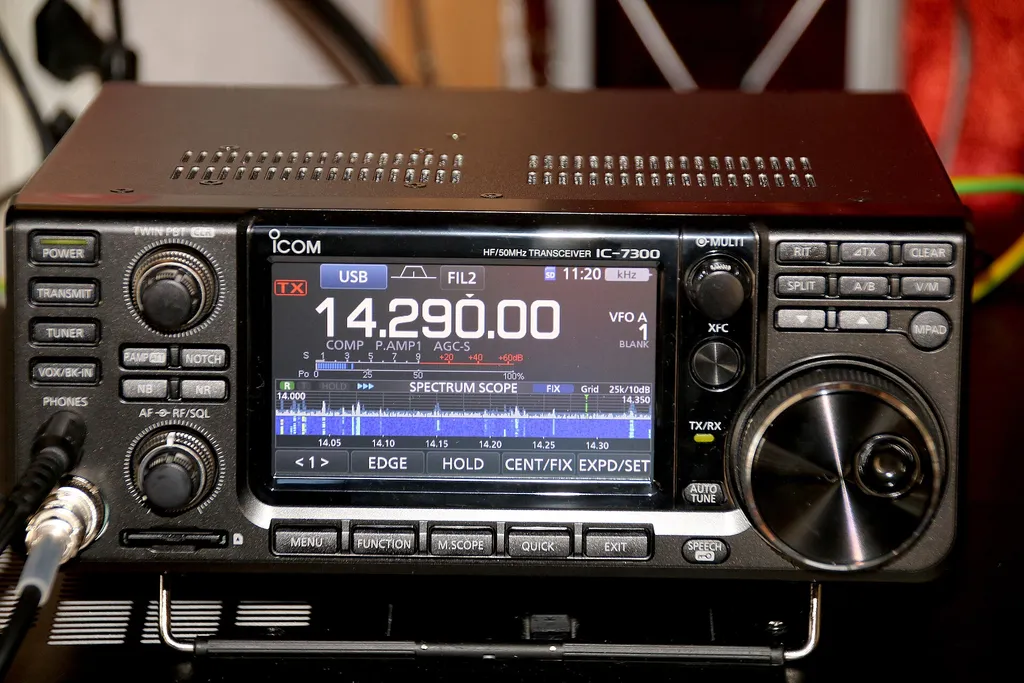
- Wikimedia Commons: File:IC-7300.jpg, Hp.Baumeler, CC BY-SA 4.0
73 – the oeradio.at team
Transparency Notice
This article was researched and written with the assistance of AI (Claude, Anthropic). The content was reviewed by the oeradio.at editorial team and prepared for the Austrian amateur radio community.