
A Jammer satire by Hansl Hohlleiter
Egon Eliteknoten, OE0EEL, has written a message. He does that often, but this time he added three exclamation marks and a rocket emoji: "ELITE REPEATER ONLINE!!! Coverage far beyond the district!"
The message received twelve reactions. In the same time, the repeater it announces forwarded zero packets. That ratio is rare in the history of radio engineering, and I am grateful I was there to see it.
The announcement
An announcement on the mesh network follows a fixed procedure, which Egon celebrates like a pontifical mass. First comes the photo: the device, the battery beside it, a mountain in the background that has nothing to do with the location. Then comes the map, with a blue circle drawn on it. The circle has a radius of a hundred kilometres. It is beautiful.
The circle does not come from a measurement. It comes from a drawing program. Anyone who draws a coverage map like that has about as much to do with radio as a weather frog has with the summer of the century. Then comes the sentence I now know by heart: "This will be the backbone of the network."
And last of all, the hashtags. I have found no connection between Egon's announcements and his actual transmit power, but that is probably down to my measuring method. I counted.
The count
So far Egon has announced eleven elite repeaters. As befits a reporter, I checked how many of them can still be seen on the network today.
- Announced: 11
- Online today: 4
- Of those, continuously online for more than a week: 1
- By his own account "only briefly offline, battery": 5
- By his own account "being relocated": 2
The five with the battery are particularly remarkable. They sit at sites chosen in midsummer, with a solar panel that was sufficient in midsummer, and since mid-October they have been going into a kind of hibernation. Egon calls this "seasonal optimisation". I call it "a sun that stands lower in winter than the announcement had planned for".
He has never explained the elite status in any detail. I asked him. His answer was: "Elite is when you put it up." That is a surprisingly durable business model. It would work in the restaurant trade, too.
The names
There would even have been instructions for all of this. A naming convention has become established on the network that sounds simple: first the place, then the site, then the height, so that anyone looking at the list can see at a glance where the thing stands and what they can rely on. Whoever knows it finds the right repeater when they need a connection on the road. Whoever does not know it finds a list in which one repeater is called "Repeater".
Egon's elite nodes are called:
- ELITE!!!
- Elite_Egon_NEU
- Egons Kastl 🚀
- Repeater (Elite)
- test
- Elite_Egon_NEU_final
- König der Berge
The other four have names I cannot reproduce here, because they consist mostly of symbols. Exactly two out of eleven stick to the convention, and they are two of these four: the ones Egon did not name himself, but a neighbour who "entered them properly" because it bothered him. Egon does not know who that was. He suspects a competitor.
It is easily overlooked that names in a network are more than decoration. Anyone tracing a path in the app sees names. Anyone who wants to know which repeater their message went through reads names. And anyone looking for a fault first has to know which of eleven Egons is currently the suspect. If three of them are called "Elite", that becomes a rather long search.
The alp
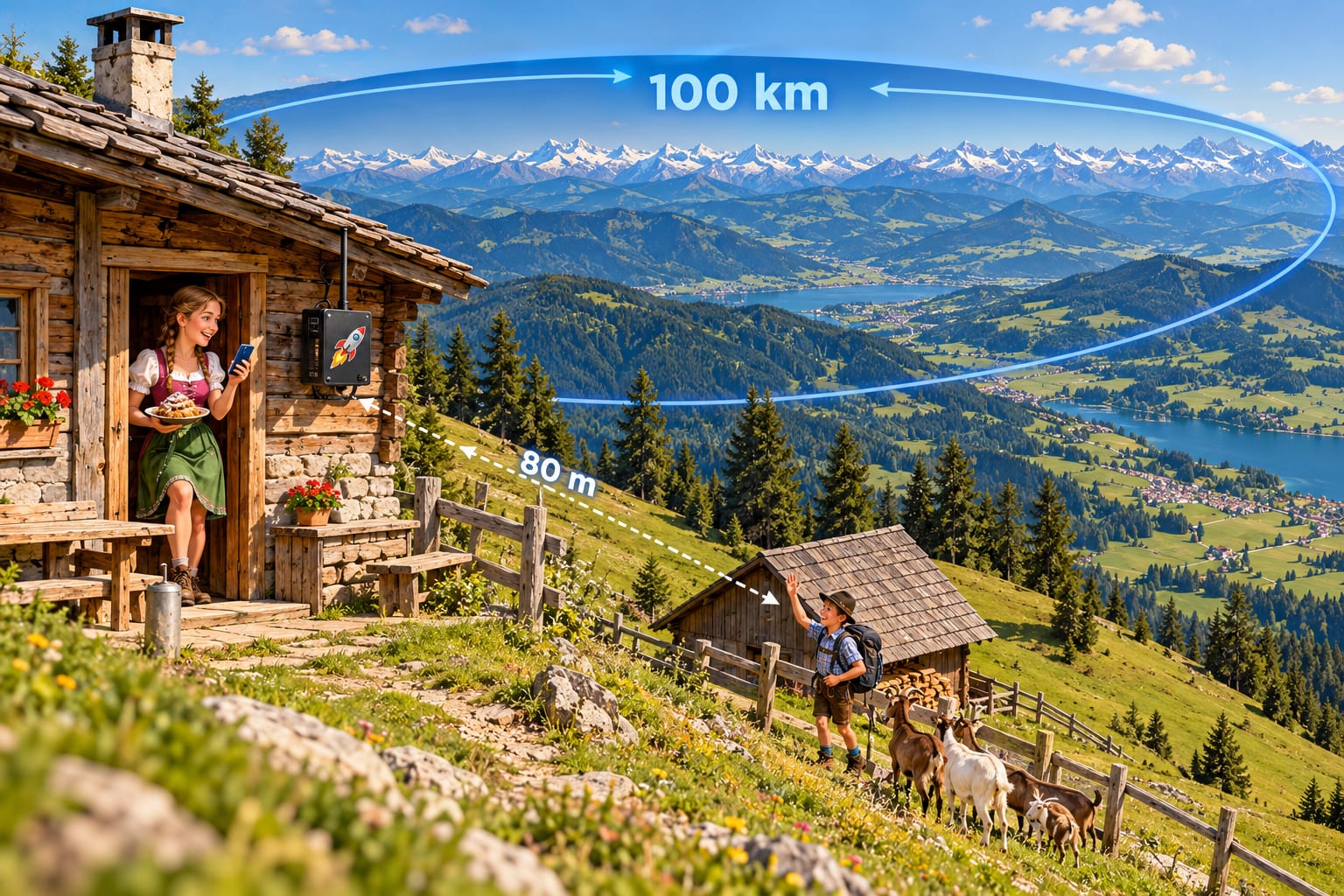
The high point of the Elite series is the node on the Heidialm. It is, one has to give Egon that, the most beautifully situated. At 1,800 metres, with a view over three valleys, and on a clear day you can see all the way to the horizon from there.
The radio cannot do that. The radio does not stand up there at all, but in the hut porch, behind a wooden wall, next to the fridge, with the antenna in a corner so that it "doesn't get wet". Nobody on the Heidialm has yet dared to put a repeater outdoors, because, as the landlady says, "there's always something standing around and carrying on".
The actual range was measured by Peterle, who looks after the goats. Like every good goatherd, Peterle has a MeshCore device in his rucksack and knows his way around wherever he goes. Every day he sits roughly eighty metres below the hut, behind the barn.
That is where the elite repeater arrives. Nowhere else.
We documented the conversation:
Heidi: "Peterle, can you hear me?"
Elite Repeater: (transmits after fourteen seconds)
Peterle: "Yes!"
Heidi: "There's Kaiserschmarrn."
Peterle: "Coming."
That was it. The conversation took fourteen seconds per sentence, because the network, like any sensible network, manages airtime carefully. Shouting would have been faster. The landlady timed it: in that time you could have reached Peterle on foot three times over.
And yet, if you look at it closely, this is the most reliable connection in the whole Elite series. It works every day. It has a demonstrable range, a real use and two satisfied users. If you wanted to put it unkindly, you could say: this is the only elite repeater that lives up to its announcement by more than four per cent. And it does so because Heidi and Peterle actually need it.
The map, meanwhile, still shows the blue hundred-kilometre circle. On the alp they know it is wrong. Nobody up there has ever seen it, because on the alp you do not look at the map, you look at the slope.
The statistics
Egon likes to calculate in percentages. The day before yesterday he announced that 100 per cent of his elite repeaters have transmitted "at least once". The figure is correct. I checked it.
Another figure that is also correct, but was not in the announcement: 11 announced, 4 online, 2 with a proper name, 1 with a use. The use, by the way, was not achieved by him. Heidi achieved it.
On top of that, the announcements in the groups run more reliably than the repeaters in the landscape. For every working elite repeater there are on average six posts talking about it. It would be an enormous step forward if radio coverage were built out with the same discipline as the announcements.
The colleague
Of course there is also someone in this story who does everything right. Nobody knows him.
His name is Leopold, OE0LPD, and half a year ago, without any announcement, he put a repeater on a garage roof. The name follows the convention: place, site, height. It has been online for 187 days. He has never taken a photo of it. He has never spoken of a "backbone". He wrote to the network just once, when the power failed: "Back in an hour."
He was back after 52 minutes. That, as you can see, is not elite. It is just good.
Hansl's conclusion
Hansl's conclusion: I do not want to be against announcements. Whoever puts up a repeater may be pleased, and the network is pleased with them. Without people who carry devices onto the roof, up the mountain or onto the alp, there would be nothing to write about. That applies explicitly to Egon, who is right on one point: he put it up. That is more than most do.
But a repeater is not elite because it is called that. It is elite if it is still running in February. An announcement is not operation, a photo is not coverage, and a blue circle is not a measurement. Anyone who wants to know how far a node actually gets should enter the result, not the wish. And anyone who shares a network with others should stick to the rules that make that network usable: pick a name that strangers understand too, and do not change it every week.
My practical suggestion is therefore simple. First let it run for four weeks, then announce it. Put the site and height in the name, and a photo of the roof instead of the circuit board. Settle one winter question in advance: will the battery hold when the sun is low? And try out the range you write into the announcement beforehand, just once. Whoever manages that no longer needs the word elite. Then a proper name is enough.
The Heidialm, incidentally, is exemplary: one repeater, one job, two satisfied users. That it only reaches eighty metres is no disgrace. It is a range that someone actually needs. And sometimes that is worth more than a hundred kilometres that exist only on the map.
There is more about the network itself in MeshCore: radio without a mobile network. Anyone who wants to know what happens when someone puts too many nodes on one table should read the Self-Talk Mesher. And the man who asks for permission can be found in The Cellar Node.
All persons, callsigns, alps and repeaters in this article are fictitious. Any resemblance to real sites, operators or goatherds is unintentional, and no connection to any particular region exists. The author accepts no liability for spontaneously checked online lists, changed node names or a sudden glance at the battery.
Transparency Notice
This article was researched and written with the support of AI (Claude, Anthropic). Illustrations were created with AI unless marked otherwise. Editorial responsibility and content review rest with the oeradio.at editorial team. Suggestions and complaints, including from all Elite operators, are welcome at [email protected].
