A Jammer satire by Hansl Hohlleiter
There are radio amateurs who build something and say nothing. And there is Kurt Kellerknoten, OE0KKN, who says something and builds nothing.
To be fair, he does build. He has been building for four years. What he builds is in the cellar.
The site
Kurt's repeater is in the cellar. Not in a basement room with a window, not on the raised ground floor, but in the cellar. Next to the wall. More precisely: next to the wall facing the neighbouring house, because the boiler is on the other side and that causes interference, says Kurt.
The antenna is in the cellar too. It stands in a plastic bucket filled with leftover screed so it does not fall over. Its feed point therefore sits about 2.2 metres below the surrounding ground. Kurt knows this. Kurt says it is not ideal, but you have to start somewhere.
What Kurt does not say is that he has been starting there for four years.
He is puzzled all the same. He is puzzled loudly and regularly, in several groups at once, about why his repeater sees so little traffic. He attributes the cause variously to the sunspot number, the neighbours, the club, and an unnamed group of people who begrudge him the whole thing.
The wall does not appear on that list. The wall is simply there. To Kurt, walls are not an explanation, they are furniture.
The polarisation
A few months ago Kurt read that horizontal and vertical polarisation exist. This occupied him. He then laid his antenna on its side, because horizontal goes further, he had seen that in a video.
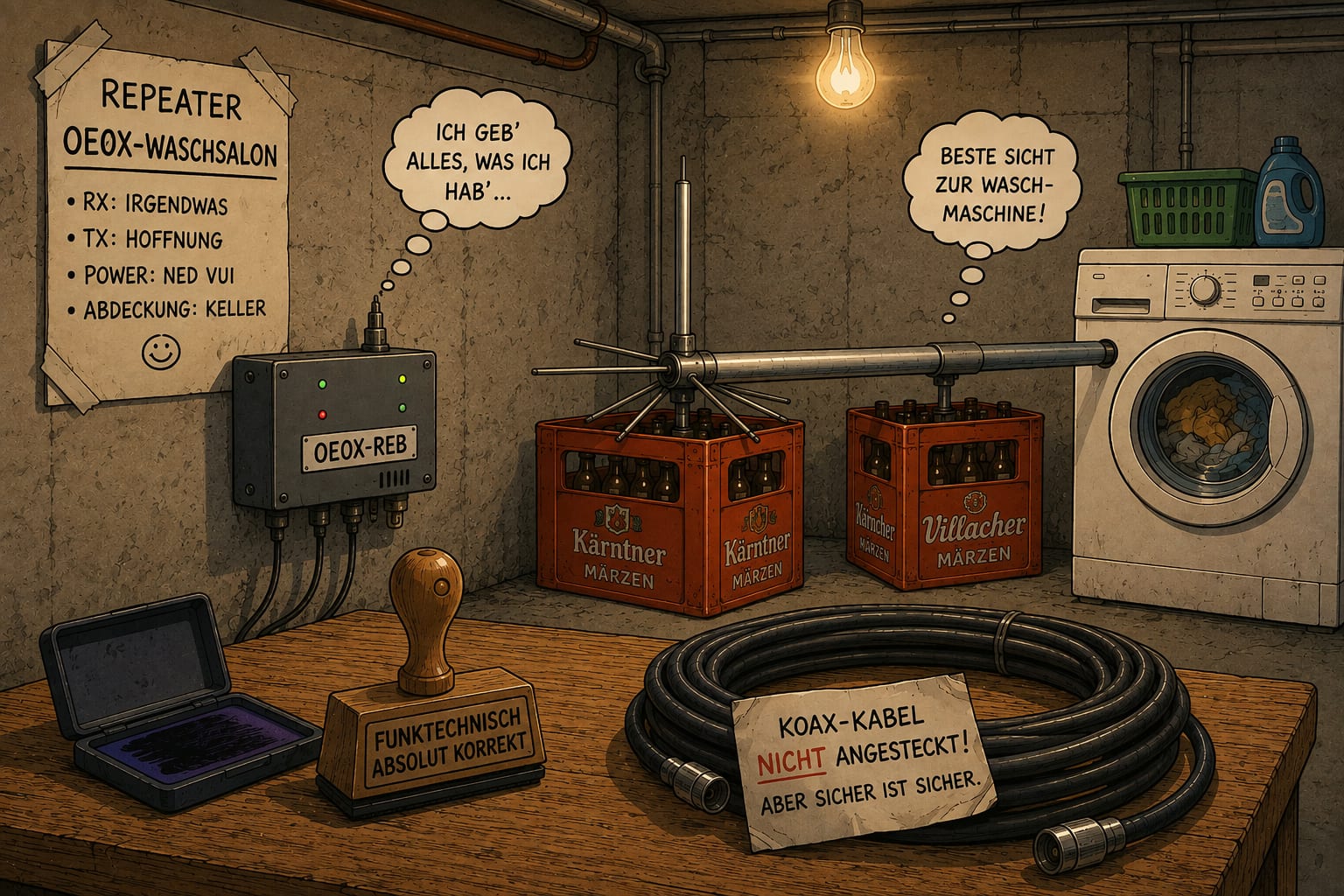
The video was about meteor scatter on 144 MHz with a long Yagi eight metres up. Kurt's antenna is an omnidirectional in a bucket. It now lies across two beer crates, pointing at the washing machine.
Traffic has not changed significantly since then, says Kurt. He is considering standing it back up, but wants to gather more experience first.
The cable
Let me stay factual here, because this part of the story is the only one that is genuinely short.
The antenna is not connected.
It never was. The cable lies beside it, neatly coiled, fixed with a cable tie that carries a label. On the label is Kurt's callsign. But it is not plugged in.
Anyone now asking how a repeater with no antenna connected is supposed to carry traffic for four years: Kurt has not been asking himself that question for four years. Kurt asks other questions.
The fee
Let us be fair: formally, everything about Kurt is in perfect order. He properly applied to the telecoms authority for a frequency to operate his repeater, and he was granted one. He has an official decision. He has a QRG. He had the document framed and hung it in the hallway, right next to the fuse board.
And he has been dutifully paying his annual fee ever since. On time, by standing order, for four years.
That makes Kurt the only repeater keeper in the country whose installation has so far generated traffic in exactly one direction: from his bank account to the authority.
What bothers him about it, however, is not that he has paid for four years of radio silence. What bothers him is the club. The club does not cover the cost. Kurt feels it ought to, given that he is running infrastructure for the common good here.
He raised the matter with the club, too. With four question marks.
The question
Kurt asks his questions in groups. In all the groups. Simultaneously. And it is always the same one:
"May I test???"
Not "testing briefly". Not "anyone QRV". But a request for permission, addressed to nobody, in a hobby whose entire point is that you press the button and see what happens.
He gets no answer. He has been getting no answer for months. This in turn puzzles him, so he asks whether he did something wrong, with four question marks, and then it goes quiet, and then he asks why it is so quiet.
It is the only case in amateur radio of somebody producing radio silence without ever having transmitted.
The stamp
Kurt has a rubber stamp. A real one, with a wooden handle. His callsign, the place name below it, a little lightning bolt below that.
He stamps his QSL cards, although he has no QSOs. The back of his printouts. The inside of the repeater enclosure. The label on the cable that is not plugged in. On one documented occasion, the lid of his lunchbox.
And because a stamp does not transmit, he also stamps while talking. Listening to a voice message from Kurt, you do not just hear what he says. You hear the callsign used as punctuation. You hear the question marks. All four of them. There are people whose punctuation you can see when they speak, and Kurt is the reason I know this.
The mesh network
Since this year Kurt has been on the mesh network. That was predictable.
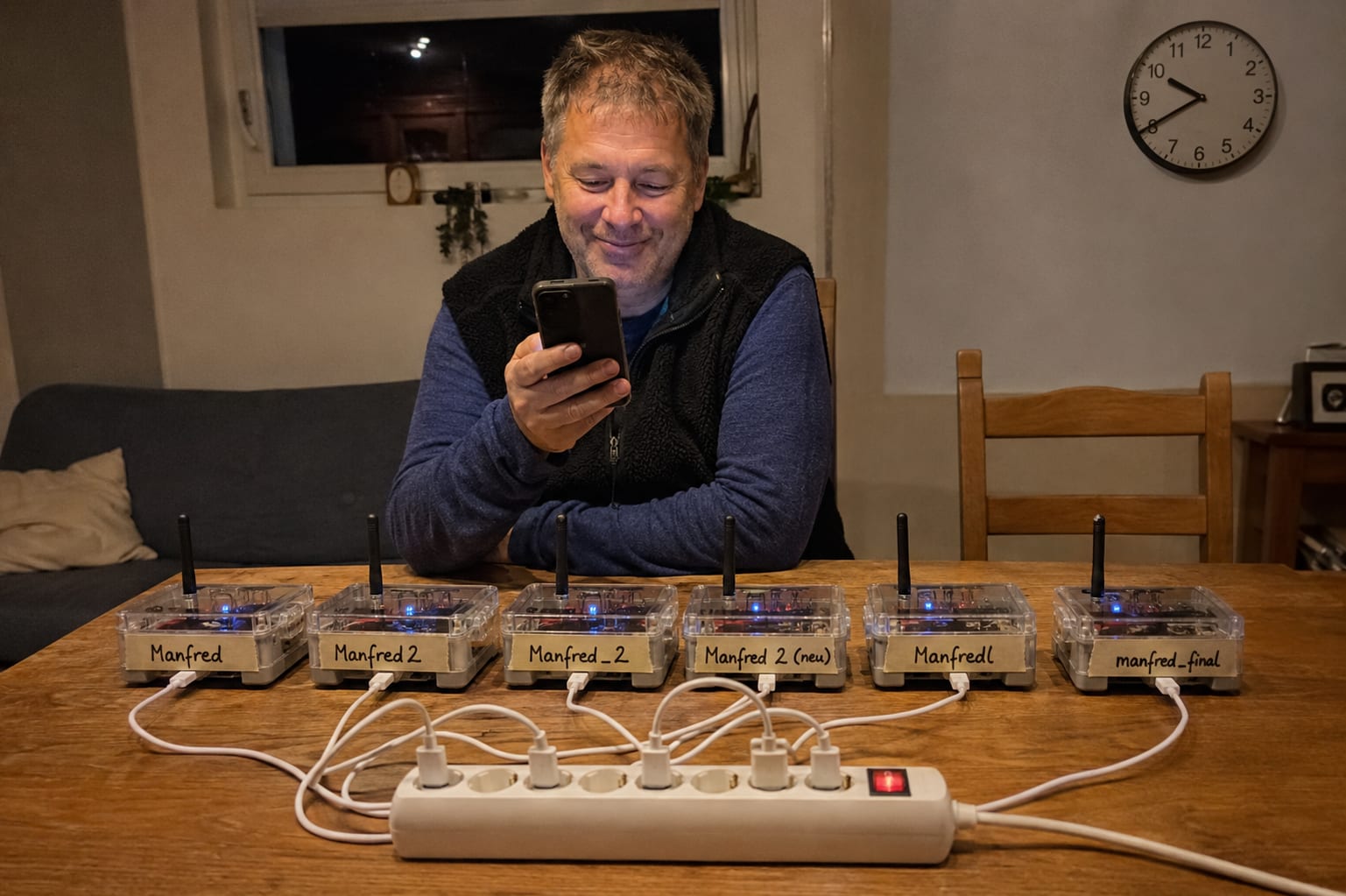
He bought a board, labelled it, stamped it and put it into service. The node is named after him. He labelled the solar panel too, although it does not play much of a role in a cellar.
Because yes: the mesh node is in the cellar as well. Next to the repeater. Next to the wall. This time the antenna is even connected, in fairness. It just happens to sit two and a half metres below the lawn.
Kurt asked in the mesh group whether he may test. Four question marks. Nobody answered, because nobody hears him, and because nobody hears him, nobody can answer. In the literature this is called a closed loop.
Last week he posted that the mesh network is overrated. Nothing works at his place. He has tried everything by now.
Everything except going upstairs.
The diagnosis
A good friend of mine who works with networks professionally listened to this for a while and then said just one thing: Layer 8.
For anyone unfamiliar: the OSI model has seven layers. The eighth does not officially exist. It sits in front of the equipment and types.
Some logbooks also record a certain callsign for cases like this. I am not going to spell it out. Those who know it, know it. Those who do not have probably simply never put a repeater in a cellar.
Hansl's verdict
Hansl's verdict: Kurt Kellerknoten is not stupid. That is the uncomfortable part. He read, he bought, he built, he labelled. He put in more effort than most people who simply switch on a handheld and get on the air.
His problem is a different one: he would rather ask whether he is allowed than check whether it works. He would rather look for the cause outside than right next to him. And he had a stamp made before he had a single QSO.
Anyone who wants to put up a repeater or a node needs no committee and no permission from a chat group. They need height, a connected cable, and the willingness to climb three flights of stairs. The rest is cosmetics.
And if somebody is sitting in a cellar right now wondering whether this is about them: no. But please connect the antenna anyway.
All persons and callsigns in this article are fictitious. Any resemblance to living radio amateurs is intentional but not actionable. The author accepts no liability for spontaneous self-recognition.
Transparency Notice
This article was researched and written with the support of AI (Claude, Anthropic). Illustrations were created with AI unless marked otherwise. Editorial responsibility and content review rest with the oeradio.at editorial team. Suggestions and complaints, including from Kurt, are welcome at [email protected].