Table of Contents
- Twenty Euros. Allegedly.
- The Four Sacred Numbers
- The 915 Man
- The Map Is the Actual Hobby
- Michi Modulation's Workshop
- What This Network Actually Carries
- The Range Record
- The Schism
- The Infrastructure-Independent Network and Its Dependency
- The Winter Question
- The Real Emergency
- And Why Your Hansl Is In It Anyway
- The Moral of the Story
- Transparency Notice
A Jammer satire by Hansl Hohlleiter
In Carinthia a radio network has been growing for months that belongs to nobody, that nobody registers and that nobody can switch off. The motto of the scene is „Nur Mesh is fesch" — Carinthian dialect, roughly: mesh is fresh. Your Hansl thinks it is magnificent. Your Hansl has two nodes on his own windowsill. And that is exactly why your Hansl gets to write this down. Hi.
Twenty Euros. Allegedly.
Mario Maschenwerk read an article in February. Twenty euros, no licence, no exam, no running costs. Mario did the maths: less than a dinner out. Mario ordered.
The current state of Mario's dinner: one Heltec at 19.90. A 3D-printed enclosure (filament €24; the printer was already there, so it doesn't count). A better antenna at €31, because the one in the box is "just for testing anyway". A second better antenna, because the first better one wasn't better. A power bank. A second power bank, for the road. A solar panel at €89. A second board "for comparison". A third board, because two break and three never do. A mast clamp set. An aluminium pole. A weatherproof housing. Cable glands. And a soldering iron he would have needed regardless.
Total: 640 euros. Mario continues to insist the hobby costs twenty euros. And he is right. The hobby costs twenty euros. The rest is accessories. Mesh is fresh — the accessories are expensive. Hi.
The Four Sacred Numbers
Anyone who wants to be on the network has to hit four values exactly: 869.618 — 62.5 — SF8 — CR8. In Carinthia these four numbers are now recited like a rosary. At the barbecue. At the baker's. At children's birthday parties.
And then there is Sigi Spreizfaktor. Sigi has been transmitting on SF11 since March. The old values, straight out of the factory firmware. His device runs flawlessly, the app connects cleanly, the LED blinks impeccably, every packet goes out exactly as the textbook prescribes. Nothing ever comes back. For five months now.
In that time Sigi has returned two devices, rebooted a router and once phoned the manufacturer. What he actually operates is the most exclusive network in Austria: no interference, no repeats, no arguments, no idiots. A network of exactly one participant, technically perfect. Some radio amateurs dream of that their whole lives — your Hansl knows a few, see the Repeater Cop.
The 915 Man
Franz Fehlband saved four euros. The marketplace listing had the same designation, the same product photo, the same colour. Only 915 MHz. The US version.
The device boots. The app connects. The battery lasts four days. It is in every respect an excellent device, and it talks to nothing and nobody on this continent. Franz now owns the most expensive keyring in Carinthia, and the returns process has been running for six weeks. Saved: four euros. Hi hi.
The Map Is the Actual Hobby
And then there is the map. The map with the nodes, the coverage areas and — this is the point — the white spots.
A white spot on the map causes a mesh person physical pain. Since April, Mario no longer drives up mountains because the view is nice up there. Mario drives up mountains because they have line of sight. This year's summer holiday was chosen by elevation profile. His mother-in-law has recently come to live "strategically well placed". While driving, Mario no longer watches the road but the ridgelines, wondering who lives up there and whether they are a nice person.
Gerlinde Gateway runs four repeaters. Three of them sit in the same attic and look out of the same window in the same direction. The map shows a beautifully dark green patch of high redundancy there. The patch is called: Gerlinde's house.
Michi Modulation's Workshop
And then there is Michi Modulation, known in the channel only as "the joker". Michi has a 3D printer. Above all, Michi has time with that 3D printer.
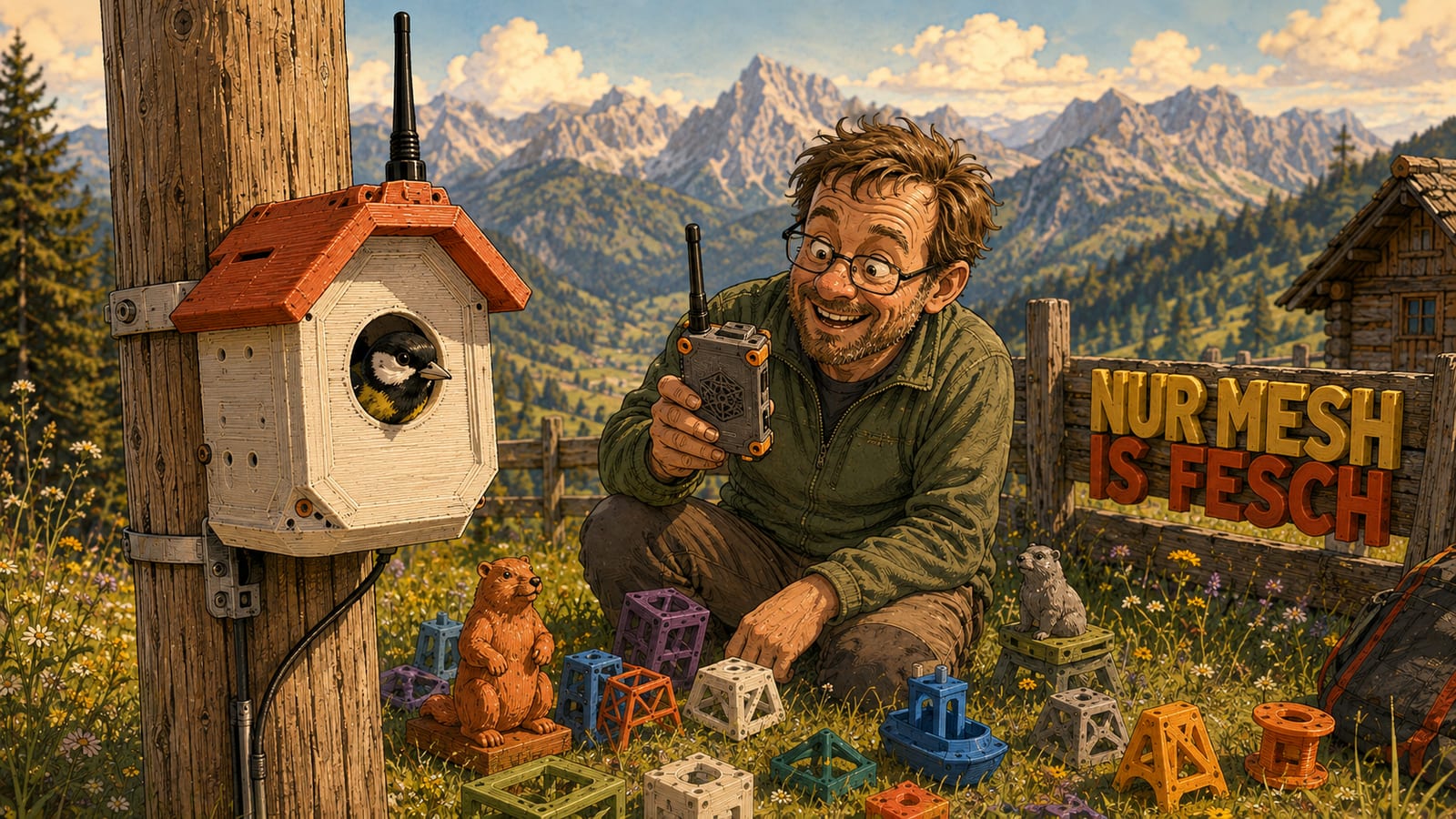
What Michi has printed so far: fourteen enclosure variants, eleven of which fit no board he owns. A weatherproof outdoor case in PLA that turned into a highly expressive sculpture on the south-facing balcony in July. An antenna mount for an antenna he does not have. A car mount for a device that is pointless in a car, because you have a phone in there anyway. A phone holder so you can work the app while the board lies right next to it. And a node stand shaped like a marmot, "for camouflage on the mountain" — although nobody wanted to camouflage a marmot, and certainly no marmot at 1,900 metres would bother anyone.
His masterpiece: a repeater enclosure in the format of a birdhouse. Functionally excellent, weatherproof, ventilated, inconspicuous. In May a great tit moved in. The repeater has been running non-stop ever since, because you must not switch it off during nesting season, and Michi did not object, on principle. The most reliable node in the entire network is currently guarded by a bird.
Then the collection: sixty calibration cubes, forty Benchy boats, a lattice tower at 1:87 scale as desk decoration, and since May an enclosure for a board he sold in April. He is printing it to completion. Out of respect.
The motto, incidentally, is Michi's too. He printed it in March as a 3D lettering, two-colour, with support structures, and screwed it to his garden gate: NUR MESH IS FESCH. Since then it has appeared on stickers, on mast clamps, on two car rear windows and on the lid of a lunchbox. A hobby only becomes a hobby once somebody prints a slogan for it that nobody ordered.
And now the punchline that quietly annoys your Hansl: Michi is the only person in the entire scene who produces something other people actually want. His enclosures now hang on masts from Villach into the Gail valley. He charges nothing, he only wants to know whether they hold up. While Discord has been arguing about routing philosophy since spring, the joker with a printer and a roll of filament has weatherproofed more nodes than any debate ever did.
Whoever has fun tinkering ends up being the most useful one. That has always been true, in every radio hobby. You just don't notice it until it rains.
What This Network Actually Carries
And now comes the part where your Hansl put his beer down.
The network is up. Over three hundred nodes. No provider, no data centre, no contract, no shutdown date. Range across entire valleys. An infrastructure a mobile operator would spend eight figures on.
The total traffic of an average week:
- twelve times "hello"
- "test"
- "test 2"
- "anyone hear me?"
- "working now" (four minutes later, without anybody having changed anything)
- "just trying it briefly, sorry"
- "no problem, me too"
- a weather report from a bot nobody asked for and everybody wants to keep
A network with the capacity of an entire province and the conversational appetite of a waiting room.
Before anyone smirks: we radio amateurs know this one. We have repeaters sitting on mountains, maintained, de-noised, buffered with backup power, for which clubs have been paying rent since the eighties. And up there it is just as quiet. Only more expensive. Hi.
The Range Record
"34 kilometres!!!" Screenshot. Three exclamation marks. Nine thumbs up.
The conditions missing from the screenshot: Dobratsch. Gerlitzen. Both stations on a summit. Clear line of sight like in the brochure. And the other station was Mario's brother-in-law Kurt, who had been sent up there with the second board, a thermos flask and moderate enthusiasm.
Kurt is not a radio amateur. Kurt is infrastructure.
The Schism
MeshCore or Meshtastic: the hardware is identical. The decision is made at flashing time. So it is a question of faith that you answer with a USB cable and revoke in four minutes.
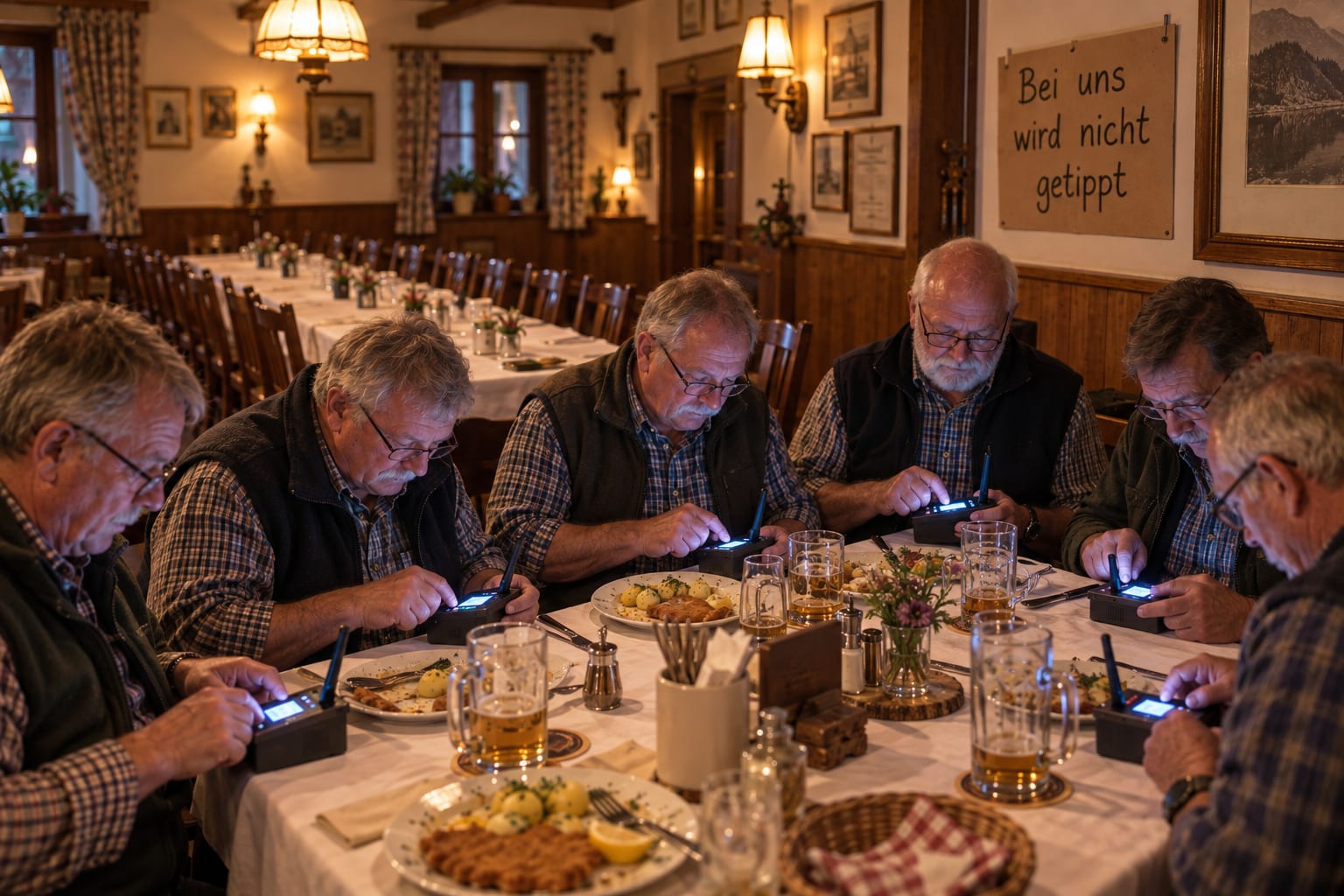
This stops nobody. Discord has been debating since spring whether handhelds are allowed to forward. Not whether they can — that is settled. Whether they may. Theology with ping times.
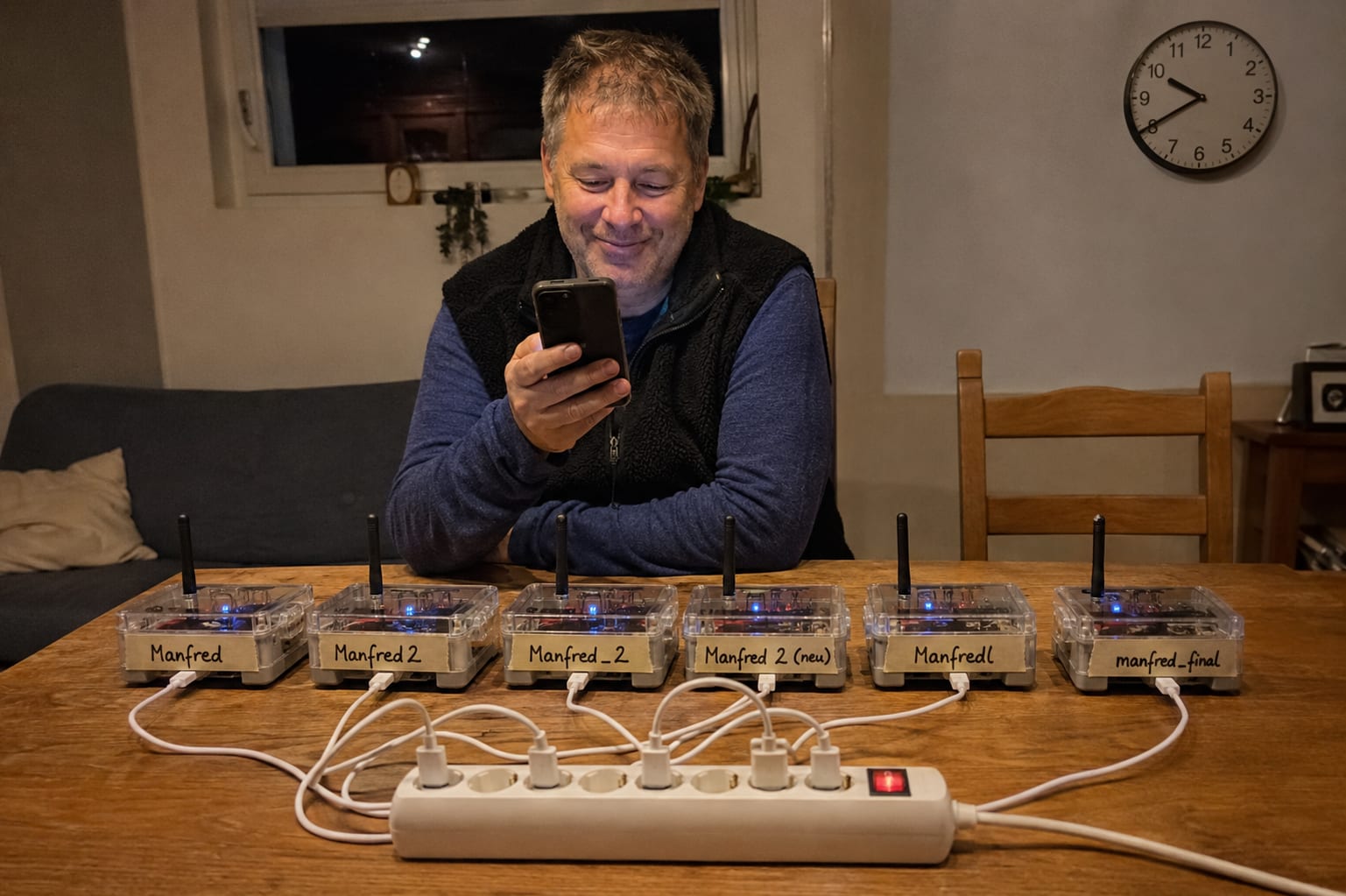
Norbert Node, OE0NOD, runs both. Two boards, two firmwares, one windowsill. Both camps consider him not entirely trustworthy.
Your Hansl has seen all of this before. FM versus SSB. Then packet versus everything. Then DMR versus D-Star versus C4FM, three systems that to this day do not greet one another. Plus, if you insist, MeshCom and HAMNET as side theatres. New technology, old quarrel. The only progress: conversion now takes four minutes instead of forty years.
The Infrastructure-Independent Network and Its Dependency
The finest thing about MeshCore: no provider, no operator, no server, no sign-up. Completely independent of infrastructure.
The community organises itself on Discord. That is: over the internet. Via an American cloud service. Across nine channels, with four hundred members and around forty messages a day. Which is roughly forty times what happens on the radio network itself.
When the internet was down in Villach for two hours in June, this was discussed at length. Afterwards. Hi hi.
The Winter Question
Since October the wiki has carried the question: "How does solar operation hold up over the winter?" It is asked in every round, by every newcomer, and nobody can answer it. It has become the scene's moment-of-truth question. People counter with assumptions, panel sizes, tilt angles, battery chemistry.
The answer arrived in April and reads: it doesn't.
More precisely: from late November to mid-February, a 10-watt panel on the north-facing slope of a Carinthian valley delivers about as much energy as a candle in a shoebox. This insight is not yet documented in the wiki. Somebody is taking care of it. Since April.
The Real Emergency
Mario's favourite argument: blackout. Mobile network gone, internet gone, everything gone — and the mesh stands. He even has a plan for it, with roles, channels and a reporting scheme.
Two details from practice. First, Mario's attic repeater is plugged into an entirely ordinary wall socket. Second, the power bank of his handheld has been flat since May, because there was no reason to charge it.
In February the power really was out in his village for forty minutes. Three people wrote into the channel. All three with a phone in the other hand, which also worked. Anyone who is serious about it should read our blackout preparedness guide — that is where the difference between an emergency communications concept and a bit of tinkering is spelled out.
And Why Your Hansl Is In It Anyway
Now the uncomfortable part, for me.
I have two nodes. One on the windowsill, one in the attic. I look at the map more often than at the channel. In June I drove up a mountain I would otherwise never have driven up. And my aluminium pole is already standing there too.
Why? Because in April somebody answered my "hello". Six kilometres away, somebody I had never heard before, over a connection involving no provider, no contract and no data centre. Two devices, air in between.
And your Hansl grinned like an OM after his first QSO. That is exactly the feeling that pulled us onto shortwave forty years ago. Except this time it takes no exam, no callsign and no three thousand euros — just an evening, a USB cable and thirty euros.
So a word to the faction now shouting "but that isn't amateur radio!": correct. Nobody claimed it was; it says so in as many words in our own MeshCore article. And anyone who needs a passed exam in order to feel superior probably passed it narrowly. Out there right now are hundreds of people voluntarily putting up antennas, measuring range and talking about propagation. If we cannot find that likeable, we are in the wrong hobby. And anyone who looks at where licence-free radio started for most of us knows the rest of the story anyway.
The Moral of the Story
- The hobby costs twenty euros. The accessories cost the rest, and the aluminium pole is coming for sure.
- Four numbers decide whether you are on the network — or whether you operate Austria's most exclusive one: yours.
- A repeater on a mountain is worth more than twenty nodes in a drawer. A node in a drawer is still worth more than three boards in a shopping cart.
- Whoever looks at the map more often than at the channel is not running a radio network but a map with a hobby attached.
- Eleven useless enclosures and one useful one is a better record than zero enclosures and an opinion. Ask the great tit.
- A network that belongs to nobody belongs to you as well. So write something into it. "Hello" will do.
- And anyone who recognised themselves in this article: so did your Hansl. On both windowsills. Hi.
So, dear people: keep building, keep printing, put up repeaters and finally write something into the channel. Because one thing is true, even after your Hansl has spent a whole chapter claiming the opposite: mesh is fresh.
73 and 62.5 kHz of bandwidth,
your Hansl Hohlleiter, OE0HHL
Transparency Notice
This article is satire. Mario Maschenwerk, Sigi Spreizfaktor, Franz Fehlband, Gerlinde Gateway, Michi Modulation, Norbert Node and brother-in-law Kurt are entirely fictional; so is the great tit, though she stands in for all the birds that move into radio infrastructure, and there are more of them than you would think. The callsigns used lie in the unassigned OE0 prefix. Any resemblance to living node operators is purely coincidental and, as a rule, well documented — on the map. The technical details (868 MHz, 869.618 / 62.5 kHz / SF8 / CR8, hardware prices) reflect the state of our MeshCore introduction; the winter solar arithmetic is a satirical exaggeration, not a measurement series. This article was written with the support of AI (Claude, Anthropic) and reviewed by the oeradio.at editorial team; the title image is AI-generated. Objections, additions and real winter data are welcome at [email protected].