Table of Contents
- The Valve Era — Pioneers of Glass and Metal (1950s–1970s)
- Collins KWM-2 (1959) — the Cadillac of Ham Radio
- The Collins S-Line (32S/75S) — the Dream Team
- Drake TR-4 Series (1964–1978) — the Contest King
- Heathkit HW-101 (1970) — the Electronics School in a Kit
- The Solid-State Revolution — a Paradigm Shift (1970s–1990s)
- Yaesu FT-101 (1970) — the Icon of the Japanese Era
- Kenwood TS-520/TS-530 — the Affordable Gateway to HF
- Icom IC-735 — the Compact All-Rounder
- Kenwood TS-440S — the Workhorse
- The IC-706 — the Radio That Changed Everything
- Modern Legends — SDR and the Digital Revolution
- Elecraft K2 and K3 — the Spirit of Heathkit Lives On
- Icom IC-7300 (2016) — the SDR Revolution for Everyone
- Icom IC-705 (2020) — the New Portable Standard
- Yaesu FT-818ND — the QRP Legend
- Flex Radio 6000 Series — the Future Is Software
- What Makes a Radio Legendary?
- Collecting Vintage Radios — Tips for Beginners
- An Austrian Perspective
- Looking Ahead
- Transparency Notice
Some amateur radio transceivers are more than mere technology — they are milestones that fundamentally changed the hobby. From the glowing valves of the post-war era to the Software Defined Radios of today, certain transceivers have shaped generations of radio amateurs, enabled new operating modes, and secured a permanent place in the history of our hobby. This article looks back at the radios that truly made history — and explains why they remain unforgettable to this day.
The Valve Era — Pioneers of Glass and Metal (1950s–1970s)
In the early years of modern amateur radio, valve-based equipment was the gold standard. Anyone venturing onto the shortwave bands needed not only a licence but also a solid understanding of RF engineering — and often a generous budget. Yet some equipment from this era proved so outstanding that it is still revered today.
Collins KWM-2 (1959) — the Cadillac of Ham Radio
If there is one single device that defines the word "legendary" in amateur radio, it is the Collins KWM-2. As the first genuinely practical mobile HF SSB transceiver, it united transmitter and receiver in a single enclosure — a concept we take for granted today but which was revolutionary at the time. It covered 3.4 to 30 MHz in 200 kHz segments and handled SSB and CW; AM and FM were deliberately left out. Collins' mechanical filters set benchmarks for selectivity and signal quality that remained unmatched for decades.
The build quality was so high that the KWM-2 was also used by the US military and professional radio services — units from Vietnam-era stocks still surface on the collectors' market today. With more than 24,000 built between 1959 and the mid-1970s, it is the most-produced Collins valve rig of all. To this day, well-preserved units fetch over 2,000 euros on the second-hand market.
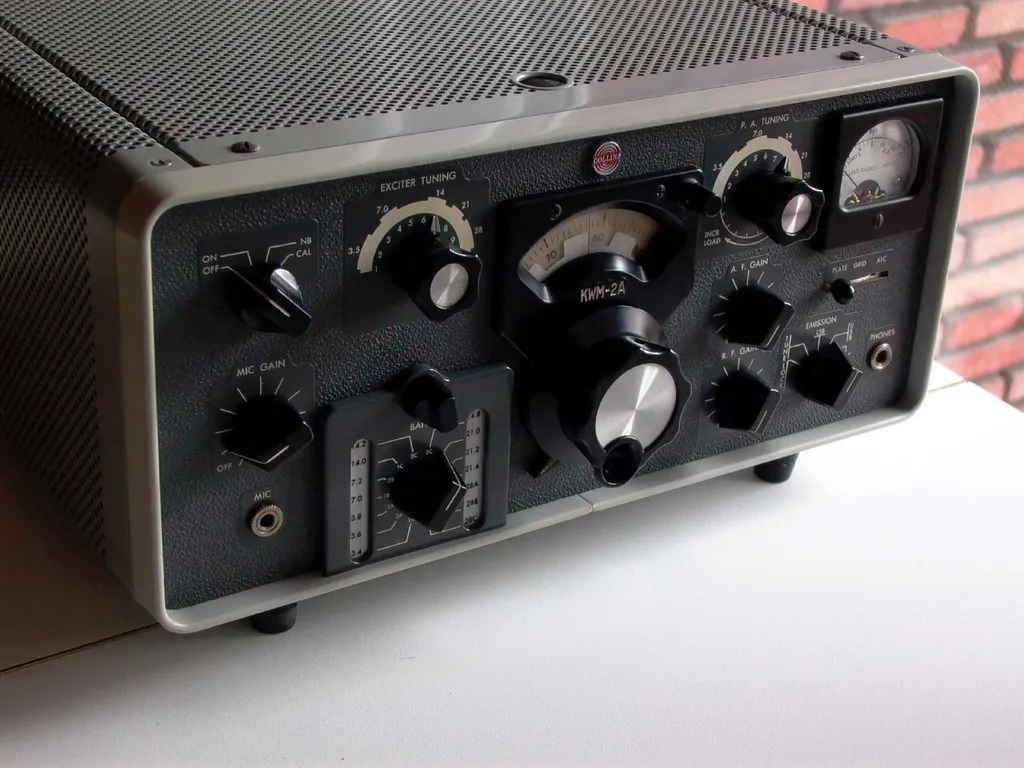
A KWM-2A with a military past: technology, history and operation of the classic (Video: Real Ham Radio, YouTube).
The Collins S-Line (32S/75S) — the Dream Team
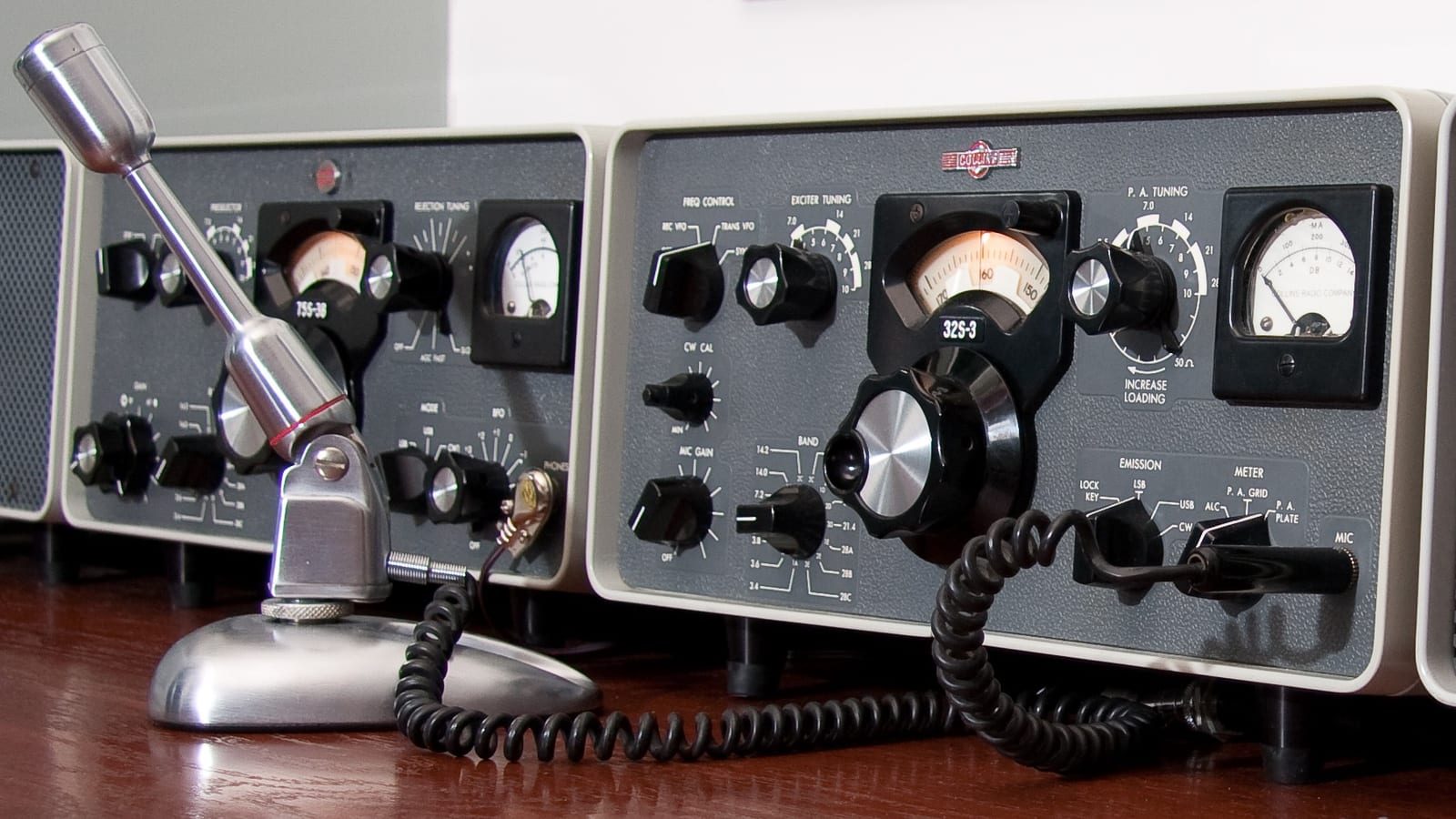
For those who wanted even more Collins quality, there was the legendary S-Line: the 32S transmitter and the 75S receiver. This combination of separate transmitter and receiver offered a flexibility and signal quality that many radio amateurs still consider unmatched. The S-Line was the ultimate setup for DX chasers and contesters of the 1960s and 1970s.
The title image of this article shows exactly such a station: the 75S-3B receiver on the left, the 32S-3 transmitter on the right, and a desk microphone of the same era in front. Sit down at a setup like that and you quickly understand why that grey-and-beige finish became known as "the Collins look" — and why complete S-Line stations command their price at collectors' fairs.
Drake TR-4 Series (1964–1978) — the Contest King
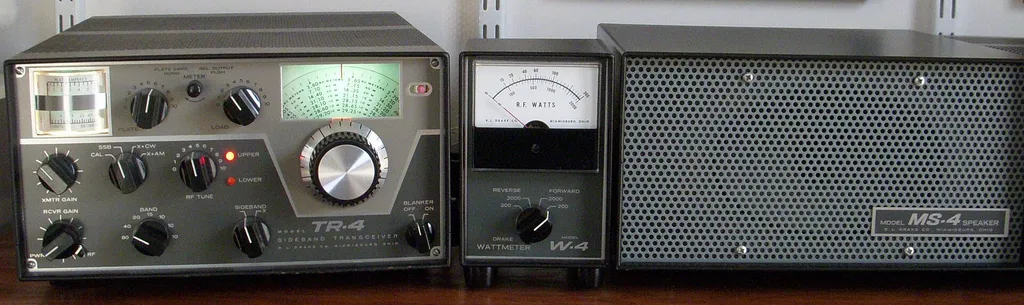
The Drake TR-4 series from Miamisburg, Ohio was America's answer to Collins — somewhat more affordable, but with an excellent receiver that was extremely popular among contesters. The TR-4 arrived in 1964 as a development of the TR-3; the final version, the TR-4C, was built until the spring of 1978 and is considered one of the finest valve transceivers ever made. Drake's passband tuning was far ahead of its time and was later adopted by many manufacturers.
Heathkit HW-101 (1970) — the Electronics School in a Kit
The Heathkit HW-101 was more than a transceiver — it was an education in RF engineering. Designed as a kit, it taught an entire generation of radio amateurs how to solder, measure, and understand analogue circuits. Anyone who successfully built an HW-101 knew their equipment inside and out. The radio offered solid performance across all HF bands while being significantly more affordable than products from Collins or Drake.
The numbers show how well the concept worked: the HW-101 appeared just before Christmas 1970, stayed in the catalogue until late 1983, and an estimated 35,000 to 40,000 were built in that time — by the buyers themselves, component by component. Many Austrian radio amateurs made their first QSOs on a Heathkit and still fondly remember the feeling of switching on the transceiver they had built themselves for the very first time.
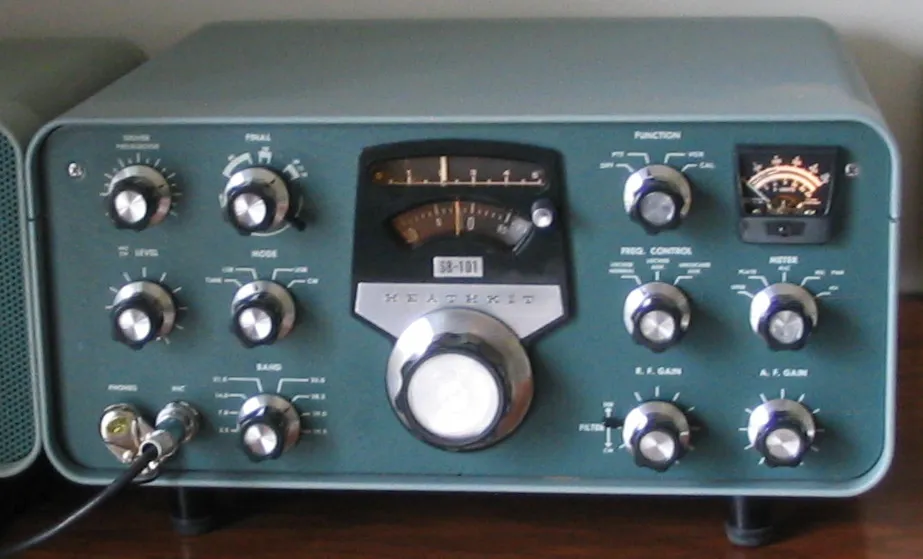
What it takes to get such a kit rig back on the air after more than 50 years is shown in the video below: from the eBay find through the power-supply overhaul to the first QSO — a realistic preview of what a restoration actually involves.
From eBay find to working station: restoring an HW-101 (Video: Will Everett, YouTube).
The Solid-State Revolution — a Paradigm Shift (1970s–1990s)
With the advent of high-performance transistors, a fundamental transformation began in the 1970s. Valves disappeared first from the front-end stages, then from the mixers — only in the final amplifier did they hold on for a long time. The Japanese manufacturers Kenwood, Yaesu, and Icom took over market leadership from the American pioneers during this era.
Yaesu FT-101 (1970) — the Icon of the Japanese Era
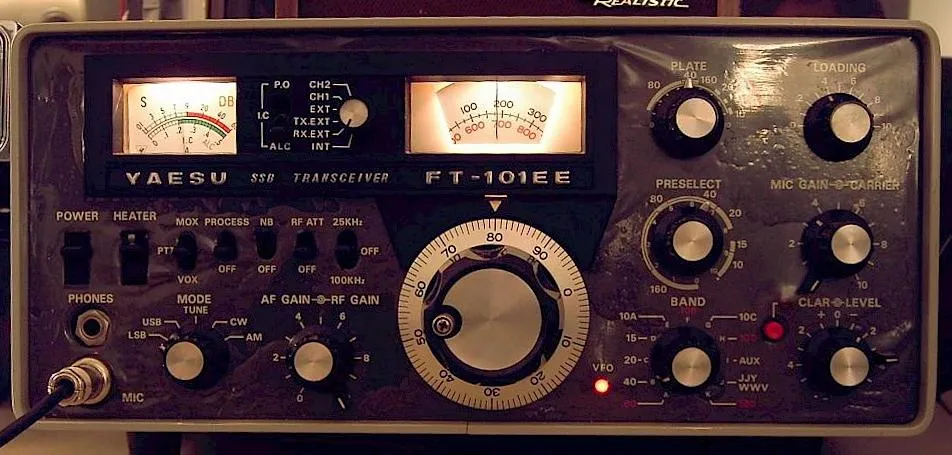
The Yaesu FT-101 was one of the first Japanese radios to gain worldwide recognition. Launched internationally in 1970 and sold in the United States from January 1971, the series stayed in production until 1978. Its hybrid design, with transistors in the front-end stages and valves in the final amplifier, combined the best of both worlds and delivered a dependable 100 watts. The illuminated twin meters above the large tuning dial made it instantly recognisable in any photograph. The FT-101 proved that Japanese manufacturers could build world-class equipment — at a fraction of the Collins price. The later FT-101E became the most-produced variant of all.
Kenwood TS-520/TS-530 — the Affordable Gateway to HF
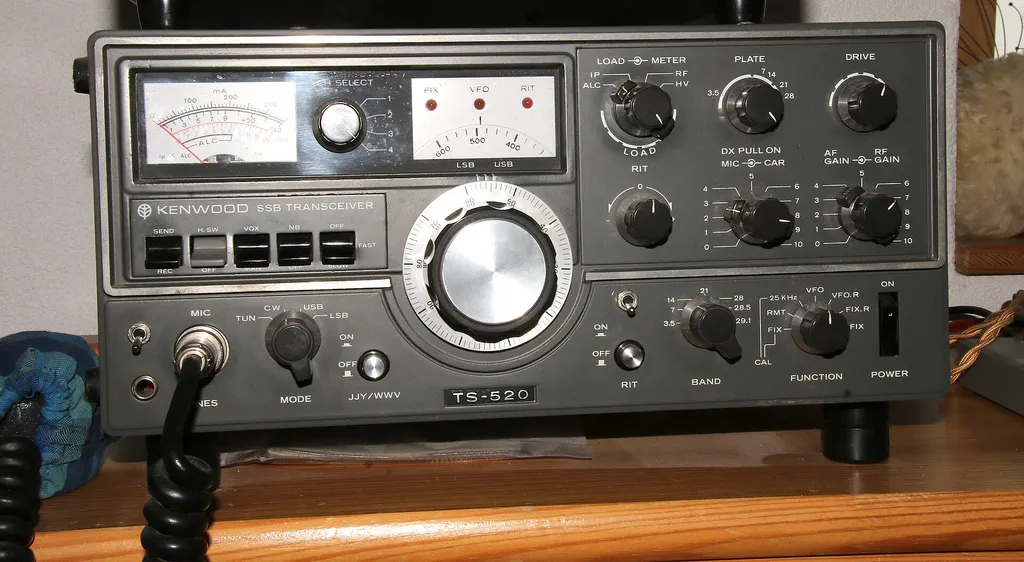
The Kenwood TS-520 (1973, still sold under the Trio brand in parts of Europe) and its successor the TS-530 were hybrid transceivers that gave many radio amateurs affordable access to HF operating. The receiver and driver stages were already fully solid-state, while a pair of 6146B valves did the work in the PA. That mix delivered an excellent balance of performance, ruggedness and price. In Austria, these radios were particularly popular and brought countless OMs onto the bands who could never have afforded a Collins rig.
Icom IC-735 — the Compact All-Rounder
The Icom IC-735, released in 1985, marked a turning point: it was one of the first truly compact and entirely solid-state HF transceivers. No more valves, no warm-up time, instantly ready to operate. With a general-coverage receiver and 100 watts output, it set the standard for a new generation of compact base station transceivers.
Kenwood TS-440S — the Workhorse
The Kenwood TS-440S earns its place on this list as one of the most reliable and versatile radios of the 1980s. Its general-coverage receiver with excellent strong-signal handling made it a favourite among shortwave listeners and active radio amateurs alike. Many TS-440S units are still in daily use after more than 35 years — a testament to the quality of this radio.
The IC-706 — the Radio That Changed Everything
The Icom IC-706 deserves its own chapter, because no other radio changed amateur radio as fundamentally as this little marvel from 1995. Icom marketed it as the world's smallest HF transceiver, and it created an entirely new class of radio: the all-band mobile with HF, 6 m and 2 m in a housing barely larger than a car stereo. Competitors took years to catch up. The later version, the IC-706MKIIG, added UHF (70 cm) as well.
The IC-706 revolutionised portable operation, mobile operation, and even home station use. Suddenly you no longer needed a separate 2-metre radio. You could switch from HF to VHF without changing equipment. For QRP enthusiasts and portable operators, it was a game changer. The IC-706 was also a popular choice for remote shack operation thanks to its compact form factor. Thousands of IC-706 units remain in service worldwide on mountain summits and in vehicles to this day.
Modern Legends — SDR and the Digital Revolution
With the new millennium came the era of Software Defined Radio. Initially dismissed as exotic niche products, SDR-based transceivers have since fundamentally reshaped the market.
Elecraft K2 and K3 — the Spirit of Heathkit Lives On
The Elecraft K2 (first shipped in January 1999) and the K3 (announced in 2007, delivered from 2008) proved that the kit concept not only survived into the 21st century but thrived. The K2 remains the only full-featured desktop transceiver available as a complete kit. The K3, meanwhile, is a high-performance radio that regularly achieves top placements in international contests — on its introduction it topped the Sherwood Engineering receiver tests, still the reference for strong-signal performance. Elecraft has carried the spirit of Heathkit into the modern era: a radio you build yourself that nonetheless competes with the most expensive factory-built equipment.
Icom IC-7300 (2016) — the SDR Revolution for Everyone
If the Collins KWM-2 was the Cadillac of amateur radio, then the Icom IC-7300 is the Tesla — the radio that brought a new technology from a niche into the mainstream. Icom showed it at the Tokyo Ham Fair in August 2015 and it reached shacks from 2016: the first affordable transceiver with a direct-sampling architecture, digitising the RF signal without analogue mixing stages and processing it in an FPGA. Add a real-time waterfall display, and suddenly every radio amateur could see at a glance where the activity was on the band.
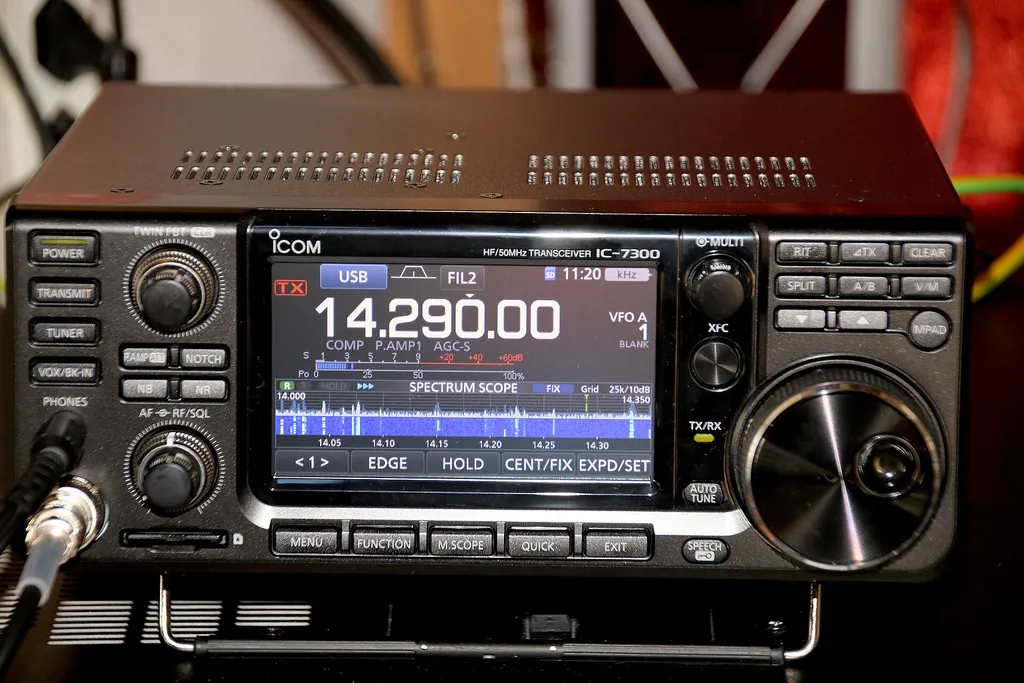
More than 100,000 units sold worldwide make it the best-seller of its class, in Austria as elsewhere. For newcomers interested in the technology behind SDR receivers, the IC-7300 offers a perfect entry point into the world of software-defined radio — without the complexity of a pure SDR system.
As of 2026: at the JARL Ham Fair in August 2025 Icom unveiled the IC-7300 MK II, the first real successor in ten years. It adds a built-in CW decoder, an HDMI output for an external monitor, a LAN port for remote operation without an intermediary server PC, USB-C, and separate SMA sockets for a dedicated receive antenna. The measurable gains are mostly in the receiver: around 105 dB RMDR at 2 kHz spacing and roughly 12 dB less phase noise than its predecessor. It costs noticeably more than the original — which means the classic IC-7300 is likely to remain on the used market exactly what it was when new: the best value in its class.
What the IC-7300 MK II actually changes compared with the original (Video: Waters and Stanton, YouTube).
Icom IC-705 (2020) — the New Portable Standard
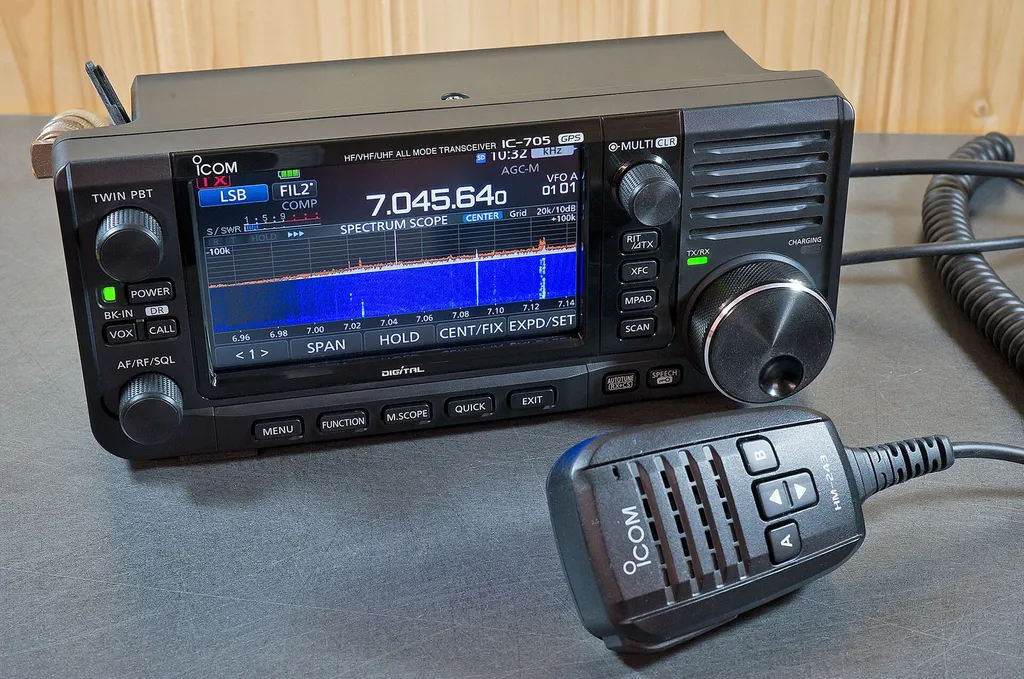
The IC-705 defined a new category in 2020: the fully featured SDR transceiver for the field. With HF, VHF, and UHF, a built-in battery, touchscreen, GPS, D-STAR, and Bluetooth, it combines practically everything a radio amateur needs in a backpack. For SOTA and POTA activators in the Austrian Alps, the IC-705 has become the standard radio. Its 10 watts of output power, combined with a good antenna, are enough for worldwide contacts — that is the fascination of QRP operation in its purest form.
Yaesu FT-818ND — the QRP Legend
The Yaesu FT-818ND (2018) is the updated version of the legendary FT-817, which appeared in 2000 as the world's first self-contained all-band HF/VHF/UHF transceiver with an internal battery — and redefined portable operating in the process. With a maximum of 6 watts, robust construction and modest current consumption, the FT-817/818 has brought more radio amateurs to mountain summits than any other radio. It is proof that sometimes less is more.
At the end of December 2022 Yaesu ended production of the FT-818ND, officially because of the worldwide component shortage. That closed a 22-year era with no direct successor announced. Anyone looking for a radio of this class today ends up with a used FT-817/818 — or a new and considerably pricier IC-705, or QRP rigs from Elecraft and the Chinese market (Xiegu, (tr)uSDX). That is precisely how the FT-818 turned from an everyday radio into a legend: it is finished.
Flex Radio 6000 Series — the Future Is Software
The Flex Radio 6000 series, introduced from 2013 alongside its SmartSDR control software, takes a radically different approach: there is no front panel with knobs and dials. Everything is controlled via software on a computer. This may seem alien to traditionalists, but Flex Radio has taken remote operation to a new level. A Flex Radio can be controlled from anywhere in the world over the internet — with latency that is barely noticeable. For radio amateurs who want to operate a remote antenna in the countryside from their city home, it is the ideal solution.
What Makes a Radio Legendary?
Not every successful radio becomes a legend. What distinguishes the radios presented here from the hundreds of other models that appeared on the market over the decades? Several common characteristics can be identified:
- Innovation: Each of these radios introduced something new — whether it was the first compact SSB transceiver (KWM-2), the first all-band mobile radio (IC-706), or the first affordable direct-sampling SDR (IC-7300).
- Timing: These radios appeared precisely when the technology was mature and the market was ready. The IC-7300 would not have worked five years earlier — ADC technology was not yet advanced enough.
- Reliability: Legends endure. Many Collins KWM-2s and Drake TR-4s are still in operation after more than 50 years. That speaks to a build quality that is hard to match.
- Community: Around each of these radios, a loyal fan base has formed that shares experiences, develops modifications, and keeps the equipment alive.
- Emotional connection: Anyone who made their first DX contact on a particular radio never forgets it. Legendary radios are linked to memories that transcend the technology itself.
Collecting Vintage Radios — Tips for Beginners
Collecting and restoring old amateur radio equipment is a fascinating hobby within the hobby. Those interested should keep several points in mind:
- Check condition: Valve equipment can develop problems with dried-out electrolytic capacitors after decades of storage. A power supply overhaul is often the first necessary step.
- Find documentation: Original manuals and circuit diagrams are worth their weight in gold. For most radios mentioned here, they are available online.
- Secure spare parts: Certain components such as Collins mechanical filters or specialised valves are becoming increasingly rare and expensive. Anyone planning to operate a radio long-term should buy spare parts in advance.
- Use the community: For virtually every legendary radio, there are online forums, mailing lists, and local groups. The Collins Collectors Association, Drake enthusiasts, and the Heathkit community are just a few examples.
- Be patient: Good specimens regularly appear at flea markets, club meetings, and in online classifieds. Those who wait patiently often find bargains.
- Be cautious with eBay purchases: Shipping heavy valve equipment carries risks. Local collection is always preferable.
An Austrian Perspective
In Austria, the worldwide development is reflected with some distinctive features. In the 1960s and 1970s, Collins and Drake equipment was popular among well-heeled OMs, while many newcomers started with Heathkit kits or home-built transmitters. Heathkit clubs were active in several provincial capitals and nurtured new talent.
With the arrival of Japanese manufacturers in the 1970s, the market shifted dramatically. Kenwood, Yaesu, and Icom offered excellent equipment at prices that were affordable for the average radio amateur. Today, the IC-7300 is by far the best-selling HF radio in Austria, and the IC-705 has established itself as the standard radio for SOTA activations in the Alps. Those who want to learn more about the history of amateur radio in Austria will find a detailed article in our archives.
Looking Ahead
Which radios will become the legends of tomorrow? The trends point to a continuation of the SDR revolution: even wider-bandwidth receivers, even better signal processing, even more seamless integration of digital modes. At the same time, there is a counter-movement — radio amateurs who deliberately choose simple technology and achieve maximum results with minimal equipment. Devices like HackRF-based portables or simple QRP kits show that the builder spirit of Heathkit lives on.
One thing is certain: the next legend is already waiting in a development laboratory to change amateur radio once again. Perhaps it will be an AI-powered transceiver that pulls signals from the noise that no human ear can perceive. Perhaps it will be a radio that blends amateur radio and the internet so seamlessly that the boundaries between them dissolve. Whatever it may be — the radios described here have paved the way. If you are interested in amateur radio as a hobby, you will find many more articles about technology, operation, and community on our site.
Which radio is your personal favourite? Do you still have a Collins KWM-2 in the shack, or are you out on the mountains with an IC-705? Share your stories with the community — because every legendary radio also has a personal story to tell.
73 – your oeradio.at editorial team
Transparency Notice
This article was researched and written with the assistance of AI (Claude, Anthropic). The editorial team has reviewed and edited all content. The article was revised in August 2026: production figures and unit numbers were re-checked, the IC-7300 section was extended to cover the MK II version presented in 2025, and the FT-818ND section now notes the end of its production. All equipment photographs come from Wikimedia Commons under free licences; the photographer and licence are given in each caption. The embedded videos come from external YouTube channels and reflect their authors' views. Despite careful review, occasional inaccuracies may occur — we welcome corrections via email to [email protected].