Table of Contents
- Where D-STAR came from
- What actually happens: GMSK, AMBE and 4800 bit/s
- The data channel: what travels alongside your voice
- The four fields: MYCALL, UR, RPT1 and RPT2
- Callsign routing: the idea hardly anyone uses
- Reflectors: REF, XRF, DCS and XLX
- The path of a QSO
- DD mode: 128 kbit/s, but only on 23 cm
- No repeater in range: hotspot, terminal and access point mode
- Radios: what does D-STAR today
- Five pitfalls from practice
- D-STAR in Austria
- Read on: our digital voice series
- Transparency Notice
D-STAR (Digital Smart Technologies for Amateur Radio) was the first digital voice system designed specifically for amateur radio — and it is still in daily use. This article explains what happens under the bonnet: how the voice gets onto the band, what the four callsign fields in your radio mean, how reflectors and callsign routing relate to each other, and how to get on the air when there is no repeater in range.
If you are after the practical entry route in Austria — registration, local reflectors, first steps — that is covered in D-STAR in Austria. And if you are still deciding which system suits you at all, start with D-STAR vs. DMR vs. C4FM vs. M17 vs. TETRA.
Where D-STAR came from
D-STAR was developed from the late 1990s by the JARL, the Japan Amateur Radio League, funded from public money earmarked for promoting amateur radio. Icom was the only major manufacturer to turn the standard into products — which is why D-STAR is effectively an Icom world to this day, even though the specification itself is published openly.
The decisive difference to everything before it: D-STAR was never conceived as "digital FM" but as a networked system from the outset. Every transmission carries callsigns, and even the first generation of repeaters was designed to be connected to the internet. DMR, C4FM and later M17 all followed that lead.
What actually happens: GMSK, AMBE and 4800 bit/s
In voice operation (DV mode, Digital Voice) D-STAR sends a 4800 bit/s data stream, modulated as GMSK, in a bandwidth of roughly 6 kHz — narrower than an FM channel. That stream splits up as follows:
- 2400 bit/s of voice, encoded with the AMBE vocoder
- 1200 bit/s of forward error correction (FEC) for exactly that voice data
- 1200 bit/s of data running alongside the voice
DV mode works on 2 m, 70 cm and 23 cm. The AMBE codec is proprietary and licensed — the main criticism levelled at D-STAR, and precisely the reason open alternatives such as M17 and FreeDV exist.
In practice the difference to FM shows at the edge of coverage. Analogue degrades gradually into noise; digital stays clean for a long time and then simply stops — the notorious cliff effect. What that sounds like day to day, and why digital audio is not automatically "better", is described from practice by Alex OE8HAM in D-Star — far more than just voice.
A compact explanation of the D-STAR basics: modulation, network structure, operating (Video: Jonathan M0JSX – Ham Radio, YouTube).
The data channel: what travels alongside your voice
Those 1200 bit/s next to the voice are the genuinely underrated part of D-STAR. They carry:
- your own callsign and the destination fields (more on those in a moment)
- a short free-text message stored in the radio — usually name and QTH
- your GPS position, if the radio has a receiver
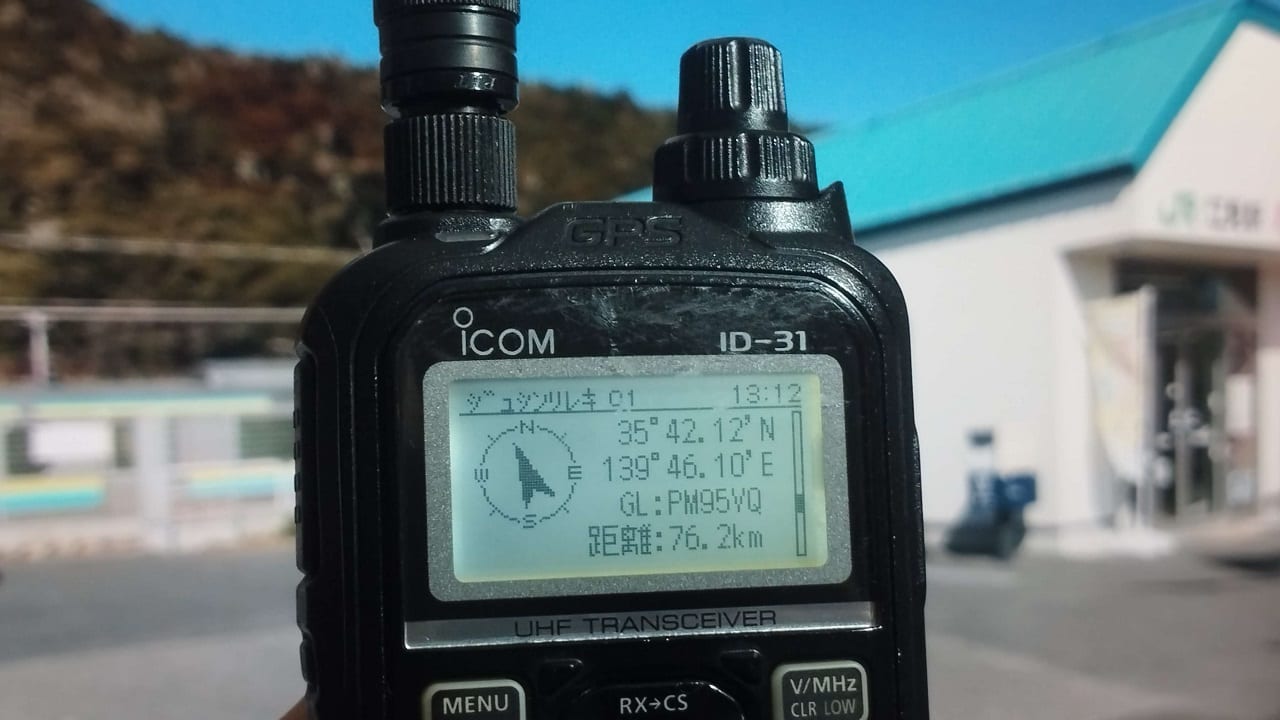
That is why a D-STAR radio shows, after every received transmission, not merely that someone spoke but who, from where and how far away. Exactly that is visible in the title image of this article: an Icom ID-31 displaying its receive history — the other station's coordinates, grid locator PM95VQ and a distance of 76.2 km. For a handheld on 70 cm that is information you would otherwise have to ask for.
The four fields: MYCALL, UR, RPT1 and RPT2
Every D-STAR transmission contains four callsign fields. They are the reason the system scares off newcomers — even though three of them are set once and then forgotten.
- MYCALL — your own callsign. Enter it once and you are done. Without MYCALL no gateway will pass your transmission.
- UR (Your Call) — the destination. For normal operating this reads
CQCQCQ, a general call. Only direct routing or reflector commands put anything else here. - RPT1 — the repeater you are transmitting through, including its module letter (e.g.
OE0XXX Bfor the 70 cm module). - RPT2 — usually the same repeater with module
G: the gateway, that is, the way into the network.
The module letters grew historically and are the same across the entire D-STAR world: A = 23 cm, B = 70 cm, C = 2 m, G = gateway. Remember that and you will immediately understand why a reflector is called XLX905 B or why a repeater entry ends in C.
Callsign routing: the idea hardly anyone uses
D-STAR's most elegant trick: instead of CQCQCQ you simply put the callsign of the station you want into UR. The network looks up which repeater last heard that station and routes the connection straight there — without either of you needing to know where the other one currently is. That is telephone-grade convenience by radio, and it has existed for over twenty years.
That it is rarely used has two reasons. First, callsign routing requires your callsign to be registered with a gateway — otherwise the network does not know the station. Second, day-to-day operating has shifted to the reflectors: there is always somebody there, whereas calling a specific station assumes that station happens to be switched on. The callsign database behind it all is nowadays largely maintained by the ircDDB network.
How registration works in Austria is set out step by step in our Austria article. Short version: one-off, free of charge, and not even mandatory for plain reflector operating through a hotspot.
Reflectors: REF, XRF, DCS and XLX
A reflector is a server on the internet that ties any number of repeaters and hotspots into one shared room. Whoever is linked to a reflector hears everything spoken into that room anywhere in the world. Functionally that matches talkgroups on DMR or rooms on EchoLink.
Four systems grew up side by side, differing only in their linking protocol:
- REF — the classic, Icom-adjacent system using the DPlus protocol. Requires registration in the US Trust network.
- XRF — open reflectors using the DExtra protocol.
- DCS — Digital Call Server, likewise open.
- XLX — the modern multi-protocol reflector. It speaks DPlus, DExtra and DCS simultaneously, translates between them, and can additionally bridge to C4FM and DMR. XLX needs no D-STAR registration.
Linking happens through the UR field: reflector name, module letter and an L for "link" — for instance XLX905BL. To disconnect, a U for "unlink" in the same place is enough. Afterwards UR belongs back on CQCQCQ, otherwise you will wonder why nobody answers. That is by far the most common beginner's mistake.
Reflectors and talkgroups explained across D-STAR, DMR and C4FM (Video: HamRadioConcepts, YouTube).
The path of a QSO
DD mode: 128 kbit/s, but only on 23 cm
Besides voice, D-STAR has a second and much faster mode: DD (Digital Data) carries 128 kbit/s in roughly 150 kHz of bandwidth. That allows genuine IP over radio — the repeater becomes a network access point and the radio hangs off your computer via Ethernet.
The catch, which many descriptions gloss over: DD exists on 23 cm only, and it needs specific hardware at both ends. In Austria it has remained a curiosity; anyone looking for data over radio in practice is better served by HAMNET or Packet Radio. Those 128 kbit/s still belong in the story — around 2004 they were a small sensation.
No repeater in range: hotspot, terminal and access point mode
Not everywhere has a D-STAR repeater within reach. Three routes get you there anyway, and all of them end in the same reflector:
- Hotspot: a small board (MMDVM, ZUMspot, DVMEGA, openSPOT) running Pi-Star or WPSD. It produces a weak signal inside your home and dials into the reflector of your choice over the internet. How to set one up is covered in Set up a Pi-Star hotspot — DMR and C4FM included.
- Access point mode: a second Icom radio takes on the hotspot role and connects to the internet itself.
- Terminal mode: here nothing is transmitted at all. The radio goes online directly over USB, Bluetooth or LAN — useful from a hotel room. The IC-705, IC-905 and IC-9700 do it over LAN; handhelds use a PC or the Android app RS-MS3A. You need an IPv4 address, and behind some carrier-grade NAT that turns into a fight.
If you would rather build than buy, we describe a comparable concept for the analogue world in Build your own SVXLink hotspot.
Radios: what does D-STAR today
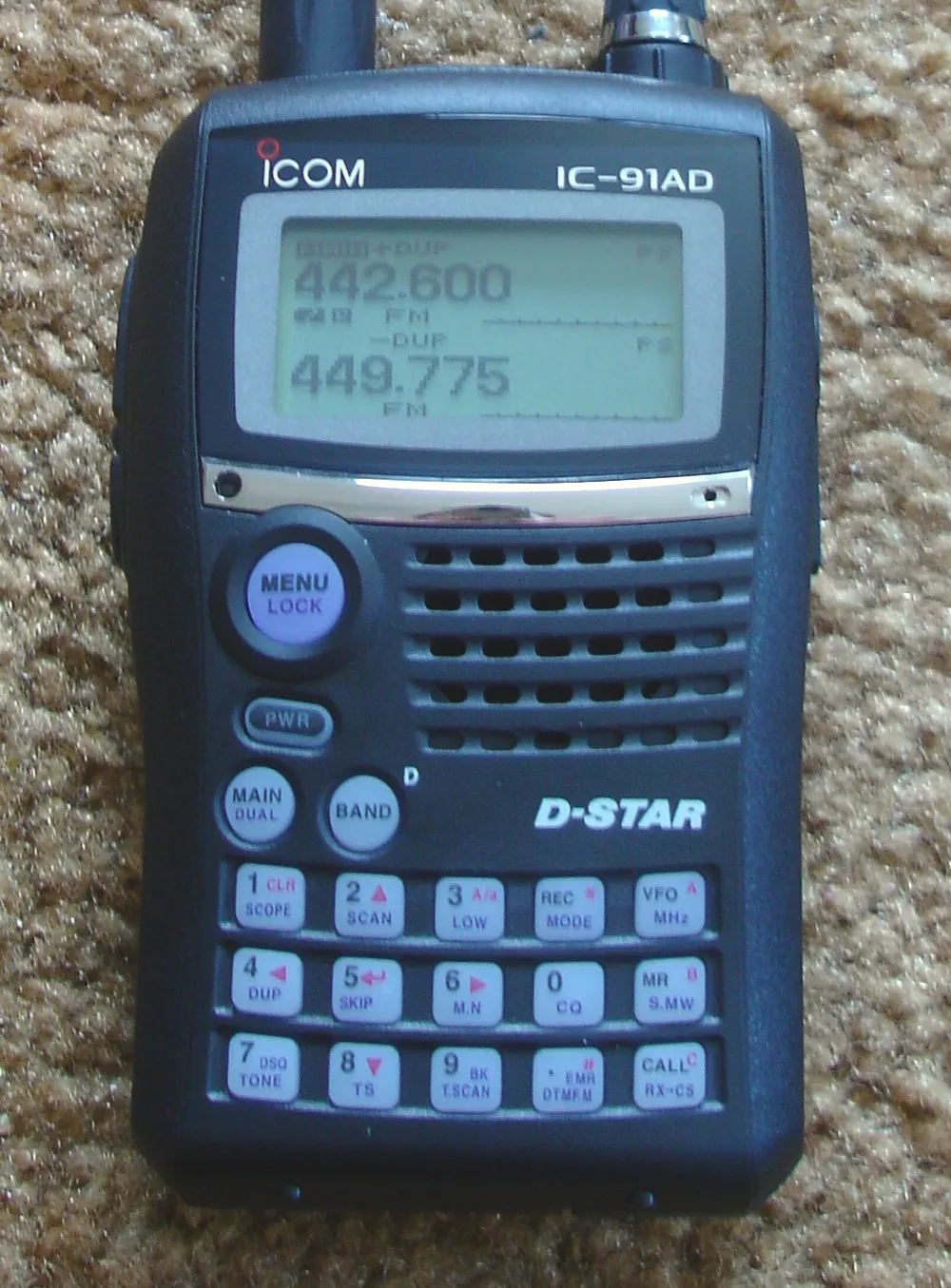
D-STAR remains effectively an Icom domain. Currently in the range, among others:
- ID-52E (PLUS): handheld for 2 m and 70 cm with GPS, Bluetooth and a colour display — the standard way in.
- ID-50E: the more affordable handheld option.
- ID-5100E: mobile rig for 2 m and 70 cm with a touchscreen. (Older texts often mislabel it "IC-5100" — the radio is the ID-5100.)
- IC-9700: base station for 2 m, 70 cm and 23 cm, and the only current radio with DD mode.
- IC-705: portable from HF to 70 cm, D-STAR included.
- IC-905: the microwave rig, likewise with D-STAR.
One quirk of the newer models: using the RS-MS1A app they can send pictures — slowly, but it works, and it shows the data channel can do more than position reports.
Linking reflectors on the radio, shown step by step on the ID-5100E (Video: Icom UK, YouTube).
Five pitfalls from practice
- UR left unchanged: after linking, UR must go back to
CQCQCQ. Otherwise you keep sending commands instead of speech. - Wrong module letter: one space too few and the reflector command goes nowhere. The fields are eight characters wide and the module letter belongs at the far right.
- MYCALL empty or wrong: without a registered callsign the gateway passes nothing — the repeater acknowledges, the network stays silent.
- Hotspot too strong or on the wrong frequency: a hotspot is a transmission too. Respect the band plan, keep the power minimal.
- Speaking too soon: digital systems need a moment to establish the path. Wait a second after keying up or the first word is lost.
D-STAR in Austria
The Austrian network hangs off its own reflectors, chiefly the multi-protocol reflectors XLX232 and XLX905, with modules on DCS009 also in use. Because several of these reflectors are cross-linked between modes, you will also meet stations there running C4FM or DMR gear.
Which reflector is currently linked to which, and which repeaters are attached, changes constantly — so we point at the live dashboards rather than printing a snapshot. Details, registration and the current contact points are in D-STAR in Austria; the analogue repeater landscape around it is described in VHF/UHF repeaters in Austria.
Read on: our digital voice series
D-STAR is one mode among several. In our series Digital voice in Austria each of them is covered separately:
- D-STAR in Austria — reflectors, registration, getting started
- DMR in Austria — BrandMeister and talkgroups, plus DMR for beginners and a look inside the BrandMeister network
- C4FM / Yaesu Fusion in Austria — the analogue-compatible counter-proposal
- M17 in Austria — open digital voice with Codec2, no AMBE licence
- TETRA in Austria — professional trunked radio on amateur bands, plus TetraPack in the BrandMeister network
- SVXLink in Austria — reflector operating with any FM radio, and how to build one yourself
- Set up a Pi-Star hotspot — one hotspot for D-STAR, DMR and C4FM
- The big comparison — which system suits whom
73 – your oeradio.at editorial team
Transparency Notice
This article was researched and written with the support of AI (Claude, Anthropic) and reviewed by the oeradio.at editorial team. In August 2026 it was thoroughly revised and extended with the technical fundamentals. The figures for modulation, data rates and DD mode come from the JARL specification and Icom product documentation; the model designation ID-5100 was corrected (it previously read "IC-5100"), and the reference to 128 kbit/s now carries the restriction to DD mode on 23 cm. Title image and equipment photo come from Wikimedia Commons under free licences, with photographer and licence given in each caption; the signal-path graphic is our own. The embedded videos come from external YouTube channels and reflect their authors' views. Corrections are welcome at [email protected].