Table of Contents
- Classical Propagation Models: Powerful but Limited
- Machine Learning: A New Approach
- foF2 Prediction: ML Outperforms IRI
- TEC Prediction: 24% Improvement Over Traditional Methods
- NASA DAGGER: Predicting Geomagnetic Disturbances
- PINNBARDS: Prediction Over Weeks Instead of Hours
- Solar Cycle Prediction with Neural Networks
- Kp Index Prediction: Random Forest at 82.5% Accuracy
- Real-Time Tools: The New Generation
- Amateur Radio Data as a Scientific Instrument
- HamSCI: Citizen Science Connecting Research and Amateur Radio
- The Future: Personalised Propagation Assistants
- What This Means for Radio Operations
- ML vs. VOACAP: Not Either-Or
- Transparency Notice
HF propagation is one of the most fascinating — and frustrating — phenomena in amateur radio. Whether a signal from Austria reaches Japan, Australia, or South America depends on the ionosphere, a dynamic system influenced by solar activity, time of day, season, and geomagnetic conditions. Since the 1980s, radio amateurs have used models like VOACAP to predict propagation conditions. But these classical models have their limits: they work with monthly median values, cannot account for real-time disturbances, and carry uncertainties of 40-50 dB. Artificial intelligence promises to change this fundamentally.
Classical Propagation Models: Powerful but Limited
The classical tools of propagation prediction have proven themselves over decades:
- VOACAP: The "Voice of America Coverage Analysis Program" calculates link probabilities based on empirical ionospheric models. It is the standard tool for radio amateurs.
- ICEPAC: An extension of VOACAP with improved modelling of polar and high-latitude paths.
- REC533 / ITURHFProp: The official propagation code of the International Telecommunication Union (ITU), based on Recommendation ITU-R P.533.
- IRI (International Reference Ionosphere): An empirical ionospheric model describing parameters such as the critical frequency foF2 and total electron content (TEC).
These models have fundamental limitations: they use monthly median values, cannot handle real-time events, exhibit an RMSE of approximately 12.9 dB against actual signal strengths, and perform poorly on polar paths where the ionosphere is particularly variable.
Video tip: Rob Wagner, VK3BVW, walks through what the major 2026 update changes in the classic VOACAP prediction tool:
Machine Learning: A New Approach
Machine learning offers a fundamentally different approach: instead of modelling the ionosphere with simplified physical equations, ML algorithms learn patterns directly from data — discovering relationships no human researcher has explicitly programmed. The range of methods is impressive:
- LSTM (Long Short-Term Memory): Recurrent neural networks particularly adept at handling time series. They "remember" past states and detect long-term dependencies — ideal for the ionosphere, which is influenced by processes on scales from minutes to years.
- CNN (Convolutional Neural Networks): Originally developed for image recognition, CNNs identify spatial patterns in ionospheric maps and capture global structures.
- Random Forest and SVR: Ensemble methods and Support Vector Regression that are robust against noise in data and work well with limited datasets.
- GRU and BiLSTM: Gated Recurrent Units (a simplified LSTM variant) and Bidirectional LSTMs that process time series in both directions, leveraging both past and future context.
- Physics-Informed Neural Networks (PINNs): A hybrid approach that embeds physical laws directly into the network architecture — the AI learns from data while being guided by physics.
Video tip: How do LSTM networks, so common in ionospheric forecasting, actually work? StatQuest explains it clearly:
foF2 Prediction: ML Outperforms IRI
The critical frequency of the F2 layer (foF2) is the key parameter for HF propagation. It determines the MUF (Maximum Usable Frequency) and thus which bands are open at any given time. Numerous studies have shown that ML models — particularly SVM, Random Forest, and BPNN — consistently outperform the established IRI-2020 model for foF2 prediction, under both quiet and disturbed geomagnetic conditions.
The advantage is especially pronounced during geomagnetic storms (where IRI uses static correction terms while ML models learn the complex nonlinear ionospheric responses), at regional anomalies (equatorial anomaly, polar regions), and during sunrise/sunset transitions — precisely where classical models struggle most.
TEC Prediction: 24% Improvement Over Traditional Methods
Total Electron Content (TEC) is another crucial parameter affecting both HF propagation and GPS/GNSS accuracy. The hybrid CNNBILSTM_SE model (combining CNN spatial pattern recognition with BiLSTM temporal dependencies and Squeeze-and-Excitation attention mechanisms) has achieved a 24% improvement over traditional methods.
For radio amateurs, more accurate TEC prediction means better MUF forecasting, more precise signal delay estimation (important for FT8 and other data modes), and more reliable DX planning.
NASA DAGGER: Predicting Geomagnetic Disturbances
Geomagnetic storms are the greatest enemy of HF propagation, capable of shutting down HF communication entirely within hours. NASA's DAGGER (Deep leArninG for GEomagnetic peRturbation) system uses deep learning to predict geomagnetic disturbances with 30 minutes warning time. Inference takes less than one second — delivering near-instantaneous alerts.
DAGGER analyses solar wind data from satellites at the L1 Lagrange point (approximately 1.5 million km ahead of Earth) and forecasts the resulting geomagnetic disturbances. For radio amateurs: early warning of HF blackouts and the ability to adapt operations — switching to lower bands or starting WSPR monitoring to observe actual propagation.

Video tip: The difference between solar flares and coronal mass ejections, explained by NASA Goddard:
PINNBARDS: Prediction Over Weeks Instead of Hours
One of the most exciting breakthroughs in 2026 is PINNBARDS (Physics-Informed Neural Network for Balanced Auroral Region Dynamics Simulation). This model combines physics-based modelling with neural network learning capability, extending the prediction horizon from hours to weeks.
While conventional ML models typically look ahead 1-24 hours, PINNBARDS delivers reliable predictions over multiple weeks. This is possible because the embedded physical constraints prevent the model from drifting into unrealistic states over longer prediction periods. For planning DXpeditions, grey-line DX, or contests, reliable multi-week forecasts would be a quantum leap beyond today's monthly medians.
Solar Cycle Prediction with Neural Networks
Neural networks are increasingly used for long-term solar cycle prediction — sunspot numbers, solar flares, and coronal mass ejections (CME). Various NN architectures address different prediction tasks:
- Sunspot numbers: LSTM-based models estimate solar cycle progression months in advance — more accurately than classical McNish-Lincoln or ISES methods.
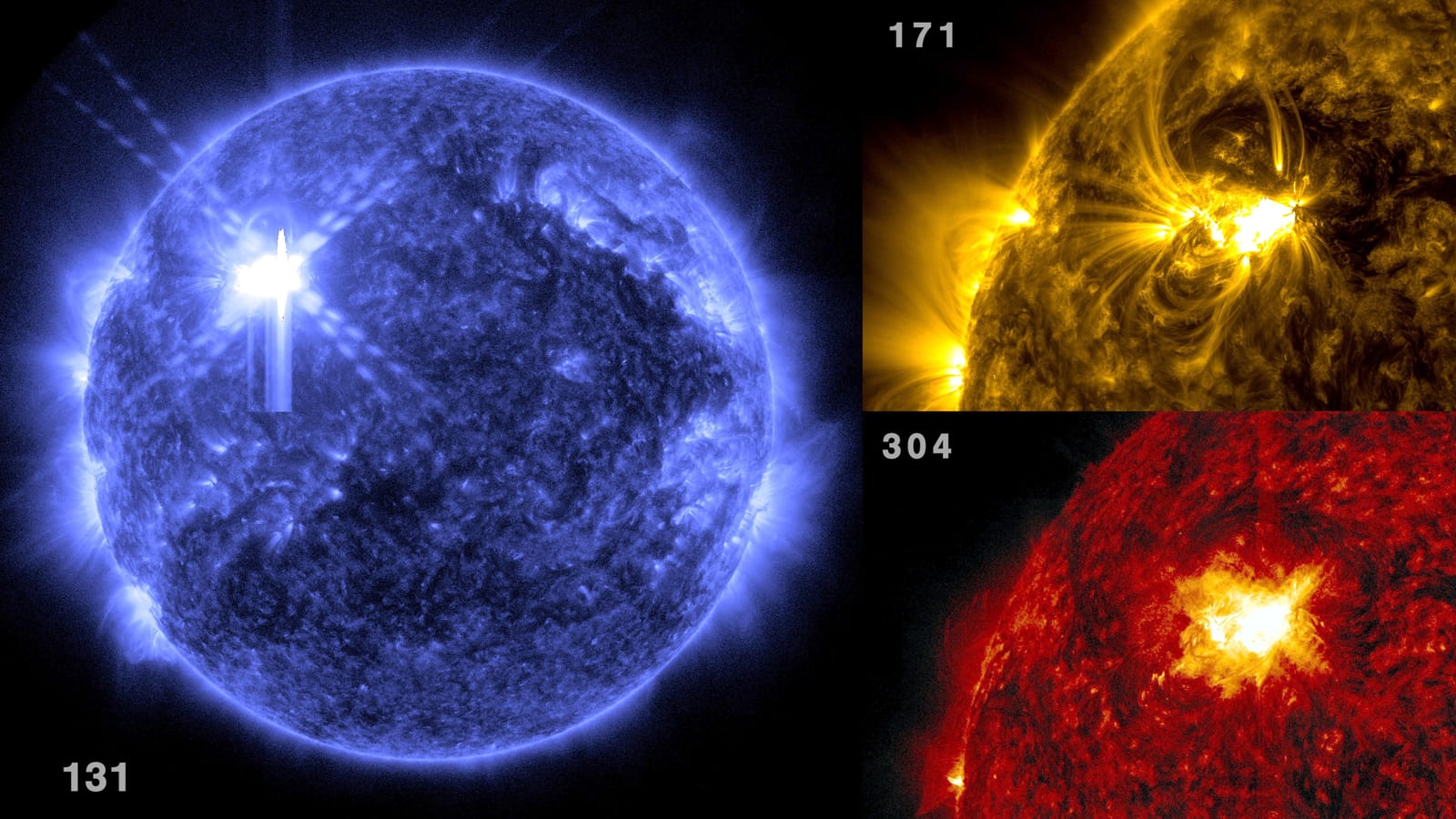
- Solar flares: ML models classify the probability of M- and X-class flares from active region magnetograms with significantly better performance than purely statistical methods.
- CME arrival times: Predicting when a coronal mass ejection reaches Earth is critical for estimating geomagnetic storms. ML models have reduced the prediction error from +/- 12 hours to under +/- 6 hours.
For amateur radio, this means better long-term planning. Knowing that the coming months will bring good conditions on 10 m and 12 m allows operators to adjust their activity accordingly.
Kp Index Prediction: Random Forest at 82.5% Accuracy
The Kp index measures global geomagnetic activity and is one of the most important indicators for radio amateurs. A Kp of 0-2 means quiet conditions; from Kp 5 onwards, geomagnetic storms begin that can severely impair HF propagation.
Researchers have demonstrated that Random Forest models can predict the Kp index three hours ahead with 82.55% accuracy, using real-time solar wind parameters as input. Three hours of warning is highly relevant for radio operations: enough time to switch to lower bands, complete a DX QSO in progress, or start WSPR monitoring.
Real-Time Tools: The New Generation
Research results are already flowing into practical tools for radio amateurs:
- DXLook: A personalised band conditions tool using ML algorithms to recommend the best bands and times for a specific location and target region.
- DXPulse: Analyses in real time which modes (SSB, CW, FT8) are currently feasible on which bands — based on ML analysis of cluster data and ionospheric measurements.
- HamClock: The popular amateur radio clock increasingly integrates ML-powered propagation indicators alongside classical indices like SFI, Kp, and A-index.
Amateur Radio Data as a Scientific Instrument
A fascinating aspect of AI-powered propagation research: the amateur radio community itself provides a large portion of the data used to train ML models. Three networks play key roles:
- Reverse Beacon Network (RBN): A worldwide network of automatic receivers (skimmers) that decode CW and RTTY signals, reporting them with timestamp, frequency, and SNR. RBN delivers millions of data points per day — a real-time picture of actual propagation.
- PSKReporter: Similar to RBN but for data modes like FT8, FT4, and PSK31. Every decoded frame is reported with position, frequency, and SNR — the largest real-time data source for HF propagation research.
- WSPRnet: The Weak Signal Propagation Reporter Network transmits and receives purpose-designed test signals at minimal power (typically 200 mW). WSPR data is particularly valuable because transmit power, frequency, and position are precisely known — ideal training data for ML models.
These networks make amateur radio a distributed scientific instrument: thousands of stations worldwide deliver real-time ionospheric measurements — a data density no professional ionosonde network achieves.
HamSCI: Citizen Science Connecting Research and Amateur Radio
The NASA-supported HamSCI project (Ham Radio Science Citizen Investigation) bridges amateur radio and professional ionospheric research. HamSCI systematically uses amateur radio data — particularly from RBN, PSKReporter, and WSPRnet — for scientific studies and the development of better propagation models. Projects include the Personal Space Weather Station, solar eclipse campaigns, and systematic propagation model validation.
Every radio amateur using RBN, PSKReporter, or WSPR is actively contributing to the improvement of ML propagation models — citizen science at its finest.
The Future: Personalised Propagation Assistants
- Personalised propagation assistants: AI systems considering individual location, antenna, and preferred modes — "Now is the best time for an SSB QSO to VK on 20 m with your dipole."
- AI integration in transceivers: Future devices with built-in ML models suggesting optimal bands and modes. As described in our article on AI-powered noise reduction, AI is already entering transceiver hardware — propagation prediction would be a logical next step.
- Sporadic-E prediction: One of the biggest open challenges. ML models combining weather data, tidal forces, and ionospheric measurements could achieve breakthrough results.
- Real-time propagation maps: Like weather maps, but for the ionosphere — continuously updated by ML models fusing data from ionosondes, satellites, GPS receivers, and amateur radio networks. First approaches already exist in RF coverage maps.
Video tip: Citizen science in practice: NASA Goddard shows how radio amateurs study total solar eclipses:
What This Means for Radio Operations
ML-powered propagation prediction is not a theoretical future topic — it is changing amateur radio today. In practical terms:
- Better DX planning: Instead of relying on VOACAP monthly medians, ML tools can provide day-specific recommendations.
- Earlier storm warnings: Systems like DAGGER warn 30 minutes before geomagnetic disturbances — enough time to secure a DX QSO or switch to a more robust band.
- Optimised QRP operation: When running low power, every dB counts. More precise propagation predictions help hit the narrow window of optimal conditions.
- Smarter contests: ML models can recommend band changes in real time during a contest — an advantage over intuition alone.
- Contributing data: Every FT8 contact, every WSPR spot, and every RBN report feeds the next generation of ML models. Being active on the bands is simultaneously a contribution to science.
ML vs. VOACAP: Not Either-Or
An important point: ML models do not replace classical tools like VOACAP — they complement them. VOACAP remains the best tool for long-term planning and systematic band comparisons. ML models excel where VOACAP reaches its limits: short-term predictions, disturbed conditions, and real-time recommendations.
The hybrid approach — Physics-Informed Neural Networks combining physical knowledge with data-driven AI — is likely the future. PINNBARDS and similar models demonstrate that the best results emerge when physics and ML are combined rather than pitted against each other.
More on using AI tools in amateur radio — from noise reduction to shack assistants — can be found in our other articles.
The ionosphere remains a chaotic system that can never be fully tamed. But ML models bring us closer to an understanding that was unthinkable just a few years ago. For radio amateurs, this means: more successful QSOs, less frustration, and a deeper understanding of the fascinating medium between Earth and space.
73 – your oeradio.at editorial team
Transparency Notice
This article was researched and written with the assistance of AI (Claude, Anthropic). The editorial team has reviewed and edited all content. Despite careful review, occasional inaccuracies may occur — we welcome corrections via email to [email protected].