Table of Contents
- What is TETRA?
- TETRA vs. DMR: The Comparison
- TetraPack.Online: TETRA Meets BrandMeister
- Technical Architecture
- What Equipment Do I Need?
- Recommended Handheld Radios
- Base Stations
- Operating Modes: TMO and DMO
- Getting Started with TETRA
- More TETRA Projects for Amateur Radio
- Videos and Resources
- TETRA Austria – Introduction by OE8VIK
- Introduction to TETRA – M17 Conference 2025
- TetraSpot Mini BTS on Raspberry Pi 5
- TetraPack.Online – TETRA-DMR Bridge in Action
- Conclusion: Is It Worth Switching?
- Further Reading
- Transparency Notice
Most radio amateurs know BrandMeister as the world's largest DMR network. But since 2024, there's a new family member: TetraPack.Online brings the professional TETRA standard to amateur radio — with superior voice quality, full-duplex capability and seamless integration into the existing BrandMeister ecosystem.
What is TETRA?
TETRA stands for Terrestrial Trunked Radio and is a European ETSI standard for digital trunked radio systems. Originally developed for public safety organisations — police, fire services, emergency medical services — TETRA offers several advantages over conventional repeater systems:
- 4 timeslots on 25 kHz bandwidth (DMR has only 2 on 12.5 kHz)
- ACELP codec (from the GSM family) with noticeably better voice quality than AMBE+2 used in DMR
- Full-duplex calls — like a telephone, talk and listen simultaneously
- Trunking — the base station assigns timeslots dynamically, no manual timeslot management needed
- Integrated data services — SMS (SDS), GPS positioning, IP data, telemetry
Unlike DMR, where each user manually sets the timeslot in their codeplug, TETRA base stations assign channels automatically. Of the 4 timeslots, one is reserved for signalling — the remaining 3 can carry three independent voice calls simultaneously.
TETRA vs. DMR: The Comparison
| Feature | DMR | TETRA |
|---|---|---|
| Timeslots | 2 per 12.5 kHz | 4 per 25 kHz |
| Codec | AMBE+2 (proprietary) | ACELP (GSM family) |
| Voice quality | Good | Very good |
| Duplex | Half-duplex only | Full-duplex capable |
| Trunking | Optional | Built-in |
| Data services | SMS, GPS (basic) | SMS/SDS, GPS, IP data, APRS |
| Radio cost | €30–150 (new, e.g. Anytone) | €50–170 (used/surplus) |
| Base station | Simple repeater | Full BTS required |
| Entry barrier | Low | Medium to high |
Those already using DMR will immediately recognise the parallels — but also the clear improvements in voice quality and flexibility.
TetraPack.Online: TETRA Meets BrandMeister
The centrepiece of the new TETRA offering in the BrandMeister ecosystem is TetraPack.Online, developed by Artöm, DL5ABM, and his team. The project was first presented at HamRadio 2023 in Friedrichshafen and has been continuously developed since.
TetraPack.Online is not a standalone, isolated network — it is seamlessly integrated with BrandMeister. This means:
- Same IDs: DMR IDs assigned by RadioID.net work on TetraPack too — no separate registration needed
- Shared talkgroups: All talkgroups from TG 90 upwards are shared between DMR (BrandMeister) and TETRA (TetraPack) — a QSO on TG 232 (Austria) reaches both networks
- Group and private calls: Both group and private individual calls work across networks
- SMS: Text messages can be exchanged between DMR and TETRA devices
Technical Architecture
The TETRAPACK Core (SWMI — Switching and Management Infrastructure) forms the backbone, comparable to the BrandMeister master server. The codebase comprises over 40,000 lines in C, C++, Lua and JavaScript. Currently, one production server and one test/development server are operational.
The architecture supports unlimited interconnected subnets with 1–7 base stations each. Beyond voice, geolocation (LIP/NMEA), scan lists and APRS services are also supported.
What Equipment Do I Need?
Unlike DMR, where handheld radios like the Anytone AT-D878UV are available for under €150, there are no purpose-built amateur TETRA radios. Instead, operators use surplus professional equipment capable of operating in the 70 cm band (430–440 MHz).
Recommended Handheld Radios
- Motorola MTP850 / MTP850S — the classic and most popular device in the HamTetra community. Used from around €50–100, refurbished €100–170. Models covering 380–440 MHz are ideal. Important: only buy units with CLEAR firmware (no encryption)!
- Motorola MTH800 — compact unit, frequently found on the second-hand market
- Motorola ST7000 — newer generation
- Sepura STP8040 / SC21 — robust alternative, often decommissioned from public safety agencies. From around €60–120 used
- Hytera PT580H — professional TETRA radio
- Airbus THR880i — formerly marketed as EADS/Cassidian
Important: When purchasing, ensure the devices cover the 430–440 MHz frequency range or can be reprogrammed to it. Some public safety units operate at 380–395 MHz and can be software-reprogrammed up to approximately 434 MHz — this needs to be verified case by case.
Base Stations
Several options exist for running your own TETRA site:
- Motorola Compact TETRA (CTS-X00 series) — currently the only base station officially supported by TetraPack.Online. Additional hardware compatibility is in development
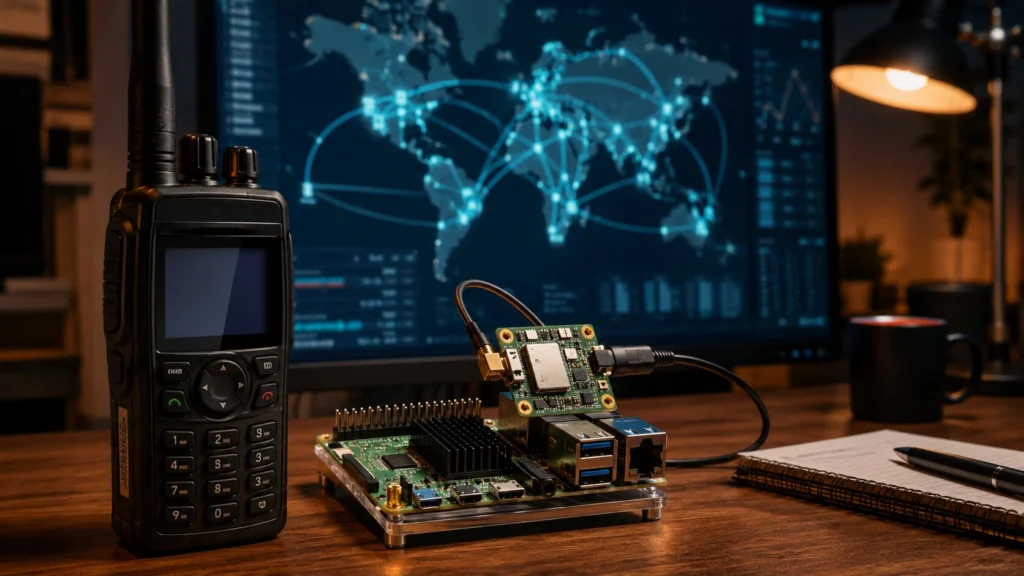
- TetraSpot TMO Mini BTS — an open-source project by SP8MB from Poland. Built on a Raspberry Pi 5 and the Semtech SX1255 SDR transceiver. A few milliwatts of RF power cover an entire house. Supports authentication, group/private calls and can connect to BrandMeister or TetraPack
- TETRA-BlueStation — another SDR-based mini BTS with TMO support
- SXceiver — a full-duplex SDR transceiver (420–450 MHz) for Raspberry Pi, optimised for TETRA experiments. Supports DMO repeater operation and experimental TMO BTS operation
Operating Modes: TMO and DMO
TETRA has two fundamental operating modes:
- TMO (Trunked Mode Operation) — operation via a base station, comparable to a DMR repeater but with dynamic channel assignment. TetraPack.Online operates in TMO mode
- DMO (Direct Mode Operation) — direct operation without infrastructure, similar to simplex. A TETRA device can function as a DMO simplex repeater — without an expensive base station with duplexer
For beginners, DMO is particularly attractive because no expensive base station infrastructure is needed. A single handheld radio can serve as a simplex repeater, enabling local TETRA communication.
Getting Started with TETRA
- RadioID.net registration: If you don't have a DMR ID yet, register at radioid.net. The same ID is used for TETRA
- Acquire a TETRA radio: eBay, ham flea markets or specialised surplus dealers. Ensure it covers 430–440 MHz
- Programme the codeplug: Similar to DMR but simpler — just enter base station frequencies and talkgroups. Timeslots are assigned automatically
- Join the Telegram group: The TetraPack support group on Telegram is the central point of contact for getting started
- Use the dashboard: At tetrapack.online you can monitor network status and active stations
More TETRA Projects for Amateur Radio
TetraPack isn't the only TETRA project in amateur radio. The community is growing rapidly:
- HamTetra (GitHub) — an open-source project implementing TETRA protocols on SDR hardware. Supports both DMO simplex repeater and experimental TMO BTS operation
- TetraLink Romania (TetraLink-Core YO) — a modern TETRA network in Romania, coordinated by Chris, YO3TCO. Offers RoIP, SIP, Push-to-Talk over Cellular and APRS integration
- VKTetra — the Australian TETRA network for radio amateurs
- SvxLink — reflector software with TETRA support and worldwide dashboards
Videos and Resources
For a visual overview, several good starting points are available on YouTube:
TETRA Austria – Introduction by OE8VIK
Introduction to TETRA – M17 Conference 2025
TetraSpot Mini BTS on Raspberry Pi 5
TetraPack.Online – TETRA-DMR Bridge in Action
Conclusion: Is It Worth Switching?
TETRA doesn't replace DMR — it complements it. For those who want the best digital voice quality, appreciate full-duplex calls, or simply seek a new playground, TETRA is a fascinating option. Integration with BrandMeister significantly lowers the entry barrier, as there's no need to build new infrastructure from scratch.
Surplus equipment is affordable, the community is growing, and projects like TetraSpot and HamTetra make home base stations possible with a Raspberry Pi. TETRA in amateur radio is still in its early days — but that's exactly what makes it exciting.
Further Reading
- TetraPack.Online — Dashboard and network status
- BrandMeister News: TETRA announcement
- HamTetra Network — TETRA resources for radio amateurs
- HamTetra on GitHub (open source)
- ÖVSV Wiki: TETRA devices for amateur radio
- RadioID.net — DMR/TETRA ID registration
Transparency Notice
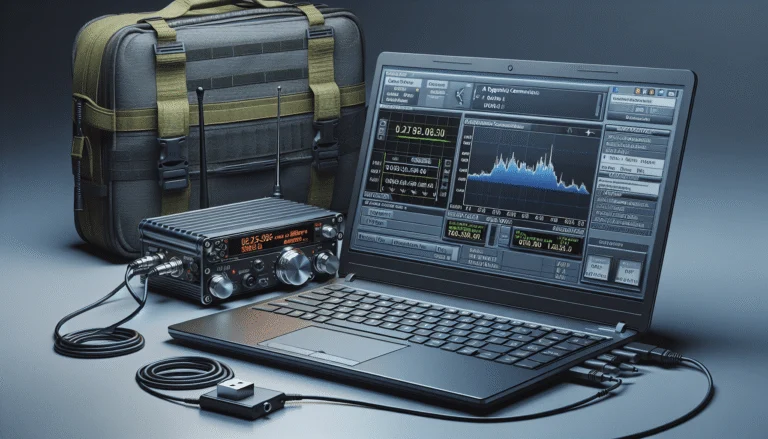
This article was researched and written with the assistance of AI (Claude, Anthropic). Any illustrations used were generated with AI (ChatGPT/DALL·E, OpenAI) unless otherwise noted. All content has been reviewed by the oeradio.at editorial team. Corrections or additions to [email protected].