Table of Contents
- How automatic tuners work today
- Approaches from research
- 1. Genetic algorithms
- 2. Neural networks
- 3. Reinforcement learning
- What already exists: tuners that remember antennas
- Stage 1: memory instead of searching
- Stage 2: measure and calculate instead of trying
- Stage 3: "Tune Once" in the demonstrator
- Open source projects to build along
- What an AI tuner in the shack could look like
- Challenges and limits
- Try it yourself
- Two background videos
- Related AI applications in the shack
- Conclusion
- Sources and further links
- Transparency Notice
An antenna tuner (ATU, Antenna Tuning Unit) is an everyday tool for radio amateurs. It transforms the impedance of the antenna system so that the transceiver sees the familiar 50 ohms. Automatic tuners do this at the push of a button. The question of this article: what could machine learning improve here, what is documented, and what is so far only an idea? The honest answer up front: there are a number of research papers, but during our research we did not find a finished "AI tuner" product for amateur radio.
How automatic tuners work today
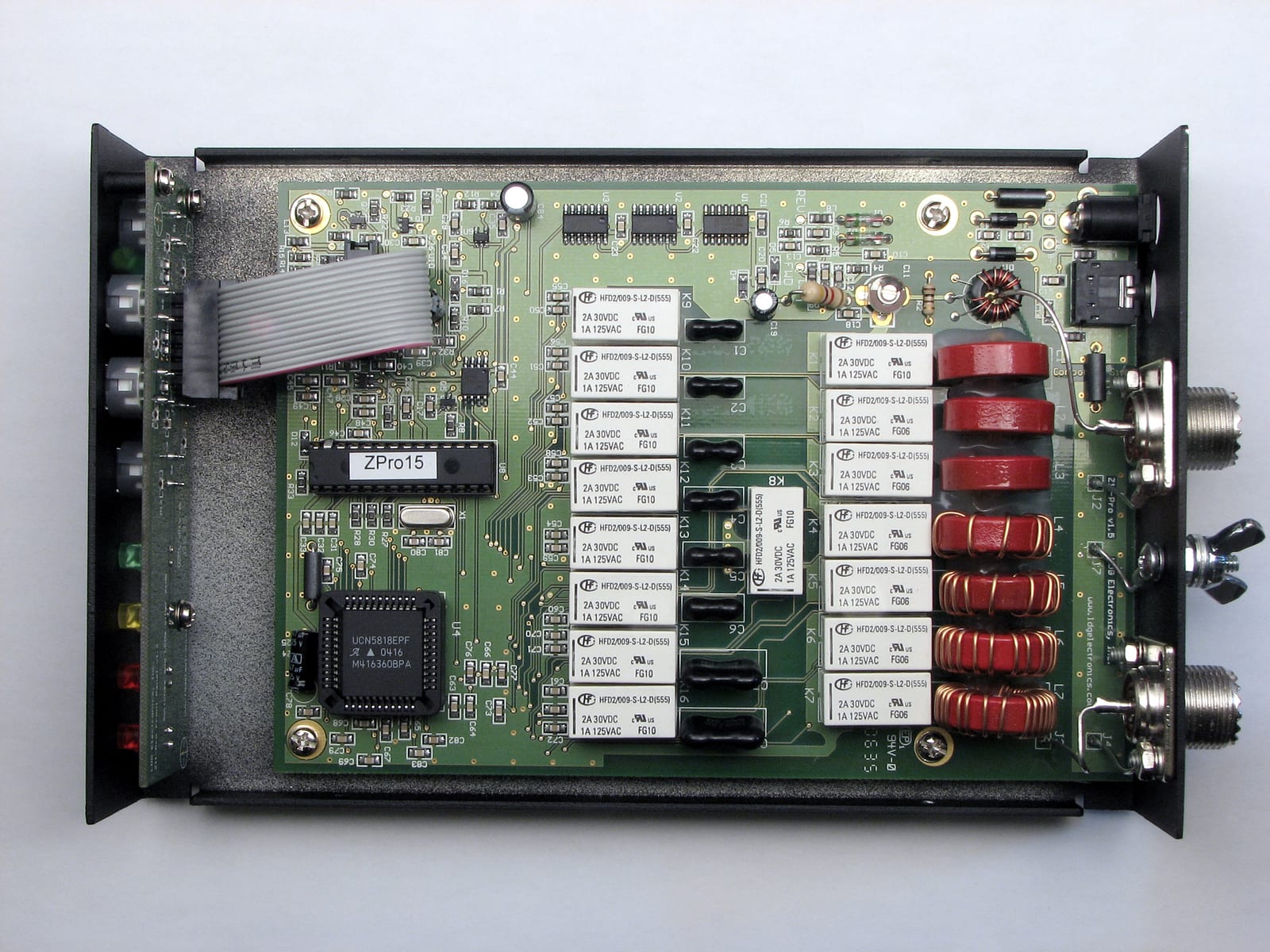
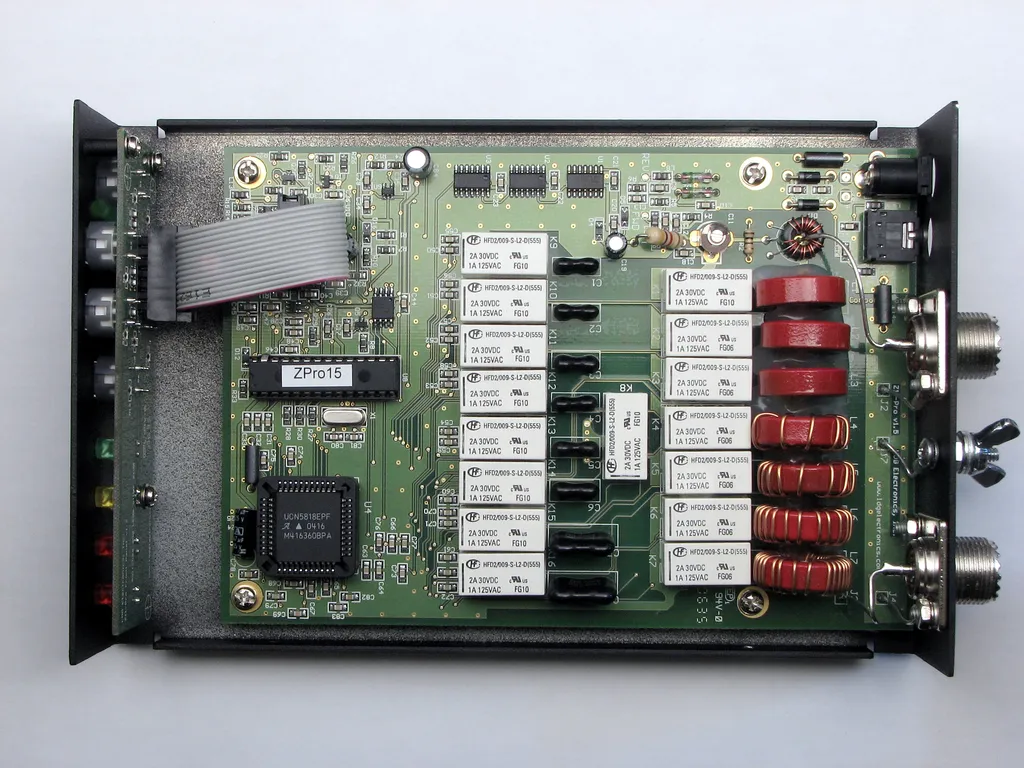
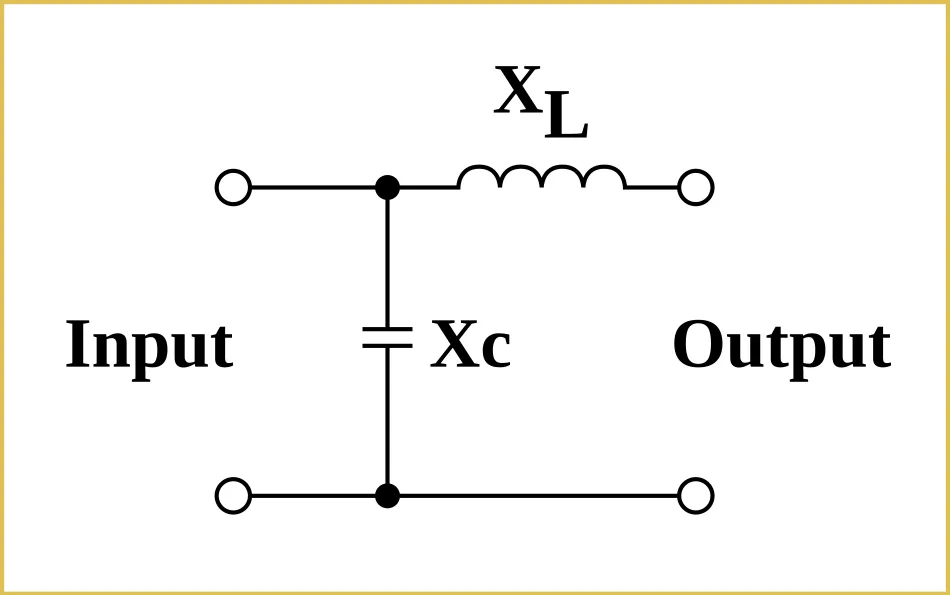
Most automatic tuners are an L-network made of one coil and one capacitor. Relays switch various capacitance and inductance values in, and a microcontroller measures the SWR and tries combinations until the match is right. In the LDG AT-11MP, for example, the manual lists 256 capacitance and 256 inductance steps, with a tuning time between 0.1 and 6 seconds, averaging around 2.5 seconds.
Important: even classic tuners already "learn" a little. They store the settings they found so that they are immediately ready again at the same frequency. The Elecraft KAT500, for example, divides the frequency range into segments (10 kHz wide below 3 MHz, 20 kHz wide from 3 to 26 MHz) and remembers the setting for each segment. If a segment is still empty, it starts with the values of the nearest stored segment. For the LDG AT-1000ProII, dealers quote a tuning time from memory of under 0.2 seconds. A new frequency takes longer, on average around 3 seconds according to the data sheet.
So where is there room for improvement? With frequencies and antennas the tuner has never seen, with complicated loads that have several similarly good solutions, and with systems that change with weather and season. For contest operation, where every band change counts, this would be interesting.
Approaches from research
The problem of "matching impedance by switching component values" is well studied in science, but almost exclusively for mobile networks, Wi-Fi and other GHz applications, not for shortwave with high-power relays. Three directions are relevant.
1. Genetic algorithms
A genetic algorithm generates a "population" of component combinations, keeps the best ones, crosses and mutates them, and repeats this. Alibakhshikenari and colleagues (Scientific Reports, 2020) use a quantum-inspired variant (AQGA) to tune a T-network between transceiver and antenna in the range of 1.4 to 5 GHz. Their measurements: 49 to 75 percent shorter tuning time than with a classic genetic algorithm, at 1.4 GHz an average of 6.5 instead of 26.1 seconds, and significantly fewer computing steps (around 190 to 440 instead of 15,000 to 577,000 epochs). This work does not show that a genetic algorithm is faster than a good classic search algorithm in a radio, only that it can be improved.
2. Neural networks
Here a trained network determines the component values directly, without lengthy trial and error. Kim and Bang (Sensors, 2021) trained a deep neural network that determines the values of a matching network for an inverted-F antenna (0.8 to 1.5 GHz) from the magnitude of S11. Training used simulated data and took around 10.5 minutes. Hasan and Cheffena (IEEE Access, 2023) present a particularly small "shallow learning" variant for 2.45 GHz that also needs only the S11 magnitude. Older, but closer to a tuner microcontroller: Hemminger (2005) used three small neural networks for double-stub tuners, with the goal of a cheap microcontroller system.
The appeal: an SWR meter delivers only the magnitude of the reflection coefficient, not its phase. A network that still makes sensible guesses would also be interesting for simple hardware.
3. Reinforcement learning
In reinforcement learning (RL), an agent learns through reward which switching steps lead to the goal. A paper by Zhang, Cheng, Wang and Chen (arXiv, April 2026) describes tuning as a control problem and applies a deep RL method. Frequency features and matching quality serve as the state, and the reward weights accuracy and speed. According to the authors, it is more accurate, more efficient and more stable than classic heuristic and gradient-based methods. The abstract gave no concrete figures, and the paper is also a preprint that has not yet been peer-reviewed. Several US patents likewise describe RL- and ML-assisted tuning, mainly for mobile phone antennas.
What already exists: tuners that remember antennas
We have not come across a tuner with a true neural network. But industry and the homebrew scene are already part of the way toward "intelligent" matching, in three stages.
Stage 1: memory instead of searching
The classic among learning tuners is the SGC SG-237 "Smartuner" (1.8 to 60 MHz, 3 to 100 W PEP). A non-volatile memory holds L/C combinations already found for 170 frequencies. According to the data sheet, the first tuning typically takes under 2 seconds, a repeat under 10 milliseconds. The tuner has since been discontinued. On the page by OE3MZC, Austrian users collect their experiences, problems included: some wire lengths could not be tuned, one tuner hung up on 50 MHz, and poor grounding led to erratic behavior. This is a good hint of how strongly a learning method depends on the installation.
Stage 2: measure and calculate instead of trying
The MFJ-939 IntelliTuner (200 W, 1.8 to 30 MHz) goes one step further. If nothing is stored for the frequency (over 20,000 memory locations), an "AdaptiveSearch" algorithm starts. It measures the complex impedance of the antenna, calculates the required components, switches them in and then fine-tunes for minimum SWR. If the impedance is outside the measuring range, it searches specifically only in the suitable component ranges and, if necessary, repeats the search with a different pattern. This is exactly the combination of starting point and fine tuning that we describe as an idea further below, only without training. According to the description, a new tuning takes "a fraction of a second".
Stage 3: "Tune Once" in the demonstrator
Southwest Antennas shows an HF auto-tuner (1.8 to 30 MHz) as a technology demonstrator for system integrators. According to the manufacturer, the "Tune Once" technique learns successful tuning solutions, stores them on up to 512 channels and recalls them later. The manufacturer also says that thousands of matching combinations are evaluated. How this works internally is not stated there. Whether machine learning in the narrower sense is involved remains open. But it is the area in which the industry is experimenting with professional radio platforms.
Open source projects to build along
Anyone who wants to get started themselves will find solid platforms. None of them contains machine learning, but all have the hardware (switchable L and C stages) and a microcontroller on which a learning method could be built:
- ATU_0_HW by DM1CR (papamidas): KiCad design of an LC/CL tuner with 256 capacitance steps (0 to 2.5 nF) and 256 inductance steps (0 to 15 µH), Arduino Nano, bistable relays (25 to 45 mA), control via Bluetooth app, ten memory buttons for bands.
- ATU by DM3MAT (Hannes Matuschek): small portable QRP tuner for a wire of about 10 m with a 1:9 UnUn on 80 to 10 m. Hardware and firmware are under CC BY-SA 4.0. The author describes the state as a first prototype.
- K3NG Antenna Tuner: Arduino-based automatic tuner by the well-known open source developer, GPL-3.0.
- UR7HFO: Simple Automatic Antenna Tuner: low-power tuner on an STM32F103, with schematics and Gerber files.
- TCI ICOM Tuner Interface: ESP32 firmware that connects an ICOM AH-4 tuner to an SDR with the TCI protocol, over WLAN. Interesting as an example of how an ESP32 gets frequency data from the radio. Exactly this information is what a learning tuner would need.
A note for context: the scientific tool AntennaCAT uses machine learning to design antennas with EM simulation. That is related, but not a tuner.
What an AI tuner in the shack could look like
This section is a thought experiment, not a description of a product:
- Learning during operation: The tuner logs frequency, antenna, output SWR and the setting found. From this data a model emerges that provides a good starting point for known antennas.
- Starting point plus fine tuning: The model suggests a setting, then a classic algorithm fine-tunes it in one or two more steps. This keeps the result good even if something has changed, for example through wet antennas or a changed environment.
- Antenna detection: Impedance patterns can be used to infer which antenna is currently connected. An EFHW behaves differently from a dipole or a magnetic loop.
Challenges and limits
- Measurement data: An SWR meter delivers only the magnitude, not the complex impedance. With magnitude and phase (for example via a NanoVNA or a measuring bridge in the tuner), the task becomes easier.
- High power: The papers deal with milliwatt signals in the GHz range. On shortwave with 100 W to 1 kW, relays switch high voltage. Here tuning may only be done with no signal or at very low power, so that the contacts do not burn.
- Computing power: Small models run on microcontrollers, large RL networks need more. Edge AI hardware such as Google Coral or NVIDIA Jetson would be one possible route.
- Training data and overfitting: A model trained on only one antenna performs poorly on another. It would have to relearn with every new installation.
- Safety: A learning method must never choose settings that endanger the transceiver. Limits for SWR and power must remain hard-coded.
Try it yourself
A complete AI tuning setup is a tinkering project for advanced users. A starting point is the open-source ATU-100 tuner (PIC microcontroller, documented for example as a project at PCBWay). A learning layer on top, such as a table of remembered settings or a small model on a Raspberry Pi, would be a manageable experiment. A practical example of related AI experiments can be found in Automatic CW Decoding with Neural Networks.
Two background videos
These two videos explain how a tuner works (both in English). They cover classic tuners, not AI. But they provide the foundation on which any AI variant would have to build.
The first film ("How Does an Antenna Tuner Work?" by Budget Ham Radio) uses a NanoVNA to show how a T-network compensates for a mismatch.
The second ("Antenna Tuners: How does it do THAT?" by Electronics for the Inquisitive Experimenter) explains the principle behind the matching.
Related AI applications in the shack
- AI-powered noise reduction
- AI and propagation prediction
- Automatic CW decoding
- ChatGPT and Claude as shack assistants
Conclusion
The idea of improving antenna tuners with machine learning is scientifically well founded. Genetic algorithms, neural networks and reinforcement learning have already been studied for impedance matching. However, the figures come from the GHz range and from low power levels. For shortwave, our research found neither measurement series nor an amateur radio product with a demonstrably trained model. The path there is already laid out: from pure memory (SG-237) through measuring and calculating (MFJ IntelliTuner) to learning solutions such as the Southwest demonstrator. And open hardware such as the tuners by DM1CR and DM3MAT is just waiting for someone to add the learning layer. Today's tuners are fast and remember settings, so a large time saving is conceivable mainly with new frequencies and new antennas. Anyone who wants to experiment can do so at their own risk, with hard safety limits for SWR and power.
73 – your oeradio.at editorial team
Sources and further links
- Zhang, Cheng, Wang, Chen: An Adaptive Antenna Impedance Matching Method via Deep Reinforcement Learning, arXiv:2604.07736, April 2026 (preprint)
- Alibakhshikenari et al.: Improved adaptive impedance matching for RF front-end systems of wireless transceivers, Scientific Reports 10, 14065 (2020), DOI 10.1038/s41598-020-71056-0
- Kim, Bang: Antenna Impedance Matching Using Deep Learning, Sensors 21(20), 6766 (2021), DOI 10.3390/s21206766
- Hasan, Cheffena: Adaptive Antenna Impedance Matching Using Low-Complexity Shallow Learning Model, IEEE Access, 2023
- Hemminger: Antenna impedance matching with neural networks, Penn State, 2005
- Patents: US 11,882,527 (Data-driven methods for look up table-free closed-loop antenna impedance tuning) and US 11,916,606 (Machine learning-assisted adaptive antenna tuning)
- Elecraft: KAT500 Owner's Manual (memory per frequency segment)
- LDG: AT-1000ProII at WiMo (data sheet specifications), AT-11MP manual (steps and tuning time)
- Products: SGC SG-237 Smartuner (OE3MZC user page), MFJ-939 IntelliTuner, Southwest Antennas HF Auto-Tuner (manufacturer information)
- Open Source: ATU_0_HW (DM1CR), ATU (DM3MAT), K3NG Antenna Tuner, UR7HFO STM32 tuner, TCI ICOM Tuner Interface, AntennaCAT
- IZ2UUF: How does a tuner… tune? and Electronics Notes: What is an ATU? (basics)
- Videos: Budget Ham Radio, Electronics for the Inquisitive Experimenter (YouTube)
- Images: cover image and interior view: Adamantios, Wikimedia Commons, CC BY-SA 3.0. L-network: Ken g6, Wikimedia Commons, public domain.
Transparency Notice
This article was researched and written with the assistance of AI (Claude, Anthropic). The editorial team has reviewed and edited all content. Despite careful review, occasional inaccuracies may occur, we welcome corrections via email to [email protected].