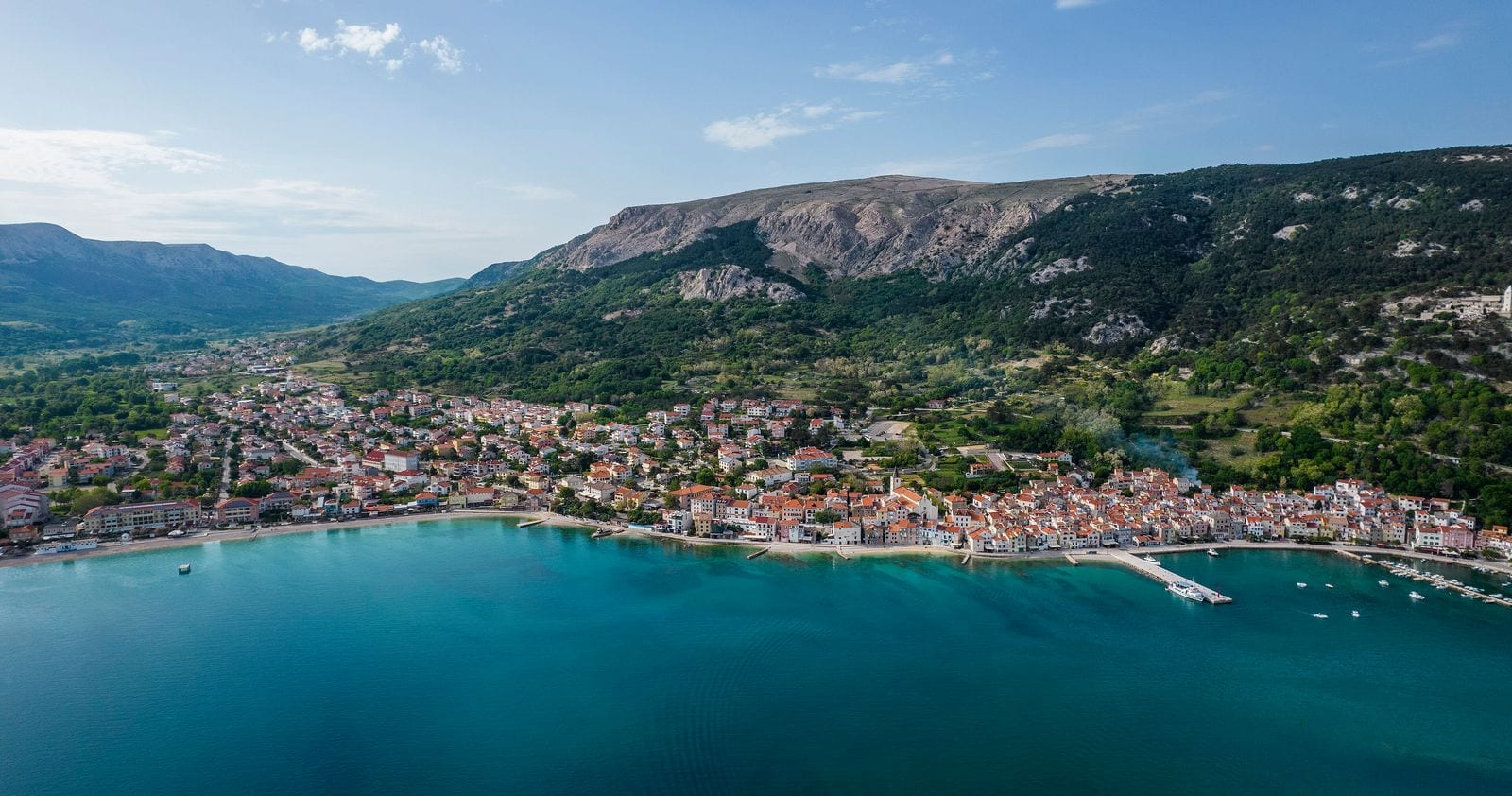
First the awkward news: Austria has not a single IOTA island. Not the Donauinsel in Vienna, not the islands in Lake Wörthersee, none at all. Anyone in OE who wants to activate an IOTA reference has to cross a border — and that is closer than you might think: the nearest group is a good three hours' drive from Villach, in the Kvarner Gulf.
Why that is, what IOTA actually counts, and how a landlocked operator still gets to play — all below.
What IOTA is
Islands on the Air is the oldest and largest island award programme in amateur radio. It was invented in 1964 not by a society but by one man: Geoff Watts, a British shortwave listener and publisher of a DX bulletin. Only in 1985 did the RSGB take the programme over, and for many years it was run by Roger Balister, G3KMA. In 2016 administration moved to the independent, not-for-profit Islands On The Air (IOTA) Ltd, which has run it in partnership with the RSGB ever since.
Today the programme covers around 1200 IOTA groups, of which more than 1100 have been activated at least once. A group is not necessarily a single island — it can range from one islet to hundreds of islands.
The saltwater rule — and why OE gets nothing
Here is the point that causes most of the confusion: IOTA counts sea islands only. Islands in rivers, inland lakes and enclosed bays are explicitly excluded. That rules out everything an Austrian would think of first — the Donauinsel just as much as any island in the Wörthersee or the Neusiedler See.
A landlocked country therefore cannot hold an IOTA reference, and according to the official reference list Austria has none. The same goes for Slovenia: its coastline is too short and has no qualifying island.
Reading reference numbers
Every group carries a continent prefix plus a running number:
| Reference | Group |
|---|---|
| EU-005 | Great Britain (England, Scotland, Wales) |
| EU-110 | Istra group (9A) |
| EU-136 | Kvarner group (9A) |
| EU-179 | Black Sea Coast group (UR) |
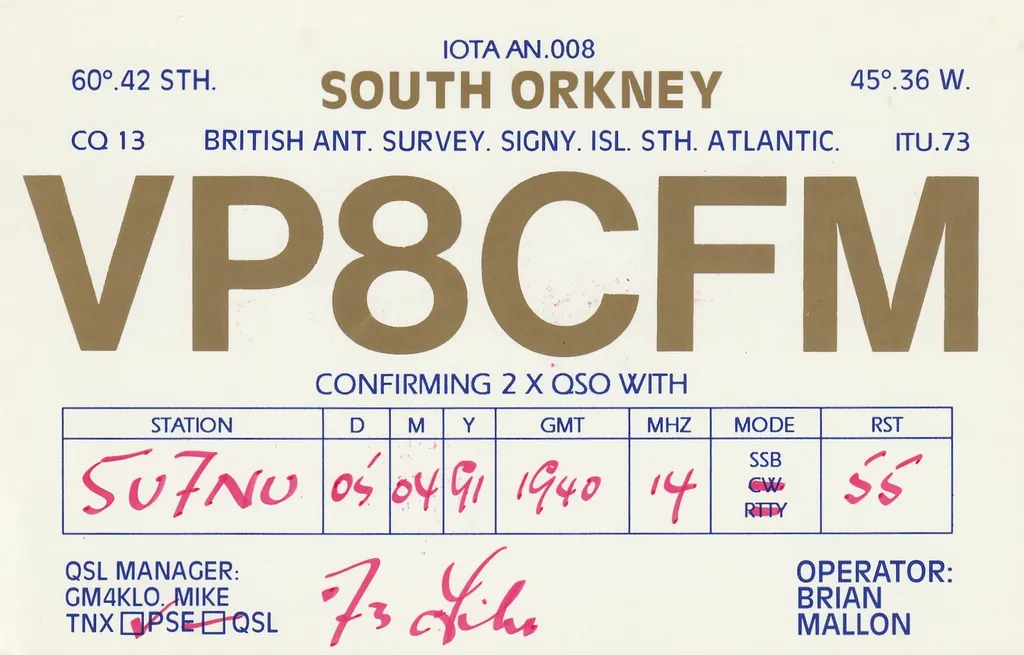
| AN-008 | South Orkney Islands |
The prefixes are AF (Africa), AN (Antarctica), AS (Asia), EU (Europe), NA (North America), OC (Oceania) and SA (South America). QSL cards from island stations usually print the reference prominently — here on a card from Signy Island in the South Atlantic:
The awards
The basic award is „IOTA 100 Islands of the World": 100 confirmed IOTA groups with at least one per continent. After that it continues in hundreds — 200, 300 and so on. Continental and regional awards and special honours come on top.
For the competitive side there are the annually published performance listings: Honour Roll, Annual Listing, plus separate tables for VHF/UHF, club stations and SWLs. Confirmation is by traditional QSL card via the checkpoints or electronically — how that works in practice from Austria is in our article on QSL cards.
Video tip: David Casler explains the programme from the ground up in „Islands on the Air (IOTA), Another Operating Activity".
The IOTA Contest
Once a year the award programme turns into a contest — and for many people that is the actual way in. The essentials:
- When: the last full weekend of July, Saturday 1200 UTC to Sunday 1200 UTC. In 2026 that was 25/26 July.
- Bands: 3.5 / 7 / 14 / 21 / 28 MHz
- Modes: CW and SSB — no digital modes
- Exchange: RS(T) plus serial number; island stations append their IOTA reference, e.g.
59 378 EU136 - Categories: Island or World station, single operator (assisted/unassisted), 12 or 24 hours, high power / low power / QRP
- Points: 15 points for a QSO between different IOTA references, 5 points island-to-world, 2 points world-to-world. The multiplier is the number of different references per band.
The scoring tells you everything about the character of this contest: whoever operates from an island wins. From the mainland you are a point supplier — which is still fun as a first outing, because you will log more island references in 24 hours than in the previous six months. How to approach such a weekend is in Contests for beginners.
What you can actually do from Austria
Chasing from home
The simple route: collect. IOTA stations show up on the usual clusters and on the Reverse Beacon Network, and activations are announced in the DX bulletins. For a start, see DX for beginners — pile-up discipline on a wanted reference is the same craft as on a DXpedition.
Activating on holiday
The more interesting route — and surprisingly close to home. Croatia has exactly five IOTA groups, and two of them sit within the usual Carinthian holiday radius:
| Reference | Group | Well-known islands |
|---|---|---|
| EU-110 | Istra group | Brijuni, Sveti Nikola |
| EU-136 | Kvarner group | Krk, Cres, Rab, Lošinj |
| EU-170 | Dalmatia North group | Pag, Ugljan, Dugi otok |
| EU-016 | Dalmatia South group | Brač, Hvar, Korčula, Vis |
| EU-090 | Palagruža Islands | Palagruža |
Krk is reachable by bridge, no ferry needed — you can drive right up to your operating site. For the licence side, CEPT applies: with an Austrian licence you sign 9A/OE8XYZ, no prior application. Anyone planning this seriously should still check the current Croatian regulations beforehand and announce the activation — nobody finds an unannounced reference.
Video tip: „Ham Radio from a Desert Island — IOTA EU-179 Adventure" documents a real activation from an uninhabited island in the Black Sea, including logistics, antenna work and weather.
How it differs from SOTA and POTA
IOTA is older and slower than the modern outdoor programmes — and that is a property, not a criticism. An IOTA activation is a journey, not an afternoon out. There is no app-based self-spotting as with POTA and no points for the climb as with SOTA. In return, a rare island reference carries a weight that one more summit rarely matches — and for landlocked operators IOTA is the programme you combine with the summer holiday rather than with a weekend.
In short
- Founded in 1964 by Geoff Watts, with the RSGB from 1985, with IOTA Ltd since 2016
- Around 1200 groups, saltwater islands only — no river or lake islands
- Austria holds no IOTA reference at all, and neither does Slovenia
- Basic award at 100 confirmed groups, at least one per continent
- Contest on the last full weekend of July, 1200–1200 UTC, CW and SSB on 80–10 m
- Nearest activatable groups: Istra (EU-110) and Kvarner (EU-136) in Croatia
Sources
- Islands On The Air (IOTA) Ltd — programme overview, reference list, performance listings (retrieved 10 August 2026)
- RSGB: IOTA Programme — founding by Geoff Watts, award levels
- RSGB Contest Committee: IOTA Contest 2026 — dates, bands, categories, scoring
- IOTA Most Wanted List by prefix (PDF) — complete reference list
73 – your oeradio.at editorial team
Title image: Baška on Krk, Kvarner Gulf (IOTA EU-136). Photo: Arne Müseler, CC BY-SA 3.0 DE, via Wikimedia Commons.
Transparency Notice
This article was researched and written with the support of AI (Claude, Anthropic); the details come from the IOTA Ltd and RSGB pages and from the official IOTA reference list and were checked by the oeradio.at editorial team. An earlier version of this article contained two errors: it credited the 1964 founding to the RSGB and gave „EU-120" as a reference for Austrian Danube islands. In fact the programme was created by Geoff Watts, EU-120 denotes the English coastal islands, and Austria — having no saltwater islands — holds no IOTA reference at all. The images are freely licensed; author and licence are given with each image. Found an error? Write to us at [email protected].