A Jammer satire by Hansl Hohlleiter
The club night has been saved. That is what Gottfried Grundsatz, OE0GRS, says, and because nobody else says it, he says it more often.
He saved it from typing. Somebody else, however, had already done the real work.
The talking down
The lad was nineteen, freshly licensed, and made the mistake of having ideas. A foxhunt afternoon for the local school. A balloon with a tracker. A weekend where you show newcomers how to build an antenna instead of explaining why theirs is bad.
Every one of those ideas got the same treatment at the same table.
„We tried that already." „It is not worth the effort." „Nobody will turn up anyway." „And who clears it all away afterwards?" Not a single outright no, just thirty small ones spread over months, friendly in tone, lethal in sum. Nobody threw him out. They simply explained to him, every time, why the thing he wanted would come to nothing.
The rest was handled by Johannes Quantensprung, OE0QTS.
Johannes is the loudest man in the room, reliably, in every round, on every subject. He talks about things he does not do, at a volume that leaves no room for objection. His knowledge is broad, his interest in follow-up questions is not. And on a Wednesday in autumn he threw something at that nineteen-year-old in front of the assembled company that will not be repeated here, because it does not improve on second reading.
Two of them laughed. Nobody objected. And that is the part nobody mentions three years later, when the missing newcomers come up.
The quantum leap
There is a detail about Johannes you need in order to place him properly.
Johannes is also an expert on quantum computers. Two years ago he explained to the assembled company that the quantum computer would shortly replace all other computers. All of them. The laptop, the logbook, the Raspberry Pi in the shack. He did not phrase it as a question but as an announcement, wearing the expression people wear when they have read an article as far as the headline.
The state of the art, briefly: a quantum machine is not a better computer, it is a special tool for a handful of problem classes, factoring for instance, or quantum chemistry. It has no operating system that keeps your log, it needs cooling close to absolute zero, and it will replace your FT8 computer about as soon as a scanning electron microscope replaces your reading glasses. People who know this say „complements". People who do not say „replaces", and they say it loudly.
You could find that funny. I do not find it funny, because the same man explained to a nineteen-year-old with exactly the same certainty what he would never amount to.
A small footnote for the statistics department: when an article appears on this site that somebody dislikes, sometimes a single star gets clicked. One, no comment, usually within an hour of publication. I am not saying who that is. I am only saying that a person with an opinion writes it down, and that a click without text is the shortest way to have one without having to form one.
The campaign
Once the lad was gone, one remnant was left: the group chat on the phone where a few of the younger ones posted photos of their antennas and their portable trips. Too much activity for Gottfried's taste. Too much joy in the wrong place.
Gottfried put a stop to it, thoroughly. He raised the matter at every meeting. He spoke of data protection without ever naming a single item of data. He spoke of dependency on the mobile network, which is technically true, and in the same minute put his own phone on the table because he needed the weather forecast. He explained to a room full of licensed operators that writing is not radio operating.
The strongest argument was the quietest one: „We managed without that in the old days too."
The victory
Gottfried won. You have to give him that, and it is the saddest sentence in this story.
Announcements went back to the noticeboard in the clubhouse and to the Wednesday net, which starts at 19:30, for everybody who at 19:30 is not at work, not putting a child to bed and not studying sixty kilometres away. Whoever was not heard was not there. Whoever was not there was not interested.
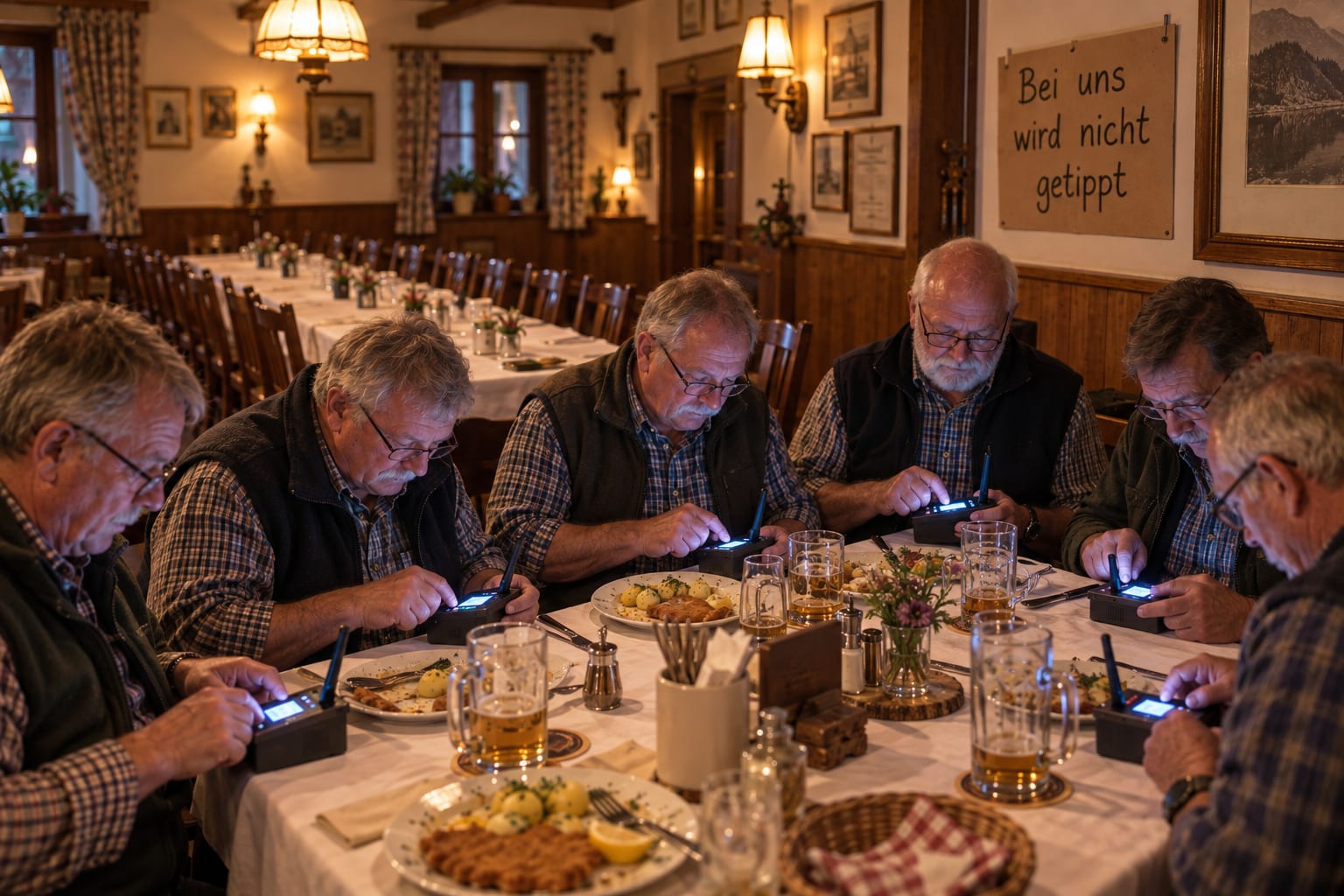
It has been lovely in the clubhouse ever since. Seven people at a table for forty, the schnitzel arrives faster, so does the beer, and nobody shoves a display under your nose uninvited. There is talk of antennas, of the old days and of the state of the club. The state of the club takes a while. Always with the same conclusion: young people just are not interested any more.

The intrusion
And then the mesh network arrived.
In spring a few people started putting up MeshCore devices. Little boxes for twenty euros, 868 MHz, no exam, no licence, no provider. The network grew faster than anybody expected, reaching 32 sites in two weeks, and at some point the coverage reached Gottfried's valley too.
What happened next was announced by nobody. Out of the darkness behind the framed certificates, the Schnitzel Faction stepped into the network.
Gottfried first. „Test", he wrote. Then „Test 2". Then, an hour later, „Can anyone hear me?" At 22:40, long after the Wednesday net had finished. Then Erich with the balcony dipole. Then the treasurer. Then two men everybody assumed had given up the hobby, and who had in fact only given up entering the room where the talking happened.
And then, with the force of a man who has found a new subject, Johannes. Within a week he had explained mesh routing in the channel. He explained it wrongly. He explained it loudly.
The fine distinction
One could now point out that Gottfried is doing exactly what he fought for three years. Typing. In a group. With people who are not currently in the same room.
That would be unfair, because Gottfried has an explanation, and he had it ready instantly, which suggests he needed it beforehand: „That is something completely different. That is radio."
And he is right, actually. It really is different. It is slower, it cannot do pictures, it has no read receipts and no voice messages, thank God. It runs over devices you put up yourself and over repeaters your neighbours paid for, instead of a data centre in Ireland. That is an honest difference, and it is the reason many of us like the network.
There is only one thing it is not: it is not amateur radio. On 868 MHz you need no licence, no callsign and no exam. Gottfried, who spent years explaining that writing is not radio operating, now writes in a network where his licence is worth precisely nothing, next to people who never sat an exam. And he enjoys it.
Good for him. Truly. It is just striking how quickly „that is not radio" turns into „well, that is radio too" once the little box sits on your own windowsill.
The private channel
After two weeks in the public channel came the wish for one of their own. Every group goes through that, and it is not even unreasonable. With the Schnitzel Faction the justification had a familiar ring: there are people writing in here we do not know.
So Gottfried created a channel. „Just for us."
You need to know how this works in the mesh, and it is no secret, it is in every guide: a channel key is derived from the channel name. Whoever knows the name is in. Instantly, without an invitation, without anybody noticing. A channel name is not a password, it is an address that happens to look like one.
The Schnitzel Faction then handed the name around like a leaflet.
Gottfried announced it on Wednesday in the clubhouse, twice, because the back of the room had not caught it the first time. Erich wrote it in the public channel, with the note that everybody should please move over there, because too many people are reading along here. Gustl has been setting it up on every device he gets his hands on ever since, including those of people who never asked. And Johannes explained at length in the public channel why this channel is secure, naming it, twice, because his first post had come out too short.
The private channel now has more listeners than the public one. Nobody knows exactly, because in the mesh you cannot see who is listening. That is also the part the group consistently skips: that you cannot throw anybody out if you do not know who is in.
The bitter bit is that something genuinely private does exist. Direct messages run end to end between two devices, and those really cannot be read by anyone else. Only the Schnitzel Faction does not use direct messages. Nobody else reads direct messages, and a man who writes wants to be heard.
And yes, these are the same people who shut down the group chat on the phone for data protection reasons.
The flasher
The second part of the story has already begun. There will be repeaters, plenty of them, and that is emphatically good, because that is exactly what the network lacks.
Only it will not be just any device. It will be the device everybody has. Not because it is the best one, but because somebody wrote in the channel that this is the one he has, and because by the third time a purchase decision has become a norm. In the end fourteen identical boxes sit on fourteen kitchen tables, and when the fifteenth man asks whether there are alternatives, three people answer: „Take that one, everybody has it."
All of them are flashed by Gustl Großsignal, OE0GGS.
It came about the way such things do: Gustl was the first to write in the channel that he does this, and he has done it ever since. The man who reconfigured his handheld three times a week without ever knowing what changed is now responsible for the firmware on two dozen devices.
He updates. Immediately, consistently, on every release, including the ones whose changelog consists of a single word. What is different afterwards he usually does not know, but current is current. Twice he has altered the radio parameters in the process, whereupon the affected devices transmitted perfectly, just on their own. In the channel this produced a fault-finding session involving eight people whose conclusion was: it was Gustl.
He remains reachable exclusively via WhatsApp. Write to him in the mesh network, for whose firmware he is half responsible in this district, and you get nothing. Message him on the phone and you get three replies.
And Gustl vouches. When somebody in the channel asks what the coverage is like in the next village, he answers reliably: „All good, Kurt has one there, I flashed it myself."
Kurt is Kurt Kellerknoten. His node sits in the cellar. With no antenna attached. It has been running flawlessly for months, the firmware is bang up to date, and nobody has ever heard it. Kurt asks the group roughly every second week whether he may do a quick test. Still nobody answers, except Gustl, who confirms that everything is fine.
The installer
The putting up is then done by Siegfried Pickerl, OE0PIC. He is not a radio amateur, he is a specialist, a distinction he explains gladly, at length, unasked.
Siegfried drives out. Siegfried drills. Siegfried explains while drilling why everybody else would do it wrong, and to be fair: on three sites out of ten he is right. He owns tools nobody else has, he knows how to bond a mast properly, and he is the only man for miles with a ladder you do not have to cross yourself before climbing.
Then, before he closes the lid, he sticks his label on it.
On an enclosure designed by a team in New Zealand. Over firmware written by volunteers. At a site provided by Frau Kowatsch, whose name nobody knows, because what it says on the box is not „Frau Kowatsch's roof" but the logo of a one-man company with its own website.
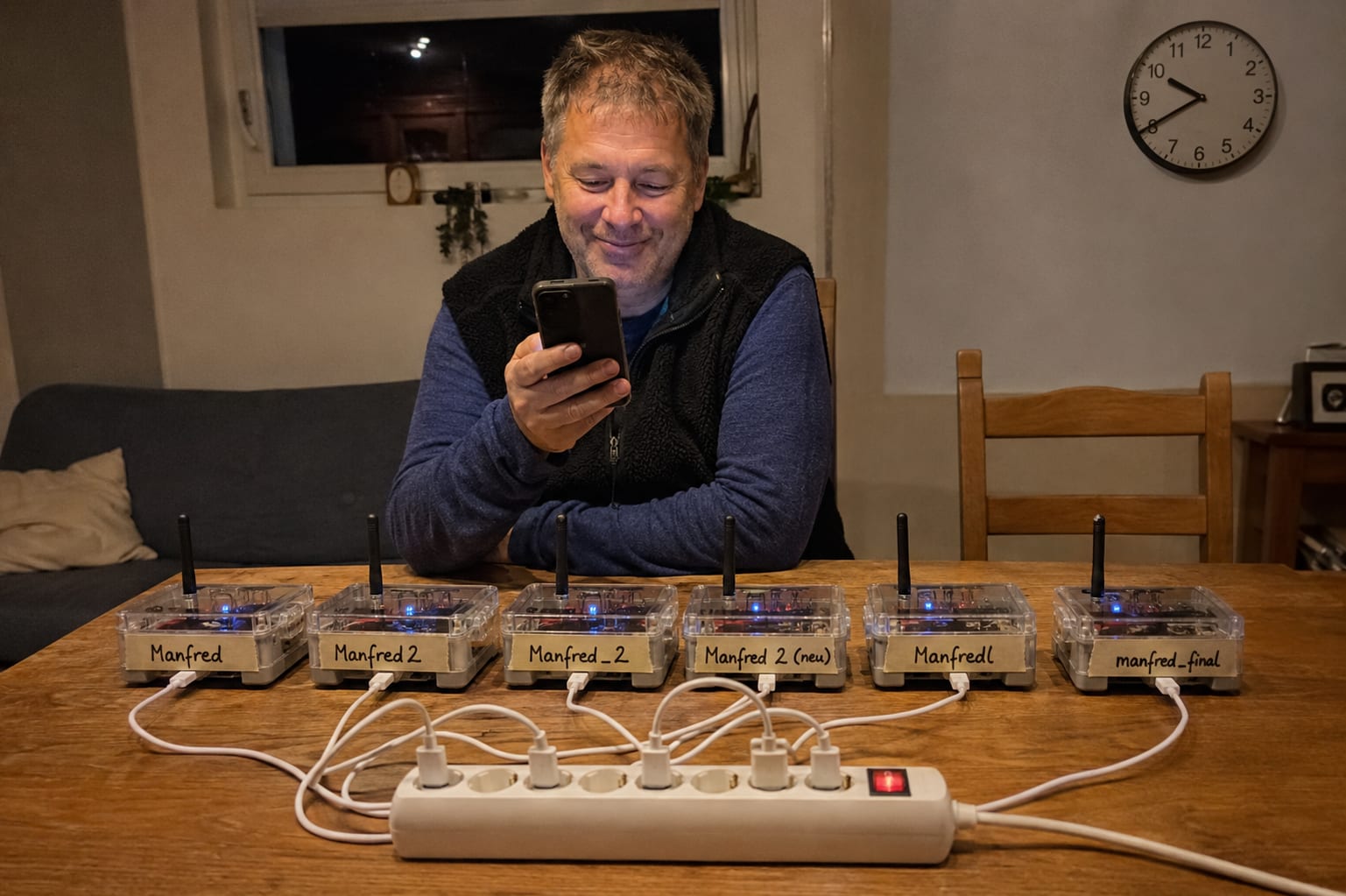
The node list therefore holds six repeaters that are technically identical, and you can still tell them apart. Five are named after mountains. One is named after Siegfried.
The channel they write in
One small thing remains that Gottfried does not know yet, and I have spent a week wondering whether to tell him.
The channel in which the Schnitzel Faction has been writing so diligently since spring was not created by them. Channels in the mesh have no owner, the key is derived from the name, and whoever knows the name is in. But somebody has to claim the name first and pass it on, otherwise you are talking to yourself.
It was claimed by a twenty-two-year-old, eighteen months ago, together with two others who started the network in this district because they fancied doing radio and could not find a place for it.
He is the same one who was told thirty times that his ideas would come to nothing, and to whom Johannes then said what he thought of him.
He is still there. He reads along when Gottfried asks at 22:40 whether anyone can hear him. And he answers. Every time.
And now seriously
This is not a story about old men and new technology. Old men and new technology get along splendidly, see every second homebrew project in this country.
This is a story about two channels. The first ran for three years across a table in the clubhouse on Wednesday at half seven, and whoever could not sit at it did not exist. The second costs twenty euros, runs at ten in the evening from the sofa, and suddenly everybody is back. The young ones who never left, and the old ones everybody assumed had quit.
The difference between the two is not the technology. The difference is that in the second one nobody gets told mid-sentence that it will come to nothing anyway.
So when somebody says at the next club night that young people are not interested any more, please do not hold a phone under his nose. Show him the node list. And then ask him which of those names last sat at his table.
All persons and callsigns in this article are fictitious. Similarities to living radio amateurs are intentional but not actionable. The author accepts no liability for schnitzel going cold during reading, nor for stars awarded afterwards.
Transparency Notice
This article was researched and written with AI assistance (Claude, Anthropic). Editorial responsibility and fact checking rest with the oeradio.at team. The title image was generated with AI; the inline photograph comes from Wikimedia Commons and is credited accordingly. Suggestions and complaints, including from the Schnitzel Faction, are welcome at [email protected].