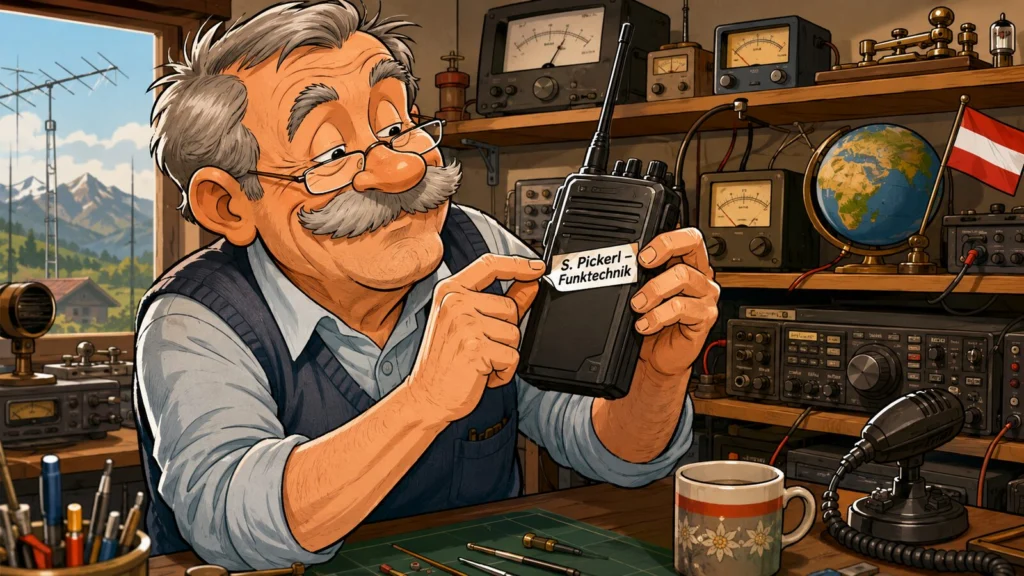
A Störsender satire by Hansl Hohlleiter
Siegfried Pickerl, OE0PIC, is a specialist. Not a radio amateur — a specialist. He's happy to explain the difference, at length, unprompted. A radio amateur, says Siegfried, tinkers. A specialist knows. And Siegfried knows everything. He has known everything for over forty years, and since retiring he knows it with even more time on his hands.
By rights Siegfried should be sitting in the garden by now. Instead he sits in the company van — which he bought off the firm "for sentimental reasons" — and drives to jobs nobody called him for. "I'll just take a quick look," he says, and then spends three hours rebuilding something that worked fine before. Siegfried cannot stop. Working is the only thing he has ever done, and a man who can only work doesn't stop working just because nobody pays him anymore.
His trademark — quite literally — is the sticker. Over the years Siegfried has commissioned thousands of radios. Business radio, taxi firms, the fire brigade in the next village, a sawmill. And onto every single device that passed through his hands he stuck his company label. Not just anywhere. Right over the manufacturer's logo. Where it once said "Motorola" it now says "Pickerl Radio Systems — Your Specialist". Neatly trimmed, bubble-free, aligned with a ruler. You have to turn a unit over and hunt for the type plate to realise Siegfried didn't build it.
And that's the point. That is exactly the point. The sticker doesn't just cover the logo. It covers who actually did the work. Engineers in Illinois spent years calculating that receiver, an entire supply chain built it, tested it, shipped it. Siegfried unboxed it, programmed it — and stuck his label on top. To the customer at the sawmill it's a "Pickerl unit". A Siegfried unit. And Siegfried never disturbed him in that belief.
When Siegfried turns up at the local net — rarely, but effectively — it isn't to listen. He comes to correct. Someone mentions an antenna: mounted wrong. Someone talks about digital radio: "done completely differently these days". Someone proudly describes a homebrew project: Siegfried smiles the smile of the man who knew back in 1987 that it would come to nothing. He rarely says outright that someone is wrong. He says: "Weeell." And that "Weeell" has silenced more newcomers than any jammer.
The tragic part: Siegfried has never built anything. In forty years he has not developed a single device, designed a single circuit, invented a single solution that didn't exist before. He installed, configured and re-labelled other people's technology. That is honourable work, important work even — but it is not what Siegfried takes himself for. Siegfried takes himself for the inventor of radio. When all along he was only ever the one who put the sticker on. His life's work is an adhesive film over the achievements of others.
Amateur radio Siegfried despises politely. "You hobby operators," he says, meaning everything he is not: unpaid, curious, learning, willing to be wrong. That a radio amateur calculates an antenna himself, builds it, scraps it, rebuilds it and in doing so understands something Siegfried never had to understand because it was all in the manual anyway — that thought does not occur to him. His knowledge is a memorised datasheet. Deep, but rigid. He knows every value. He has never asked a question.
And there isn't just one Siegfried. In every district sits a specialist who covers the manufacturer's logo and explains the world to everyone else. They recognise each other at a hundred metres — by the company van, the shirt with the embroidered logo, the tool case that cost more than some people's whole station. They nod to one another like colleagues in a profession that doesn't really exist: the profession of being right.
Sometimes, when the van sits in the garage and the phone doesn't ring because the firm has long belonged to someone younger, Siegfried sits in his workshop among a thousand re-labelled radios and, for a moment, doesn't know who he is if he isn't the specialist. The sticker he spent his life putting over other people's logos has, in the end, covered something of himself too: the question of what remains once you peel the film away.
Hansl's verdict: Being a specialist doesn't mean sticking your logo over someone else's. It means being able to do something that wouldn't happen without you. The most honest sticker would be one that covers nothing — but adds: built by many, set up by me, understood by the one who asked. Until then: covering someone else's logo doesn't make you the manufacturer. It just makes you someone with a nice sticker.
All persons and callsigns in this article are fictional. Resemblances to living radio amateurs are intentional but legally inconsequential. The author accepts no liability for spontaneous self-recognition.
Transparency Notice
This article was written with the assistance of AI (Claude, Anthropic). Editorial responsibility lies with the oeradio.at team. Feedback — including from Siegfried — welcome at [email protected].