The antenna gets all the attention – yet the unremarkable piece in between often decides between success and frustration: the coaxial cable. The wrong cable quietly burns off much of your transmit power and weakens every incoming signal. This article shows which cable makes sense when – from RG-58 through RG-213 and LMR-400 to Ecoflex – with solid attenuation figures and practical notes for Alpine setups.
Why the cable matters
Every cable attenuates – it turns RF into heat, measured in decibels per length (dB/100 m). The key rule of thumb: 3 dB of loss means half the power, 6 dB a quarter, 10 dB just a tenth. And it works both ways: what stays in the cable on transmit never reaches the antenna; what is lost on receive you never hear. Attenuation is a length multiplier – double the cable, double the dB.
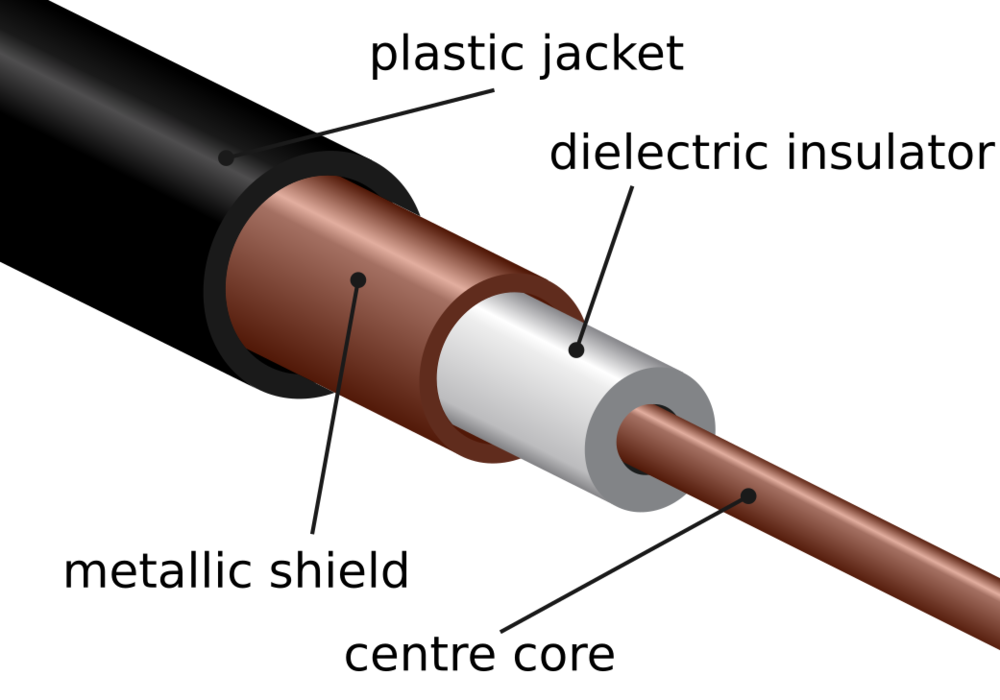
The build: four layers
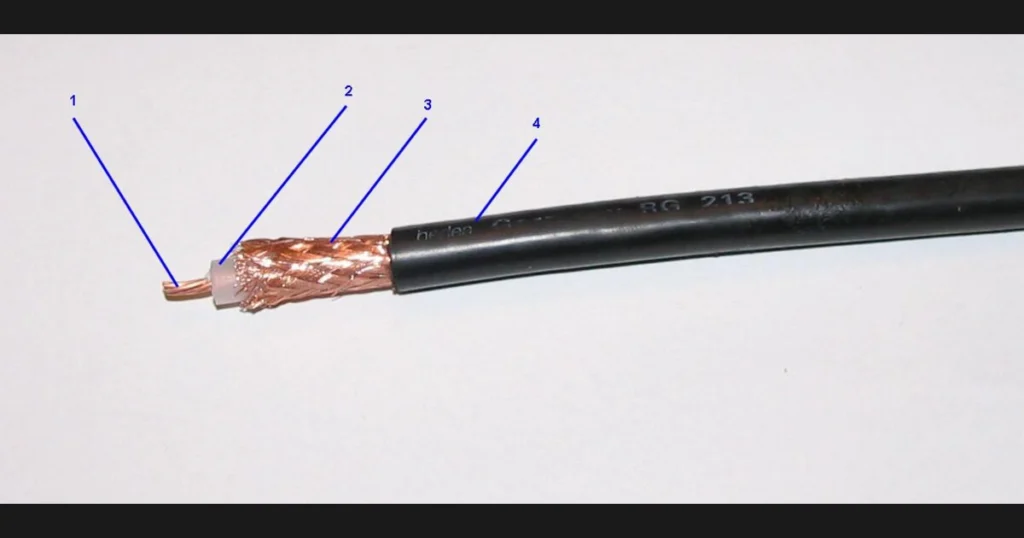
From the inside out, a coax has a centre conductor, a dielectric (insulation, often foam polyethylene), a shield (braid, plus foil on good cables) and an outer jacket. The shield keeps interference out and transmit energy in. Cheap RG-58 often has only a thin single braid; modern low-loss cables such as Ecoflex or Aircom Plus combine foil and braid for over 90 dB of shielding – important against QRM.
50 or 75 ohms? For transmitting, 50 Ω is standard: the best compromise between power handling and loss. 75 Ω (e.g. RG-6) sits closer to minimum loss and is used for receive, video and cable TV – unsuitable for transmit. Velocity factor: solid-PE cables (RG-58, RG-213) run 0.66, foam cables like LMR-400 around 0.85 – relevant once you use cable lengths for matching.
Attenuation: the number that counts
This is where cables part ways. The figures below are typical, rounded values from manufacturer datasheets and amateur-radio references, cross-checked across several sources:
| Cable | ~14 MHz (HF) | ~144 MHz (2 m) | ~432 MHz (70 cm) |
|---|---|---|---|
| RG-58 | ~4,9 | 20,3 | ~35 |
| RG-8X | ~3,3 | 15,4 | ~28 |
| RG-213 / RG-8 | ~1,8 | 9,2 | ~17 |
| LMR-400 | ~1,5 | 4,9 | ~8,8 |
| Aircell 7 | ~2,6 | 7,6 | 13,6 |
| Ecoflex 10 | ~1,4 | 4,9 | 8,9 |
| Ecoflex 15 | ~1,0 | 3,4 | 6,1 |
| RG-6 (75 Ω) | ~2,3 | ~9 | ~17 |
The takeaway: on HF, all the „thick" cables are practically equal (RG-213, LMR-400, Ecoflex all under 2 dB/100 m). Only on 2 m and 70 cm does it split dramatically: RG-58 loses about 35 dB/100 m at 70 cm – practically useless for longer runs – while LMR-400 or Ecoflex 10 stay under 9 dB.
Run the numbers: instead of a rule of thumb, work out your specific case. The KV5R Coax Loss Calculator and the CO8TW Coax Calculator compute, for dozens of cable types, the matched loss, the extra loss from SWR and the power actually reaching the antenna – just enter cable type, length and frequency.
Which cable for what?
Rule of thumb: keep total feedline loss under 1–2 dB where you can. That gives:
HF (up to 30 MHz), up to ~30 m: RG-213 is usually plenty and offers the best value. For long runs or high power: Ecoflex 10 or LMR-400. RG-58 only for short patch leads under 5 m.
2 m (144 MHz): from ~10 m use at least RG-213, better Aircom Plus, Ecoflex 10 or LMR-400. Avoid RG-58.
70 cm (432 MHz) and up: low-loss is mandatory – LMR-400, Ecoflex 10/15, Aircom Plus. For long runs to the mast or summit, Ecoflex 15.
Portable/QRP: RG-8X or Aircell 7 – a good compromise of loss, weight and flexibility. A fit for a vertical antenna or a Yagi.
At the usual 100 W, by the way, power handling is almost never the issue – even RG-58 takes several hundred watts on HF. The criterion is practically always loss, not power rating.
The SWR fallacy
A low SWR at the shack is not proof of a good antenna. Reflected power has to travel back through the cable and is attenuated a second time. With a long or lossy cable, barely anything returns – so the SWR meter reads deceptively low. A 2.0:1 at the antenna can disguise itself as a harmless 1.3:1 at the rig. To know for sure, measure at the antenna, for example with a NanoVNA.
Connectors: PL-259, N or BNC?
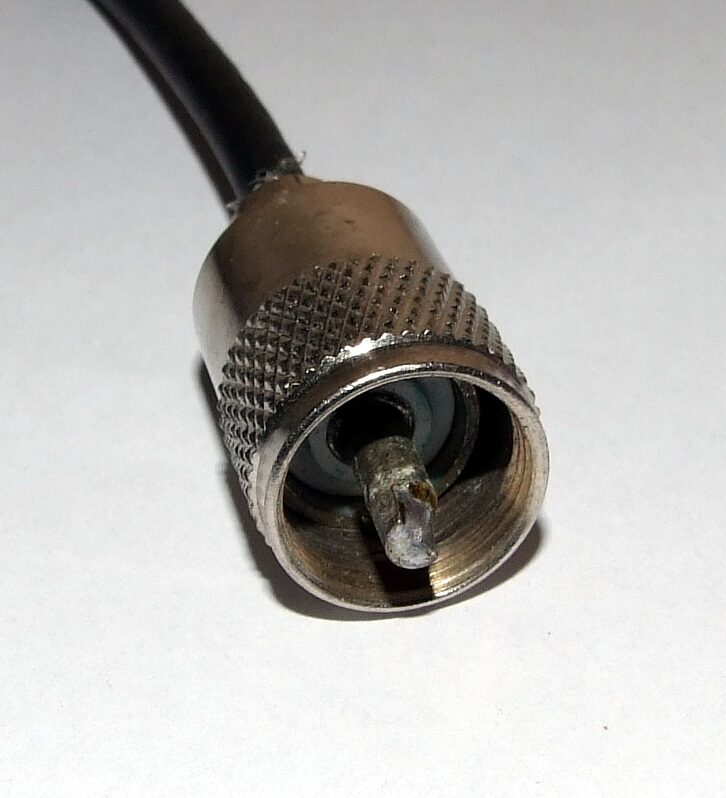
PL-259 / SO-239 (UHF connector): the classic on HF through 2 m. Not a true 50-Ω connector by design, which is irrelevant on HF but measurable at 70 cm. Rugged, high current capacity, easy to solder.
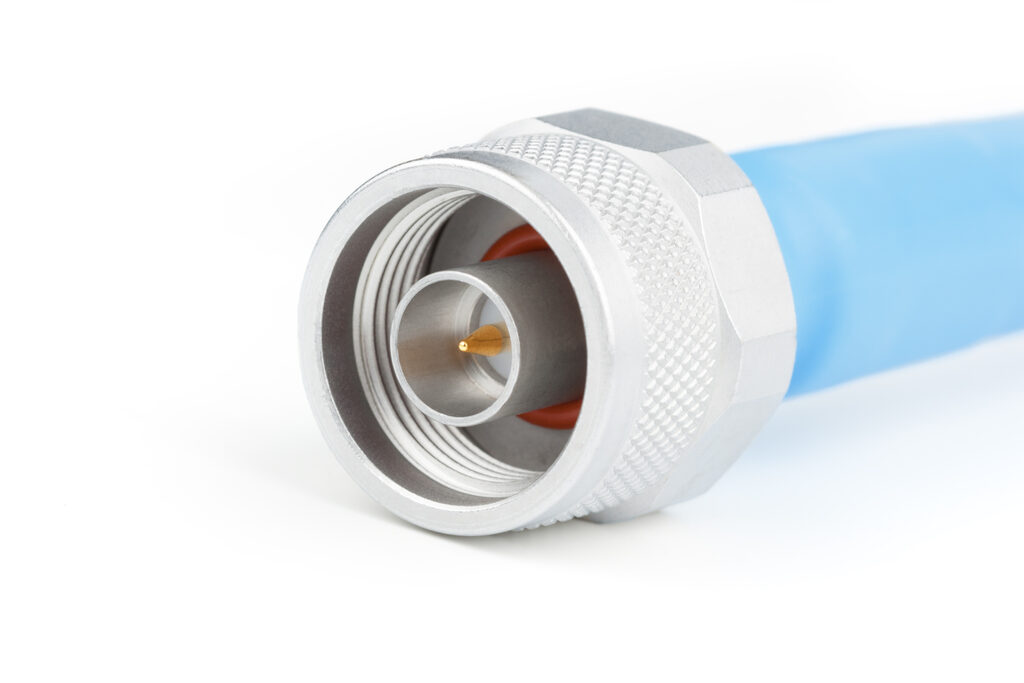
Type N: a true 50-Ω connector into the GHz range, weatherproof – the first choice for VHF/UHF and any outdoor connection.
BNC: bayonet quick-lock, true 50 Ω (careful: 75-Ω versions exist too!), ideal for test gear, handhelds and QRP – not for high power or exposed outdoor use.
Important: seal every outdoor joint with self-amalgamating tape, then a layer of UV-resistant tape on top. Water ingress is the most common cause of slowly rising attenuation.
Common mistakes
• RG-58 for long VHF/UHF runs – the classic, throws away most of your power.
• Unsealed connectors – water wicks into the braid and attenuation rises for good.
• Cheap CCS cable (copper-clad steel core) – mechanically fragile; choose solid copper for serious feedlines.
• Bend radii too tight – they deform the dielectric and create impedance bumps. Thick low-loss cable is stiff!
Alpine practice: fixed vs. portable
Two worlds. Fixed station: with the antenna on the roof or on a mast, 15–40 m of cable adds up quickly – on 2 m/70 cm that clearly argues for low-loss. Portable and SOTA: the opposite. Here the cable is short (5–10 m) and loss is barely an issue – instead every gram counts. Nobody hauls stiff LMR-400 up a summit; you take light, flexible RG-8X or Aircell 7. Beyond that, in the mountains: intense UV at altitude ages PVC jackets fast – choose UV-resistant PE. And temperature swings plus moisture make cable „breathe" and draw water – sealed connectors here are not a luxury but a must.
Video: cables compared
Conclusion
Don't buy the most expensive cable – buy the right one: on HF, RG-213 is almost always correct; on VHF/UHF and over long runs, there is no way around low-loss. Measure when in doubt, seal every outdoor joint – and remember that the feedline is the invisible half of your antenna system.
73 – your oeradio.at editorial team
Image credits
Title image (RG-213) & PL-259: Appaloosa, CC BY-SA 3.0 • cross-section diagram: Tkgd2007, CC BY 3.0 • Type-N connector: Swift.Hg, CC BY-SA 3.0 – all via Wikimedia Commons.
Transparency notice
This article was researched and written with the help of AI (Claude, Anthropic). The technical data – especially the attenuation figures – were checked against several independent sources (manufacturer datasheets, amateur-radio references). Errors can never be fully ruled out; verify critical values in the relevant datasheet before buying. Questions or corrections? Write to us at [email protected].