Table of Contents
- What is ARDF?
- How a classic event runs
- The four formats
- Classic 80 m (3.5 MHz)
- Classic 2 m (144 MHz)
- Sprint
- Foxoring
- The technology: transmitters
- The technology: receivers and antennas
- Video: what it looks like in practice
- ARDF in Austria
- Registering
- Categories
- Why it works so well for newcomers
- Alpine terrain: curse and blessing
- In short
- Sources
- Transparency Notice
Five transmitters are hidden somewhere in the forest. Each one comes up for exactly one minute, then the next takes over. You have a map, a compass, a direction-finding receiver and running shoes — and you have to work out the order in which to collect them so you are not the last one home. This is ARDF, Amateur Radio Direction Finding, also known as fox hunting or radio orienteering.
The most important sentence first: you do not need an amateur radio licence. Competitors only receive — nobody transmits. At the Austrian ÖVSV events you can even borrow a direction-finding receiver when you register.
What is ARDF?
ARDF is orienteering with an extra dimension: the controls are not printed on the map, they have to be found by their radio signal. It combines stamina, map reading and direction-finding technique — and a fast runner who picks the wrong route loses to a slower one who takes clean bearings and plans well.
The sport is organised internationally: IARU Region 1 publishes the rules that Austrian events follow too. You do not have to treat it as a competition, though — the ÖVSV explicitly welcomes beginners, and an event takes about an hour.
How a classic event runs
Five transmitters plus a finish beacon are placed in the competition area. The five foxes transmit one after another on the same frequency, each for exactly one minute, in a five-minute cycle. You tell them apart by their Morse identification:
| Transmitter | Code | Slot in the cycle |
|---|---|---|
| Finish beacon | MO | continuous, own frequency |
| No. 1 | MOE | first minute |
| No. 2 | MOI | second minute |
| No. 3 | MOS | third minute |
| No. 4 | MOH | fourth minute |
| No. 5 | MO5 | fifth minute |
The scheme is elegant: after MO comes E (·), I (··), S (···), H (····), 5 (·····) — the number of dots is the transmitter number. You do not need to be a CW expert; after two cycles you count the dots without thinking.
The rest of the rules in brief:
- Not everyone hunts all five. The number of transmitters depends on your category — from three plus beacon in the older classes up to five plus beacon in M21. The order is free; only the finish beacon must be registered last.
- The foxes are well spread out: at least 400 m apart, and the nearest one at least 750 m from the start.
- Effective course lengths run from roughly 5 to 10 km depending on category, and total climb must not exceed 6 % of the course length.
- Each transmitter is marked with the orange-and-white orienteering flag (three 30 cm squares) and an electronic punching device — usually SportIdent, as in orienteering.
- Two bands, two days: at championships 80 m and 144 MHz run in parallel with six transmitters each. One group of categories runs 3.5 MHz on day one and 144 MHz on day two; the other group swaps.
The four formats
Classic 80 m (3.5 MHz)
The standard discipline. On 80 m propagation in the forest is predictable, the signal largely follows the ground wave. Bearing errors come less from reflections than from terrain shape and your own impatience.
Classic 2 m (144 MHz)
Technically the harder version: on 2 m, slopes, rock faces and forest edges reflect the signal, and a clean maximum can point in completely the wrong direction. Recognising reflections and discarding false bearings is where you win time — especially in alpine terrain.
Sprint
Short, fast and spectator-friendly: two loops of five transmitters with a spectator control in between. The transmitters do not change every minute but every 12 seconds, so a full cycle lasts one minute. The second loop uses a different frequency and faster keying. Planned winning time: about 15 minutes. Transmitters stand only 100 m apart, and the event is often held in a city park.
Foxoring
The beginners' discipline — and tactically the most interesting. The approximate transmitter positions are printed on the map, but the transmitters run on just 10 milliwatts: audible only within about 30 m, and definitely not at 250 m. So you navigate to the circle on the map like an orienteer and then take bearings for the last few metres. Get lost and you hear nothing at all — but you need very little direction-finding experience to succeed.
The technology: transmitters
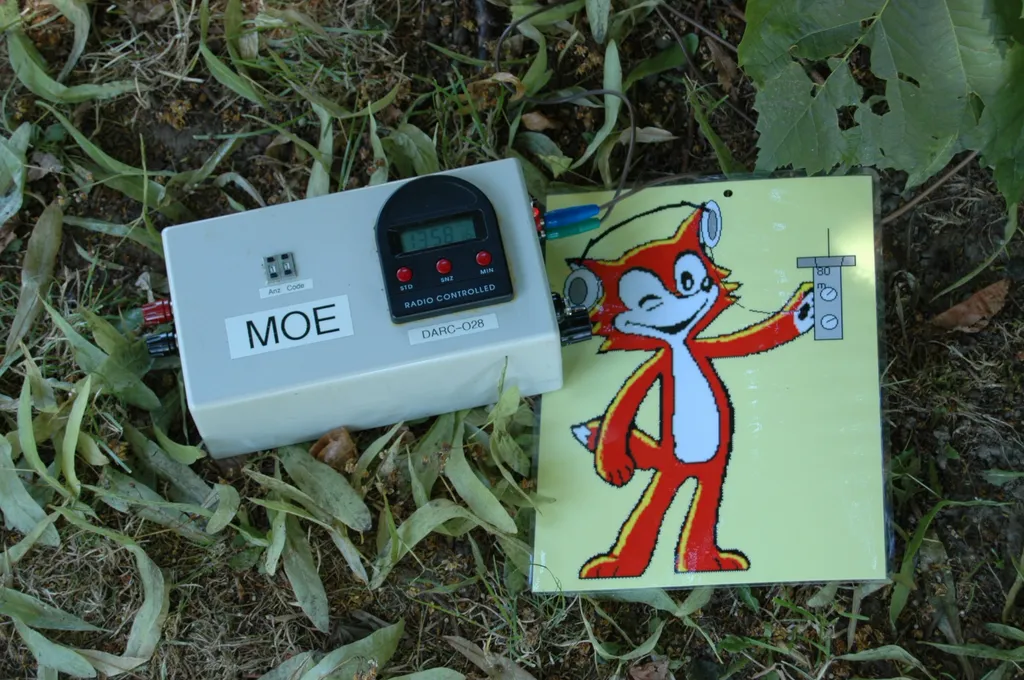
The foxes are not improvised boxes but built to IARU specification:
- 80 m: 3.510–3.600 MHz, 1 to 5 watts, mode A1A (keyed unmodulated carrier), keying speed 8–15 WPM, vertical antenna.
- 2 m: 144.500–144.900 MHz, 0.25 to 1 W ERP, A2A (tone-modulated carrier), horizontal polarisation, antenna 2 to 3 m above ground.
- Foxoring: only 10 mW — the finish beacon still runs at normal power.
So the difference in range between the bands comes less from power than from polarisation, antenna height and propagation behaviour. And note: the transmitters must be operated by licensed radio amateurs — only the competitors need no licence.
The technology: receivers and antennas
One misconception is stubborn, so let us be clear: you do not use a Yagi on 80 m. A Yagi for 3.5 MHz would be twenty metres wide — nobody carries that through a forest.
- 80 m: a ferrite rod or small loop antenna. It has a figure-of-eight pattern with two sharp nulls, so you do not aim at the maximum but at the point where the signal disappears, which is far more precise. The figure-of-eight gives two opposite directions; a switchable sense antenna resolves that by turning the pattern into a cardioid with a single null. Two bearings from different places, crossed in your head, give you the line.
- 2 m: a compact handheld antenna, typically a two- or three-element Yagi or an HB9CV — about arm's length, swingable on the run. Here you aim at the maximum and reduce sensitivity as you close in, otherwise everything sounds equally loud.
The receivers themselves are specialised sets with adjustable attenuation and a signal meter. Kits and small production runs from within the sport are common, alongside ready-made units from Czech and Chinese manufacturers. For a first outing the rule is simple: borrow before you buy — the ÖVSV provides receivers on registration.
What to bring yourself: stereo headphones with a 3.5 mm (three-pole) jack and a 9 V battery, plus trail shoes and long trousers for the undergrowth.
Video: what it looks like in practice
ARDF in Austria
The ÖVSV runs around 17 direction-finding events per season, spread from April to October across almost all regional associations. Most of them count towards the Austrian ARDF championship. Carinthia's contribution this year was Döbriach on 22 July, embedded in the DX camp at Lake Millstatt.
Still to come in 2026:
| Date | Location | Region | Event |
|---|---|---|---|
| 16–22 August | Târgoviște, Romania | — | 25th IARU R1 ARDF Championship |
| Sat 29 August | Ebenau | OE2 | 80 m |
| Sat 5 September | Vienna-Kaltenleutgeben | OE1 | 80 m foxoring + 80 m classic |
| Sun 13 September | Telfs-Mieming | OE7 | 80 m, at the OE7 regional field day |
| Sat 19 September | Bad Loipersdorf | OE6 | 2 m, at the Thermenland meeting with flea market |
| Sat 17 October | Mureck (Röcksee) | OE6 | 80 m, season finale with roast chestnuts |
Briefing at most events is at 10:30, start at 11:00. The current calendar is at ardf.oevsv.at.
Registering
An informal email to [email protected] with your callsign or name. First-timers also give their year of birth (for the category) and say whether they need a receiver and an introduction. Both are available free of charge. You can leave a mobile number for last-minute SMS updates; those are also posted on the ARDF site.
Categories
Competitors are grouped by sex and age: W19, W21, W35, W45, W55, W65 for women and M19, M21, M40, M50, M60, M70 for men. W21 and M21 are open classes regardless of age — that is where you go for the full course. With increasing age the number of transmitters and the course length go down; the challenge does not.
Why it works so well for newcomers
ARDF is one of the few amateur radio activities you can take part in fully before passing the exam. No callsign, no rig to buy, no antenna negotiation with the landlord — running shoes will do. And anyone who then wants to know why a ferrite antenna has two nulls ends up looking at the licence exam all by themselves.
There is also the sporting appeal that many people miss in the hobby: a clock, a ranking, and a direct link between skill and result. If that appeals, contesting is the on-air equivalent — and for a first playful taste, our Funkparcours is the lowest possible threshold. More on the subject in Youth and amateur radio.
Alpine terrain: curse and blessing
In Austria you rarely run on the flat. Steep slopes cost energy and distort your sense of distance; on 2 m, rock faces produce reflections, and on 80 m hilly ground appears to shift the bearing. The rules cap total climb at 6 % of the course length, but you still feel the metres that remain.
The compensation: in the mountains, route choice becomes the real discipline. Whether you cross the gully or run around it decides minutes — and that is exactly the attraction.
In short
- Five transmitters, codes MOE to MO5, one minute each in a five-minute cycle, beacon MO continuous
- 80 m: ferrite or loop antenna, bearing on the null, sense antenna to resolve the ambiguity
- 2 m: small Yagi or HB9CV, bearing on the maximum, watch out for reflections
- Four formats: classic 80 m, classic 2 m, sprint (12-second slots), foxoring (10 mW)
- No licence required, receivers are lent out, registration to [email protected]
Sources
- IARU Region 1 — ARDF Working Group, Rules Part B (2020 edition) with the appendices on equipment, sprint and foxoring
- ÖVSV — ARDF / Amateurfunkpeilen and ardf.oevsv.at (2026 calendar, registration details)
- IARU R1 — 25th ARDF Championship 2026, Târgoviște
73 – your oeradio.at editorial team
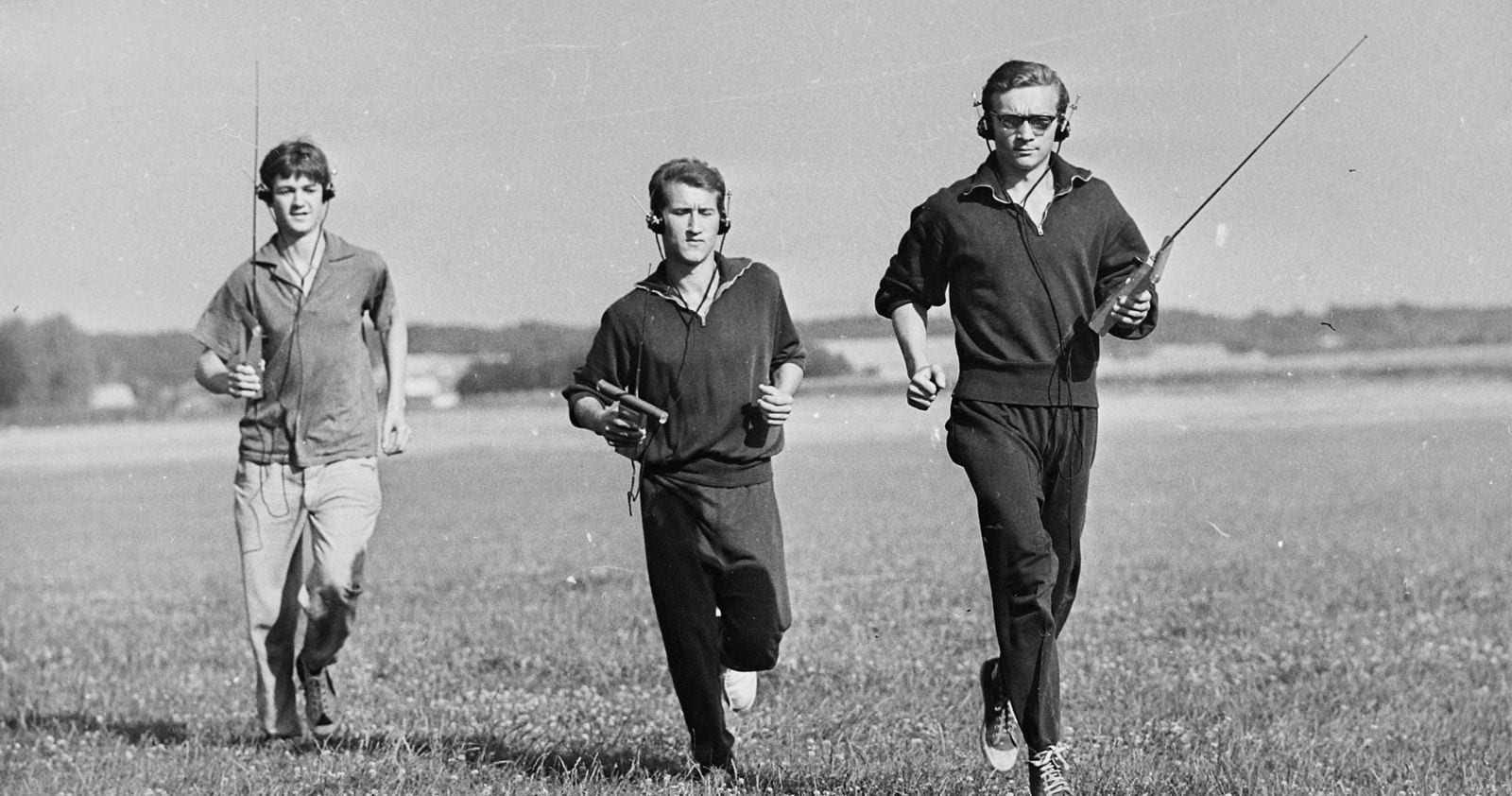
Title image: direction-finding competition, 1966. Photo: Fortepan / MHSZ, CC BY-SA 3.0, via Wikimedia Commons.
Transparency Notice
This article was researched and written with the support of AI (Claude, Anthropic); the technical figures come from the IARU Region 1 rules (Part B, 2020 edition) and the ÖVSV pages and were checked by the oeradio.at editorial team. The title image and the transmitter photo are freely licensed pictures from Wikimedia Commons; the licences are given with the images. Questions or corrections? Write to us at [email protected].