Table of Contents
- What is FunkParcours, exactly?
- A full dozen game modes, one principle
- Spelling, Numbers & Time
- Reports & Procedure
- Maps & Situations
- For Advanced Operators & for Fun
- Why it works so well with PMR
- Set up a game in five minutes
- Fair is fair: anti-cheat and scoring
- Game ideas for your next PMR session
- Passed the real-world test: HTL Villach activity days
- Open to everyone — give it a try
- Transparency Notice
Hello everyone, Ferdl here again. Today with something that genuinely delights me, because it brings together two things that rarely sit at the same table: real radio operation and a bit of fun and games. I'm talking about FunkParcours, a small web tool from the oeradio.at workshop that lets you run a radio exercise as a competition in just a few minutes. And the best part: it works with any radio — even the licence-free PMR walkie-talkies you can pick up at the hardware store.
What is FunkParcours, exactly?
FunkParcours is a web tool for radio exercises. The idea behind it is as simple as it is clever: a control station sees a task on their screen and must pass it over the radio to a receiving team. The team listens and reconstructs the task on their own screen. At the end, the tool tells you plainly how accurately the message came through and how long it took.
The key trick: the radio is the channel, not the internet. The platform never transmits the task content from the control side to the receiving side. It is only the source of truth and the referee that measures accuracy at the end. Anyone who wants to get the task across must actually pass it cleanly — spell it out, structure it, repeat it. Exactly what matters in emergency radio and real-world operation.
A full dozen game modes, one principle
To make sure there's something for every occasion and every skill level, there are currently thirteen different task types. All follow the same basic principle — pass it on, reconstruct it, score automatically — but each trains quite different skills. From a gentle introduction for children to a serious emergency radio drill, everything is covered.
Spelling, Numbers & Time
- Spelling (NATO) – passing call signs or words cleanly using the international phonetic alphabet. Alfa, Bravo, Charlie — and woe betide anyone who lets an "Anton" slip in.
- Active spelling (Encode) – the reverse: the control station reads out a plain word, and the team must translate it themselves into the NATO alphabet (Foxtrot Uniform November Kilo). After this, the alphabet is guaranteed to stick.
- Numbers & frequencies – digits, frequencies, and channels in radio speech: "Zero, Two, Three" instead of mumbling. Exactly what you really need on the air.
- Time & date – passing times and dates in radio format and typing them back. Sounds simple, but under time pressure it's half the battle.
Reports & Procedure
- Report – a structured emergency radio report with multiple fields (From, To, Location, Situation, Number, Priority …). Practises passing a real report in an orderly and complete fashion, so nothing is missing on the receiving end.
- Radio message (fill-in-the-blank) – a fixed message template is provided; the team only fills in the blanks (call sign, location, time …). Perfect for internalising procedure and the correct way to speak.
- Sequence / march table – the control station announces the correct order of stations or steps; the team sorts them. Trains focused listening across multiple items.
Maps & Situations
- Symbol grid – a labelled grid with shapes and colours, announced field by field ("C3, blue triangle"), reconstructed by tap or drag & drop. A wonderful starting point, great for children too.
- Coordinates – placing markers on a labelled grid, essentially "Battleship" over the radio. Trains precise position calling.
- Tactical sketch – a small situation map with arrows, hazard points, assembly areas, and objectives is described and reconstructed cell by cell — including direction. The queen of map tasks.
For Advanced Operators & for Fun
- Relay (Chinese Whispers) – a message passes through an entire chain of groups: each one passes on what it understood. At the end every group is scored against the real original, and you can see in black and white how errors compound. An eye-opener.
- Interference (copy through noise) – the platform deliberately generates noisy radio audio that the control station plays over the channel. The team copies what they can still make out. Exactly the skill that counts with weak signals.
- Radio theory (quiz) – the control station reads out a question along with the answer options; the team notes only the letter they heard. Knowledge and listening in one.
Scoring happens automatically: the tool compares the reconstructed answer with the original and calculates an accuracy from 0 to 100 percent. On top of that comes the time, which is stopped server-side — from the moment the control station reveals the task until the team submits. Cheating with a stopwatch on your phone won't get you anywhere.
Why it works so well with PMR
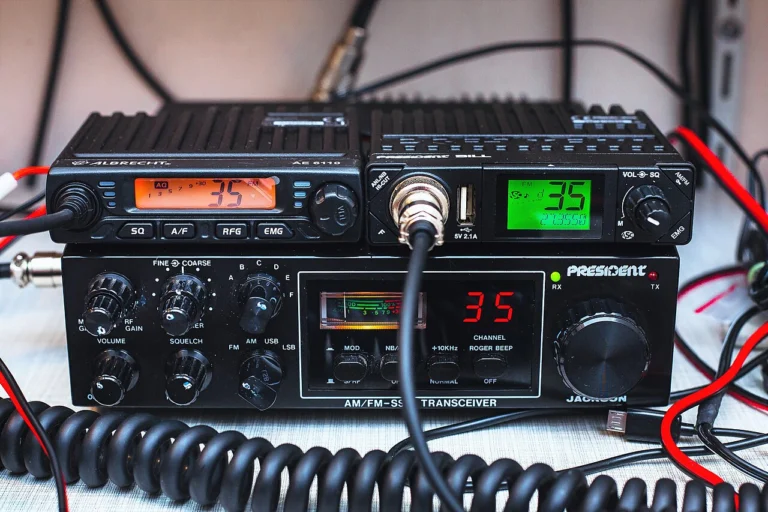
And now comes the part that is closest to my heart. For FunkParcours you need no amateur radio licence. A pair of PMR446 walkie-talkies is enough — the small 0.5-watt radios that anyone can buy and operate without a test. This instantly turns the tool into something you can play with the whole family, a school class, a youth group, or at a club night.
The maths is simple: two cheap PMR radios, two phones or tablets with a browser, and the radio link is up. No call sign, no registration, no expensive equipment. For us radio amateurs this is a door-opener: you put a radio in someone's hand, let them pass a symbol grid — and suddenly that person understands all by themselves why you spell things out, why you speak briefly and clearly, and why this hobby with radio waves is actually a lot of fun.
Of course FunkParcours works just as well on 2 m and 70 cm in the amateur bands, via a repeater, or simplex. But the PMR option has the lowest barrier to entry — and is therefore the best invitation for anyone who has never held a radio before.
Set up a game in five minutes
You don't need to install anything or register anywhere. Everything runs in the browser at funkparcours.oeradio.at, and anyone can create their own game — you simply choose your own password to manage the session. No account, no activation, no waiting. Here's how:
- Create a game: On the home page, create a new game, enter a title and an admin password. You get a short game code.
- Configure: Set up radio groups, choose a task type (e.g. symbol grid), set the scoring mode and the anti-cheat mode, then save.
- Share links: Each group gets two access links — a control link and a team link, each with a QR code. Control link on one device, team link on the other.
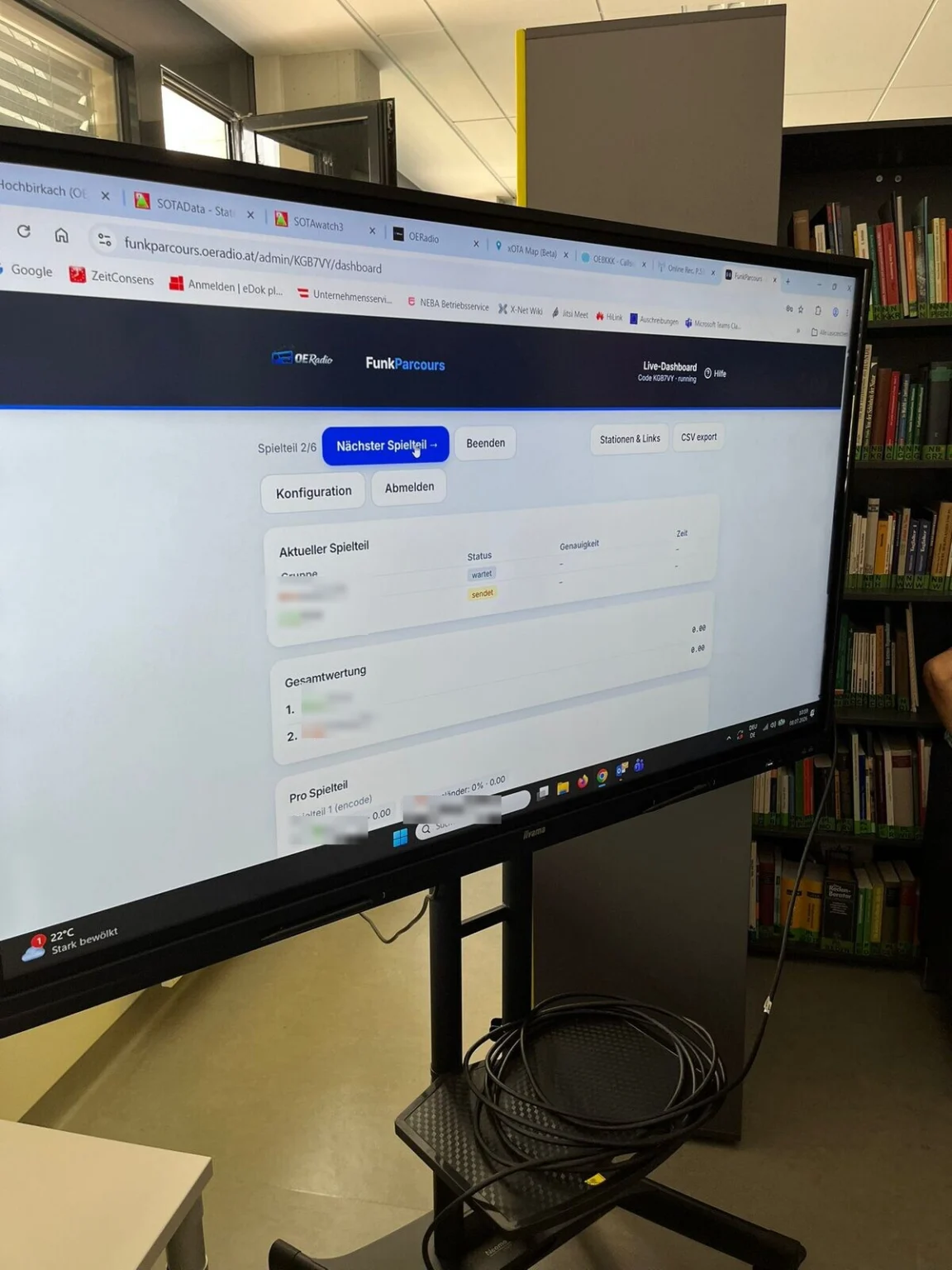
- Start: Start the game and the live dashboard opens.
- Transmit: The control station taps "Start transmission", the task is revealed, and the timer starts. Now: pass it cleanly over the radio.
- Reconstruct & submit: The team places the symbols on the grid and presses "Submit". Accuracy and time appear instantly, and the leaderboard updates live.
If the Wi-Fi drops out or someone reloads the page, nothing is lost — the game state lives on the server, and everything is back after reconnecting.
Fair is fair: anti-cheat and scoring
Because everyone tends to operate on the same frequency, in the default mode each group gets its own random task — same difficulty, but different symbols. That way nobody can eavesdrop on their neighbours. Anyone who prefers a direct head-to-head comparison can switch to "same for everyone". For scoring you have the choice: time only, with a minimum accuracy threshold, weighted from accuracy and speed, or as ranking points across multiple rounds. "Fastest wins" usually suffices for the school playground; for a serious emergency radio drill you'll want the minimum accuracy threshold instead.
Game ideas for your next PMR session
- Holiday activity & open day: Set the symbol grid to easy, two children per team — one transmits, one places — and after two rounds they swap. Loud laughter guaranteed.
- Club night: NATO spelling as a tournament. Who can spell a random call sign the fastest without errors?
- Emergency radio training: The report type with realistic fields, minimum accuracy as the threshold. Here completeness counts before speed — exactly as in a real emergency.
- Field day: Coordinates game between two locations, simplex on a handheld. A nice addition between QSOs.
Passed the real-world test: HTL Villach activity days
Theory is all well and good — so FunkParcours had its baptism of fire on 8 July 2026 at the HTL Villach activity days. Students picked up radios, passed tasks, reconstructed them, and you could clearly see how quickly initial hesitation turns into genuine competitive fire the moment the leaderboard lights up. That is exactly what the tool is built for: radio you can reach out and touch, without barriers, with instant feedback. The test ran smoothly, the concept holds up, and the enthusiasm was the best proof of all.
Open to everyone — give it a try
FunkParcours is freely accessible and open to all. It costs nothing, requires no account, and no registration: anyone can create a game immediately and set their own password. All you need is a browser, a few radios, and the desire to try something out. Whether it's a local radio club, a school class, a youth group, or simply a family afternoon — visit funkparcours.oeradio.at, create a session, and get on the air. And if you've had a great session or have an idea for a new task type: write to us — we welcome every bit of feedback.
Until then: antenna up, radio on, and enjoy the parcours.
73 – your Ferdl
Transparency Notice
This article was researched and written with the support of AI (Claude, Anthropic). It is based on the project documentation for FunkParcours and the practical test at the HTL Villach activity days on 8 July 2026. For questions, suggestions, or corrections, you can reach us at [email protected].