Update 24 May 2026 – Corrections based on reader feedback and article ratings:
Based on your ratings and feedback, we have clarified the following points:
- afukurs.oevsv.at is not an online learning platform for self-study, but a contact form where you submit your details to be contacted by the responsible ÖVSV regional association. The actual course (in-person, online, or hybrid) is then organized by the regional association. The original article's description differed significantly from the page's actual function.
- Free SDR stick in OE7 (Tyrol): This was a previous offering. Currently, young participants receive a DMR/analog radio after successfully completing the course and passing the amateur radio exam – a considerably more valuable gift to start the hobby.
- Note on ÖVSV data availability: It is generally difficult to find current and reliable data about course offerings, youth programs, and initiatives from the various ÖVSV regional associations, as the information on their websites is unfortunately often not up to date. We have researched to the best of our knowledge, but welcome corrections via email to [email protected].
Thank you to our readers for the valuable feedback!
Amateur radio is a hobby just for old men? Think again! Right now, in 2026, amateur radio is more exciting than ever before – and that goes especially for young people. Whether it is satellite communication, digital mesh networks, Software Defined Radio, or making contact with the International Space Station: amateur radio combines technology, adventure, and international community in a way no other hobby can. And the best part: Austria is hosting the international YOTA Camp in 2026 – this is YOUR year!
The Graying Problem – And Why Everything Is Changing Right Now
Yes, it is true: the average age of amateur radio operators is around 68 in the USA and over 71 in the UK. Austria and Germany show similar demographics. But these numbers only tell half the story. Because worldwide, something is happening: youth programs are booming, license numbers among young people are rising, and the current solar cycle SC25 is providing excellent HF propagation conditions. Suddenly, even beginners with small stations can reach the entire world – and that is exciting!
The community has recognized that it needs to actively reach out to young people. And the programs that have been created are truly impressive.
YOTA – Youngsters on the Air
YOTA (Youngsters on the Air) is THE international youth program of the IARU (International Amateur Radio Union) and a true highlight for young radio amateurs. The program consists of several pillars:
- YOTA Summer Camp: Every year, around 80 young people from over 30 countries come together for a week full of radio, workshops, technology, and international exchange. The camp is hosted by a different country each year.
- YOTA Month (December): In December, approximately 48 special callsigns go on the air worldwide. Young people operate these stations and collectively make over 80,000 QSOs. A fantastic opportunity to gain first experiences!
- Youth Contesting Program: Special competitions where young radio amateurs are supported and encouraged.
And here is the best part: Austria hosted YOTA back in 2016 in Wagrain – and will be the host again in 2026! From July 25 to August 1, 2026, young radio amateurs from around the world will come to Austria. This is a unique chance to become part of this international community, make connections, and create unforgettable memories.
JOTA/JOTI – The World's Largest Scout Radio Event
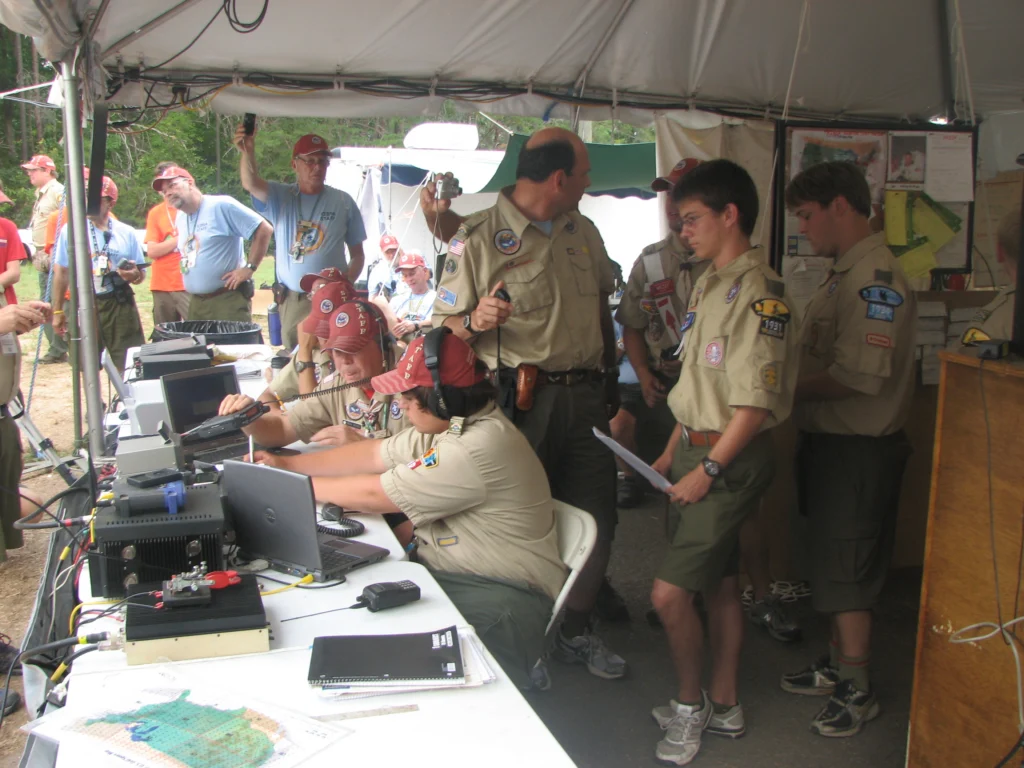
Jamboree on the Air / Jamboree on the Internet (JOTA/JOTI) is the world's largest digital Scout event. Every year in October, over 2 million participants from more than 170 countries take part. Scout groups worldwide connect via amateur radio and the internet to communicate, share experiences, and build friendships.
In Austria, JOTA/JOTI is coordinated by the Pfadfinder und Pfadfinderinnen Oesterreichs (PPOe – Scouts and Guides of Austria). The next JOTA/JOTI takes place from October 16 to 18, 2026. You do not need your own license – you can participate at an existing station under the supervision of a licensed radio amateur. A perfect way to get started!
Licensed at 14 – Here Is How It Works
In Austria, there is no minimum age to take the amateur radio exam. You can theoretically sit the exam at any age! Your own callsign is then issued from your 14th birthday. There are three license classes:
- Class 3 (Entry-Level License): 2m and 70cm bands, ideal for getting started. The simplest exam.
- Class 4 (CEPT Novice): Includes HF (shortwave) – with this you can reach the entire world!
- Class 1 (Full CEPT License): All bands, maximum power, recognized worldwide.
The upgrade path is open: you can start with Class 3 and work your way up. Many young people pass the Class 4 or even Class 1 exam on their first try – the exams are absolutely doable!
SDR as an Entry Point – Listen Without a License
The easiest entry into the world of radio costs less than a cinema ticket: an RTL-SDR dongle for around 25 euros, plugged into your computer, and you can start exploring the world of radio communications – completely without a license, because receiving is free!
Here is what you can do with it:
- Track aircraft (ADS-B): Follow every airplane in your area on screen – like Flightradar24, but received by yourself!
- Receive weather satellite images: Download weather images directly from NOAA satellites – fascinating pictures from space!
- Listen to amateur radio: Follow radio traffic on 2m, 70cm, and many other bands live.
- Software: SDR# (Windows) or CubicSDR (cross-platform) – both free of charge.
For many young radio amateurs, the SDR dongle was the gateway to getting their license. Once you hear what is happening on the airwaves, you will soon want to transmit yourself!
Digital Modes – Technology That Inspires
Amateur radio is no longer just Morse code and voice communication (though those are fun too!). It is especially the digital modes that excite tech-savvy young people:
- FT8: Reach the entire world with just a few watts of power! FT8 is a digital mode that works even under the most challenging conditions. Perfect for beginners on a budget.
- Meshtastic/LoRa: Off-grid mesh networks that are experiencing an absolute boom right now. Build your own communication network with affordable LoRa modules – completely without internet or mobile phone service. This is maker culture at its finest!
- APRS: Automatic Packet Reporting System – GPS tracking via radio. Ideal for hikes, bike tours, or SOTA activations.
- Arduino/Raspberry Pi projects: Build your own transmitters, receivers, antenna controllers, or weather stations. Programming meets electronics meets radio – the perfect combination for young makers!
School and University – Amateur Radio in Education
Amateur radio is not just a leisure activity – it also has a firm place in education:
- AATiS (Working Group for Amateur Radio and Telecommunications in Schools): Promotes amateur radio at schools throughout German-speaking countries. Kits, projects, and competitions specifically designed for students.
- ARISS (Amateur Radio on the International Space Station): School classes can talk live with astronauts on the ISS! This is not science fiction – it happens regularly and is an unforgettable experience.
- TU Wien Radio Amateur Club OE1XTU: The Technical University of Vienna has its own amateur radio club. Ideal for students who want to combine theory and practice.
- STEM Connection: Amateur radio covers science, technology, engineering, and mathematics – great for your CV and university applications!
- Radioklub Vegova S59VEG (Ljubljana, Slovenia): A shining example of youth work! This school-based club at Vegova high school in Ljubljana trains new radio amateurs every year – in January 2025, all 20 course participants passed the exam. Members regularly attend the YOTA Summer Camp, where in 2025 in Paris they even conducted an ARISS contact with the ISS. Courses run via Discord, practice exams online – a modern approach showing how youth outreach works in the 21st century.
- OE8DDX – Domenik Hochegger (AMRS Youth Officer): At age 11, Domenik passed the exam as Austria's youngest radio amateur. Today at 17, he has already achieved 277 DXCC entities. Since November 2024, he serves as Youth Officer of the AMRS (Amateur Radio Society of the Austrian Armed Forces) – living proof that amateur radio and youth are a perfect match. His journey shows: start early, go far!
Videos: Youth Amateur Radio in Action
A picture is worth a thousand words – and a video even more! Here are some glimpses into the world of youth amateur radio:
Students Talk to the ISS (ARISS)
School Radio Day Radkersburg (Austria)
YOTA Summer Camp
UK Scouts Talk to ISS During JOTA 2025
How to Get Started in Austria – Step by Step
Are you curious now? Here is your roadmap into amateur radio:
- Step 1 – Get an SDR dongle: Around 25 euros on Amazon or from an electronics retailer. Plug it in, install the software, and start listening!
- Step 2 – Register for a course: At afukurs.oevsv.at you can register your interest in an amateur radio course, free and without obligation. The regional association in charge will then reach out with specific dates and formats (in person, online or hybrid).
- Step 3 – Take the exam: Choose Class 3 (entry-level) or Class 4 (with shortwave). The exam is held at the telecommunications authority.
- Step 4 – Find a local community: Look for a local amateur radio chapter or regulars' table in your area. There you will find like-minded people, help setting up your station, and plenty of expertise.
- Step 5 – Get active: SOTA (Summits on the Air) for mountain enthusiasts, contests for competition lovers, digital modes for tech fans – there is something for everyone!
- Step 6 – Connect internationally: Sign up for YOTA, participate in YOTA Month, attend the YOTA Summer Camp. The international amateur radio youth community is waiting for you!
2026 Is YOUR Year – YOTA Is Coming to Austria!
There is no better time than NOW to get into amateur radio. YOTA 2026 is taking place in Austria – from July 25 to August 1, young radio amateurs from around the world will gather in our country. This is a once-in-a-lifetime opportunity!
Amateur radio in 2026 means:
- Space communication: Operating via satellites, talking to the ISS
- Emergency communication: When internet and mobile networks fail, amateur radio still works
- Maker culture: Building your own hardware, 3D printing, soldering, programming
- Coding meets radio: Python scripts for digital modes, Arduino projects, Raspberry Pi gateways
- International friendships: Contacts in over 190 countries – via radio, not social media!
Whether you are 12 or 25, whether you are interested in technology, nature, competitions, or international encounters: you will find your place in amateur radio. And who knows – it might be the beginning of a lifelong passion or even a career in technology and science.
Talk to your parents about it, get an SDR dongle, and simply tune in. The world of amateur radio is waiting for you!
73 – your oeradio.at editorial team
Transparency Notice
This article was researched and written with the assistance of AI (Claude, Anthropic). Any illustrations used were generated with AI (ChatGPT/DALL·E, OpenAI) unless otherwise noted. The editorial team has reviewed and edited all content. Despite careful review, occasional inaccuracies may occur — we welcome corrections via email to [email protected].