There are radio amateurs who prepare for emergencies. Who have a backup generator, a wire antenna in the basement and perhaps a power bank.
And then there's Herbert.
Herbert Hochsicher, OE0HHS, is not prepared. Herbert is overprepared. Herbert is so prepared that he prepares for the preparation. And in case the preparation fails, he has a backup plan. And a backup plan for the backup plan.
The Inventory
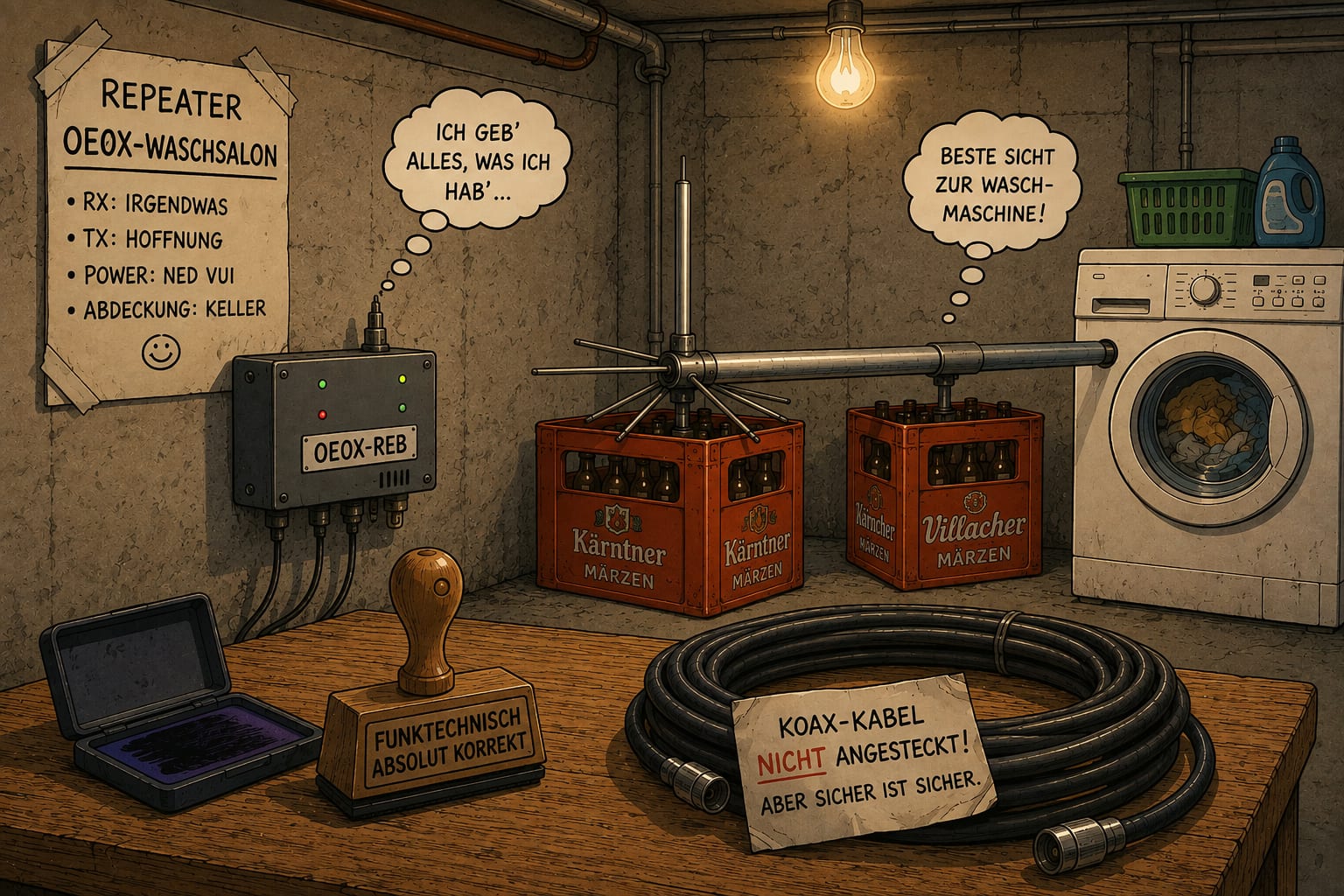
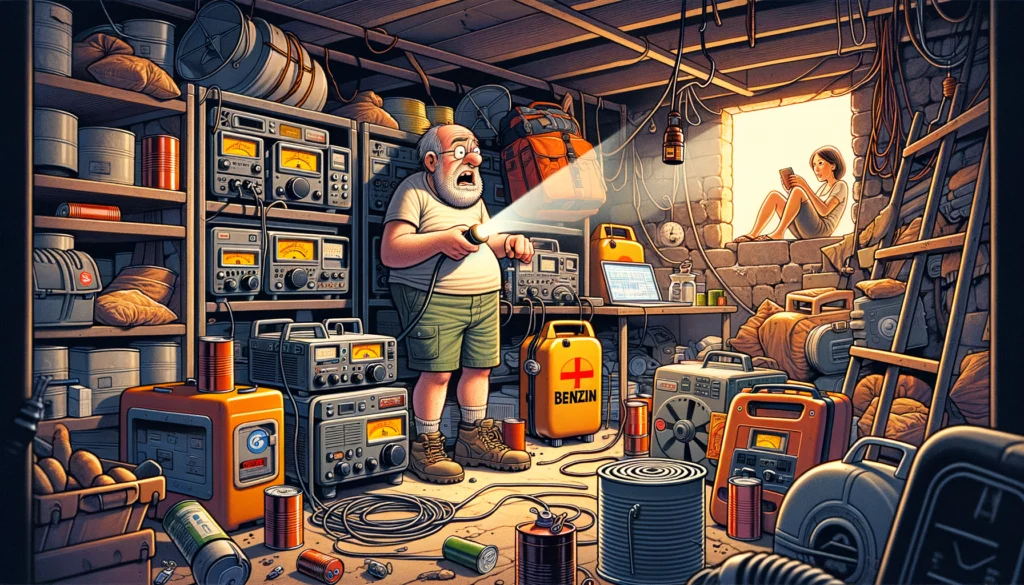
Herbert's basement looks like the props department of a disaster movie. Three generators (petrol, diesel, and one "for emergencies" — as if the other two were there for fun). Five transceivers: an IC-7300 for shortwave, an FT-991A as backup, an FT-817 for portable, a handheld for 2 m/70 cm, and an old Kenwood TS-830, "in case all the others fail". Which, for a device that hasn't seen maintenance since 1983, is entirely possible.
Four antennas: an EFHW in the garden (permanent), a dipole in the basement (as reserve), a magnetic loop (in case the garden becomes inaccessible — Herbert thinks of everything) and a wire supply for "improvised antennas". 200 metres of wire, neatly wound on a cable drum.
A Winlink setup with VARA, tested once a year. Three solar panels on the garage roof — not connected, but "ready". A water filter. Tinned food for three months. And a laminated emergency communications plan hanging on the basement wall like the Ten Commandments.
The Presentation
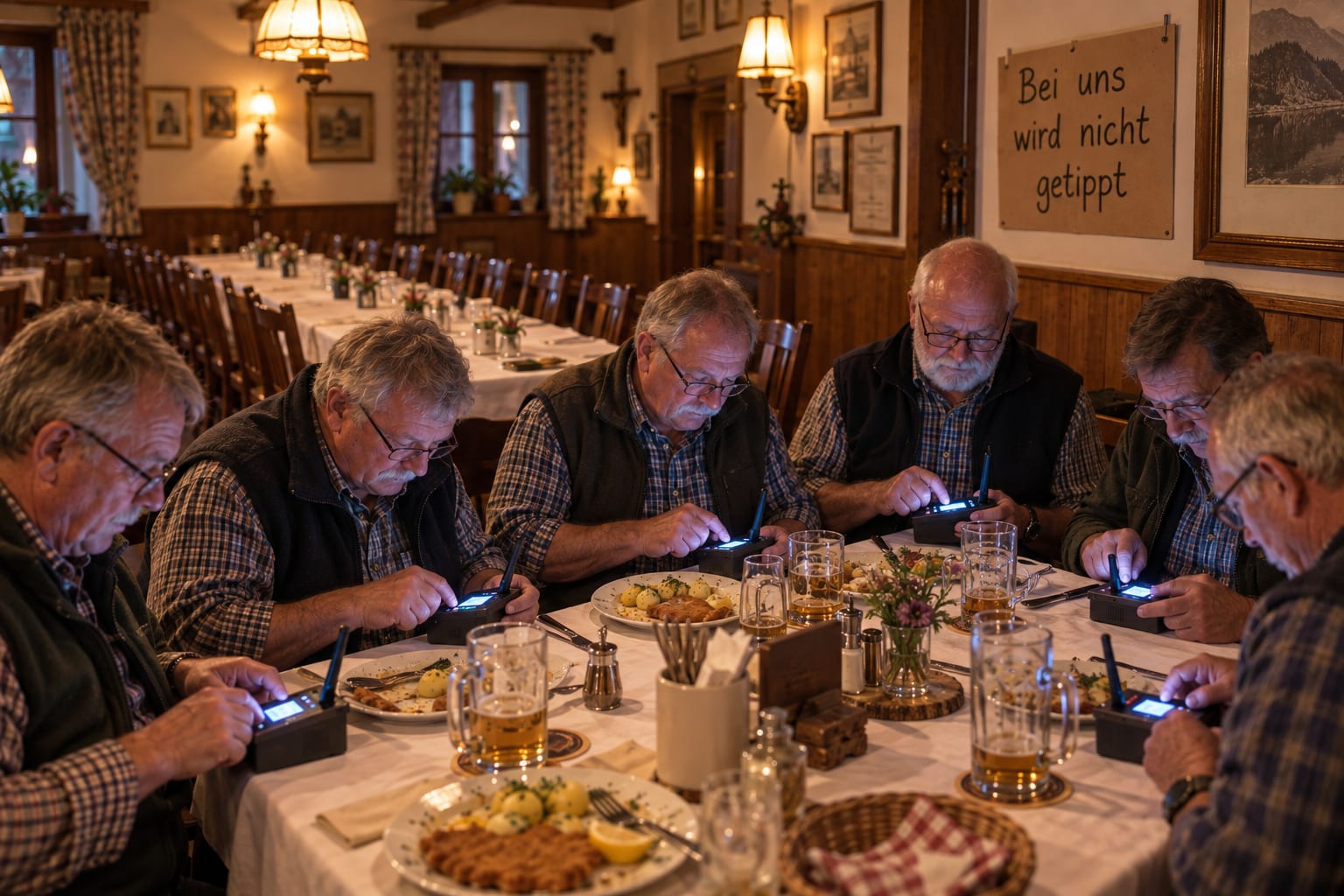
Once a quarter, Herbert gives a talk at the local chapter. Topic: always the same. "Emergency communications preparedness — Are we ready?"
The answer is: Herbert is ready. The chapter is not. But not because they don't want to be — rather because after 45 minutes of PowerPoint with 73 slides, including three digressions about water supply in crisis situations, nobody is listening any more.
Slide 34 shows an Excel spreadsheet with the battery capacity of all his devices, calculated down to minutes of transmit time at 100 watts, 50 watts and QRP. The spreadsheet has colour coding. Herbert is proud of the colour coding.
The chapter leader tried to limit the presentation time to 20 minutes. Herbert needed 20 minutes just for the introduction. Since then, there is no time limit. There is only silent suffering.
The Exercise
Twice a year Herbert organises an emergency drill. He sends out a 14-page PDF plan by email, including frequency lists, callsign assignments, a schedule in UTC and local time (with conversion table), and a sketch of the "operational area" — his garden and the surrounding three blocks of houses.
Two participants came to the last exercise. Herbert and his neighbour Rudi, who actually just wanted his lawnmower back.
Herbert still recorded the exercise as "successful" in his report. "All available forces were deployed."
The Real Emergency
On a Tuesday evening in November, it happens. Power outage. Not widespread — just his street. A digger hit a cable. Estimated repair time: two hours.
Herbert leaps up. This is it. The moment. His moment.
He runs to the basement. Switches on the torch — the one with three light modes that he bought on Amazon as a "Tactical Flashlight". He tears the laminated emergency plan off the wall.
Step 1: Start generator.
The petrol generator. Where was the fuel canister? Behind the tinned fish. Herbert moves 47 tins of tuna aside. Finds the canister. Empty.
Right, diesel generator. That's in the garage. Herbert goes to the garage. The garage has an electric door. The electric door has no power.
Herbert stands in the dark in front of his own garage, wondering why he didn't fit a manual emergency release. It was on the list. He was sure of it. Slide 58.
So the FT-817 then. Battery operation. QRP. 5 watts. Herbert switches on. The display lights up. He tunes to 145.500 — the calling channel.
"OE0HHS for emergency drill — er, emergency deployment. Power outage in my sector. Requesting situation report."
Silence.
"OE0HHS, once more. Power outage. I repeat: power outage. Sector Delta-7."
His neighbour Rudi knocks on the window. "Herbert, I've already called. The power company says two hours. Fancy a coffee? I've got a camping stove."
Herbert puts down the microphone. Slowly.
The Debrief
The next day Herbert writes a three-page "After Action Report" and sends it to the chapter mailing list. Subject: "Lessons from real-world deployment 12.11.2026".
Key points:
- Fuel reserves must be checked quarterly
- Garage door: manual emergency release urgently needed
- Solar panels: finally connect them
- Invite Rudi to get his amateur radio licence
- Buy more tuna
Nobody replies to the email. Except Rudi, who writes: "Do you want your lawnmower back or not?"
Herbert reads the message, ignores it and begins updating his PowerPoint for the next quarterly presentation. Slide 74: "Lessons from the Blackout 2026".
The power outage lasted one hour and forty minutes.
Editor's Note
Herbert Hochsicher is entirely fictional. All callsigns with the OE0 prefix are fictitious and not assigned to any real person. Any resemblance to living radio amateurs who own three generators and can't start any of them is purely coincidental — and entirely intentional. Emergency preparedness is genuinely important, by the way. Just not like this.
Yours, Hansl Hohlleiter
Transparency Notice
This article was researched and written with the support of AI (Claude, Anthropic). The editorial team has reviewed and edited all content. Despite careful review, occasional inaccuracies may occur — we welcome corrections via email to [email protected].