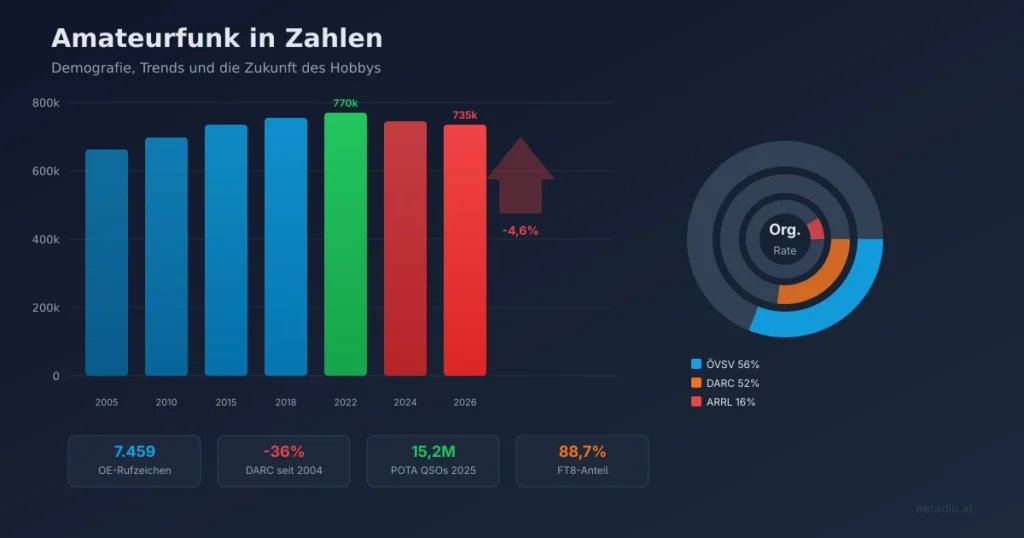
Is amateur radio dying? The data paints a more nuanced picture: the hobby is transforming. We have compiled the reliable figures from the USA, Europe and worldwide.
1. USA: Licenses Near All-Time High — But the Trend Is Tipping
The FCC issues five license classes. The total number of active licenses reached its historic peak in 2022 at 770,217 — and has been declining since.
Sources: ARRL Fact Sheet [1], ARRL News [2], [3], ARRL NW Division [4], ARRL FCC License Counts [5]
| Year | Active Licenses | Change | Source |
|---|---|---|---|
| 2005 | 661.272 | — | [6] |
| 2008 | 663.564 | +2.292 | [1] |
| 2010 | 696.041 | +32.477 | [1] |
| 2012 | 706.592 | +10.551 | [1] |
| 2014 | 726.275 | +19.683 | [1] |
| 2015 | 735.405 | +9.130 | [1] |
| 2016 | 742.787 | +7.382 | [2] |
| 2018 | 755.430 | +12.643 | [3] |
| 2022 | 770.217 | +14.787 | [4] |
| 2023 | 756.012 | -14.205 | [4] |
| 2024 | 745.571 | -10.441 | [4] |
| Apr 2026 | 734.841 | -10.730 | [5] |
License Classes April 2026
Source: ARRL FCC License Counts, April 13, 2026 [5]
2. ARRL: The National Association Is Losing Members Faster Than the License Base
The ARRL (American Radio Relay League) is the largest amateur radio association in the world. While license numbers rose until 2022, ARRL membership has been declining for two decades.
Source: K4FMH, AmateurRadio.com [7]
ARRL CEO Howard Michel (WB2ITX) stated in a QST editorial in May 2019 that the average age of ARRL members was 68 years. Non-members average 52 years old — significantly younger, but still far from "youth."
Source: QST May 2019, Editorial Howard Michel (WB2ITX); referenced in [8] and [9]
3. Germany: DARC Members in Free Fall
The German Amateur Radio Club (DARC) is the largest national amateur radio association in Europe — and it has been shrinking continuously for 20 years.
Source: QSLonline.de DARC Membership Statistics [10]
| Year | DARC Members | Change from Previous |
|---|---|---|
| 2004 | 49.346 | — |
| 2006 | 46.591 | -2.755 |
| 2008 | 44.246 | -2.345 |
| 2010 | 41.962 | -2.284 |
| 2012 | 39.695 | -2.267 |
| 2015 | 37.091 | -2.604 |
| 2017 | 34.788 | -2.303 |
| 2019 | 33.492 | -1.296 |
| 2021 | 32.819 | -673 |
| 2023 | 32.217 | -602 |
| 2024 | 31.623 | -594 |
Source: QSLonline.de [10]
Federal Network Agency: Total Licenses vs. DARC Members
As of December 31, 2025, there are 61,105 personal amateur radio licenses in Germany. The DARC now represents only about half of them.
| Class | 2024 | 2025 | Trend |
|---|---|---|---|
| Class A | 52.115 | 51.155 | -960 |
| Class E | 8.858 | 9.133 | +275 |
| Class N (new since 2024) | 342 | 817 | +475 (+139%) |
| Total | 61.315 | 61.105 | -210 |
Source: DARC News / Federal Network Agency Statistics 2025 [11], BNetzA PDF [12]
Exams in Germany
Source: DARC / BNetzA [11], [13]
Age Structure in Germany
The Federal Network Agency published data on age structure in 2014/2016: The majority of German call sign holders are between 44 and 77 years old. A detailed percentage breakdown was not made publicly available.
Source: Hamspirit.de, based on BNetzA data [14]
4. Austria: Detailed Analysis
Austria is a small but stable amateur radio market by international comparison. The data situation is better than often assumed — the Telecommunications Office publishes an official call sign list.
Call Signs and Licenses
According to the official call sign list of the Telecommunications Office (as of July 1, 2025), there are 7,458 assigned call signs in Austria — of which 7,013 are personal licenses and 445 are club/repeater stations (OE#X call signs).
Source: Telecommunications Office, Call Sign List of Austrian Amateur Radio Stations, as of July 1, 2025 [30]
| Prefix | Federal State | Call Signs | Share |
|---|---|---|---|
| OE3 | Lower Austria | 1.552 | 20,8% |
| OE5 | Upper Austria | 1.263 | 16,9% |
| OE1 | Vienna | 1.170 | 15,7% |
| OE6 | Styria | 1.064 | 14,3% |
| OE7 | Tyrol | 726 | 9,7% |
| OE8 | Carinthia | 697 | 9,3% |
| OE2 | Salzburg | 431 | 5,8% |
| OE9 | Vorarlberg | 364 | 4,9% |
| OE4 | Burgenland | 191 | 2,6% |
| Total | 7.458 | ||
License Classes
| Class | Description | Count | Share |
|---|---|---|---|
| Class 1 | CEPT Full License (all bands, up to 1,000W) | 7.085 | 95,0% |
| Class 4 | CEPT Novice | 242 | 3,2% |
| Class 3 | National entry-level class (2m/70cm) | 131 | 1,8% |
Source: Telecommunications Office Call Sign List [30]
Historical Development
| Year | Licensed Stations | Personal | Source |
|---|---|---|---|
| 1934 | 31 | — | [32] |
| 1971 | ~1.500 | — | [31] |
| 1998 | ~6.500 | — | [31] |
| Oct 2010 | 6.033 | 5.686 | [30] |
| 2018 | 6.288 | — | [33] |
| Jun 2024 | 7.461 | 6.995 | [30] |
| Jul 2025 | 7.458 | 7.013 | [30] |
Sources: Parliament Government Bill 1218/XX. GP [31], Salzburg Wiki [32], FM4/ORF [33], Telecommunications Office [30]
OEVSV: Licensed vs. Members
The OEVSV (founded 1926, celebrating its 100th anniversary in 2026) has an estimated ~4,200 members. With 7,459 call signs, that means:
| Metric | Value | Source |
|---|---|---|
| Assigned call signs | 7.458 | [30] |
| OEVSV members (estimated) | ~4.200 | [34] |
| Organization rate | ~56% | calculated |
| QSP circulation (club magazine) | ~3.800 | [34] |
| Possible call sign combinations | 15.548 | [35] |
| Of which still available | >9.000 | [35] |
| Active repeaters (all bands/modes) | 204 | [36] |
| Membership fee (full member) | 85–125 EUR/year | [37] |
Sources: QSL.design Lexicon [34], Parliament SNME 1560/XXVI [35], RepeaterBook [36]
Austria in Comparison: National Association Organization Rate
| Country | Licenses | Members | Organization Rate |
|---|---|---|---|
| Austria (OEVSV) | 7.458 | ~4.200 | ~56% |
| Germany (DARC) | 61.105 | 31.623 | ~52% |
| UK (RSGB) | ~86.000 | 20.400 | ~24% |
| USA (ARRL) | 734.841 | ~137.000 | ~16% |
5. United Kingdom (Ofcom / RSGB)
| Metric | Value | Source |
|---|---|---|
| Persons with license (2025) | ~86.000 | [16] |
| Assigned call signs (March 2025) | 104.441 | [16] |
| RSGB members (2024) | 20.400 | [16] |
| Licenses 2017 (Ofcom FOI) | 84.583 | [17] |
Sources: Essex Ham [16], ARRL/Ofcom [17]
UK Exams by Year
Source: Essex Ham [16]
6. Japan: The Most Dramatic Decline Worldwide
In the year 2000, Japan still had 1,296,059 licensed radio amateurs — more than any other country in the world. Since then, the number has fallen by nearly one million.
Sources: IARU/ARRL [18], ICQ Podcast [19], [20]
| Year | Licensed Stations | Source |
|---|---|---|
| 2000 | 1.296.059 | IARU [18] |
| 2015 | 435.581 | JARL [18] |
| 2019 | 402.180 | ICQ [19] |
| 2020 | 389.343 | ICQ [19] |
7. Worldwide: Nobody Knows for Sure
The IARU published a figure of 3 million radio amateurs worldwide in the year 2000. Then it stopped the survey — precisely at the point when the numbers began to decline. A 2021 estimate puts the figure at 1.75 million.
Source: ARRL [18]
| Country | Licenses | As of |
|---|---|---|
| USA | 734.841 | Apr 2026 |
| Japan | ~389.000 | 2020 |
| China | 174.000+ | 2021 |
| UK | ~86.000 | 2025 |
| Canada | 70.198 | 2018 |
| Germany | 61.105 | 2025 |
| Austria | 6.000+ | 2025 |
8. The "Demographic Cliff" in Contesting
The most detailed demographic study in amateur radio comes from K4FMH and K0MD, published in the National Contest Journal (NCJ, Sep/Oct 2021). They examined ARRL Sweepstakes data from 2000 to 2020.
Source: K4FMH/K0MD, NCJ Sep/Oct 2021 [21], summarized in [22], [23]
| Finding | Figure |
|---|---|
| CW contester average age 2000 | 51 years |
| CW contester average age 2020 | 67 years |
| Phone contester average age 2000 | 50 years |
| Phone contester average age 2020 | 64 years |
| Share of Traditionalists + Baby Boomers | 88.9% |
| Retention rate over 5 years | 33–50% |
9. What Is Growing: POTA, Digital Modes, YouTube
Not everything is in decline. Some areas of amateur radio are experiencing massive growth.
Parks on the Air (POTA)
Source: POTA News [24], K4FMH [25]
| Year | QSOs (millions) | Logs | QSO Growth |
|---|---|---|---|
| 2023 | 10,6 | 245.000 | — |
| 2024 | 13,0 | 333.000 | +22.6% |
| 2025 | 15,2 | 406.000 | +16.9% |
As of 2025: over 29,000 activators, 49,000+ active hunters, 500,000+ total participants. Single-day record on February 22/23, 2026: 1,477 activations, 63,710 QSOs.
FT8 and Digital Modes
FT8 has fundamentally changed amateur radio since 2017:
- 2017: FT8 accounted for 4.8 million of 32 million QSOs on Club Log (15%) — and overtook CW and SSB that same year.
- 2020: Over 50% of all Club Log contacts were FT8 (out of 66.4 million total contacts).
- 2026: PSKreporter processes ~26 million spots per day. 88.7% of them are FT8.
Sources: ARRL [26], EI7GL/Club Log [27], PSKreporter [28]
Ham Radio on YouTube — International
YouTube has become the most important entry point for new radio amateurs. The ecosystem is strongly dominated by English-language content — but there are relevant scenes in other languages.
English (dominant)
| Channel | Country | Subscribers | Source |
|---|---|---|---|
| Ham Radio Crash Course | USA | 407,000 | [29] |
| Mr. Carlson's Lab | USA | 371,000 | [9] |
| Live from the Ham Shack | USA | 192,000 | [29] |
| Ham Radio 2.0 | USA | 153,000 | [9] |
| OH8STN | Finland (EN) | ~60,900 | [38] |
This list may not be exhaustive.
Japanese
| Channel | Call Sign | Subscribers | Source |
|---|---|---|---|
| Momo Channel (ももチャンネル) | JR2GSW | 89,100 | [39] |
Momo Channel, with 72.4 million views and 2,972 videos, is the largest individual ham radio YouTube channel outside the English-speaking world.
French
| Channel | Call Sign | Subscribers | Source |
|---|---|---|---|
| Electro-Bidouilleur | VE2ZAZ | ~69,700 | [40] |
From Quebec, Canada — single-handedly dominates the entire francophone ham radio YouTube scene.
German (DACH)
| Channel | Call Sign | Subscribers | Source |
|---|---|---|---|
| DL2YMR — Der AFU Channel | DL2YMR | ~26,000 | [38] |
| Heinz — just me | DL8MH | ~14,700 | [41] |
| Funkwelle | DL2ART | ~13,200 | [42] |
| Der Filmer | DL6JN | ~11,600 | [38] |
| FUNKFIEBER | DO1HFS | ~11,300 | [43] |
| Radio-Bauprojekte | — | ~9,030 | [38] |
| AFU Chris | — | ~8,440 | [38] |
| Software Defined Radio Academy | — | ~5,000 | [38] |
| DARCHAMRADIO (official) | — | ~4,330 | [38] |
| Schau mal einer an | DJ3KJ | — | [38] |
This list may not be exhaustive.
33 German-language ham radio channels cataloged at afu-base.de
Austrian Channels
| Channel | Call Sign | Subscribers | Source |
|---|---|---|---|
| AlpineRadioWaves | OE4JHW | ~2,430 | [38] |
| OE8VIK | OE8VIK | ~763 | [38] |
| Max OE3MHU | OE3MHU | ~701 | [38] |
| Funkbuddy | OE2DAP | ~368 | [38] |
| Noah Krasser | OE6NOA | ~227 | [38] |
This list may not be exhaustive.
Other Languages
| Channel | Language | Subscribers | Source |
|---|---|---|---|
| YL Raisa (R1BIG) | Russian/EN | ~13,900 | [44] |
| Radio Bunker (LU8MIL) | Spanish | n/a | [45] |
Sources: FeedSpot [29], AmateurRadio.com [9], afu-base.de [38], youtubers.me [39], NoxInfluencer [40], Playboard DL8MH [41], HypeAuditor Funkwelle [42], Playboard FUNKFIEBER [43], HypeAuditor YL Raisa [44], CQ en Frecuencia [45]
Source: FUNKAMATEUR [46]
10. Interpretation: Is Amateur Radio Dying?
What is dying:
- The club culture: ARRL (-8% market share since 2000), DARC (-36% members since 2004), JARL (27 years of decline). The traditional national associations are losing their base.
- CW contesting: Average age 67, hardly any newcomers under 50. According to K4FMH/K0MD, barely sustainable in 10-20 years.
- HF ragchewing: Displaced by FT8 and digital modes.
- Japan: From 1.3 million to under 400,000 — the steepest absolute decline worldwide.
What is alive and growing:
- POTA/SOTA: 15.2 million QSOs in 2025, growth rates of 17-23% annually.
- Digital modes: FT8 dominates with nearly 90% of all spots. Low barrier to entry.
- YouTube/online content: HRCC grew from 300k to 407k subscribers in ~2 years.
- Entry-level licenses: Germany's Class N shows +45% exam growth.
- Maker scene: ESP32, SDR, MeshCom — the bridge between tech hobby and amateur radio.
A note on the data
The figures are drawn primarily from primary sources (Austrian Fernmeldebüro, FCC, ARRL, JARL, DARC). Cut-off dates and methodologies differ by country, so direct comparisons are only partially possible. An assigned licence also does not automatically mean an active radio amateur — actual activity is significantly lower in every country. For Austria, there is almost no publicly available data on demographics and activity; estimates here partly rely on analogies to Germany.
73 de OERadio
11. References
- ARRL Fact Sheet — arrl.org/arrl-fact-sheet
- ARRL News: Another Outstanding Year for Amateur Radio Licensing (2016)
- ARRL News: US Amateur Radio Population Grows Slightly in 2018
- ARRL Northwestern Division News, December 2024
- ARRL FCC License Counts (current)
- AmateurRadio.com: Ten Year Trends in US Ham Licenses
- AmateurRadio.com: The Decline in ARRL Membership and Market Share, 2001-2023
- K5ND: All Ages in Ham Radio (Nov 2019)
- AmateurRadio.com: The U.S. Ham Radio Market: Is It Dying?
- QSLonline.de: DARC Membership Statistics
- DARC: Amateur Radio in Numbers 2025
- Federal Network Agency: Amateur Radio Statistics 2025 (PDF)
- DK0IZ: Participant Numbers in Amateur Radio Service
- Hamspirit.de: Age Structure in Amateur Radio
- Essex Ham: UK Amateur Radio Statistics
- ARRL: Ofcom Releases UK Amateur Radio License Stats (2017)
- ARRL: Data on Number of Radio Amateurs Worldwide Needs Updating
- ICQ Podcast: Amateur Radio Decline in Japan Continues (2021)
- ICQ Podcast: JARL Reports First Membership Increase for 27 Years
- K4FMH/K0MD: Generational Change in ARRL Contesting, NCJ Sep/Oct 2021 (PDF)
- AmateurRadio.com: The Secret Storm Approaching CW Contesting
- ARRL: Traditional Amateur Radio Contesting Faces a Demographic Cliff
- POTA News: Big Numbers for POTA
- K4FMH: A Snapshot of U.S. POTA Sites, Activators, and Activations (Jan 2026)
- ARRL: Mode Usage Evaluation — 2017 Was the Year Digital Modes Changed Forever
- EI7GL: Latest Stats from Club Log (2021)
- PSKreporter: Statistics (live)
- FeedSpot: 25 Ham Radio YouTubers (2026)
- Telecommunications Office: Call Sign List of Austrian Amateur Radio Stations, as of July 1, 2025 (PDF)
- Austrian Parliament: Government Bill 1218/XX. GP (Amateur Radio Act 1998)
- Salzburg Wiki: Amateur Radio Association Salzburg
- FM4/ORF: Amateur Radio in Austria (2018)
- QSL.design: Lexicon — OEVSV
- Austrian Parliament: SNME 1560/XXVI. GP (Call Sign Capacity)
- RepeaterBook: Austria
- afu-base.de: YouTube Channels for Amateur Radio (63 channels)
- youtubers.me: Momo Channel Statistics
- NoxInfluencer: Electro-Bidouilleur
- Playboard: DL8MH
- HypeAuditor: Funkwelle
- Playboard: FUNKFIEBER
- HypeAuditor: YL Raisa
- CQ en Frecuencia: Radio Bunker (LU8MIL)
- FUNKAMATEUR: Funkwelle — Farewell (2024)