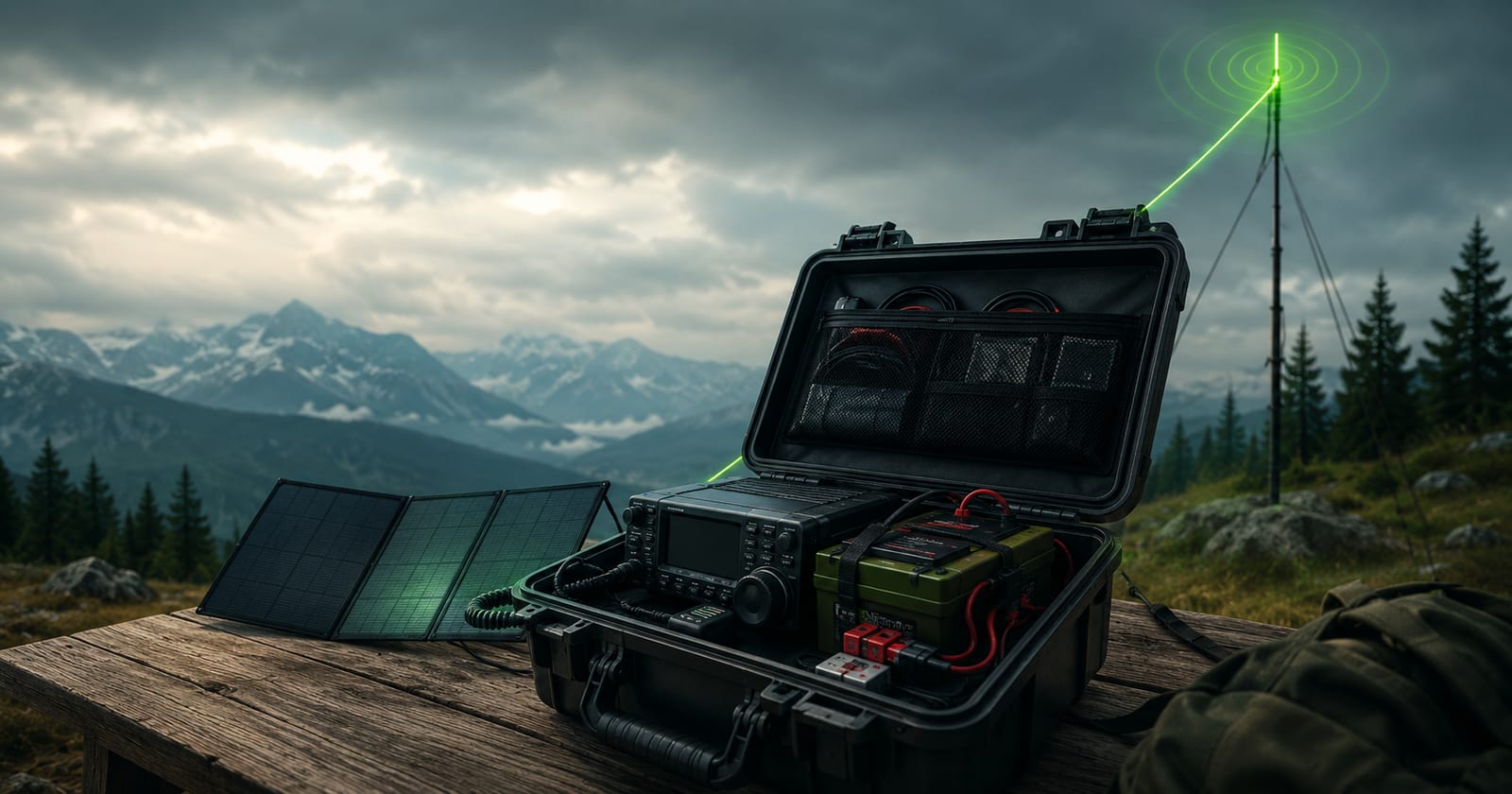
When conventional communications fail during a blackout, earthquake, or severe storm, radio amateurs are often the last link to the outside world. A prepared emergency go-box — a fully equipped portable radio station in a rugged case — can make all the difference. This article shows how to plan, build, and maintain one.
Why an Emergency Go-Box?
The concept is simple: grab the case, drive to the deployment site, open it, set up the antenna, and start operating. No searching for cables, no assembling individual components, no forgetting essential parts. Emergency communications depend on ready-to-go stations — and a well-prepared go-box is the foundation.
A go-box is also ideal for blackout preparedness: it works independently of the power grid and can be activated immediately.
This hands-on video shows a complete build and a walk-through of a finished go-box:
The Case
- Pelican Cases: Industry standard. Models like the Peli 1450 or 1500 offer sufficient space. Shockproof, waterproof (IP67). Expensive but nearly indestructible.
- Apache Cases: Budget alternative to Pelican, very popular in the US.
- Aluminium cases: Lighter than Pelican but less impact-resistant.
- Ammo cans: Cheap, robust, waterproof. A classic in emergency comms.
Plan feed-throughs for antenna (SO-239), power (Anderson PowerPole), and USB — preferably with waterproof connectors.
The Heart: Transceiver Selection
- Icom IC-705: HF/VHF/UHF, built-in battery, GPS, D-STAR — the Swiss army knife for emergency comms. Worth knowing: on the internal battery (BP-272) it only transmits at 5 watts; the full 10 watts is only available with external 13.8 V power. So for the go-box, be sure to plan for an external battery.
- Yaesu FT-891: HF and 6 m, but 100 watts — ideal when reach on HF is the priority. Note: no built-in antenna tuner (the external FC-50 is optional).
- Elecraft KX2/KX3: Extremely compact, QRP (KX2 up to 12W, KX3 up to 15W), excellent receiver
- Xiegu G90: HF, 20W, built-in tuner, budget-friendly
- Additional VHF/UHF handheld: A Quansheng UV-K5 as backup for local repeater communication
This video shows just how compact the IC-705 is as a complete "shack-in-a-box":
Power: Self-Sufficient and Reliable
- LiFePO4 battery: 12V, 20–40 Ah. Lightweight, safe, long-lasting (2000+ cycles). A 20 Ah battery powers an IC-705 at 10W for many hours.
- Solar panel: 30–50W foldable with charge controller. Enables unlimited self-sufficient operation in daylight.
- Anderson PowerPole: Standardised 12V DC connectors. ARES/RACES standard.
- Voltage display: A small voltmeter on the case shows battery status.
This video walks through, step by step, how to cleanly wire the battery, distribution, and equipment inside the case:
Antennas
- EFHW: Lightweight wire antenna for HF, quick to deploy using a throw line into a tree
- Telescopic vertical: Compact, works without trees, with radial network on the ground
- Wire dipole: Classic, flexible. 2 × 10 m of wire makes a half-wave dipole for the 40 m band (for the 20 m band, roughly 2 × 5 m)
- VHF/UHF omnidirectional: J-pole or Slim-Jim for repeater work and APRS
- Telescoping mast: 6–10 m fibreglass, lightweight and stable
This video shows how quickly an end-fed wire antenna can be deployed and tuned in the field:
Digital Modes for Emergency Comms
- Winlink: Email over radio — the most important digital emergency application. Use a Digirig Mobile or the IC-705's built-in USB port.
- JS8Call: Keyboard-to-keyboard messaging over HF — ideal for situation reports.
- APRS: Position reports and short messages via VHF — for situational awareness.
This video gives a practical demonstration of how an email is sent over HF via Winlink:
Austria has several Winlink RMS gateways available for this — including OE9XRK-10 (Feldkirch), OE5XFR-10 (Frankenmarkt), OE1XIK-10 (Vienna), and OE3XNR-10 (Waldviertel) on VHF/UHF packet, plus the HF gateway OE3XEC (Pactor).
Emergency Frequencies
A laminated frequency list belongs in every go-box. The most important reference points:
IARU Region 1 emergency Centres of Activity (each ±20 kHz — these are the first places to listen in an emergency):
- 3760 kHz (80 m) and 7110 kHz (40 m) — Region 1 emergency centres
- 14300 kHz (20 m), 18160 kHz (17 m), 21360 kHz (15 m) — worldwide emergency centres
D-A-CH / ÖVSV emergency frequencies (see the ÖVSV wiki): 1873 kHz, 3643 kHz, 7085 kHz (LSB), 10138 kHz (USB, emergency only), 14180 kHz (USB); VHF/UHF calling 145.500 MHz and 433.500 / 434.000 MHz FM. Always check the current, authoritative list in the ÖVSV wiki "Notfunk Frequenzen".
Checklist
Transceiver, LiFePO4 battery with charger, antenna(s) with coax and connectors, antenna tuner, headphones and mic/headset, paper logbook and pens, digital interface + USB cable, laptop/tablet with pre-installed software, foldable solar panel + charge controller, spare fuses and adapters, throw line, telescoping mast, laminated frequency list with emergency frequencies, and a PMR radio for unlicensed helpers.
Maintenance and Readiness
A go-box is only as good as its last test. Monthly: charge battery and check voltage. Quarterly: run a full deployment drill — from opening the case to first QSO, timed. Annually: inspect all cables and connectors for corrosion, update software, verify frequency lists. After each use: recharge, replace consumed items, document lessons learned.
An emergency go-box is not a one-time project. It's a living system that needs regular maintenance and testing — so it works when it matters most.
Further Reading
- ÖVSV – Emergency Radio: official information on emergency and disaster radio in Austria (Notfunk-Referat, A.R.E.N.A. network)
- ÖVSV – Emergency Radio Concept (PDF): official concept for emergency and disaster radio in Austria
- ÖVSV wiki – Emergency Frequencies and WINLINK in Austria (RMS gateways)
- IARU Region 1 – Emergency Communications Frequencies
- DARC Emergency Radio Handbook: comprehensive handbook covering technology, operation and example packing lists
- DARC – Radio Case: concrete build examples with parts lists
73 – your oeradio.at editorial team
Transparency Notice
This article was researched and written with the assistance of AI (Claude, Anthropic). The editorial team has reviewed and edited all content. Despite careful review, occasional inaccuracies may occur — we welcome corrections via email to [email protected].