
A Jammer satire by Hansl Hohlleiter
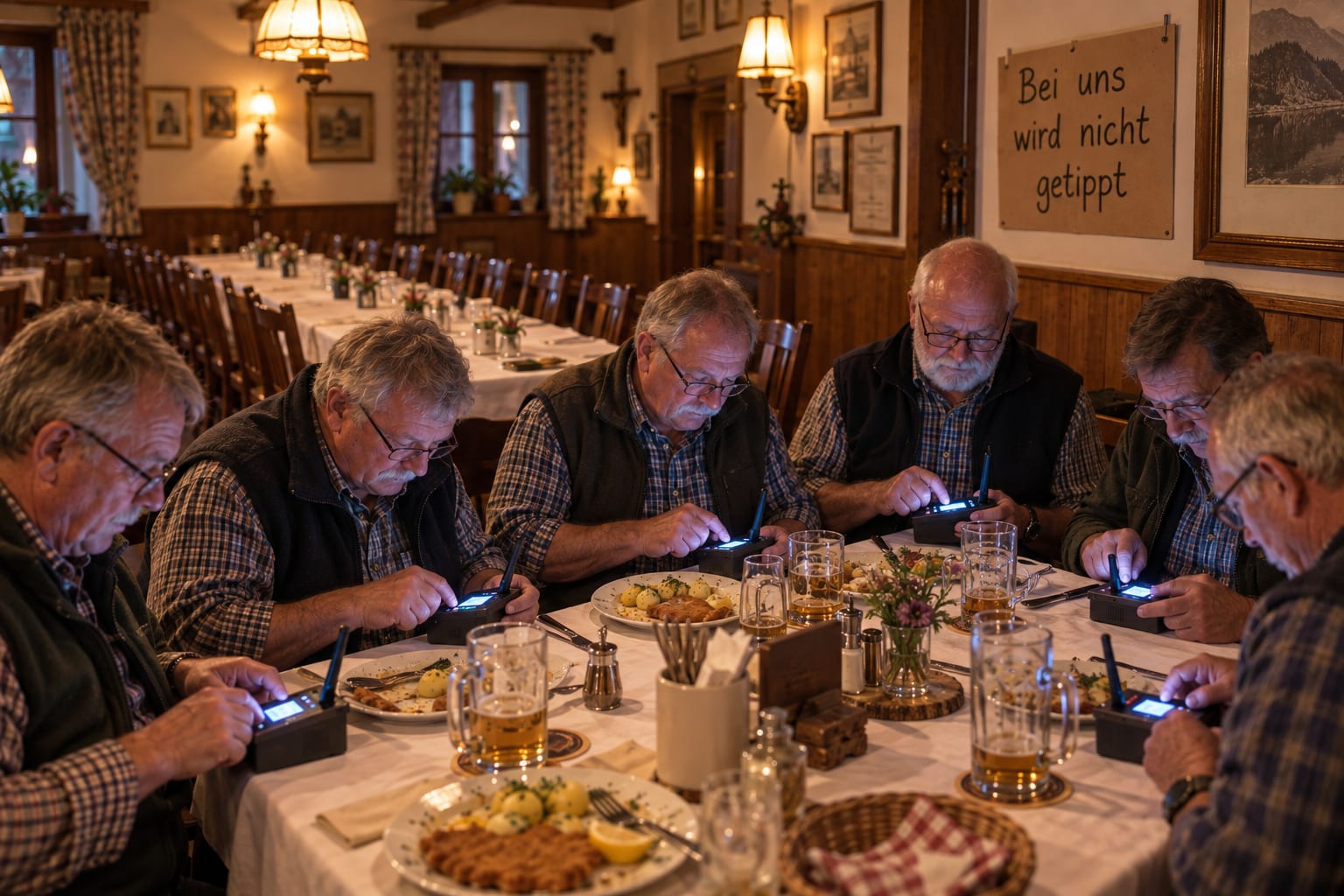
Every morning at seven o'clock sharp, as reliable as coffee trickling into the cup, the repeater OE0XRR opens up — and with it perhaps the most enduring institution in Austrian amateur radio: the Weißt-eh-Runde (the "you-know-anyway round"). That is what we call it; they themselves prefer a different title. „Die Funkspezialisten" — the radio specialists — is what they call one another, an honour they have conferred on themselves for merits nobody has ever verified. At seven the specialists report for duty — the keenest of them a few minutes early, waiting for the repeater to unlock — and their specialty, with respect, is sniping at everyone else.
We call it the Weißt-eh-Runde because in it every sentence begins with „weißt eh" (you know anyway) and ends with „hamma nie braucht" (never needed that). In between lies the accumulated wisdom of three gentlemen who have seen it all, known it all, and on principle have no intention of learning anything new.
The spokesman is Ottokar Oberlehrer, OE0OTT, a man whose life's work is to hear, in every advance, first and foremost what is superfluous about it. At his side, Poldi Pauschal, OE0POL, who has an opinion on everything, especially on things he knows nothing about, and Kurti, OE0KUR, who really only ever agrees, but does so with a fervour that could replace an entire club. Three callsigns, one world view: everything used to be better, and whoever disputes it either owns a smartphone or has too much time on their hands.
Yet the three are far from alone. In the morning, considerably more people listen in on OE0XRR than ever speak up — half the district, so to speak. Add to that the mobile operators, who key up briefly from the car on the way to work, and the portable operators, who come in from a hilltop or a park bench on a handheld. Only: they rarely have much to say. A „good morning, mobile here", a „QRV portable from the mountain", a curt „servas" (hello there) back from Ottokar — and with that, today's contribution has already been duly honoured. After which the programme of the three carries on as though nobody had said hello. Most people don't mind. You don't key up because you want to talk — you key up because otherwise it's so quiet in the car or up on the summit. A voice in the morning, any voice, beats the drone of the traffic report. Even if it's Ottokar's, explaining for the third time why everything used to be better.
And sometimes — always when he is visiting Heidi up on the mountain pasture — Peterle comes on. Portable on the handheld, cowbells in the background, in the best of spirits. Peterle wants to explain nothing and prove nothing; he just says briefly how lovely it is up there, wishes the round a good morning, and vanishes again towards the mountain hut. For a moment the Weißt-eh-Runde then almost falls silent itself — not out of respect, but because nobody quite knows what to say in reply to so much contentment. Then Ottokar clears his throat and explains that the radio link from the pasture is far too weak anyway. Weißt eh.
The specialists' favourite discipline is talking shop, and their favourite subject is the antenna. Antennas get grumbled about the way other people grumble about the weather: the neighbour's new beam radiates all wrong, the multiband vertical is one big compromise, and a decent dipole is something the young ones have never even seen. The remarkable thing is that much of it is true — it is genuine knowledge, just from back in the day. Because in the old days the three really did do everything themselves: put up masts, strung wires, climbed onto the roof in any weather. Today the mast is no longer scaled, only discussed. The doing-it-yourself has turned into verbal acrobatics, and the practitioners of yesteryear have become the commentators of today — the ones who explain from the touchline exactly how the ball should have been saved, while others have long since taken to the field.
There may even be a thoroughly technical explanation for the round's baseline mood. One or two of them, in their active years, worked plenty with directional antennas, with even more plentiful power — and got a little too close to the RF once or twice along the way. One wouldn't want to insinuate anything. But when a man has stood for decades directly in front of a well-illuminated main lobe, a certain baseline level of irritability may be considered instrumentally plausible. Radiation, they say, works slowly. In Ottokar's case, says the round behind a cupped hand, it did a thorough job.
The round's favourite bogeyman is emergency comms (Notfunk). No sooner do the young folk announce a crisis-communication exercise than Ottokar rises to peak form. „Crisis communication!", he cries, and you can hear the exclamation mark in the next valley. „What for? When the apocalypse comes, I'll call my neighbour over the garden fence, I don't need all that battery nonsense." Poldi confirms that he personally has never experienced an apocalypse, which surely is proof enough. And Kurti says „exactly" — three times, just to be safe.
That the emergency-comms people are not waiting for the apocalypse but for the perfectly ordinary blackout, the flood, the storm that sends the mobile network into retirement for two days — never mind. In the Weißt-eh-Runde the iron principle applies: what I have never needed, nobody will ever need. An argument so watertight that it doesn't even engage with the facts.
The second great battle concerns the signal report. Should a newcomer dare to speak a dutiful „you're coming in S9 with me, how's my signal?" into the repeater, the indignation is complete. „A signal report! On the repeater!", Ottokar snorts, as though someone had taken a phone call in church. „Des Relais hört di eh imma glei" (the repeater hears you loud and clear anyway), „so why the circus?" That a report on a repeater does in fact say something — about your own feedline, your antenna, your location, your rig — does not trouble him. For Ottokar a signal report is not information but an imposition: he would have to listen, and listening was never his mode of operation.
And then there's one more thing nobody says out loud. Poldi isn't even from around here. He'd have two or three repeaters within range, closer, stronger, better. But there, in his own area, nobody talks to him. So every morning he tunes one valley over to OE0XRR, where at least Ottokar grumbles „weißt eh" and Kurti says „exactly". It is not the best round in the world. But it is a round, and a round that expects you at seven in the morning beats any SWR. You can say a lot about the Weißt-eh-Runde — but it leaves no one alone who keys up at seven. Not even one who actually belongs somewhere else entirely.
The lovely part is the irony the round persistently fails to hear. Because nobody clings to the repeater as much as these three. It is their living room, their regulars' table, their daily paper. If it went out, they would be lost — and that is precisely why the blackout they scoff at loudest is the only real threat to their morning.
And then, on a grey Tuesday, the power fails. Not the apocalypse, just a fallen tree in the substation, but half the valley is dark, the mobile network dead after forty minutes. Ottokar reaches for the handheld, tunes to OE0XRR — and the repeater answers. It's alive. It's alive because hanging on it is a backup battery that the emergency-comms youngsters donated, mounted and, under Ottokar's mockery, ceremoniously put into service in the spring. „Battery nonsense", he had called it back then.
Now he sits in the dark, the radio glowing, and over the repeater that a few young people keep alive, Ottokar Oberlehrer says perhaps the most honest sentence of his radio life: „Is anyone there? The power's out on me." And somewhere a calm, young voice answers: „Servus Ottokar. Yes, we hear you. It's all fine, the repeater's running on battery. Just call in if you need anything." No triumph, no „told you so". Just someone who listens.
Hansl's verdict: The Weißt-eh-Runde is not made of bad people. It is made of men who love a hobby that threatens to slip away from them — and who wear mockery as armour, because admitting you no longer understand something is harder than sniping. The sad part is not their scorn. The sad part is that they only recognise the young ones — the ones who, when it counts, keep the repeater alive for them — as fellow radio friends once the lights go out. And yet it would be so simple: one „thank you" instead of „never needed that". Once listening to a signal report instead of dressing it down. Emergency comms abolishes no one — least of all Ottokar. It merely keeps running the repeater on which, tomorrow, Ottokar will once again explain that none of this is needed. And weißt eh: that is exactly why the young ones do it anyway.
All persons, callsigns and repeaters in this article are entirely fictional. OE0OTT, OE0POL, OE0KUR and OE0XRR are non-callsigns and stand for no one in particular. Any resemblance to living radio amateurs is purely coincidental, in so far as nobody feels addressed — and intentional, in so far as they do. The author accepts no liability for spontaneous self-recognition, not even at S9.
Transparency Notice
This article was researched and written with the support of AI (Claude, Anthropic). Illustrations used were, unless otherwise indicated, created with AI (ChatGPT/DALL·E, OpenAI). Editorial responsibility and content review rest with the oeradio.at editorial team. Feedback — from the Weißt-eh-Runde, too — is welcome at [email protected].