A Jammer satire by Hansl Hohlleiter
There are radio amateurs who wait for a QSO. And then there is Manfred Mehrfach, OE0MMF, who has given up waiting by simply buying himself somebody to talk to.
Six of them. All delivered in the same box.
The purchase
Manfred joined the MeshCore network in spring. That is good, that is welcome, the network is currently growing at a pace you rarely see — see 126.9 kilometres on half a watt and the site portraits in Show us your boxes. Getting started costs less than a decent length of coax, and you do not even need a licence.
So Manfred bought a device. Then he switched it on. And then the thing happened that happens to everyone who switches on a mesh device for the first time: it was quiet.
The usual responses to that are: wait, go higher, fit a better antenna, or ask in the group. Manfred chose a seventh option. He ordered five more devices.
It has not been quiet since. Manfred has been in conversation ever since.
The names
And here begins the part that made me write this article in the first place. Because anyone who has ever talked to themselves on the radio knows: it is a little embarrassing, but nobody notices.
Unless you do it the way Manfred does.
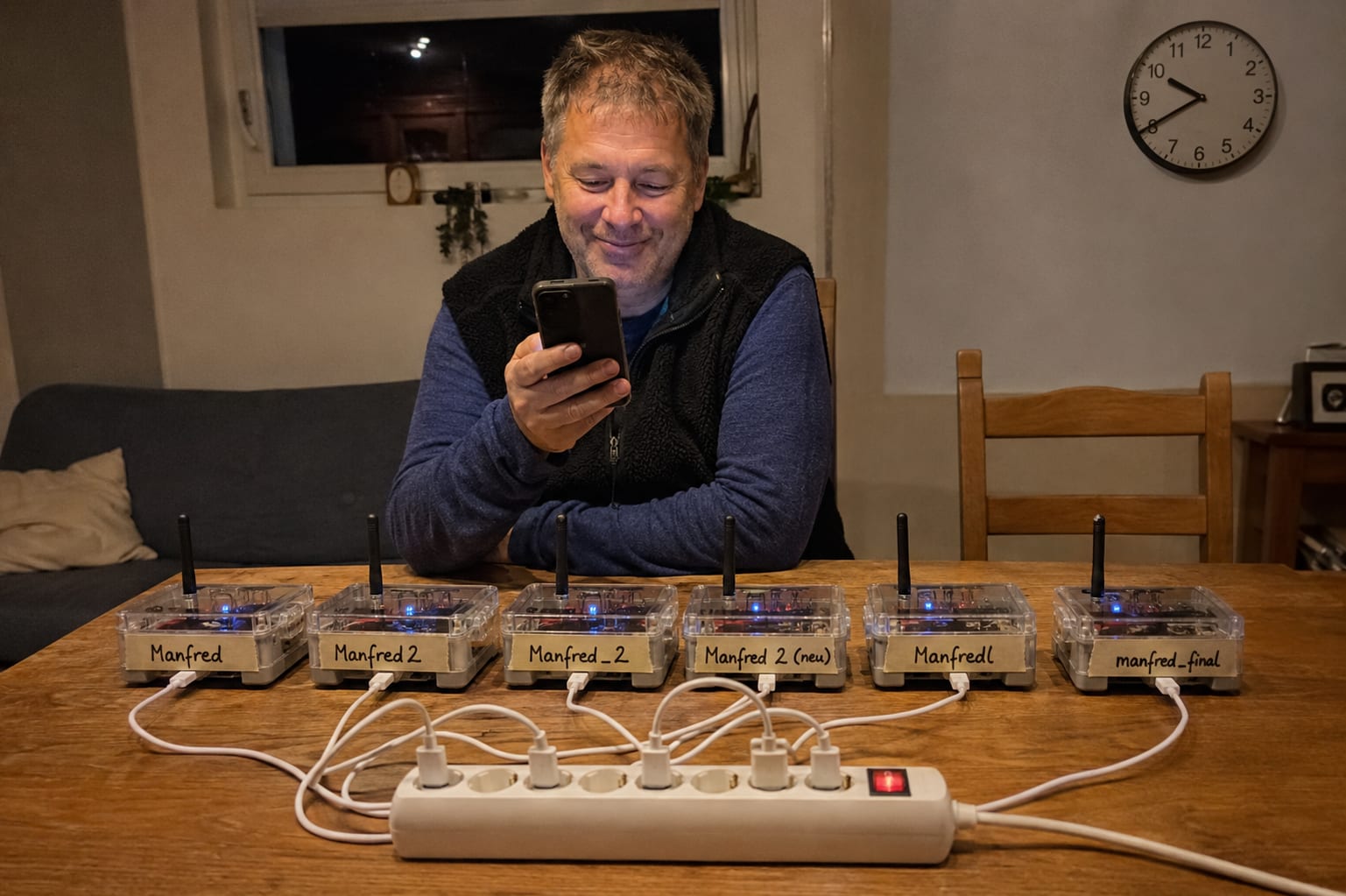
Manfred's six nodes are called:
- Manfred
- Manfred 2
- Manfred_2
- Manfred 2 (new)
- Manfredl
- manfred_final
There is a seventh node called manfred_final_2, but it only shows up now and then, because it lives in a car.
The contact list sorts alphabetically. Anyone in the district who opens the app therefore gets six lines of Manfred first and everything else afterwards. Seeing through that requires no training in cryptanalysis. It requires eyes.
Manfred considers this sufficiently disguised. He once wrote in the group that "several stations are active in the room". That is even true. The room is a living room.
The announcement
Which brings us to the detail Manfred has not thought about to this day.
A node that forwards traffic announces itself on the MeshCore network all by itself. At regular intervals it sends an advert out so the others know it exists. You do not have to go looking for it. It tells you.
Six times.
These six announcements do not arrive at random moments but within the same second, because Manfred flashed all six devices in one evening and switched them on together. They come from the same position to five decimal places. They report the same firmware version and the same board type. And they hear each other at a signal level you never see in the wild, because out there two stations are rarely 40 centimetres apart.
And when Manfred switches off the power strip in the evening, six repeaters vanish from the district simultaneously. At 22:40. Every day. Like a very small, very punctual blackout.
Manfred wonders why nobody ever asks him who the other five are.
The conversation
The traffic itself is lively. I wrote down a few lines, because otherwise nobody would believe them:
Manfred: "Test 1 2 3, is anybody hearing me?"
Manfred 2: "Yes, loud and clear!"
Manfred: "Great, thanks for the report!"
Manfred_2: "Perfect here too."
Manfredl: "👍"
Half an hour later:
manfred_final: "How is the range at your end?"
Manfred 2 (new): "Astonishingly good for that little antenna."
manfred_final: "That is what I thought too."
The finest moment of the season so far, however, was the evening when Manfred forgot which node he was typing on. He asked himself a question and answered it with the same device. Then he thanked himself for it with the same device. And then — this is the point where I put the phone down — he wished himself 73 with the same device.
The network passed it all on dutifully. The network does not ask.
The switch
Now the unfunny paragraph that unfortunately has to be here. And the part where you have to give Manfred credit for thinking along.
MeshCore is deliberately built differently from other mesh systems. Not every device forwards traffic. An ordinary node, a companion, transmits and receives for its owner, and that is that. Forwarding is done only by nodes on which the repeater role has been switched on. That is precisely why there is so little background traffic on the MeshCore network, and why a message still gets through when a lot of people join in. The details are in MeshCore: radio without a mobile network and in the comparison in MeshCom vs. Meshtastic.
So a companion is harmless by default. You have to do something for a device to start transmitting on everyone else's behalf.
Manfred did something.
Manfred, you see, had read what every sensible beginner's text says: that one repeater does more than twenty handhelds, and that repeaters are the real lever in the network. He understood that. He genuinely understood it. So he set all six devices to repeater.
He is not stupid. He is smart. He read the right sentence, found the right setting and activated it six times. Just on one table.
As a result, Manfred's living room holds the highest repeater density in Austria measured in devices per square metre, and whatever reaches him leaves him sixfold. Every "👍" from Manfredl is picked up by the other five and conscientiously passed on. Everything coming in from the mountain repeaters is sent back out into the neighbourhood by his six devices, and the mountain repeaters then carry it onwards in all diligence, because they cannot know they are currently talking to a sideboard.
We are on a band with duty-cycle limits and using a modulation where a single text packet is on the air long enough that you can count it. The airtime Manfred's table generates is airtime everyone else does not get. It is also missing for the person who one day genuinely has to get a message through when the mobile network is gone. That is exactly why MeshCore separated this switch in the first place.
Manfred sees a busy channel in his app and is satisfied. Last week he wrote that the network had "finally come alive".
The cellar
There is exactly one human being in this story who answered Manfred without being Manfred.
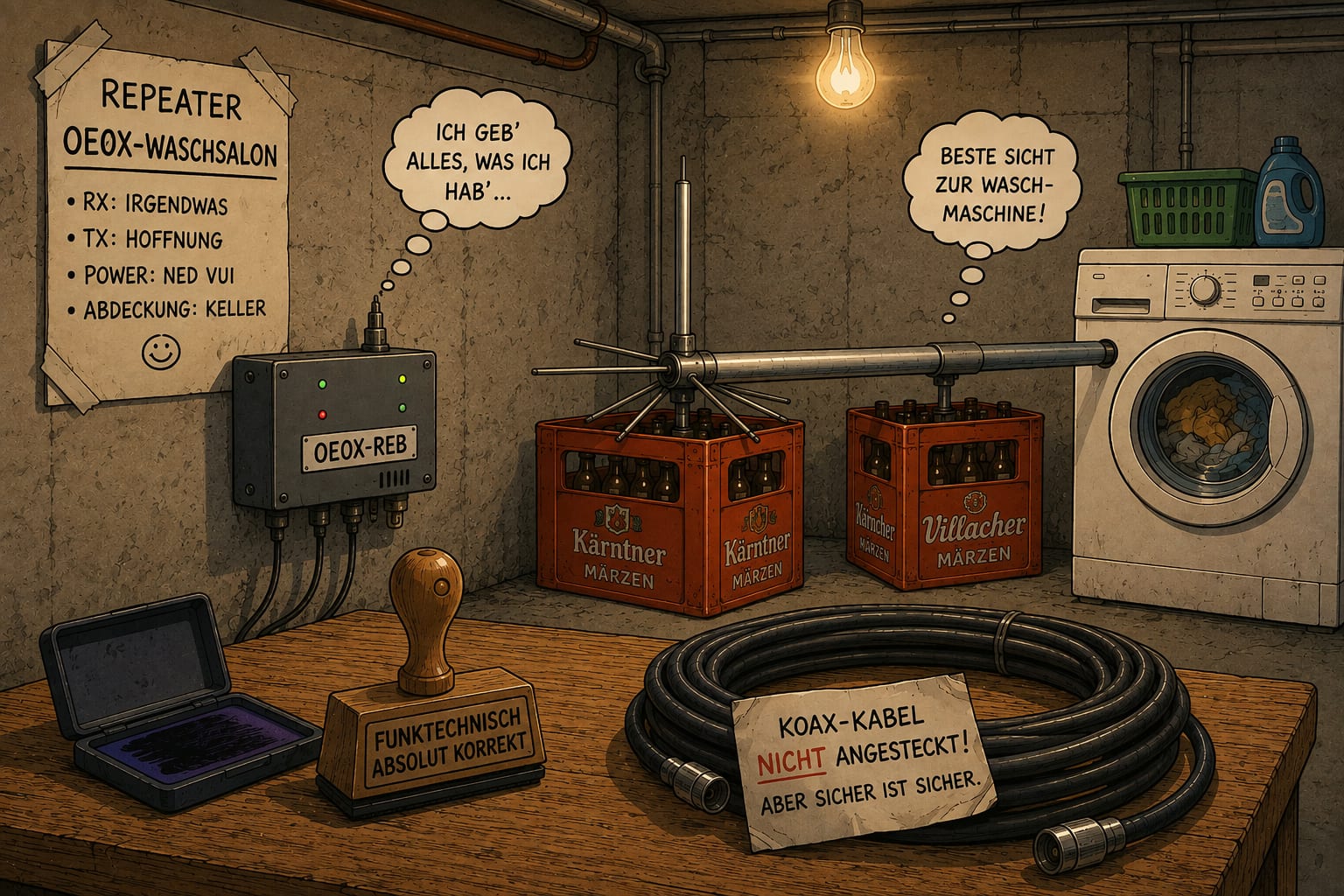
Attentive readers know him: Kurt Kellerknoten, OE0KKN, sysop of the only repeater in the country that stands two metres below the lawn, and operator of a mesh node beside it. Kurt has the repeater role switched on as well. He has had it on for four years. A repeater that has never been given anything to forward is at least economical.
At some point Manfred noticed that there was a repeater within reach. He announced this proudly in the group. He then carried node number four, Manfred 2 (new), from the living room out onto the balcony, "to reach the cellar".
I would like to let that sentence stand for a moment. A man carries a radio outdoors in order to reach a cellar.
Against all reason, it actually worked. Not because of the height, but because there is an external cellar stairwell between the balcony and the cellar window, and physics occasionally has a sense of humour. So after four years Kurt saw traffic from someone else for the first time.
His reply has been handed down. It read:
"May I test???"
Manfred replied: "Sure, I'm here with several stations anyway."
And so the two of them, each in his own way, settled the entire district network between themselves that evening: one who has six devices and nobody, and one who has nobody and asks for permission. If that is not amateur radio, then I do not know what is.
The statistics
Manfred likes to quote figures. He recently worked out that 94 per cent of the traffic in the district runs through his nodes.
The number is correct. I checked it.
91 per cent of it is Manfred talking to Manfred, forwarded sixfold by Manfred. 3 per cent are the announcements of his six repeaters informing the network every quarter of an hour that they exist, all of them. The rest is Kurt asking whether he may.
And because a repeater that announces itself also ends up on the map, all of it is on the network as well: six entries, exactly on top of one another, unmoved for months, with names that differ by one underscore.
Anyone who zooms all the way in on the map sees Manfred's living room. It is the densest repeater site in the district. It sits at 480 metres above sea level, on the ground floor.
Hansl's conclusion
Hansl's conclusion: I have nothing against having several nodes. Anyone running a repeater on a mountain, one in the car and one at home is doing exactly the right thing, and the network lives off people like that. A second device for testing is sensible. A third on the bike is a hobby.
The difference is not the number. The difference is where you put them, who you talk to, and where you switch on the repeater role. The fact that MeshCore keeps this switch separate at all is not a nuisance but the best thing about the system: you do not forward because you are present, you forward because you are standing somewhere where forwarding helps.
Manfred's mistake is not that he has six devices. His mistake is that all six sit on the same table, all six set to repeater, and that he did not fix the silence that bothered him but drowned it out instead. He bought himself a network rather than going looking for one. It is the technically more elegant solution to a problem he did not have.
And the almost identical names are the most honest detail of the whole story. Anyone trying to pass as six people does not call himself Manfred six times. Manfred never wanted to be somebody else. He only wanted someone to answer him. If need be, himself.
So, entirely without mockery, to everyone with a full box and an empty node list: take one of the devices, set it to repeater and carry it up somewhere, anywhere, as long as it clears the gutter. Leave the other five as companions and leave them lying there. Then it will be quiet for two weeks, and then at some point somebody will get in touch whom you did not pay for yourself.
That is the moment we all do this for.
All persons and callsigns in this article are fictitious. Any resemblance to living radio amateurs is intentional but not actionable. The author accepts no liability for spontaneous self-recognition, not even multiple times.
Transparency Notice
This article was researched and written with the support of AI (Claude, Anthropic). Illustrations were created with AI unless marked otherwise. Editorial responsibility and content review rest with the oeradio.at editorial team. Suggestions and complaints, including from all six Manfreds, are welcome at [email protected].