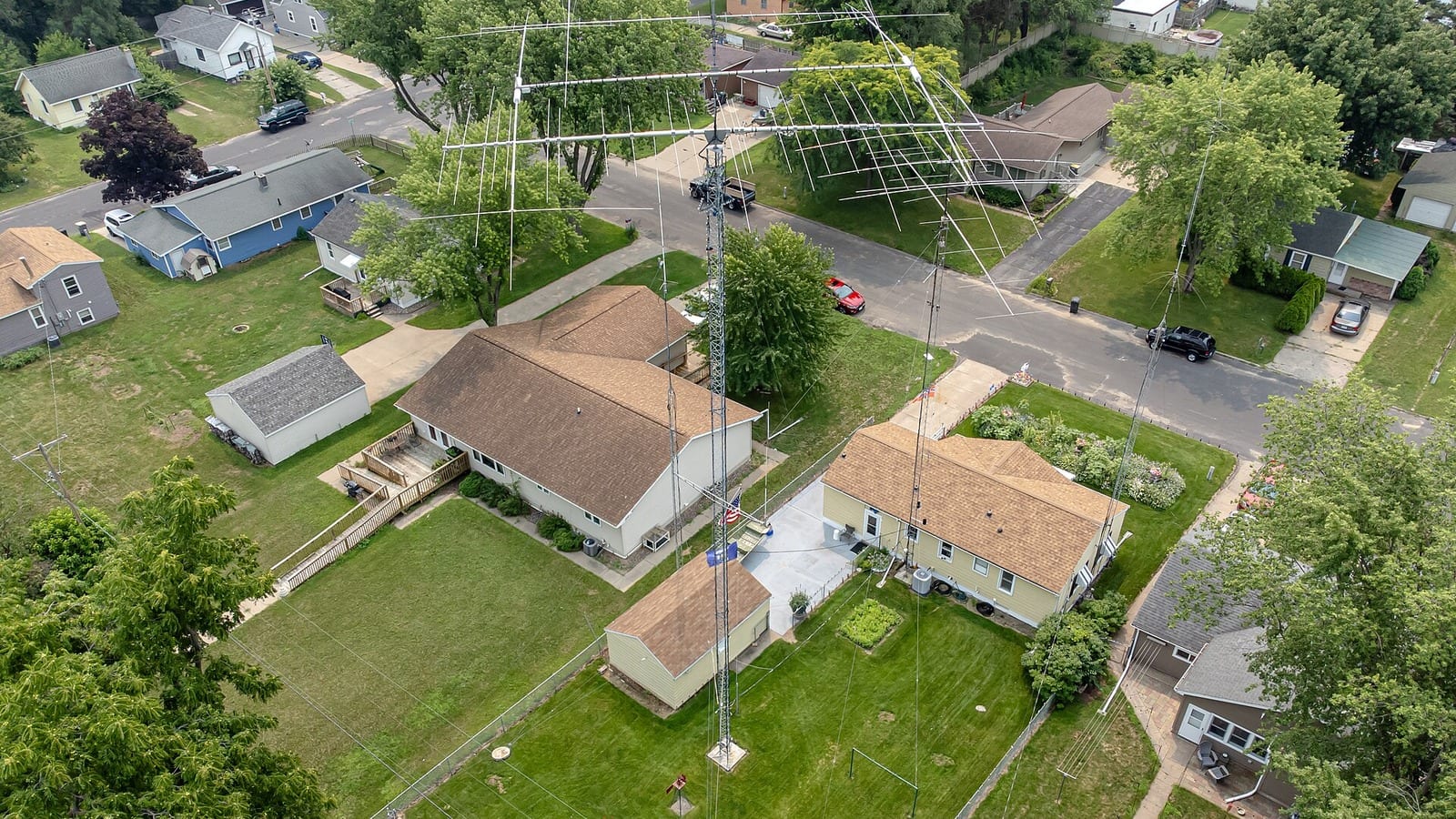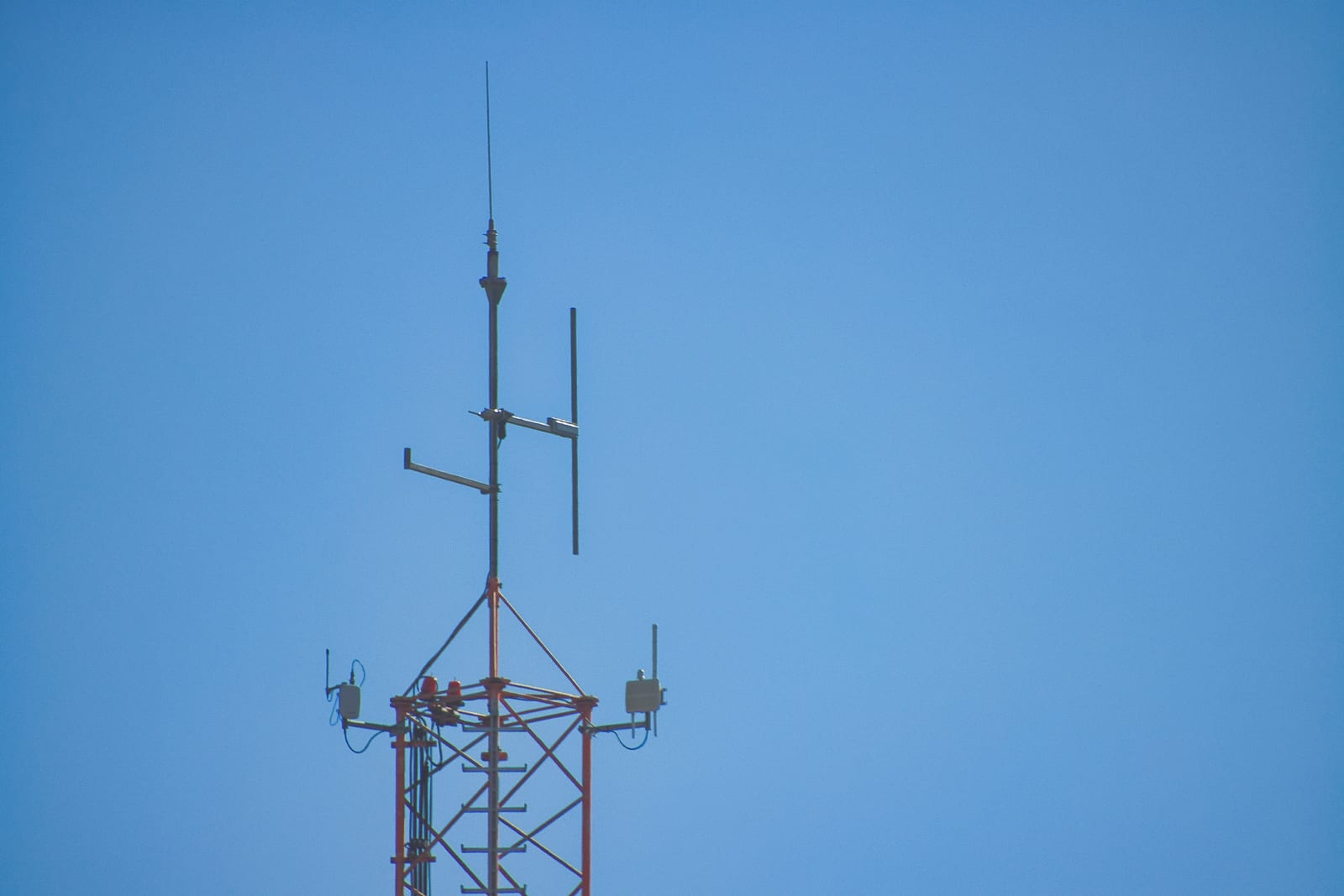
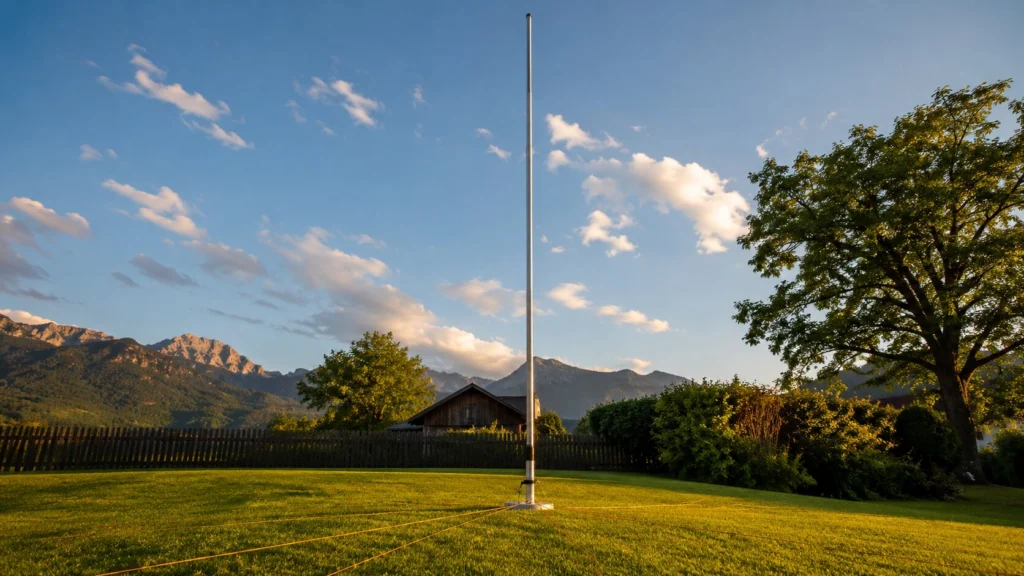
If you want to work DX and have limited space, a vertical antenna is hard to beat. Thanks to their low radiation angle, verticals send their signal flat over the horizon — exactly where the ionosphere reflects it for DX operation. At the same time, they only need a single mounting point. In this article, we explain the physics behind vertical antennas, compare the main types, and provide practical tips for installation and optimisation.
Why Vertical?
The main advantages of a vertical antenna for HF:
- Low radiation angle: A quarter-wave radiator over perfect ground radiates maximum at about 25° — ideal for DX. By comparison, a dipole at 10 m height radiates its maximum at 40–50°
- Omnidirectional: Verticals radiate equally in all directions — no rotation needed, no DX missed
- Small footprint: A vertical needs only one point on the ground, no guy wires spanning half the garden like a dipole
- No elevated support needed: Unlike dipoles or EFHW antennas, you don't need a tree or mast for the far end
However, verticals have drawbacks too. They receive more interference (QRM and QRN) than horizontal antennas, and their efficiency depends heavily on the ground system.
The Physics: Quarter-Wave Monopole
The simplest vertical antenna is a quarter-wave monopole (λ/4 radiator) over a conductive ground plane. Physically, it's half a dipole — the "missing half" is replaced by the ground reflection. The feedpoint impedance is theoretically about 36 Ω over perfect ground — close enough to 50 Ω for direct coaxial feed with acceptable SWR.
For the 20 m band (14 MHz), a quarter wave is about 5 m long — manageable and inconspicuous. For 40 m it's about 10 m, for 80 m roughly 20 m of radiator length.
The Radial System: The Key to Success
The most important — and most frequently underestimated — component of a vertical antenna is the radial system (also: ground plane, counterpoise, radials). Without an adequate radial system, large portions of the transmit power are lost as ground losses.
Ground radials lie on or just below the surface. The rule of thumb: 4 radials provide basic function but with high losses (~3–5 dB), 16 radials offer a good compromise, 32 radials reach diminishing returns, and 60–120 radials approach a perfect ground system (broadcast standard). Each radial should ideally be λ/4 long, but shorter and mixed-length radials also work — quantity matters more than exact length.
Elevated radials can be strung a few metres above ground. The advantage: just 4 resonant radials at λ/4 length already form an efficient system — far less work than 32+ ground radials. The downside: they need space outward and can be a tripping hazard.
Types of HF Vertical Antennas
Simple quarter-wave verticals: An aluminium tube or wire, λ/4 long, ground-fed with radials. The simplest and most efficient form — but single-band only. Can be self-built from a fibreglass mast and wire.
Trap verticals (multiband): Use trap circuits to make a single radiator resonant on multiple bands. Popular models include the Hustler 4-BTV/5-BTV/6-BTV, Diamond CP-6, and Cushcraft R-9. They're a compromise — covering many bands but with somewhat less bandwidth and efficiency per band than a monoband vertical.
Portable verticals: For SOTA and POTA, collapsible verticals are available: Buddipole/Buddistick (modular system), MFJ-1979 (telescopic), or a fibreglass mast + wire (cheapest option — a 10 m mast from EUR 50 plus antenna wire makes an excellent portable vertical). More details in our portable antenna comparison.
Vertical vs. Dipole vs. EFHW
How does the vertical compare to other popular antenna types?
- Vertical: Low radiation angle, omnidirectional, space-saving, needs good radial system, picks up more noise
- Dipole: Simple, cheap, quieter reception, needs two support points, radiation angle height-dependent
- EFHW: One support point, multiband capable, needs tall tree or mast, good compromise
- Magnetic loop: Tiny, ideal for balcony, but narrowband and limited power handling
No antenna is best for all situations. The vertical excels at DX on the higher bands (10, 15, 20 m), where its low radiation angle comes fully into play.
Installation Tips and Optimisation
- Choose location: The more open, the better. Ideally clear ground or at the edge of your property, away from metal fences and buildings
- Don't forget radials: Without radials, any vertical is an expensive dummy load. Minimum 16 ground radials or 4 elevated radials
- Measure SWR: Use a NanoVNA to check and fine-tune resonance
- Common-mode choke: A choke balun at the feedpoint prevents common-mode currents on the coax
- Saltwater is the best ground: On a beach or island, verticals achieve their theoretical maximum — one reason DXpeditions often prefer islands
- Higher isn't always better: The feedpoint of a quarter-wave vertical belongs as close to the ground (or radial system) as possible
Verticals and Propagation
The low radiation angle of a vertical harmonises perfectly with the propagation conditions of the current Solar Cycle 25. With high solar activity, the upper bands (10, 12, 15 m) open wide — and that's exactly where the vertical plays its advantage. During grey-line times morning and evening, a vertical enables DX connections that a low-hung dipole simply can't achieve.
Conclusion: The DX Antenna for Small Gardens
A vertical antenna is for many radio amateurs the best — and sometimes the only — solution for DX on shortwave. Those who invest in a good radial system are rewarded with a low radiation angle and 360° coverage. Combined with FT8 and the excellent conditions of Solar Cycle 25, 100 watts and a vertical are enough to work the world.
73 – your oeradio.at editorial team
Transparency Notice
This article was researched and written with the assistance of AI (Claude, Anthropic). Any illustrations used were generated with AI (ChatGPT/DALL·E, OpenAI) unless otherwise noted. The editorial team has reviewed and edited all content. Despite careful review, occasional inaccuracies may occur — we welcome corrections via email to [email protected].