A Jammer satire by Hansl Hohlleiter
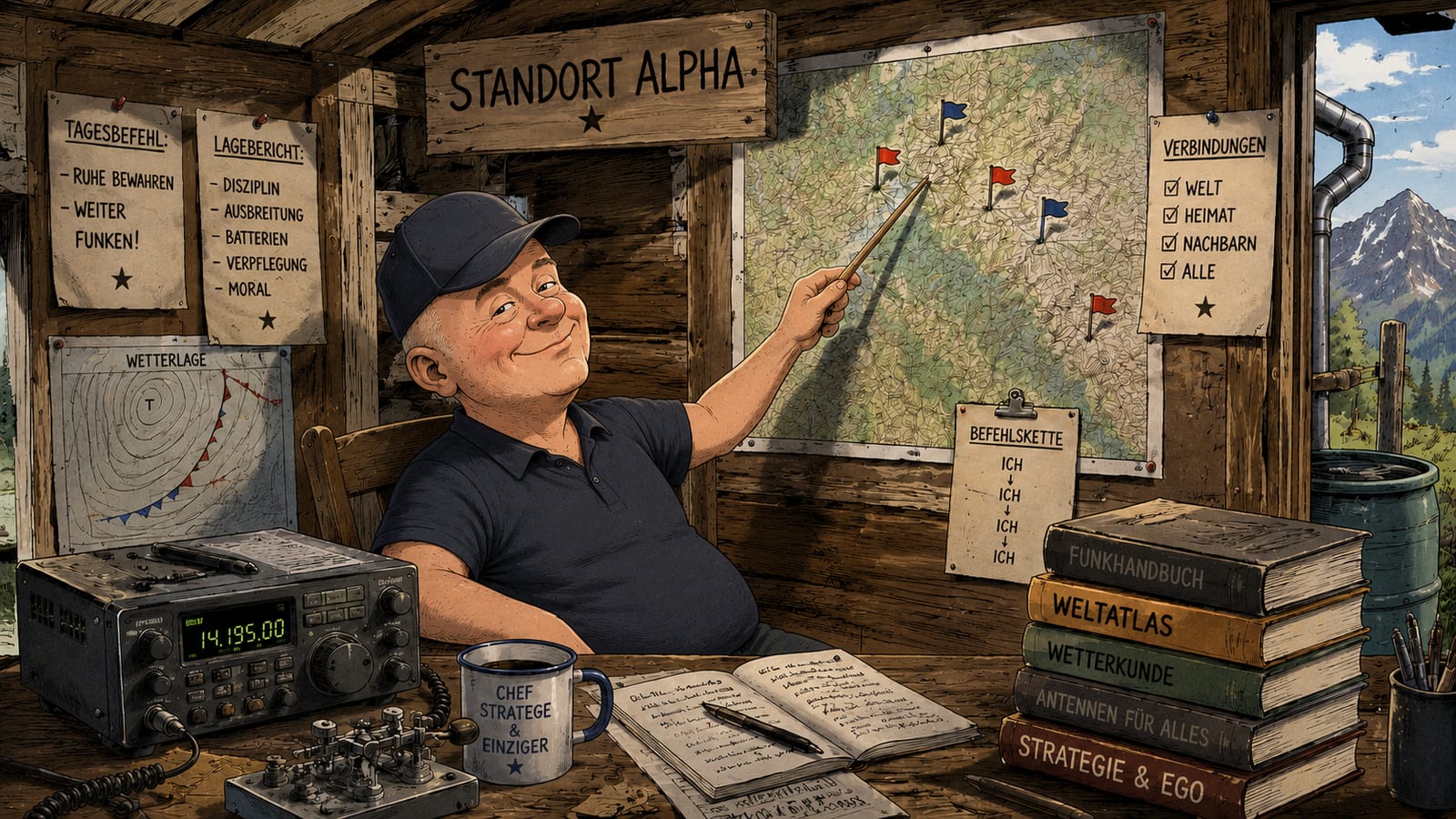
There are radio amateurs who simply pursue their hobby. And then there is Egon Eilmeldung, OE0EGN, who makes world history. At least in his own perception, which — one has to give him that — is remarkably stable.
Egon moved here a few years ago — since taking early retirement, to be precise — into a valley somewhere in the mountains that we shall, out of pure kindness, not name. The valley has not been the same since. Not because anything changed about the scenery, but because someone now lives there who treats every sunrise as a situation report.
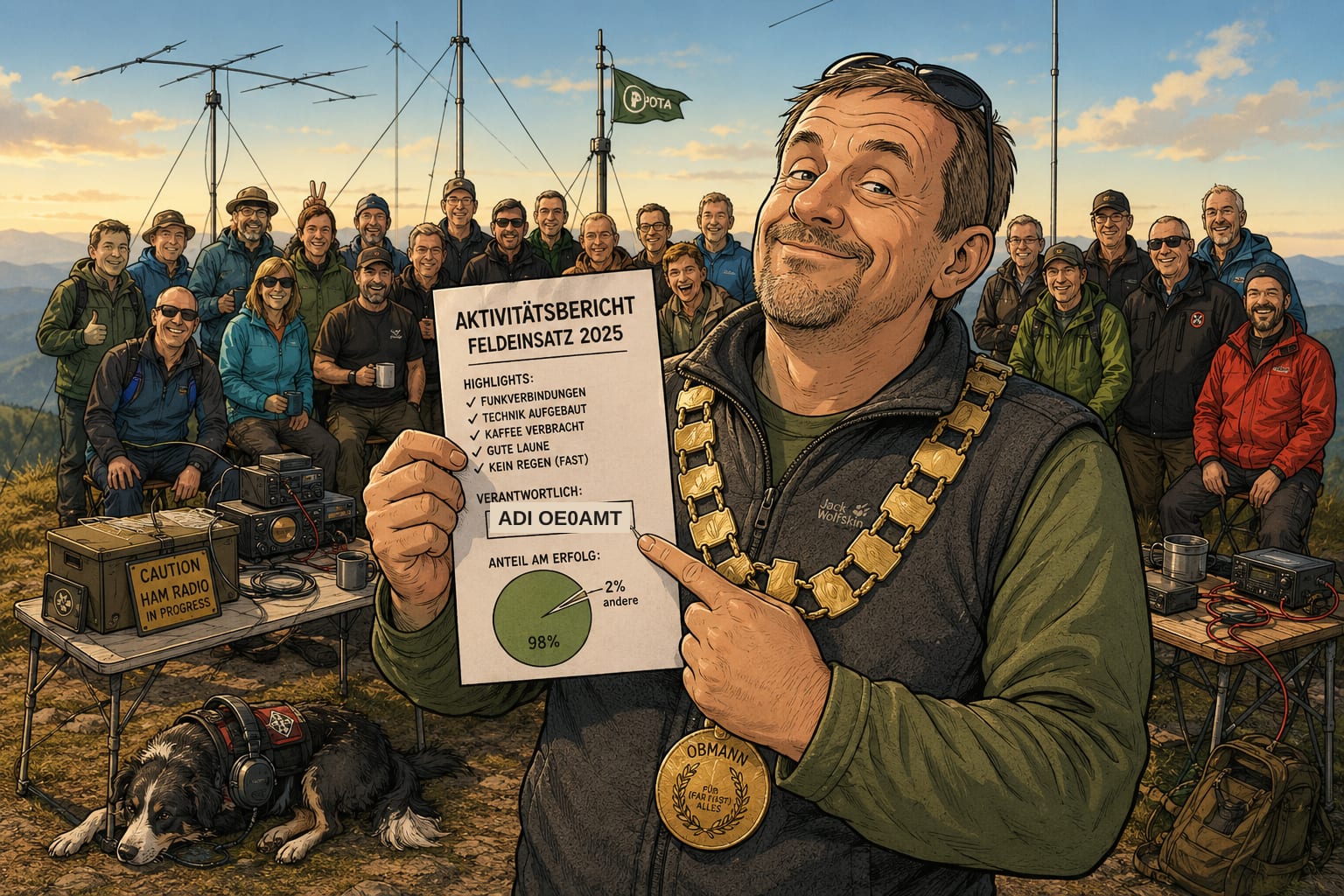
And the early retirement is not a detail here — it is the foundation of the entire operation. Egon has what the others in the valley lack: time. Unlimited. And he invests that time not in the garden, not in the grandchildren, not in the one antenna project he has been announcing for years — but entirely in his role as command-post chief. While the others are at work, Egon holds the position: he writes situation reports, monitors the storm situation, updates situation reports and, just to be safe, writes another situation report. Where others have a hobby, Egon has a full-time job — unpaid, self-appointed and carried out with a sense of duty one would wish for something more useful.
Because Egon does not transmit. Egon informs. The distinction is sacred to him. A normal person would come onto the net in the morning and say: "Good morning, nice weather today." Not Egon. Egon's morning greeting reads like a daily order from a headquarters only he knows about: "Good morning — today a major event of worldwide significance begins, in which I will take part from one of my locations. Please make the time." What follows is not an invitation. It is a mobilisation.
And here comes the real punchline: Egon's situation reports are not actually distributed by Egon. That is handled by his chief. Egon informs — and somewhere sits a dutiful soul who takes every single bulletin and dumps it into every channel there is: the club group, the second mailing list, the third group that was actually meant for field days, and, just to be safe, an e-mail to everyone he can reach. Three channels, the same message, four times a day. And the best part: nobody understands what the message is actually trying to say. Somewhere between "Location Alpha", "storm situation", "forward" and "please take note", the one piece of information that would matter — namely whether you are supposed to do anything now or not — gets lost completely. You read it three times, put the phone down, and know exactly as much as before: nothing. Without his distributor, Egon would be a man dictating daily orders to the rain barrel in his garden. With him, he is a transmitter with no receiver, but full coverage.
Egon's favourites are the contest weekends when the Austrian HQ station goes on the air. Not because he loves amateur radio as a sport — but because he finally has a format that matches his self-image: a world championship. A normal OM would say: "I'll hand out a few points today." Egon says: "I will join in from the location and, if necessary, help out on other bands, should the storm situation in other federal states require it." Let that sink in. The storm situation. In other federal states. Egon sits in his garden shed, standing ready to single-handedly save the national contest score in case there is lightning in Styria. The nation's civil defence, built on a G5 and a great deal of self-importance.
Speaking of location. Egon does not have a shack. Egon has locations. Plural. And each of them carries a code name, as if he were housed in a secret bunker programme. "Location Alpha" — that is, in truth, the club station up at the little summit hut, the jewel of the club, which generations of radio amateurs built with heart's blood, tended and carried up the mountain piece by piece. To everyone else it is the beloved club station, a place you climb up to and to which everyone has contributed a little something. To Egon it is "Location Alpha", his forward command post, which he claims for himself in his situation reports as casually as if he had set the hut up on the summit with his own hands. His second "location" is then more honest again: a little wooden hut next to the rain barrel, which is only called "the forward location" because Egon is standing in front of it. But "from Location Alpha I will join in on 80 metres in Morse" simply sounds like a command centre and not like a club hut, and that is what matters to Egon. Always.
His world view he brought with him from the old homeland, and he misses no opportunity to share it. He took his exam "in Germany, of course" — why, he reveals with a knowing smile meant to suggest that the Austrian one was too easy. At the big contest he praises the German HQ station to the skies: "For them the home stations are a decisive factor in the result", he says, and you can hear the faint disappointment that the Austrians have not quite grasped this yet. Egon measures OE against DL as a matter of principle. OE loses as a matter of principle. And Egon is, as a matter of principle, the only one who says so openly — Egon thinks.
It gets best of all when visitors come. A visit to Egon is not a coffee among friends. It is a state visit, and Egon is head of protocol, press office and host all in one. Weeks in advance he announces it on the net, in a tone as though a delegation were arriving: "Radio specialists and friends from the Rhineland" are on holiday in Austria and will do him the honour. The guest will bring a portable satellite station and demonstrate operation via the low-flying satellites. Anyone interested may attend. The pass will occur — Egon attaches the greatest importance to this statement — to the exact minute, and he names that minute as solemnly as if the fate of the Western world depended on it. Egon gives times to the second as a matter of principle, because imprecision is something for people who do not have locations.
What Egon never mentions in all this: that the guest is the genuinely interesting person. A real radio friend who actually knows something, who patiently sets up his station, explains the antenna to everyone and is delighted by every listener. Next to this man, Egon stands like a tour guide beside the Grand Canyon: loud, superfluous and firmly convinced that the people came for his sake.
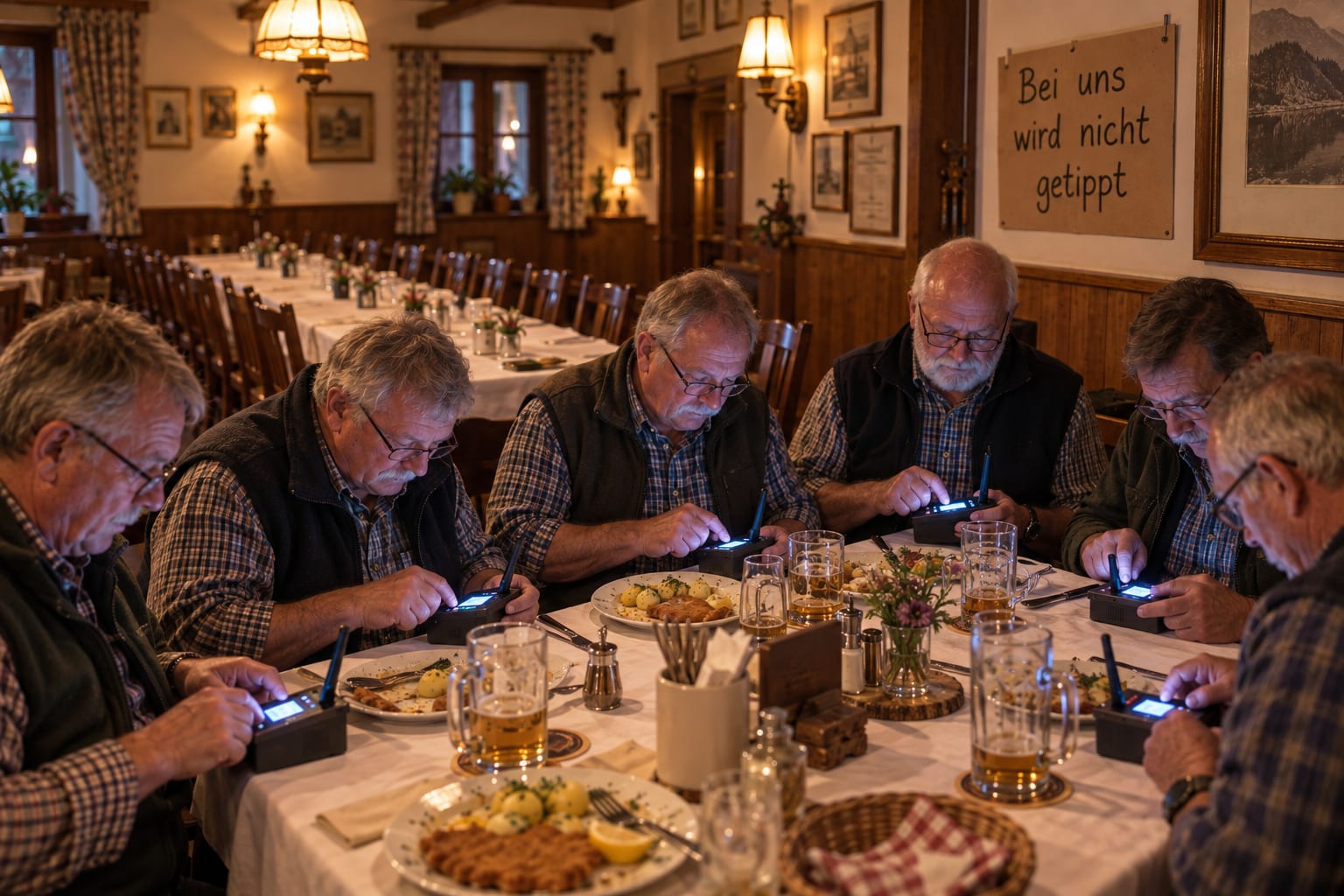
And then, of course, the highlight of every Egon event, the real goal behind all the locations, code names and situation reports: the debrief at the pub. "Afterwards we will proceed to the debriefing", Egon writes, with a winking emoji meant to reveal that he, too, has a sense of humour. He does not. But he has a regulars' table, and there he delivers the speech he has already announced three times on the net: about the contest he decided, about the storms he fended off, and about the satellites that were on time because he willed it so.
The locals in the valley have by now made a quiet peace with Egon. They let him file his situation reports, they dutifully say "thanks Egon", and when he is finished they turn the VFO twenty-five kilohertz further, where the real net takes place — the one Egon never joins, because it has too little format for him. There they talk about antennas, about field days, about the kids who get to hold the microphone for the first time. Entirely without code names. Entirely without a world championship. Just like that.
Hansl's verdict: Egon Eilmeldung has turned a lovely hobby into a front line that only he defends, against an enemy only he can see. The sad part is not that he wants to be important — many people do. The sad part is that in doing so he overlooks the only ones who really needed him: the neighbours who were simply looking for a nice person on the frequency. You do not need a location to belong. You only need to be able to listen. That is exactly what Egon never learned — he was always transmitting.
All persons, callsigns and locations in this article are entirely fictional. Any resemblance to living radio amateurs is purely coincidental, in so far as nobody feels addressed — and intentional, in so far as they do. The author accepts no liability for spontaneous self-recognition.
Transparency Notice
This article was researched and written with the support of AI (Claude, Anthropic). Illustrations used were, unless otherwise indicated, created with AI (ChatGPT/DALL·E, OpenAI). Editorial responsibility and content review rest with the oeradio.at editorial team. Feedback — from the location, too — is welcome at [email protected].