Table of Contents
- Rules first, soldering iron second
- Austria: tenancy law, condominium law, building law
- USA: HOAs, CC&Rs and a law that never arrives
- What invisibility costs physically
- The part no guide likes to mention
- Solutions indoors
- Wire in the attic
- Magnetic loop
- Balcony and window frame
- Solutions outdoors that nobody notices
- Operating: making much out of little
- Videos on the topic
- Where to start
- Transparency Notice
There are two kinds of radio amateurs without an antenna. Those who are not allowed one, and those who do not dare to ask. Both end up at the same question: how do you run a station without anything visible on the building.
This article sorts the subject into three layers, deliberately in this order: what the rules say, what physics allows, and what it costs in performance. That third layer tends to get skipped, and it is exactly why some people are happy with an invisible antenna while others give up after six months.
Rules first, soldering iron second
Austria: tenancy law, condominium law, building law
For tenants, Section 9 of the Tenancy Act (MRG) is the relevant provision. It obliges the landlord to tolerate certain alterations, antenna installations explicitly among them, provided they match the state of the art, are professionally executed and do not harm legitimate interests. The Supreme Court has made clear that this creates no right to a particular mounting location. The landlord gets a say in where the thing goes, and that is exactly where the negotiation starts.
In condominium ownership the situation is stricter. Anything mounted on common parts of the building, so the roof, the façade or the outer wall of a balcony, is an alteration requiring the consent of the other owners or, failing that, a court decision. Inside your own four walls that does not apply, which is why the indoor antenna is often the shortest route for owners.
On top of that comes regional building law. In Vienna, antennas outside heritage zones need no permit, while inside such a zone any change to the external appearance does. If you live in an old building in a town centre, find that out before drilling rather than after.
One distinction that constantly gets blurred: receiving is legally easier than transmitting. The well-known satellite dish decisions rest on freedom of information, and that covers reception. Nothing follows from them for a transmitting antenna.
The practical advice from many cases: ask in writing, start small, promise removal without traces, attach a photo mock-up, and do not make power levels the topic before anybody asks. A three millimetre wire running from the terrace to the spruce is perceived differently from „an amateur radio installation".
USA: HOAs, CC&Rs and a law that never arrives
The term stealth antenna comes from the USA, and the situation there is different. Millions of homes sit in developments governed by a Homeowners Association whose private covenants, the CC&Rs, simply forbid visible antennas. Three points, because they are regularly confused:
- PRB-1, the well-known FCC requirement for „reasonable accommodation" of amateur antennas, binds public authorities. It does not reach private contracts between owners.
- The FCC's OTARD rule protects antennas for television reception, satellite and fixed wireless broadband against such clauses. Amateur radio antennas are not covered.
- The Amateur Radio Parity Act was meant to close that gap and failed. Its successor, the Amateur Radio Emergency Preparedness Act, has been sitting in the 119th Congress as H.R. 1094 and S. 459 since February 2025 and has not been enacted.
For readers in Europe this mainly explains why half the literature on the topic is American, and why the flagpole plays such a starring role: in an HOA neighbourhood a flag is welcome and an antenna is not.

What invisibility costs physically
A hidden antenna is almost always a worse antenna. That is no reason to skip it, but it is a reason to calibrate expectations first. The losses come from four sources:
- Attenuation by building materials. Tiles, wood and dry plaster cost little, often one to three decibels. A metal roof, a foil-backed insulation membrane or reinforced concrete are effective shields. Modern insulation is particularly treacherous: you cannot see the foil once the cladding is up.
- Shortening and loss resistance. A 40-metre wire folded into five metres has a low radiation resistance. Everything that adds loss resistance, coils, joints, damp walls, comes straight off the efficiency.
- Proximity to conductive parts. Gutters, heating pipes, rebar, cable trays. They detune, couple and radiate along, usually not in the direction you wanted.
- Noise floor. Indoors the antenna sits inside the noise source. Power supplies, LED lighting, PV inverters and powerline adapters are a few metres away, see our EMC guide.
As a rough field figure: the same length of wire in the attic rather than outdoors costs one to two S-units. That is annoying, but only rarely is it the difference between „hard work" and „impossible".
The part no guide likes to mention
Transmitting indoors puts the antenna close to people who live there permanently. Exposure limits exist for assessing that, and they apply to your own family in the next room too. Three points worth taking seriously:
- Distance is the most effective measure. An attic above a bedroom is a different matter from a loop on the desk somebody sits at.
- Reducing power costs surprisingly little. From 100 to 10 watts is 10 dB, just under two S-units. In FT8 that is often the difference between decoded and decoded.
- Magnetic loops carry very high voltage at the tuning capacitor. Even at low transmit power. A loop does not belong where children can reach it.
And since it belongs here: an antenna in the attic does not make lightning protection a smaller topic. The cable still enters the building, and the external protection system of the house does not want to be bypassed.
Solutions indoors
Wire in the attic
If an attic is available and the roof is not sheet metal, a strung wire is the best invisible antenna you can get. Two forms have proven themselves:
- Dipole or inverted V, as high as possible under the ridge, fed through a common-mode choke. For 20 metres the length just about fits in many houses; for 40 metres you fold it.
- End-fed half wave with a 49:1 transformer, run in a zigzag, see our article on the EFHW. Advantage: the feed point sits where the cable arrives anyway. Drawback: the far end carries high voltage, so do not staple it to a rafter somebody reaches past.
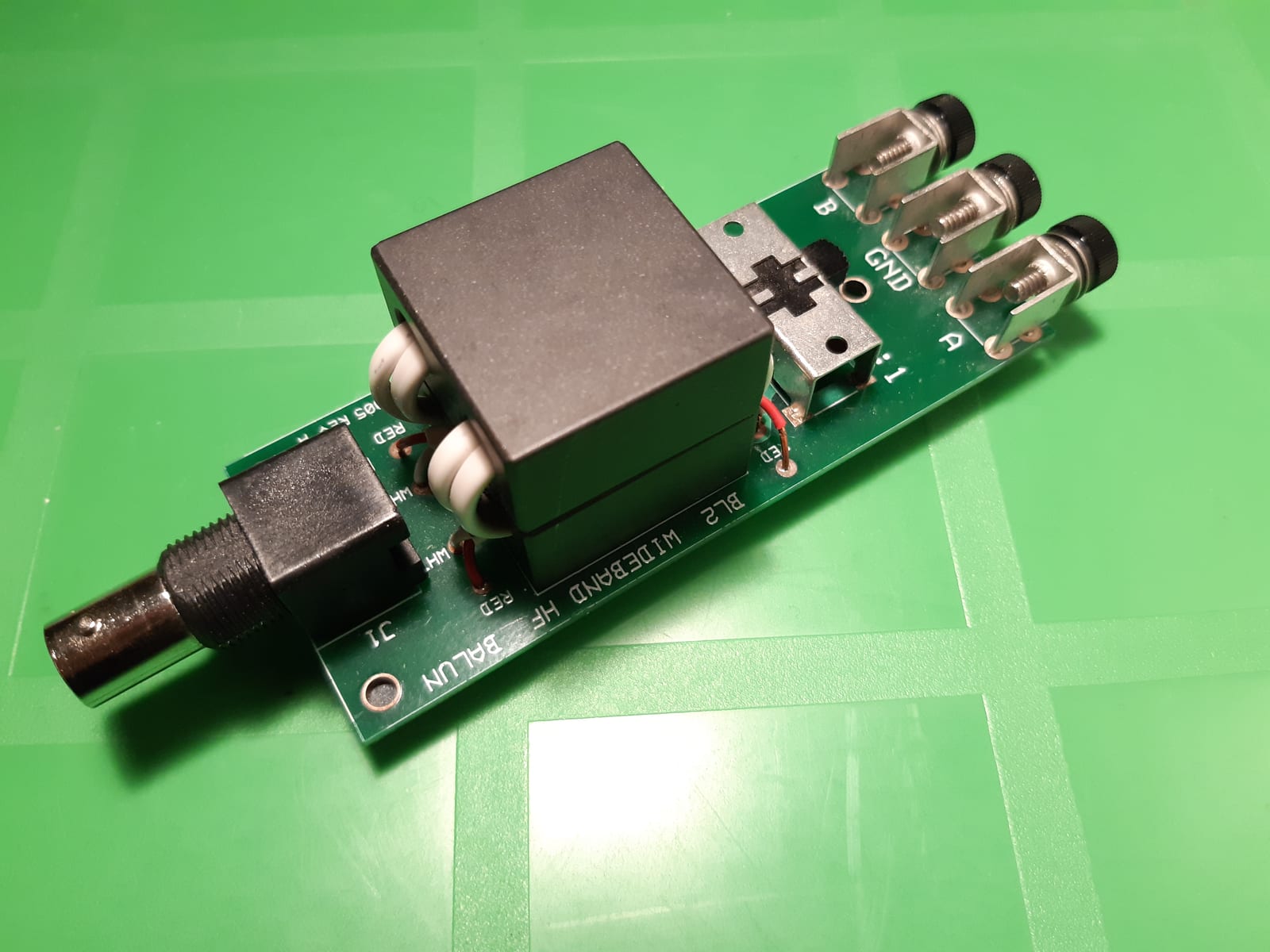
One practical point: common-mode current is not a side issue here, it is the main problem. A wire inside the house couples strongly into the domestic wiring. A proper choke at the feed point and a second one at the transceiver save a lot of grief, see baluns and ununs.
Magnetic loop
The loop is the classic apartment antenna and in practice a compromise with a clear profile. It needs little space, is noticeably quieter on receive than a wire because it responds to the magnetic field, and it can be rotated to null out an interferer. In exchange it is extremely narrowband, needs retuning after every QSY and reacts to anything conductive nearby. Details in our article on the magnetic loop.
One variant that gets mentioned too rarely: loop for receive only, wire for transmit. You do not have to do both jobs with the same structure.
Balcony and window frame
A surprising amount works on a balcony once you adjust which bands you expect. A shortened vertical with two to four tuned radials along the railing, a three metre fibreglass mast extended only while operating, or a wire strung from the balcony to a tree in the evening and pulled back in the morning. For the background see vertical antennas.
About the railing itself: a metal railing is a usable counterpoise but a miserable radiator. Using it as an antenna distributes RF throughout the building.
Solutions outdoors that nobody notices
- Thin wire. Enamelled copper wire of 0.4 to 0.8 millimetres is invisible from ten metres away. It is mechanically marginal, so every end needs a bungee as strain relief. Grey or black instead of bright copper does the rest.
- Rotary clothesline and washing line. A perfect support that is already approved, because nobody perceives it as an antenna mast.
- Flagpole. Fibreglass mast with a wire inside, radials under the lawn or in the gravel. The standard recipe in the USA, over here mainly interesting in housing estates with strict development plans.
- Fence and hedge. A wire along a wooden fence or inside a hedge is inconspicuous but couples heavily into the ground. It works and it costs efficiency.
- Gutters and downpipes. Popular, but handle with care: contact resistance at the joints creates rectifier effects and therefore interference, and the gutter carries RF exactly where you do not want it.
- Antenna only while operating. The most honest solution when the legal situation is tight. A wire thrown up for two hours in the evening is a different thing from a permanent installation, both in the neighbours' perception and in a management company's assessment.
Operating: making much out of little
- Mode beats power. FT8 and CW work 15 to 20 dB below SSB. With a compromise antenna that is the difference between a contact and noise. If you have only ever done SSB, this is the biggest lever available, see also QRP operating.
- Measure first, believe later. A NanoVNA tells you in ten minutes whether your attic wire is resonant or whether the tuner is merely flattening the meter. On that subject, our article on antenna tuners applies: it repairs the reading, not the power budget.
- Short, decent cable. With an already lossy antenna, poor coax is a second loss stacked on the first, see the coax comparison.
- WSPR as a measuring instrument. Two nights of WSPR at five watts show in black and white what the antenna can do, and produce a map that you need not show the management company but that keeps your own motivation alive.
- Change location. No contradiction to the stealth idea: if you are restricted at home, move the loud operating outdoors. SOTA and POTA exist for exactly this situation, while the quiet home station handles FT8 and the evening net.
Videos on the topic
Where to start
| Situation | First attempt |
|---|---|
| Owned house with attic, tiled roof | Wire under the ridge, dipole or EFHW with a common-mode choke |
| Rental flat, balcony, reasonable landlord | Vertical with radials on the railing, extended only while operating |
| Rental flat, no balcony, high noise floor | Magnetic loop at the window, optimise receive separately |
| Terraced house with garden, strict neighbours | Thin wire to the clothesline or the tree, painted grey |
| Metal roof or reinforced concrete | No indoor antenna; use the balcony, the garden or portable operating |
| HOA neighbourhood in the USA | Flagpole, attic, thin wire, and read the CC&Rs first |
The conclusion is a sober one. An invisible antenna is a compromise and stays one, however clever the construction. But it is the difference between a hobby that happens and a callsign that sits in a drawer. Most people who go down this road report the same thing: the first wire is too short, the second too visible, and the third has worked for years without anybody in the building knowing about it.
73 – your oeradio.at team
Transparency Notice
This article was researched and written with AI assistance (Claude, Anthropic). The content was reviewed by the oeradio.at editorial team. The legal notes are orientation, not legal advice: Section 9 MRG and the regional building codes for Austria, the FCC rules PRB-1 and OTARD plus H.R. 1094 and S. 459 of the 119th Congress for the USA, as of September 2026. Corrections are welcome at [email protected].