Table of Contents
- What Is EMC?
- The Most Common Interference Sources
- Identifying Interference
- SDR as an Interference Analyser
- Measuring and Quantifying the Noise Floor
- Noise Blanker and Noise Reducer
- Near-Field Probes
- TinySA: Pocket Spectrum Analyser
- Eliminating Interference
- Common-Mode vs. Differential-Mode Interference
- Ferrite Cores and Snap-on Ferrites
- Common-Mode Chokes (Baluns)
- Grounding and Bonding
- Mains Filters
- Galvanic Isolation
- Distance and Cable Routing
- When Your Station Causes Interference
- Legal Situation in Austria
- Receiving Antennas as an EMC Strategy
- EMC Checklist for the Shack
- Transparency Notice
EMC — Electromagnetic Compatibility — is one of the biggest practical topics in radio operation, whether amateur radio, CB, PMR, or other radio services. Whether the S-meter on 40 m constantly reads S7 with nobody transmitting, the neighbours complain about TV interference, or a new LED lamp contaminates all of HF: EMC problems are ubiquitous. The good news: with a systematic approach, most interference can be identified and eliminated.
What Is EMC?
EMC describes the ability of electrical devices to function without interference in their electromagnetic environment while not disturbing other devices. This covers two sides: emission (a device generates unwanted electromagnetic energy) and immunity (a device is sensitive to electromagnetic fields). Radio amateurs stand on both sides — as victims (reception interference from external sources) and potential causers (transmissions can disturb sensitive electronics).
The Most Common Interference Sources
- Switching power supplies: By far the most common source in modern households. Every USB charger, laptop adapter, and LED power supply operates with switching frequencies of 50-200 kHz and generates harmonics reaching well into the UHF range.
- LED lamps: LED bulbs with cheap switching power supplies are notorious for their interference radiation. Some models raise the noise floor on HF by 20-30 dB.
- Powerline/PLC (DLAN): Powerline adapters (internet over mains wiring) use frequencies up to 86 MHz — right through the HF and VHF range. The mains wiring becomes an antenna radiating broadband interference.
- Solar inverters: With the PV boom, interference from solar inverters is increasing. Switching frequencies and MPPT tracking generate harmonics audible on HF.
- Other sources: Defective insulators on power lines, electric fences, heating controllers, unshielded Ethernet cables, plasma TVs, USB 3.0 devices and cables (known for 2 m interference).
- PV optimisers (DC-DC): Systems like SolarEdge or Tigo with per-module optimisers often cause worse interference than the inverter itself. Each optimiser switches at ~200 kHz, harmonics extend well beyond 30 MHz. With 20-40 optimisers on the roof, a distributed noise antenna array emerges. Only active under load (daytime with sun).
- EV chargers (wallboxes) and heat pumps with inverter compressors: Both are rapidly growing interference sources with broadband emissions on HF.
Identifying Interference
Systematic approach:
- Assessment: Which frequencies are affected? Is it broadband or narrowband? Continuous or periodic?
- Time correlation: Does it occur only at certain times? (Night = street lighting? Day = solar system? Constant = power supply?)
- Mains-synchronous analysis: In the SDR waterfall, look for sideband structure: interference with 100 Hz spacing (full-wave rectification) or 50 Hz spacing points to mains-coupled sources (switching PSUs, dimmers). Non-mains-synchronous patterns (e.g., fixed 200 kHz spacing) indicate clock-driven sources like PV optimisers or Ethernet switches.
- Exclude your own devices: Switch off the main breaker (battery operation!) — if interference disappears, it comes from your own household.
- Check individual circuits: Switch on breakers one by one until interference returns — this identifies the circuit.
- Direction finding: Use a directional antenna or portable receiver to determine the direction. An RTL-SDR with a small directional antenna is an excellent tool for locating interference.
SDR as an Interference Analyser
An SDR receiver like the RTL-SDR or HackRF is an invaluable EMC analysis tool: broadband waterfall shows all interference at a glance, harmonics from switching supplies appear as evenly spaced lines, and it's portable for tracking interference to its source.
Measuring and Quantifying the Noise Floor
S-meter readings like "S7 noise floor" are subjective and vary between radios. For objective EMC assessment, measure the noise floor in dBm — the absolute power level referenced to 1 mW. Modern transceivers (IC-7300, FT-DX10, TS-890S) can display levels directly in dBm. Method: measure noise floor with dummy load (no antenna), then with antenna. After each EMC measure (ferrite, filter, grounding), re-measure — a 6 dB drop means interference power has quartered.
Noise Blanker and Noise Reducer
Before reaching for the soldering iron, check your transceiver's built-in tools. Modern radios offer two complementary weapons against interference:
Noise Blanker (NB) — for impulse noise. The NB detects short, strong noise pulses (ignition sparks, electric fences, switching PSUs) and briefly gates the receive path. The gap is so short (microseconds) that the desired signal is barely affected. Start with a low NB level and increase gradually — too high causes AGC pumping and signal distortion.
Noise Reducer (NR/DNR) — for broadband noise. DSP-based noise reduction estimates the noise spectrum during signal pauses and subtracts it, providing 10–20 dB improvement against continuous background noise. But set it too high and SSB sounds muffled, weak signals become distorted. On the IC-7300, NR values of 3–5 (scale 1–15) are a good starting point. NB and NR can be active simultaneously — NB removes impulse peaks, NR reduces remaining background noise.
Near-Field Probes
When the SDR shows the general direction, a near-field probe pinpoints the exact source. The small loop is held millimetres over cables, power supplies, or circuit boards — where the signal peaks, that's the culprit.
DIY: Form solid copper wire into a loop (10–30 mm diameter), solder both ends to a BNC connector. For a shielded version: bend coax into a loop, break the shield at the top — creating a Faraday-shielded H-field probe. H-field probes (loops) locate current-carrying conductors and are the best choice for ham EMC work. E-field probes (short stub) detect voltage-driven fields.
Commercial options: RF Explorer Near Field Kit (4 probes, 1 MHz–7 GHz, ~EUR 100), Beehive 101A Set (4 probes, DC–6 GHz, ~EUR 300), or professional probes from Langer EMV (Germany).
TinySA: Pocket Spectrum Analyser
The TinySA Ultra is a palm-sized spectrum analyser (100 kHz–5.3 GHz, ~EUR 120–140) that has revolutionised EMC analysis for hams. With a near-field probe connected, it directly measures emissions from power supplies, LED drivers, or PLC adapters in dBuV. The practical benefit: install a filter, re-measure, and objectively see whether it works. Limitation: ~70 dB dynamic range (vs. 100+ dB professional) — fine for shack troubleshooting, not for formal certification.
Important: Peak vs. Quasi-Peak. The TinySA measures in peak mode by default — but EMC limits (CISPR 32 for consumer electronics) are defined as quasi-peak (QP). The QP detector weights interference by repetition rate: infrequent pulses score lower than continuous signals. For impulsive interference (switching PSUs), peak readings can be 10-20 dB above QP. This means a peak measurement 15 dB above a limit may actually pass on QP. For before/after comparisons in the shack, peak is sufficient — but be aware of the difference when comparing against limits.
Eliminating Interference
Common-Mode vs. Differential-Mode Interference
Before deploying ferrites and filters, understand the difference — each requires a different countermeasure:
Differential-mode: Noise current flows in opposite directions on the two conductors — along the normal signal path. Countermeasure: X-capacitors across the line and LC filters.
Common-mode: Noise current flows in the same direction on both conductors, returning via ground. On coax, common-mode current flows on the outer shield surface (skin effect separates it from the inner signal). Countermeasure: ferrite cores and common-mode chokes.
Why common mode dominates in ham radio: Coax feedlines and house wiring act as unintentional antennas picking up noise as common-mode current. On HF, cable lengths are comparable to the wavelength, making them efficient common-mode antennas. A standard EMC mains filter combines both: common-mode choke + X-capacitors (differential) + Y-capacitors (common-mode to ground).
Ferrite Cores and Snap-on Ferrites
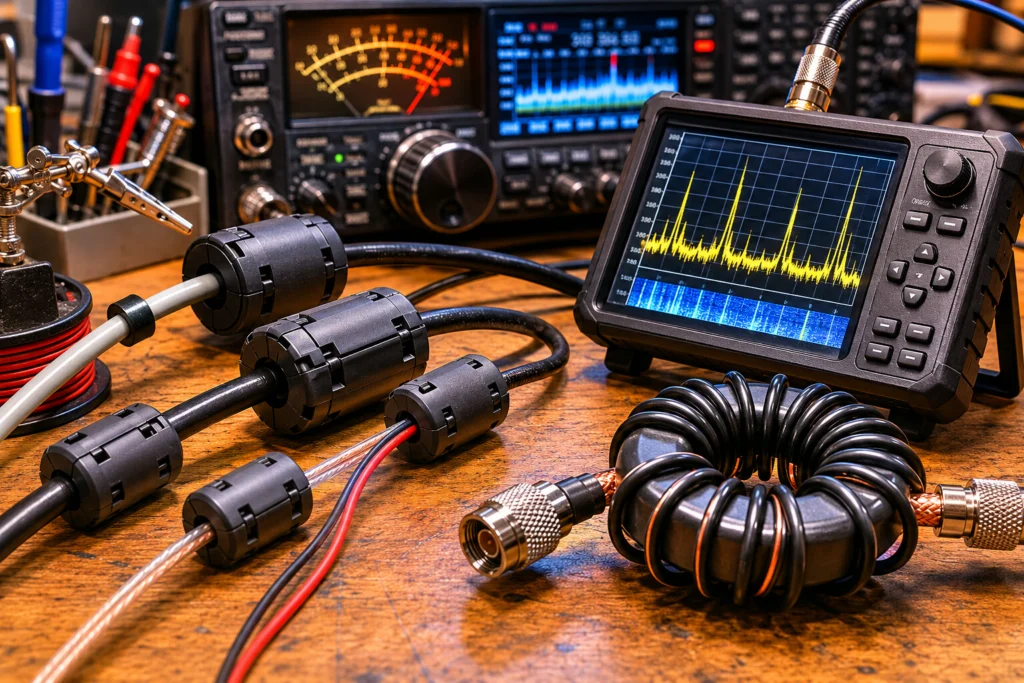
The most important tool against common-mode interference. Ferrite cores are placed around cables to attenuate interference currents flowing on cable shields:
- Material 31 (MnZn): Effective from 1 to 300 MHz — the all-rounder for HF and VHF
- Material 43 (NiZn): Effective from 25 to 300 MHz — ideal for VHF/UHF
- Material 61 (NiZn): Effective from 200 MHz to 2 GHz — for UHF and microwave
Important: Multiple turns through the ferrite core increase attenuation quadratically — 3 turns provide 9 times the attenuation of a single turn.
Common-Mode Chokes (Baluns)
At the antenna feed point, common-mode chokes prevent RF currents from flowing back on the outer shield of the coaxial cable. Without a choke, the station can cause EMC problems in its own household. For EFHW antennas and vertical antennas, common-mode chokes are particularly important.
Two proven designs:
- W2DU choke: 50 ferrite beads (FB-73-2401, material 73, µ=2500) threaded onto Teflon coax (RG-303 or RG-142) — no winding needed, solid common-mode impedance on 80–10 m. Material 73 is the original by Walt Maxwell (W2DU, QST 1983); for thicker coax (RG-8/RG-213), material 77 is the functionally equivalent modern successor with larger bore.
- Guanella 1:1 on FT240-43: 11–12 turns of coax through an FT240-43 toroid. Higher impedance than W2DU: over 8 kΩ on 80 m, ~4 kΩ on 40 m, ~2 kΩ on 20 m (DJ0IP measurements). Stack two cores for 1 kW. K9YC recommends material 43 for 80–10 m; material 31 for 160 m priority.
The reference for choke designs is the G3TXQ choke table (Steve Hunt, SK). Rule of thumb: aim for at least 1 kΩ common-mode impedance on the target band, ideally predominantly resistive.
Grounding and Bonding
The common belief that "more grounding = less interference" is oversimplified at HF. K9YC (Jim Brown) demonstrates: the earth is not a sink for RF energy. A ground rod has high impedance at HF and cannot effectively drain interference currents. Worse: a ground lead longer than a fraction of a wavelength becomes an antenna itself, potentially coupling in interference rather than draining it.
What actually helps: Bonding all equipment together with short, wide copper straps to equalise RF potential. Common-mode chokes on feedlines are far more effective than additional ground rods. Grounding remains essential for lightning protection and electrical safety — but that is a different requirement from RF interference suppression. If a ground connection is used, keep it as short as possible (under 1/20 wavelength) with wide copper strap.
Mains Filters
A good mains filter at the shack entrance effectively suppresses interference conducted via the power line. EMC filters with both common-mode and differential-mode suppression are recommended (e.g., Schaffner FN2090 or Würth WE-CLFS).
Galvanic Isolation
Sometimes the more elegant solution is not another ferrite but complete galvanic isolation of signal paths. Where ground loops couple in interference, galvanic isolation eliminates the problem at its root: USB isolators between PC and transceiver (especially for digimodes), audio transformers (1:1) to break hum loops on audio connections, and fibre optic (LWL) for Ethernet replacing the metallic connection between shack and router — no ground connection, no interference coupling. Media converters (Cat↔fibre) cost ~€30/pair.
Distance and Cable Routing
The simplest and often most effective EMC measure costs nothing: distance. Every doubling of distance from the noise source provides 6 dB of attenuation. In the near field, field strength drops even faster.
- Move the antenna away: At least 5 m, ideally 15 m+. The further from switching PSUs, LED dimmers, and PLC adapters, the lower the noise floor.
- Prefer horizontal antennas: Most man-made noise is vertically polarised. Horizontal dipoles and loops pick up less interference.
- Cross cables at right angles: Never run coax and mains cables parallel over long distances.
- No coax bundles: Don't coil excess coax — it can act as a resonant circuit.
- Chokes at two points: Common-mode choke at the antenna feedpoint AND where the cable enters the house.
RX interference vs. TX interference — different choke strategies: If you are being interfered with (RX problem), the choke belongs near the antenna — it prevents common-mode currents from mixing into the received signal. If you are interfering with neighbours (TX problem), the choke belongs at the house entry — it prevents RF energy from radiating into the mains and neighbour devices. Ideally, place a choke at both points.
When Your Station Causes Interference
- TVI: Harmonics of the transmitted signal interfere with neighbours' TV reception. Solution: low-pass filter at the transmitter output.
- Router/WiFi interference: RF ingress into routers and smart home devices. Solution: ferrite cores on all connecting cables.
- Audio hum: RF ingress into audio amplifiers. Solution: common-mode choke at antenna output, ferrite cores on speaker cables.
- Intermodulation: Spurious products generated in the transceiver. Solution: clean antenna with good SWR (check with NanoVNA), low-pass filter, no loose contacts.
Legal Situation in Austria
In Austria, the Fernmeldebüro (Federal Telecommunications Office, a subordinate agency of the BMWKMS) handles radio interference and EMC matters. The legal framework includes the Telecommunications Act (TKG 2021), the EMVV 2015 (EMC Regulation, implementing EU Directive 2014/30/EU) and the FMaG 2016 (Radio Equipment Market Surveillance Act). All electrical devices must comply with EMC Directive 2014/30/EU (CE marking). Interference can be reported to the Funkmonitoring unit: +43 1 71100-654488 (24/7) or [email protected]. The Fernmeldebüro can conduct on-site measurements and prohibit operation of interfering devices.
Practical tip: before taking the official route, always try talking to the neighbour first. Often an interference problem can be resolved amicably — a ferrite core on the offending device's power cable or a better power supply frequently solves the problem for both sides.
Receiving Antennas as an EMC Strategy
Sometimes the local noise floor cannot be reduced further — then a dedicated receiving antenna helps. Especially on the lower bands (160 m, 80 m), where man-made and atmospheric noise dominate, a separate RX antenna can lower the noise floor by 10-20 dB: Loop on Ground (LoG) — ~18 m wire laid flat on the ground (KK5JY design), responds primarily to the magnetic field component and rejects local electric-field noise. K9AY loop — compact directional loop (~3×3 m) with switchable pattern, over 20 dB front-to-back ratio. Beverage antenna — long wire (160-300 m) near ground with termination, excellent directivity on 160 m but requires space. Modern transceivers with separate RX antenna ports (IC-7610, TS-890S) can automatically switch between TX and RX antenna.
EMC Checklist for the Shack
- Common-mode choke on every coax cable at the antenna feed point
- Low-pass filter at the transmitter output for each band
- Ferrite cores on all cables leaving the shack (mains, USB, audio, Ethernet)
- RF ground with short, wide copper strap
- Check SWR: Antennas with SWR > 2:1 create unnecessarily high RF fields in the shack
- Shielded cables: Cat 6/7 instead of Cat 5, shielded USB cables
- Mains filter at the shack entrance
- Test LED lamps: Check interference emissions before buying
EMC is not rocket science — with systematic approach, the right tools, and some ferrite, most interference can be solved. The effort is worth it: an interference-free shack makes radio operation on all bands a pleasure.
73 – your oeradio.at editorial team
Transparency Notice
This article was researched and written with the assistance of AI (Claude, Anthropic). Any illustrations used were generated with AI (ChatGPT/DALL·E, OpenAI) unless otherwise noted. The editorial team has reviewed and edited all content. Despite careful review, occasional inaccuracies may occur — we welcome corrections via email to [email protected].