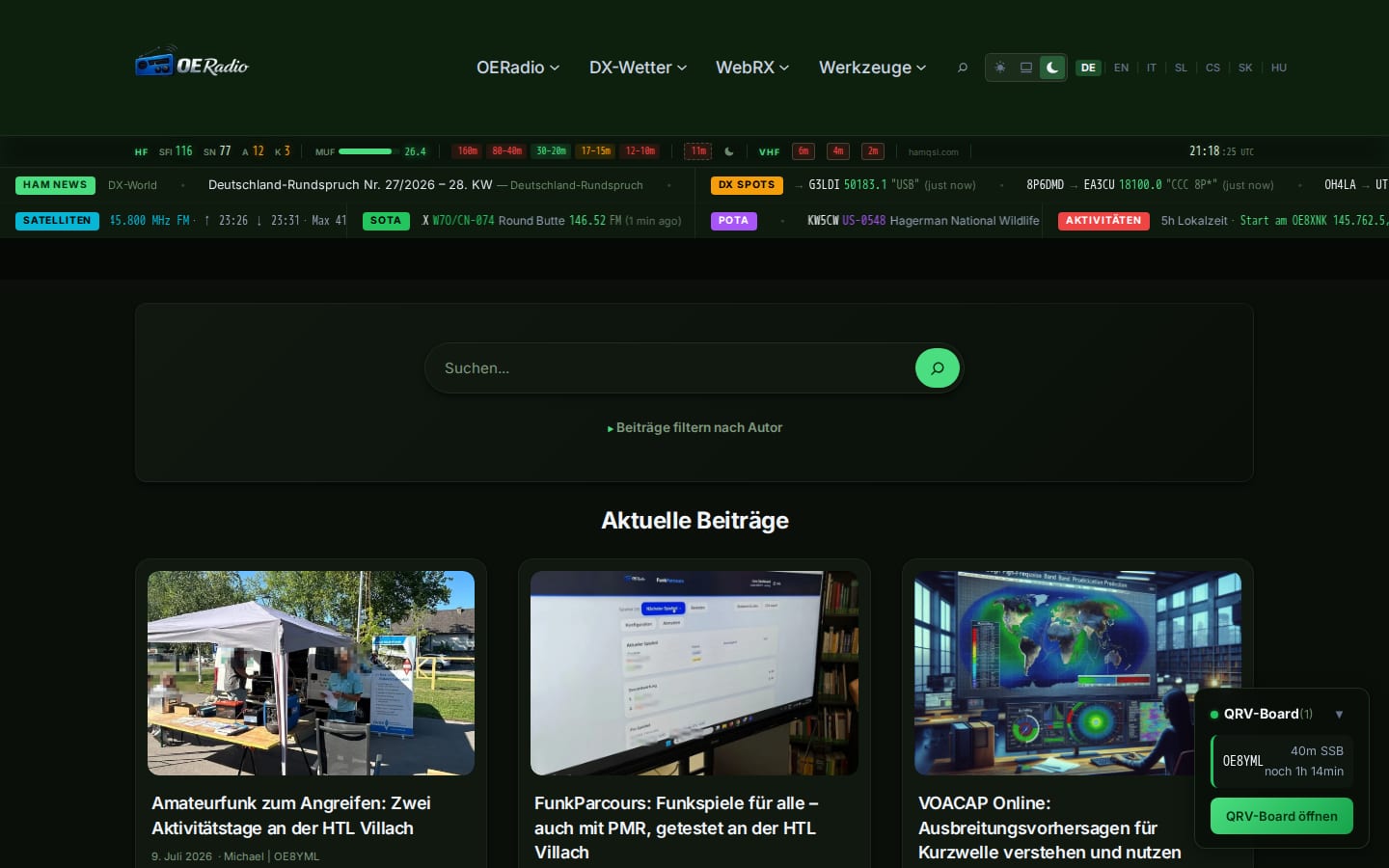
If the new green looks familiar on today's visit — yes, it's intentional, and yes, it's a nod to old tube radios and frequency displays. oeradio.at has undergone a complete rebuild over the past few days: WordPress is history. The site you're reading right now consists of static files, built from Markdown texts kept under version control. And since this is, at heart, a homebrew project — just at the server instead of the soldering iron — we'd like to tell you what we did and why.
Why move away from WordPress?
WordPress served us well for two years. But anyone who has ever looked after a club website knows the downsides: constant plugin updates, security holes, a database that wants backing up, and a cache that serves up stale content precisely when you want to show something new. For a site whose content can be described perfectly well as plain text files, that's a lot of machinery with a lot of attack surface.
The new setup turns the tables: every article is a text file, a build process renders it into finished HTML pages, and a lean web server delivers them. No database, no PHP, no admin login that would need hiding. What doesn't exist can't be hacked and can't break — a principle every QRP enthusiast will recognise.
What changes for you
- Speed: The site loads about three times faster on your phone than before. Especially out on a summit with one bar of signal, that makes all the difference.
- New look: The "Phosphor" design with the glow of old displays, an LCD-style propagation readout and frequencies in typewriter font — a bow to the equipment this site is all about. If you prefer it bright: the toggle at the top right is staying.
- Better search: Search results now appear as image tiles instead of a text list.
- Author filter: On the home page you can filter by author — from Ferdl to Hansl to our guest authors.
- Everything stays where it was: All addresses, RSS feeds and the podcast feed keep working unchanged. If you didn't notice the move, that was exactly the plan.
The tech, in brief, for the curious
The fundamental difference is easiest to explain with a picture from everyday radio life: WordPress works like an operator who only fills out each QSL card by hand once the request comes in — on every single page view it queries the database and assembles the page from scratch. A static website, by contrast, prints all the cards in advance: whenever we write or change an article, a tool builds all the pages once — and afterwards the web server merely has to deliver them. For visitors that means: nothing is computed any more, it is only transmitted. Hence the speed, hence the robustness.
For us, that tool is Astro in the brand-new version 7 — released only in June 2026, with a core rewritten in Rust. And that one build run, due after every change, is astonishingly quick: around 3,500 pages (all articles in all seven languages, plus archives, feeds and the search index) stand completely rebuilt after about six seconds. Over 1,300 articles have made the move this way — including all their links, so not a single address leads nowhere. The live elements you know from us — propagation data, the DX cluster, SOTA and POTA spots, satellite passes, the QRV board and the article ratings — are served by a small service of our own, barely bigger than an Arduino sketch. The whole thing runs, as before, on our own hardware in the home shack, not in some anonymous cloud.
Scheduled articles still publish themselves, and the statistics still work without cookies and without stored IP addresses — nothing has changed there.
Homebrewing encouraged: the code is open
Because homebrew in amateur radio thrives on sharing, we have published the platform's complete code: github.com/achildrenmile/oeradio. If you want to set up a club station website, a chapter blog or your own shack diary, you'll find everything there — from the design to the live tickers to the tools we used to move out of WordPress. We're happy to answer any questions.
And if you find corners that still stick: [email protected] — we appreciate every signal report.
73 – your oeradio.at editorial team
Transparency Notice
This article was researched and written with the assistance of AI (Claude, Anthropic) — and so, incidentally, was the website migration it describes: it came about as a collaboration between the editorial team and AI. We welcome comments and corrections via [email protected].