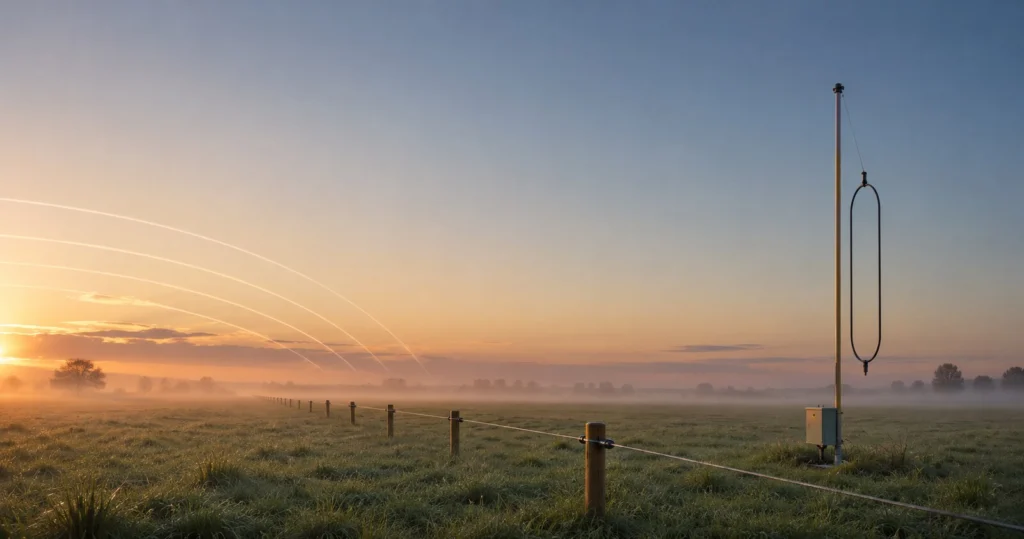
On the low bands — 160, 80 and 40 metres — a DX contact is rarely decided by transmit power, but by the station's ability to hear. Atmospheric noise (QRN) is so high here that a loud, omnidirectional transmit antenna simply drowns weak DX in the noise. The answer is a dedicated receive antenna: little gain, but directivity and a far better signal-to-noise ratio. This article covers the three most important designs — Beverage, K9AY loop and Flag/Pennant — and helps you choose.
Why a separate receive antenna?
Above roughly 14 MHz, "if you can be heard, you can hear" mostly holds. On 160 and 80 metres it does not. At night these bands are dominated by thunderstorm QRN, switch-mode power supplies and industrial noise. A vertical transmit antenna picks up that noise from every direction — weak DX from a single direction disappears in it.
Receive antennas flip the priority: instead of gain they deliver directivity. The key figure is not gain but the RDF (Receiving Directivity Factor) — a measure of how well the antenna rejects noise from unwanted directions. The higher the RDF, the more a weak signal lifts out of the noise floor. Operators report a 10–15 dB lower noise level versus the transmit antenna — signals that were inaudible suddenly pop out.
The trade-off: low output level (a preamp is often required) and usually a second antenna input on the transceiver or an RX-antenna switch. When the effort pays off is shown every week in our DX weather report — especially in the short, quiet summer nights every decibel of signal-to-noise counts.
The Beverage — the classic for large lots
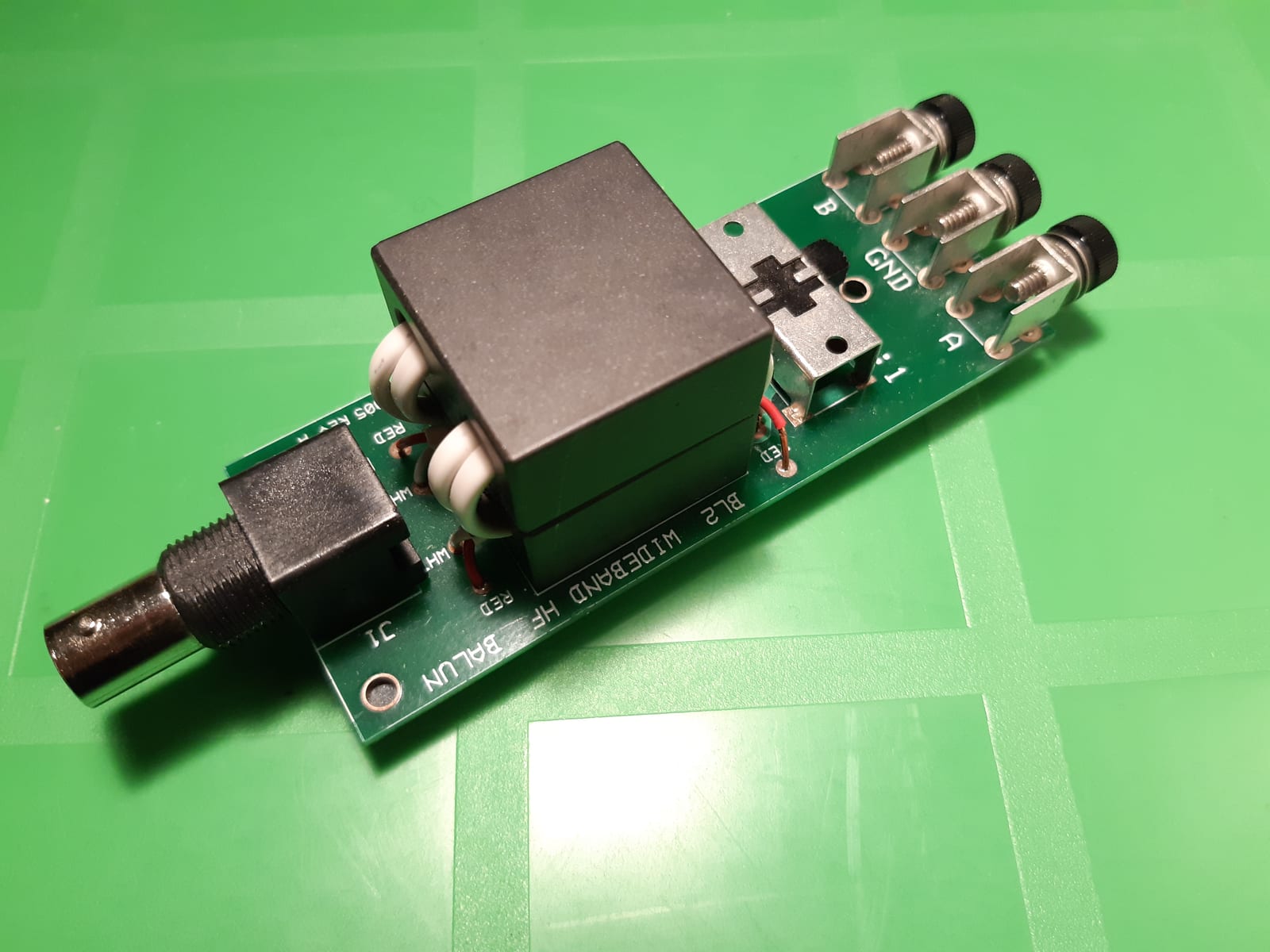
The Beverage is the oldest and still the highest-performing receive antenna for top band. Invented in 1921 by Harold H. Beverage, it is a long wire strung low over the ground — typically one to two wavelengths long (150 to 300 metres and more on 160 m), just one to three metres high. The far end is terminated through a resistor (about 400–600 Ω) to ground; at the feed point a 9:1 transformer matches it to the coax.
The result is a strongly unidirectional pattern toward the termination, with a very low takeoff angle — ideal for DX. A long Beverage reaches an RDF of 8 to 10 dB, beating every compact design. The animation shows the principle: the incoming wave travels along the wire and adds up in phase toward the feed point.

The catch: space. A full Beverage needs a large lot and cannot be rotated — one wire per favoured direction. With less room, build a shorter version or a BOG (Beverage on Ground): a 40–80 m wire laid directly on the ground, quieter (needs a preamp) but with surprisingly good directivity. This video explains exactly how a Beverage works:
The K9AY loop — compact and switchable
Not everyone has 300 metres to spare. The K9AY loop, presented in QST in 1997 by Gary Breed, K9AY, is the most popular solution for small lots. It is a terminated wire loop of about 26 metres circumference hung from a single non-conductive (fibreglass) mast roughly 8–10 m high. A box at the base holds the ground rod, 9:1 transformer and termination resistor.
The clever part: relays swap transformer and resistor, so the favoured direction can be switched electrically (typically in four directions). The K9AY produces a clean cardioid pattern with good front-to-back ratio and fits inside a circle of about 10 metres. Its RDF is around 6–7 dB.
Head to head, an optimised K9AY on 160 m is typically 3–6 dB worse than a 150 m Beverage — but on 80 m the gap shrinks markedly and it becomes very competitive. For performance per square metre it is hard to beat. The following video demonstrates the loop and its front-to-back ratio in practice:
Flag, Pennant & Ewe — the really small ones
Even more compact are the terminated small loops: Flag (rectangular), Pennant (triangular) and Ewe. They work on the same principle as the K9AY — a small, resistor-terminated loop forms a unidirectional cardioid — but likewise reach only 6–7 dB RDF at very low output. A low-noise preamp is practically mandatory.
The Flag's big advantage: it needs no ground connection and works when elevated — on a roof or balcony where a ground rod is impossible. Exactly where the K9AY struggles without a ground return, the Flag shines. Pennant and Ewe are variants for different space and mounting situations.
Which one suits me? The comparison
| Antenna | Space | Directivity (RDF) | Rotatable | Ground | Output level |
|---|---|---|---|---|---|
| Beverage | very large (150–300 m+) | very high (8–10 dB) | no (fixed per direction) | yes (termination) | high |
| BOG (on Ground) | medium (40–80 m) | medium-high | no | yes | low (preamp) |
| K9AY loop | small (10 m circle) | medium (6–7 dB) | yes (switchable) | yes (ground rod) | medium |
| Flag / Pennant | small (~3 × 8 m) | medium (6–7 dB) | no | no (also elevated) | low (preamp) |
Rule of thumb: got space? Build Beverages. Normal lot? Take the K9AY. Only a balcony or roof? Go for the Flag.
Practical tips
- Separate RX input: modern transceivers often have a dedicated receive-antenna input (RX ANT). If yours doesn't, an external switch box with TX/RX logic does the job.
- Block common-mode currents: a receive antenna is only as quiet as its feedline. A common-mode choke at the feed point and at the shack end stops the coax itself from coupling in noise.
- Distance from the transmit antenna: the further the RX antenna stands from the vertical/beam, the cleaner the pattern — coupling distorts the directivity.
- Preamp in moderation: needed for Flag, Pennant and BOG — but only enough gain so band noise just exceeds receiver noise. More only adds intermodulation.
- Adjust the termination: front-to-back depends sensitively on the termination resistor and ground quality. An adjustable pot lets you null a specific noise source.
A receive antenna is probably the most rewarding investment for serious low-band DX — often more effective than more transmit power. Once you've pulled that first weak signal out of the noise, you'll add the next direction straight away. More on antennas in our articles on the portable antenna and the Yagi.
73 – your oeradio.at editorial team
Transparency Notice
This article was researched and written with the assistance of AI (Claude, Anthropic). The title image was generated with AI (ChatGPT/DALL·E, OpenAI); the embedded animation is by Chetvorno (Wikimedia Commons, CC0). The editorial team has reviewed all content. Corrections welcome via email to [email protected].