
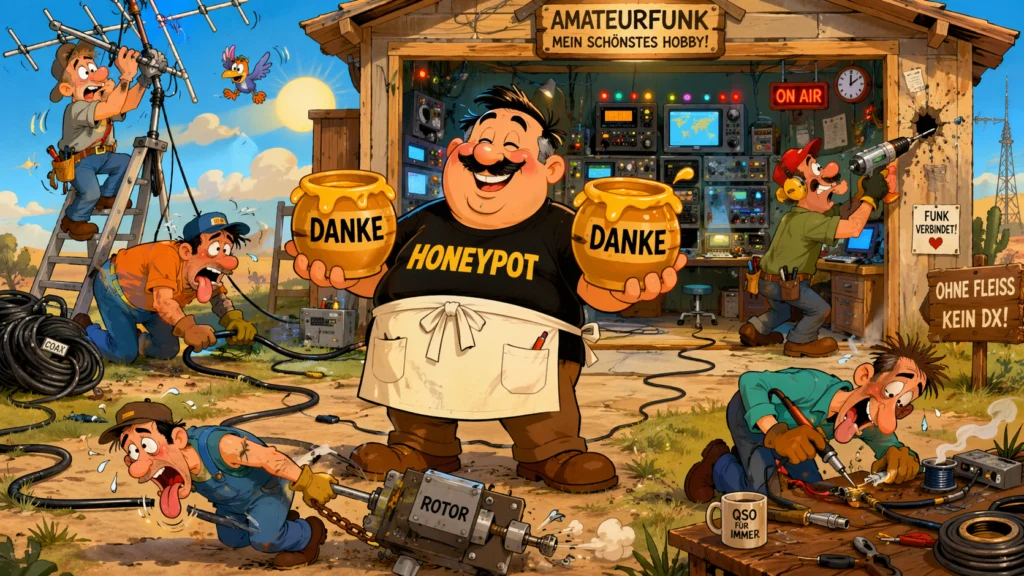
Willi: The Nicest OM
Every amateur radio community has one. You know him. He's the one who calls you "my friend" on first contact, who remembers your birthday, your XYL's name, and that you once mentioned in passing that you like Styrian pumpkin seed oil. He brings honey from his own bees. He asks about your back pain. He is, by all accounts, the warmest, most generous, most endearing human being in the entire club.
His name is Willi. And Willi has a problem.
Actually, Willi has many problems. Technical ones. His shack doesn't work. His antenna doesn't radiate. His TRX makes noises that no manufacturer manual has ever described. His power supply hums in a frequency that only appears in nightmare scenarios. And somehow — somehow — every single one of these problems lands directly in your lap.
Phase 1: The Approach
It starts harmlessly. Willi appears at the club evening, sits down next to you, and says: "You know, I've always admired how you understand all of this." He gestures vaguely at the technical universe in its entirety.
You say something modest. Willi leans closer: "No, seriously. I've heard so much about you. The people say you're the best." Which people? Where? When? Doesn't matter. The honey is already flowing.
A few weeks later, Willi brings a Roast Pork to the club meeting. "I made it myself." He places it in front of you specifically. "I thought of you." You eat. You feel flattered. You eat a second helping.
The trap has snapped shut.
Phase 2: The First Favour
"Could you just quickly look at something for me?" Just quickly. Willi's favourite phrase. The word "quickly" in Willi's vocabulary means anything between two hours and an entire weekend. "It won't take long. It's just a small thing." The small thing turns out to be a shack that was wired by an optimistic amateur in 1987 and has not been touched since, except by humidity, spiders, and the slow entropy of all matter.
You help. Of course you help. Because Willi looks at you with those grateful eyes and says: "You're truly a saint. I don't know what I'd do without you." And because the Roast Pork was genuinely excellent.
When you leave, Willi gives you a jar of honey. "From my own bees. The good stuff." You drive home with sticky fingers and a vague feeling that something has shifted. You can't quite say what.
Phase 3: The Antenna Escalation
Three months later, Willi needs an antenna. Not just any antenna — a Yagi, three elements, for 20 metres, on the roof of his house. "I'd do it myself, of course," he says, "but my back. You know." He taps his lower back with a pained expression. The same back that carried an entire beer keg at the club barbecue last month.
Berndt builds the Yagi. Two days on the roof, in October. Willi stands below with coffee and calls up: "Fantastic! You're a true artist!" Berndt climbs down, frozen and exhausted. Willi's eyes shine: "I'll make it up to you." He never does.
But Berndt doesn't say anything. Because Willi is so genuinely nice about it.
The List
At some point — much later, when the full scope of the operation becomes visible — someone compiled a list. A quiet reckoning, passed around in whispers among the club members:
- Kurt: Rewired entire shack. 16 hours. "Just quickly."
- Berndt: Mounted 3-element Yagi on roof. 2 days in October cold.
- Sepp: Laid 60 metres of coax through the attic. 1 full day, three insulation splinters, one bruised shin.
- Fritz: Programmed antenna rotor and set up CAT control. 2 visits, each "just an hour".
- Herbert: Spent 3 consecutive Saturdays in the attic installing cable channels. Lost feeling in left knee.
- Manfred: Configured antenna tuner and matched all bands. 1 day, plus follow-up call at 9pm.
- Helga: Filled out the club callsign application form. "Because you're so good with computers."
Total: somewhere between 40 and 60 hours of voluntary technical labour. In return: multiple jars of honey, two cakes, one bottle of wine (Welschriesling, 6 euros from the discount store), and the recurring feeling of being "truly one of the greats".
The Pattern: Why Nobody Says No
The fascinating thing about the Honeypot is not that he exploits people. That would be too simple. The fascinating thing is that nobody feels exploited — at least not at the time.
Willi is a master of the small escalation. He never asks for too much at once. He starts with a tiny favour, builds up trust, compliments generously, and only then increases the stakes — so gradually that every step feels like a natural continuation of the previous one. By the time you're on the roof in October, you've already justified it to yourself a dozen times.
The compliments are his real currency. "Nobody else could have done this." "You're in a completely different league." "Honestly, I don't know what the club would do without you." Each of these sentences costs Willi nothing. Each of them pays dividends.
The social contract of amateur radio — help each other, share knowledge, practice Ham Spirit — becomes his operating system. He doesn't abuse friendship. He programs it.
Willi's Help
On the rare occasions when someone asks Willi for help, something interesting happens. He shows up. This must be acknowledged — he actually shows up. He appears, brings cake, makes coffee, and stands in the shack with an expression of intense interest.
He asks questions. "What does SWR mean again?" (He has asked this question seventeen times over six years.) "Is that the thing with the — what's it called — the balun?" (He pronounces it like a French dessert.) He holds the torch. He films on his smartphone and posts it on Facebook with "Teamwork at its best! 💪 73 de Willi".
He does not touch any tools. He does not tighten any screws. He does not measure anything. When the problem is solved — which happens despite his presence, not because of it — he says: "Amazing! You've really done it again!" and drives home.
Herbert once summarised it: "Willi helps like an umbrella in sunshine. He's there, he looks good, but he does absolutely nothing."
The Plug-and-Play Amateur
The classic situation: Friday, 9 in the evening. Your phone rings. It's Willi.
"Sorry to disturb you, my friend, but I have a small problem—" Small. There it is again. "My TRX doesn't key up anymore. I've been trying for hours. You know these things so much better than I do."
You drive over. You spend two hours finding the fault (a loose mic connector — five minutes with the right tools), fixing it, checking the rest of the setup, and explaining three times why the SWR reading he's been worried about for months is completely normal. Willi watches, nods, says "incredible" at regular intervals.
When you leave, he presses a twenty-euro note into your hand. "For the trouble." The gesture is meant to be generous. It works out to approximately five euros an hour. You don't say anything because Willi is already standing in the doorway saying: "You're a lifesaver. Truly. The best."
On the drive home you feel — and this is the truly insidious part — vaguely good about yourself.
The Dark Secret
Here is the thing that nobody says out loud, the uncomfortable truth that only emerges after years of honey and Roast Pork and compliments:
Willi doesn't like you. Not really.
He likes what you can do for him. He likes your competence, your availability, your social conditioning as an amateur radio operator who helps. He likes the feeling of control that comes from knowing he can deploy you with the right combination of flattery and food.
He is not a bad person in the classic sense. He doesn't lie. He doesn't threaten. He doesn't manipulate through fear. He manipulates through warmth, and that is so much harder to defend against because warmth feels good and you desperately want it to be real.
The honey is real. The cake is real. The smile is real. But the friendship? The friendship is a tool. You are an instrument in Willis station, and you have been from the very first "my friend".
Epilogue
At some point — and this happens in every club where a Willi operates — the helpers start to quietly withdraw. Kurt stops answering the phone on weekends. Berndt has "prior engagements" whenever Willi mentions a new antenna project. Herbert moved, allegedly.
Willi doesn't understand why. He genuinely doesn't understand it. In his version of reality, he has always been generous, always been warm, always valued his friends appropriately. The honey, the cake, the compliments — what more could anyone want?
He starts calling the newer club members. Fresh arrivals, not yet inoculated. He brings honey. He calls them "my friend". He mentions, very casually, that his antenna rotor is making a strange noise lately.
The cycle continues.
The Moral
The Honeypot is not a monster. He is a mirror. He reflects back to us our own need for recognition, our social conditioning to be helpful, our weakness for being called "the best". He works because we let him work.
The antidote is not cynicism. The antidote is clarity: Help because you want to help, not because someone has engineered you into it. Accept compliments with a grain of salt. And if someone brings you honey for the third time before the antenna is even assembled — ask yourself whether the bees are really the ones doing the work here.
Ham Spirit is not a resource to be extracted. It is a gift freely given — and it should remain that way.
73 – your oeradio.at editorial team
Transparency Notice
This article was researched and written with the support of AI (Claude, Anthropic). The satirical content, characters, and situations are fictional. Any resemblance to real amateur radio operators — living, deceased, or currently installing a Yagi in October — is purely coincidental. The editorial team bears responsibility for publication.