Table of Contents
- Where System Fusion comes from
- What happens on the air: 4FSK at 9600 bps
- The four operating modes
- AMS: the actual trick
- DG-ID and DP-ID: CTCSS for digital operation
- Linking: WIRES-X, YSF and YCS
- WIRES-X — Yaesu's own network
- YSF reflectors — the open counterpart
- YCS — System Fusion II as a server
- C4FM in Austria: YCS232 and the DG-ID groups
- Radios: Yaesu and nobody else
- No repeater in range: the hotspot
- What else C4FM can do: GPS, messages, images
- Where the limits are
- QRV in three steps
- Further sources
- Transparency Notice
C4FM is Yaesu's digital voice mode, marketed as System Fusion. Its unique selling point is right there in the name: because C4FM is a flavour of frequency shift keying, it sits technically close enough to plain old FM that both worlds can share the same repeater. A radio works out by itself what is on the channel and adapts. This article explains what is actually being transmitted, how linking works via WIRES-X, YSF and the Austrian YCS232 — and where the limits of the system are.
If you are after the practical first steps rather than the technology, our compact guide is C4FM / Yaesu Fusion in Austria: Getting Started. And if you are still deciding which digital system to pick at all, compare them in D-STAR vs. DMR vs. C4FM vs. M17.
Where System Fusion comes from
When Yaesu introduced System Fusion in 2013, the digital voice train had long left the station: D-STAR had been running since the early 2000s, and DMR had spilled over from commercial radio into amateur use. Yaesu's answer to being late was less technical than strategic: analog compatibility plus an aggressive repeater programme that let clubs buy Fusion repeaters at a steep discount.
The calculation worked. A repeater that serves both worlds does not split a club — the analog regular net carries on, and whoever wants digital can have it. Neither D-STAR nor DMR offers that, and it remains the strongest argument for Fusion to this day.
What happens on the air: 4FSK at 9600 bps
C4FM spelled out is Continuous 4-Level FM. Instead of two frequencies as in classic FSK there are four deviations from the carrier — and because four states encode exactly two bits, every symbol carries a bit pair (a dibit). At 4800 symbols per second that yields a gross data rate of 9600 bps in a 12.5 kHz channel raster.
Those 9600 bps are the cake that voice, error correction and data have to share — and the way you slice it produces the different operating modes. Speech coding is always handled by the AMBE+2 vocoder, the same codec family used by D-STAR (as AMBE) and DMR. It is proprietary and licensed — more on that below.
The four operating modes
System Fusion knows four modes, and depending on the settings the radio switches between them by itself:
- DN — Digital Narrow (V/D mode): the default. Voice and data run simultaneously. Of the 9600 bps roughly 2450 bps go to the vocoder, about 1150 bps to voice error correction, and the rest to a data channel (callsign, GPS position, short messages) with its own protection. All that FEC is why DN reaches furthest — and why it has a slightly "digital" sound.
- VW — Voice Wide (Voice FR): the full data rate goes into speech, roughly 4400 bps vocoder plus 2800 bps FEC. Audibly better, almost studio-like up close — but the link breaks down sooner on weak signals. No data channel.
- DW — Data Wide (Data FR): maximum throughput for data instead of voice — in practice for images and file transfer between radios.
- Analog FM: ordinary narrowband FM, exactly as any other handheld does it.
What matters day to day: a radio in DN mode does not automatically decode a VW transmission at full quality, and vice versa. On repeaters and reflectors DN is therefore the de-facto standard — VW is reserved for simplex links and local nets where everyone involved knows what they are doing.
AMS: the actual trick
AMS stands for Automatic Mode Select, and it is the feature that earned Fusion its reputation. On every incoming transmission the radio evaluates whether it is analog FM or a C4FM data stream and switches the receive path within milliseconds. On transmit it can remember which mode the last station used and reply in kind.
For repeater operation that means: a Fusion repeater accepts both and passes both on — analog in, analog out; digital in, digital out. The analog local net notices nothing of the digital traffic apart from the occasional burst of noise when somebody comes through digitally. DMR and D-STAR repeaters cannot do this: there, the channel is either digital or it is not.
The price: a mixed repeater is only ever occupied by one flavour at a time. DMR can run two separate time slots on the same frequency via TDMA, C4FM cannot. If you need capacity, DMR serves you better; if you need to stay compatible with what is already there, Fusion does.
Video tip: how Fusion, C4FM and WIRES-X relate to each other — sorting out the three terms that get mixed up most often in everyday use.
DG-ID and DP-ID: CTCSS for digital operation
Since the second generation (System Fusion II, from around 2017) every transmission carries two extra identifiers:
- DG-ID (Digital Group ID): a number from 0 to 99. It acts like a CTCSS tone, only digital: the radio only opens when the received DG-ID matches the one set. DG-ID 0 is the "let everything through" state. Transmit and receive DG-IDs can be set separately — the equivalent of split CTCSS.
- DP-ID (Digital Personal ID): a radio-bound identifier for the GM (Group Monitor) function, which lets small groups see each other on the display — including distance and bearing when GPS is active.
The DG-ID is more than a squelch: on linked repeaters and YCS servers it is the way you select the talk group — functionally what the talkgroup is in DMR and the reflector module in D-STAR, only without registration and without a codeplug.
Linking: WIRES-X, YSF and YCS
Beyond RF, Fusion is linked in three different ways — and these are the most common stumbling block for newcomers, because they sound alike but are separate systems.
WIRES-X — Yaesu's own network
WIRES-X (Wide-coverage Internet Repeater Enhancement System) is the manufacturer's own linking system. Stations meet in rooms, each with a numeric ID; a node is the access point bridging RF and internet. It is operated straight from the radio — via the red X key used to search nodes and connect rooms.
The classic way to run a node is the HRI-200 interface plus a PC. It also works without extra hardware: in PDN mode (Portable Digital Node) a suitable radio — FT5D, FT3D, FT2D, FTM-400XD, FTM-300D, FTM-200D or FTM-100D — hangs off a Windows PC via USB and becomes the access point itself. No static public IP required. Node and room IDs are issued by Yaesu; without that registration nothing happens on the WIRES-X network.
YSF reflectors — the open counterpart
Alongside it there is the YSF world, grown around the free MMDVM software by Jonathan Naylor, G4KLX. A YSF reflector is a virtual room that hotspots and homebrew repeaters dial into. There is no central registry: whoever wants to run a reflector, runs one. That is exactly what makes the scene lively — and confusing. Older FCS reflectors are the predecessor concept and have effectively been superseded in Austria since 2018.
Important: a Yaesu repeater in WIRES-X mode cannot reach a YSF reflector directly — that needs a bridge in between. Hotspots, on the other hand, speak both protocols without trouble.
YCS — System Fusion II as a server
The YCS server is the evolution of the YSF reflector: instead of a single room it manages many groups in parallel, addressed by DG-ID. A repeater is therefore no longer stuck in one room but passes all groups through; which one you hear is decided by the DG-ID in your own radio. On top of that a YCS records the callsign and position data from the data channel and shows them on a dashboard.
C4FM in Austria: YCS232 and the DG-ID groups
The Austrian Fusion network today largely runs on the YCS232 — the national System Fusion II server, operated in the ÖVSV orbit. Group selection happens via DG-ID:
- DG-ID 32 — AT-C4FM-Austria, the nationwide group. If you set only one, set this one.
- DG-ID 91 — OE1 / eastern region, 93 — Lower Austria, 98 — OE8 Carinthia: the regional groups.
- DG-ID 28 — Switzerland, 62 — Germany: the neighbours on the same server.
- DG-ID 99 — echo, the self-test: you hear your own transmission played back and know instantly whether modulation and path are fine.
Every connected repeater also has a fixed DG-ID assigned so that allocations do not clash. For the Yaesu-native world there is the WIRES-X room "OE AUSTRIA ALL". And because the multi-protocol reflector XLX905 also accepts C4FM, you end up in the same net as D-STAR and DMR stations there.
The Austrian C4FM repeater list currently holds around 26 repeaters. Most are on 70 cm with −7.6 MHz offset, a few on 2 m with 600 kHz. A cross-section:
- OE1XAT Vienna/Wienerwald — 438.3625 MHz, YCS System Fusion II
- OE2XZR Gaisberg — 438.550 MHz, YCS
- OE5XOL Linz/Breitenstein — 438.2875 MHz, YCS
- OE5XGL Grünberg — 145.750 MHz (2 m), YCS
- OE6XAG Schöckl — 437.975 MHz, YCS
- OE7XCJ Innsbruck — 438.400 MHz, YCS
- OE8XKK Pyramidenkogel — 439.075 MHz, YCS
- OE7XLI Lienz/Hochstein — 439.075 MHz, one of the few running WIRES-X
A handful deliberately run without linking — OE3XDA on the Hochkogelberg, OE5XKL on the Krippenstein or OE6XPG on the Planai. The current list with offsets and DG-IDs is maintained on the C4FM Austria site; which group is active right now is shown live by the YCS232 dashboard. For the wider picture of what else is on the air, see our overview of VHF/UHF repeaters in Austria and the map in Relaisblick.
Video tip (German): Austria's move to YCS / System Fusion II — why DG-ID groups replaced the single reflector and what that means at the radio.
Radios: Yaesu and nobody else
C4FM is a Yaesu standard, and unlike DMR there is no third party building cheap radios for it. If you want Fusion, you buy Yaesu. The usual suspects:
- FT-70DE — the entry-level handheld: 5 W, C4FM and FM, no GPS, no colour display. The cheapest way into the mode.
- FT3DE / FT5DE — the full package: colour touchscreen, GPS, Bluetooth, APRS, PDN-capable. The FT5DE is the current step.
- FTM-200DE / FTM-300DE — 50 W mobiles with GPS and AMS; the FTM-300DE with the larger feature set.
- FTM-500DE (and the newer FTM-510DE line) — true dual receive, two active receivers at once, AESS speaker concept.
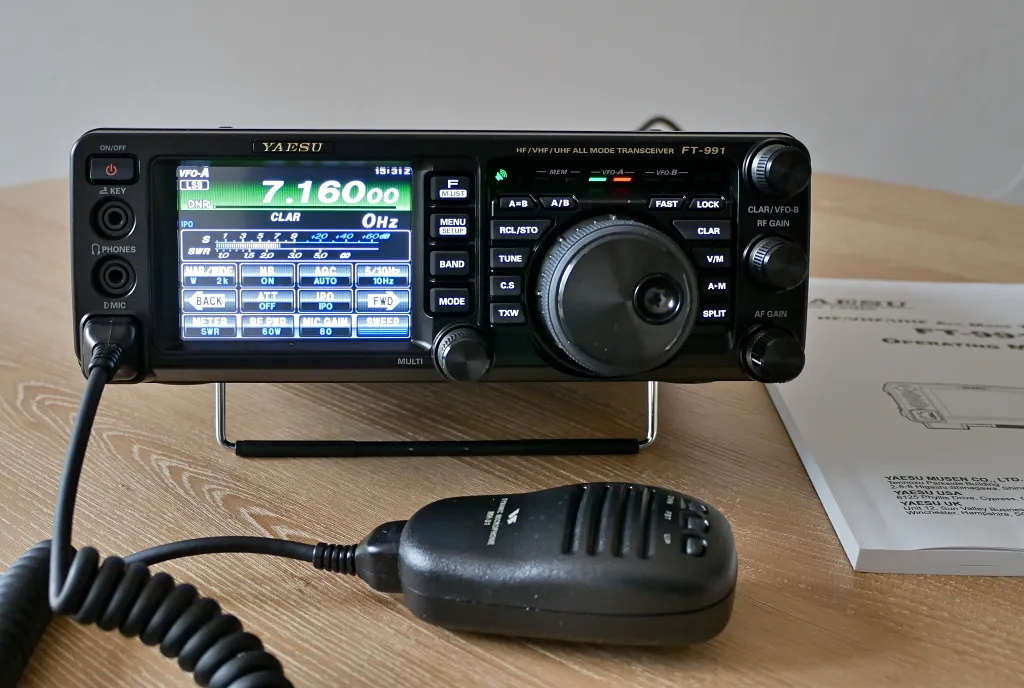
- FT-991A — the all-rounder: HF, 6 m, 2 m and 70 cm in all modes, C4FM on VHF/UHF included.
- DR-2X / DR-2XE — the repeater itself, with AMS operation and an optional LAN unit.
On the repeater side Yaesu adds IMRS (Internet-linked Multi-site Repeater System): with the optional LAN unit up to 99 DR-2X repeaters can be linked over IP — a manufacturer-native repeater chain, independent of WIRES-X. It plays almost no role in Austria, because linking runs through the YCS232.
No repeater in range: the hotspot
If no Fusion repeater is reachable, a hotspot gets you into the network: an MMDVM board on a Raspberry Pi running Pi-Star or the more modern WPSD. The hotspot dials into a YSF reflector or straight into the YCS232, and group selection remains the DG-ID on the radio. Step by step instructions are in Setting up a Pi-Star hotspot. As always: valid licence, frequency per band plan, minimum power.
What else C4FM can do: GPS, messages, images
The data channel in DN mode is not just there for the callsign. It carries the GPS position — on a YCS the positions land in the dashboard, and via suitable gateways they also reach the APRS network. Add short text messages between radios and, in DW mode, even photos from the optional camera speaker-microphone. Day to day that is a gimmick; for training, field days and contest logistics it is occasionally useful.
The GM (Group Monitor) function shows which stations of your own group are currently in range — with distance and bearing. On a field day with several teams that may be the single most underrated feature of the whole system.
Where the limits are
Three points belong in an honest account:
- One manufacturer, one ecosystem. There is no alternative to Yaesu hardware, and therefore no price pressure. DMR handhelds start just over a hundred euros; an FT5DE costs four to five times that.
- Proprietary codec. AMBE+2 is licensed intellectual property owned by DVSI. Fusion cannot be fully reimplemented in free software — precisely the point where M17 steps in with the open Codec2.
- WIRES-X is closed. Node and room IDs come from Yaesu, and the software is Windows-only. The YSF/YCS world is the open answer — but it is a parallel world, not an extension.
Against that stands the one advantage no other system has: no registration, no codeplug, no talkgroup studies. Enter callsign, set DG-ID, press PTT. That is why Fusion is many people's first digital mode — and for some the only one they need.
QRV in three steps
- Enter your callsign. Once, in the setup menu. No online registration, no ID to apply for.
- Pick a target. An Austrian Fusion repeater from the list, the WIRES-X room "OE AUSTRIA ALL", or — via hotspot — the YCS232. Frequencies and offsets are conveniently loaded into the radio by the Memory Channels Processor.
- Set the DG-ID and listen. 32 for Austria, plus your regional group. A quick test on DG-ID 99 (echo) answers the question "am I getting in at all?" in five seconds. Then call with your full callsign.
Further sources
- ÖVSV Wiki — C4FM category
- ham-c4fm.at — repeater list, DG-ID groups and guides for Austria
- YCS232 dashboard — live view of active groups and repeaters
- systemfusion.yaesu.com — manufacturer documentation on modes, WIRES-X and the DR-2X
Related on our site: Getting started with C4FM in Austria, D-STAR explained, DMR for beginners and EchoLink, AllStarLink and SvxLink for the analog counter-proposal.
This page is part of our digital voice overview — compare all modes there.
73 – your oeradio.at editorial team
Transparency Notice
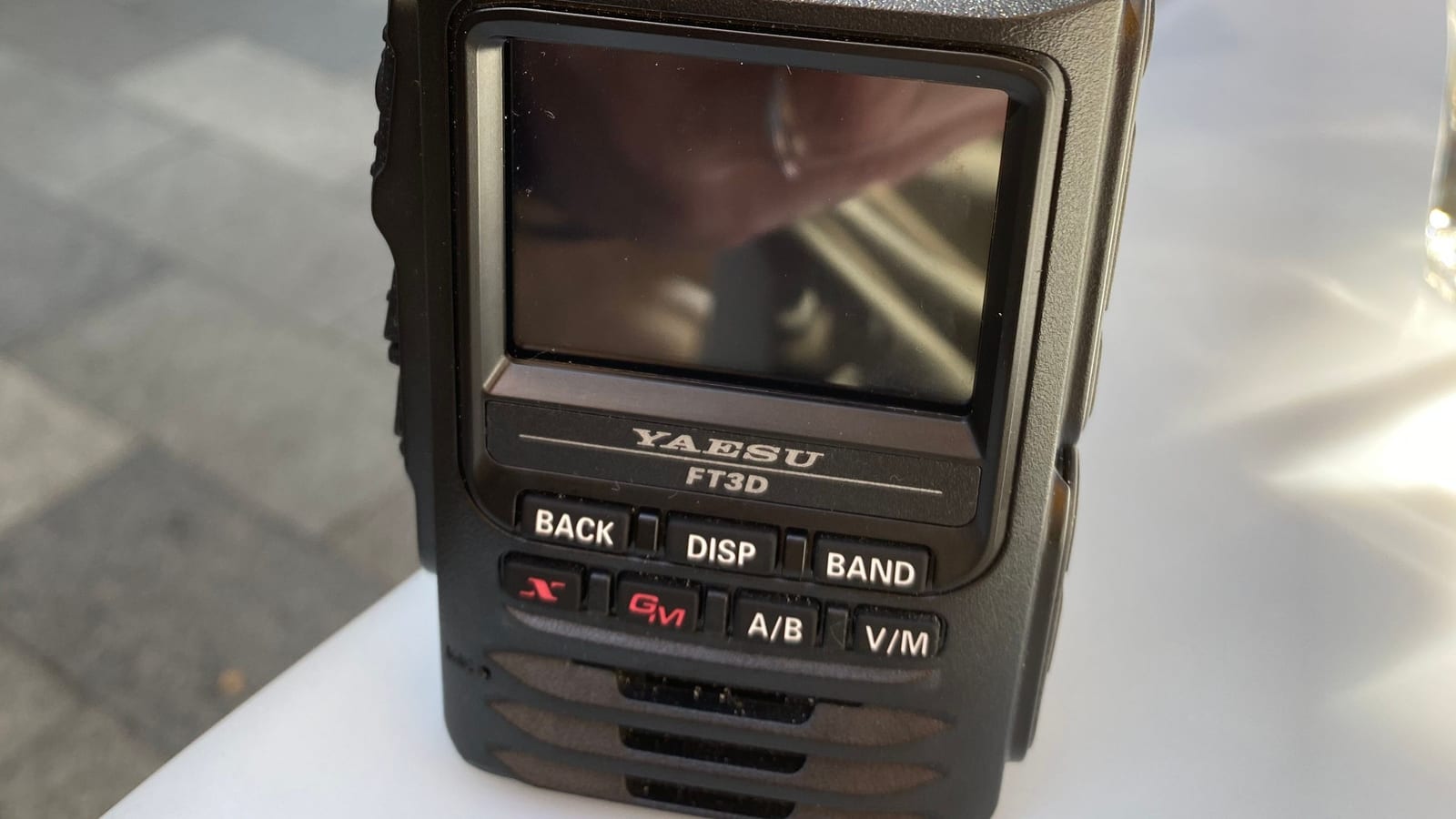
This article was researched and written with the support of AI (Claude, Anthropic) based on publicly available sources; the content has been editorially reviewed. In September 2026 the piece was substantially reworked and extended with the technical fundamentals, the network architecture and the Austrian DG-ID groups. Figures on modulation, data rates and operating modes come from Yaesu documentation and publicly available technical write-ups; repeater and DG-ID details come from ham-c4fm.at and the ÖVSV Wiki — repeater data changes, so the lists there take precedence. Lead image (Yaesu FT3D) by Ohhai-emre, CC BY-SA 4.0, via Wikimedia Commons, cropped; the equipment photo carries photographer and licence in its caption; the diagrams are ours. The embedded videos come from external YouTube channels and reflect their views. Corrections welcome at [email protected].