Parks on the Air is rebuilding its platform, and since 31 August 2026 you can watch it happen: next.pota.app is available as a public beta. It runs alongside the familiar site, uses the same production database and accepts the same login. If you only want to read spots, you do not need an account at all.
The rebuild is more than a fresh coat of paint. Day to day it changes small things, but exactly the right small things. And for everyone who did not grow up speaking English, it changes quite a lot.
First impression: the site speaks your language
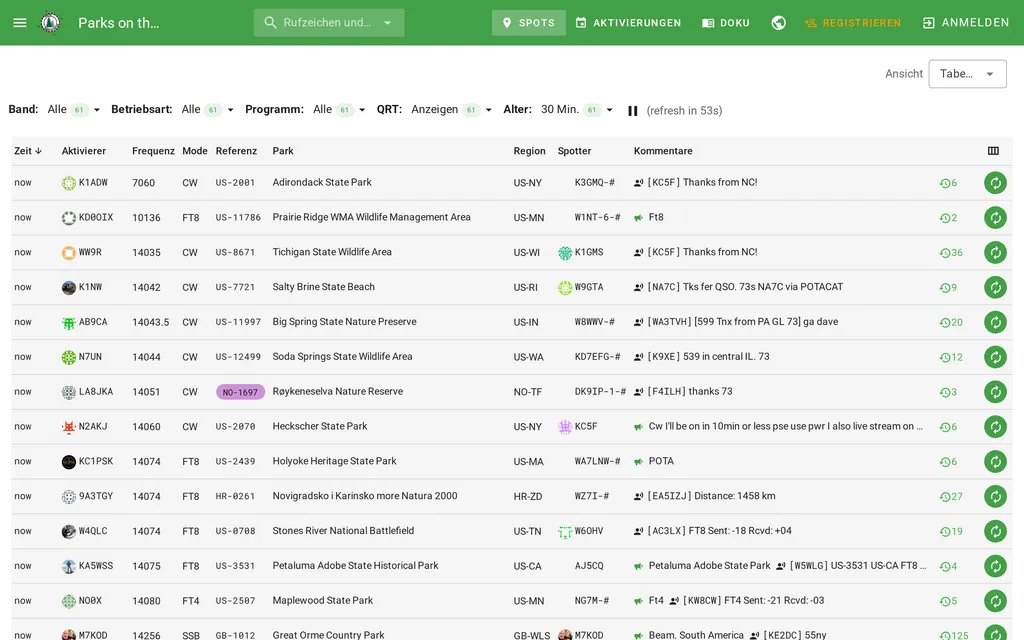
The most noticeable difference shows up before you click anything. The interface follows your browser language automatically. In German, "Spots" and "Activations" become Spots and Aktivierungen, and the menu offers Karte, Parkliste, Top-Aktivierer, Top-Hunter and Offizielle Veranstaltungen. The filter row is translated too: band, mode, program, QRT, age. POTA states that around 27 languages and localisations are planned.
That sounds like a detail, but it is exactly the hurdle newcomers in Austria have been stumbling over. Anyone activating their first park while simultaneously fighting jargon and a foreign language gives up sooner. Our POTA guide for Austria does not become redundant, but the official site now meets you halfway.
What changes about spotting
The spot list is where POTA actually happens, for hunters and activators alike. This is where the changes are felt most:
- Comments persist. Previously the next spot overwrote the activator's note. Anyone who left "QSY 40 m in 10 minutes" or "break until 14:00" was anonymous again two minutes later. Now the note stays with the spot, which is probably the single most practical improvement.
- Multi-select filters. Bands and modes can be combined instead of the previous "all or exactly one" choice.
- Column picker and views. The table can be trimmed to what you actually need, and the view control switches between table and map.
- QRT and age filters. Stations that have signed off can be hidden, and the time window is adjustable, with 30 minutes as the default. A visible countdown shows the next refresh and can be paused when you want to read in peace.
- Region at a glance. A dedicated column shows the region, such as
AT-KAorDE-RP. Handy when you are looking for European activations instead of scrolling past US spots.
There is also a new Geographic Achievement page that tracks which regions you have worked or hunted from.
The park page: much more than coordinates
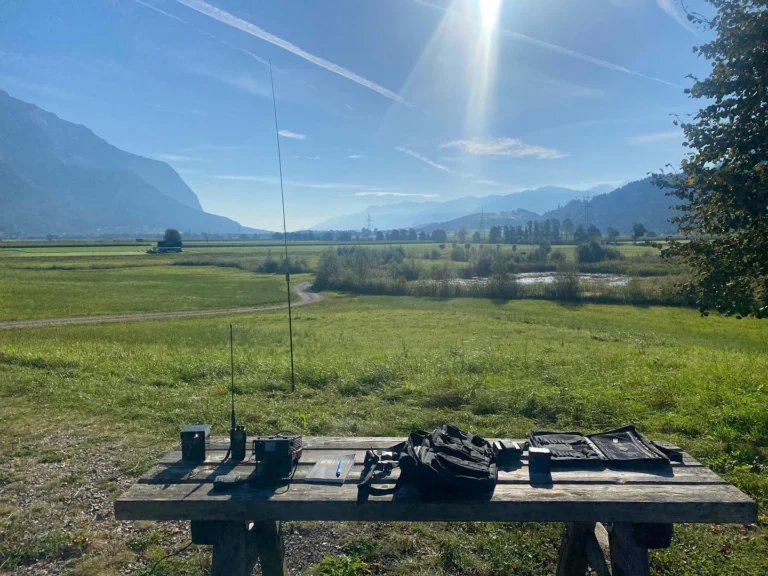
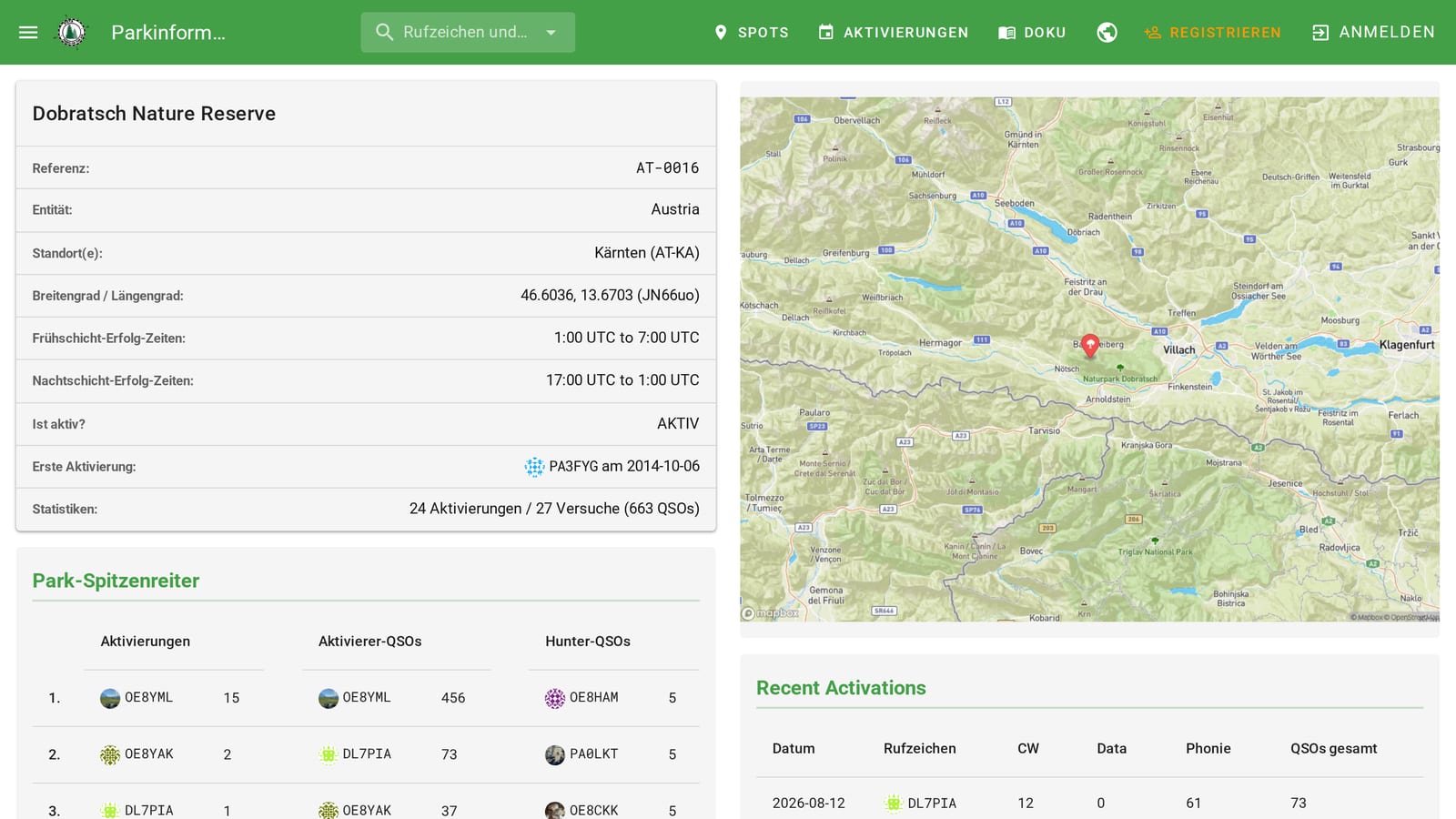
Open a reference and you now get a proper park page. Take AT-0016 Dobratsch Nature Reserve, the view shown in this article's lead image: reference, entity, federal state (Carinthia, AT-KA), coordinates including the locator JN66uo, activity status and a map that places the reserve at a glance.
The numbers below are more interesting. The Dobratsch was first activated on 6 October 2014 by PA3FYG and has since reached 24 activations from 27 attempts and 663 QSOs. Underneath sits a leaderboard for the park with familiar callsigns: OE8YML with 15 activations and 456 QSOs, followed by OE8YAK and DL7PIA. A list of recent activations runs alongside, broken down into CW, data and phone.
Two fields are new and rather clever: early shift and night shift success times. For AT-0016 they read 1:00 to 7:00 UTC and 17:00 to 1:00 UTC. That is not an oracle but an evaluation of when activations at this park have actually worked in the past. If you are planning a trip and wondering whether the early start is worth it, you finally have a number instead of a hunch.
The map
The map view has been rebuilt, with Mapbox underneath and switchable between standard, outdoor, satellite, streets and dark. A "parks in view" list runs alongside it and updates as you pan. Distances can be switched between kilometres and miles, and for once that is not a US-only default.
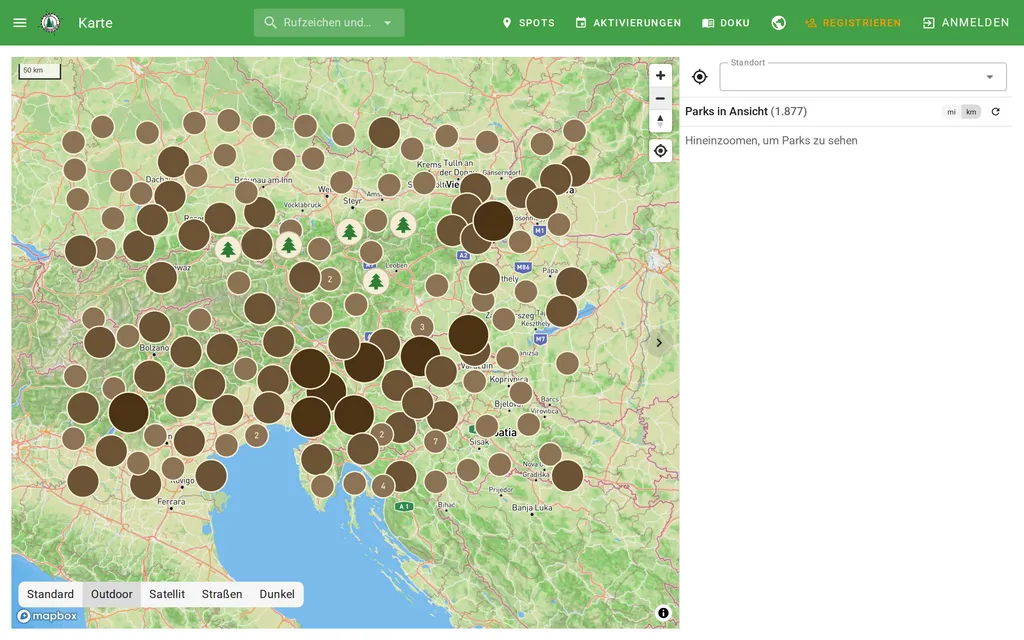
For trip planning this is the most interesting corner of the site. Two-fers and multi-references are far easier to find on a map than in a list. What that looks like in practice we described at the Pyramidenkogel, where SOTA, POTA and TOTA came together in a single activation.
Why rebuild at all?
The answer is unglamorous and familiar to many long-running amateur radio projects. The existing platform dates back to 2018 in its essentials, grew on a classic LAMP stack, and by now only a handful of volunteers know it well enough to work on it safely. Meanwhile POTA has exploded: from roughly 1,200 participants in the early days to somewhere between 85,000 and over 90,000 users today, depending on which source you take, with 100,000 seen as this year's milestone. Infrastructure costs run to several thousand dollars a month according to those running it.
The rebuild therefore uses the PHP framework Laravel and a redesigned cloud setup that scales with traffic peaks. The stated goal is explicitly not just "prettier" but maintainable by volunteers who do not need enterprise experience. The roadmap includes public APIs, faster log processing, expanded award handling, club statistics, better accessibility and integrated documentation.
The work is carried by a small volunteer team around Thom Martin, W8TAM, and Mike Case, W8MSC, with contributions from Mark Torigian K8MST, Jeremy Turner N0AW, Colby Dillion WR5B and James Linden VE3JLN. Notably, and openly communicated, the team also uses AI tooling to get anywhere at all with such a lean crew, with experienced developers reviewing the code. You can see how fast they iterate at the bottom of the site. There is a build timestamp there, and when you look it is typically from the same day.
Video tip: the AlpineRadioWaves channel walks through the new site, from the spot view via the filters to the map, and shows what still trips up in beta.
What it means for Austria
At the time of this research the POTA database lists 423 references with an AT prefix. Of those, 390 have been activated at least once, together well over 151,000 QSOs. The country is effectively covered. The days of easy first activations are largely gone, but there is almost always something within reach.
The most-activated Austrian parks:
- AT-0250, Hohe Wand, Schneeberg and Rax (Natura 2000): 171 activations, over 11,600 QSOs
- AT-0282, European long-distance trail E4: 154 activations, activatable across eight federal states
- AT-0217, Enzesfeld-Lindabrunn-Hernstein protected landscape: 153 activations
- AT-0301, Wiener Alpenbogen trail: 146 activations
- AT-0265, Pecherlehrpfad Hernstein: 145 activations
- AT-0176, Wienerwald Biosphere Reserve: 143 activations
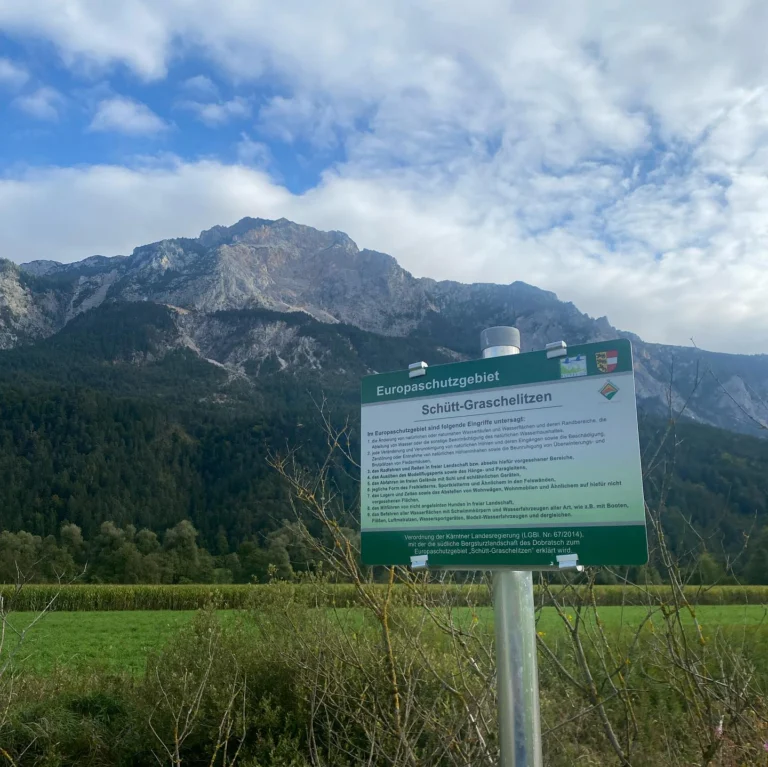
What stands out is how firmly Lower Austria holds the top of the list. The area around Vienna is densely covered with references and quick to reach. In Carinthia, where we operate ourselves, the numbers are smaller but the parks are often more spectacular. See for example our activations in the Schütt and on the Dobratsch. If you are looking to start, the OE POTA team is the place to ask.
Beta means beta
A few things belong in an honest account:
- It is a test version on live data. The site is attached to the production database, so what you spot there is real. Display glitches are possible, and the interface keeps changing.
- Filters only cover what exists. The band selector currently only offers bands where somebody is active right now. If you want to keep 10 m permanently in view so you can pounce the moment something appears, you cannot preselect that yet. Community test reports raise the same point.
- The old world keeps running. pota.app and the existing API are unchanged. Third-party tools and logging apps still pull their data from there, so there is no need to rush a switch.
Background: the Hamvention talk "Parks on the Air 2.0" explains why the rebuild became necessary and how the platform is meant to cope with growth.
What you can do now
- Take a look, risk-free. Open next.pota.app in a browser, the spot list is visible without a login.
- Test it with your own account. Same login as before. If you are spotting anyway, you might as well spot there.
- Give feedback. That is what a beta is for. Whatever does not fit in Austria, whether translations, region codes or park names, nobody else is going to notice.
- Check the park data. If you know of an error in an AT reference, such as wrong coordinates or an outdated name, report it. POTA describes the mapping teams as one of the bottlenecks in its growth.
Sources
- next.pota.app, the beta itself, observations as of 1 September 2026
- pota.app and docs.pota.app, existing platform and rules
- AE5X: POTA website gets a facelift, first hands-on report
- UFRC: Next.POTA.app est en ligne, context including languages and costs
- Q5: The Volunteers Rebuilding Ham Radio's Fastest-Growing Movement, background on architecture and team
Related on our site: POTA in Austria, the beginner's guide, how POTA fever caught us, the best portable antenna for SOTA and POTA and WWFF in Austria as a related programme.
73 – your oeradio.at editorial team
Transparency Notice
This article was researched and written with the support of AI (Claude, Anthropic) based on publicly available sources, and the content has been editorially reviewed. The description of the interface is based on our own inspection of next.pota.app on 1 September 2026. A beta changes, so deviations are to be expected. The figures on Austrian parks come from our own analysis of the public POTA program data as of 1 September 2026. User numbers, costs and architecture come from the articles linked under "Sources", which differ in detail, which is why we give ranges. The screenshots are ours and show a third-party website, and the station photo carries photographer and licence in its caption. The embedded videos come from external YouTube channels and reflect their views. Corrections welcome at [email protected].