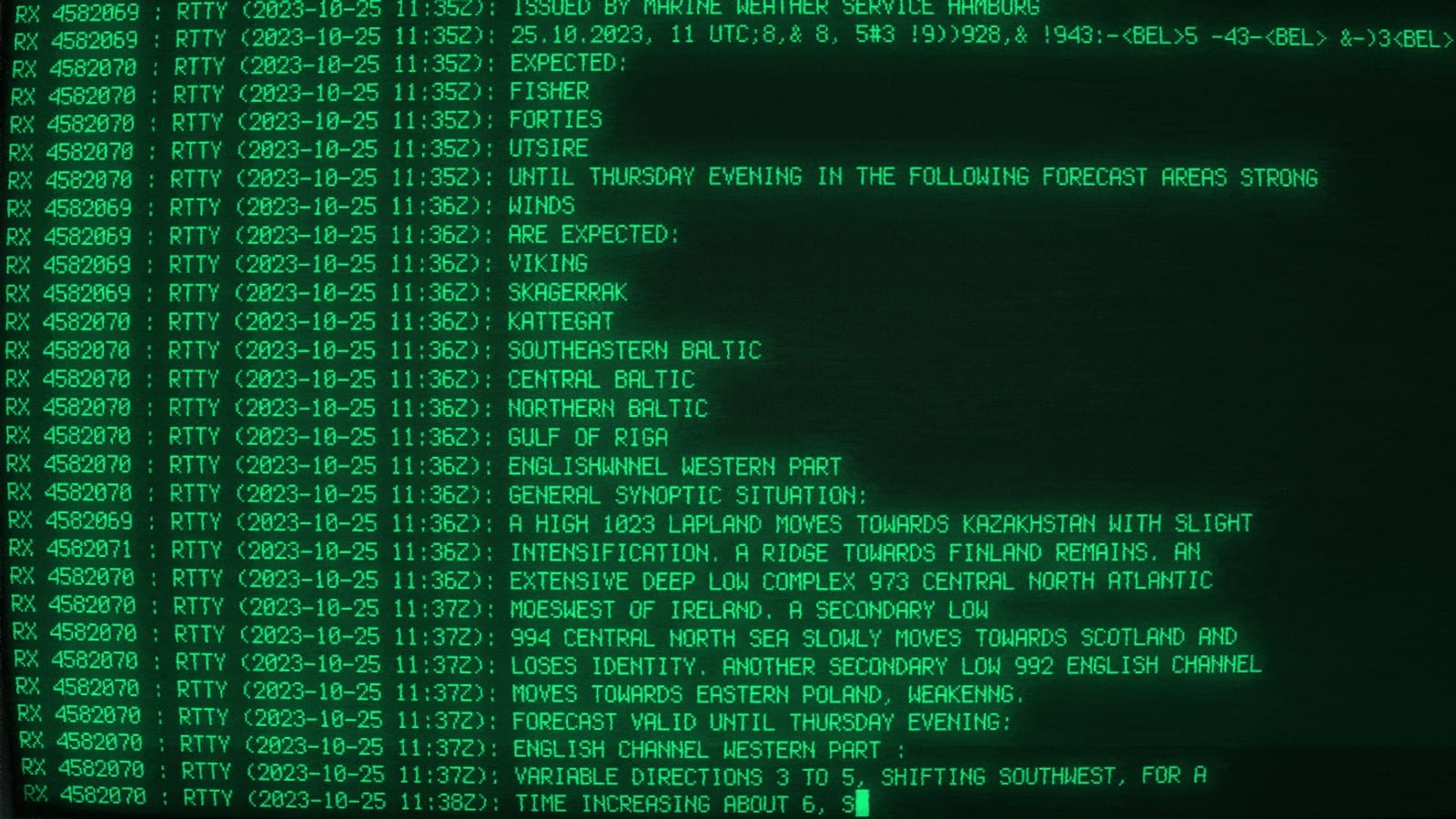
On 5 May 2023 around 160 pupils were sitting in the assembly hall of the BORG Hermagor secondary school. On the roof stood an 85 cm satellite dish, and at the other end of the link someone answered from a research station that rests on 16 hydraulic legs above the Antarctic ice shelf.
On 20 September, someone who lived down there for a year is coming to Villach.
Operation Penguin
The event was Carinthia's contribution to the International Schools Day. It was organised by OM Chris, OE8CKK, physics teacher at BORG Hermagor, together with a small team of radio amateurs. For a school hall the setup was remarkably serious: dish with helix antenna on the roof, an IC-9700, transmit gear from SG-Labs, receive gear from AMSAT-DL, and twice 42 metres of coax down into the hall.
At 11:00 sharp the first call went out via QO-100. From Antarctica came Markus, DK7DA, the station's IT engineer, and station leader Peter. A parallel class listened in via a WebSDR, a livestream ran for pupils in hospital, and YL Anna-Maria, OE8YAK, today a multiple AOEE winner, brought in a second school. Everyone who got on the microphone later received a personalised QSL card from the ice.

The place and the callsign
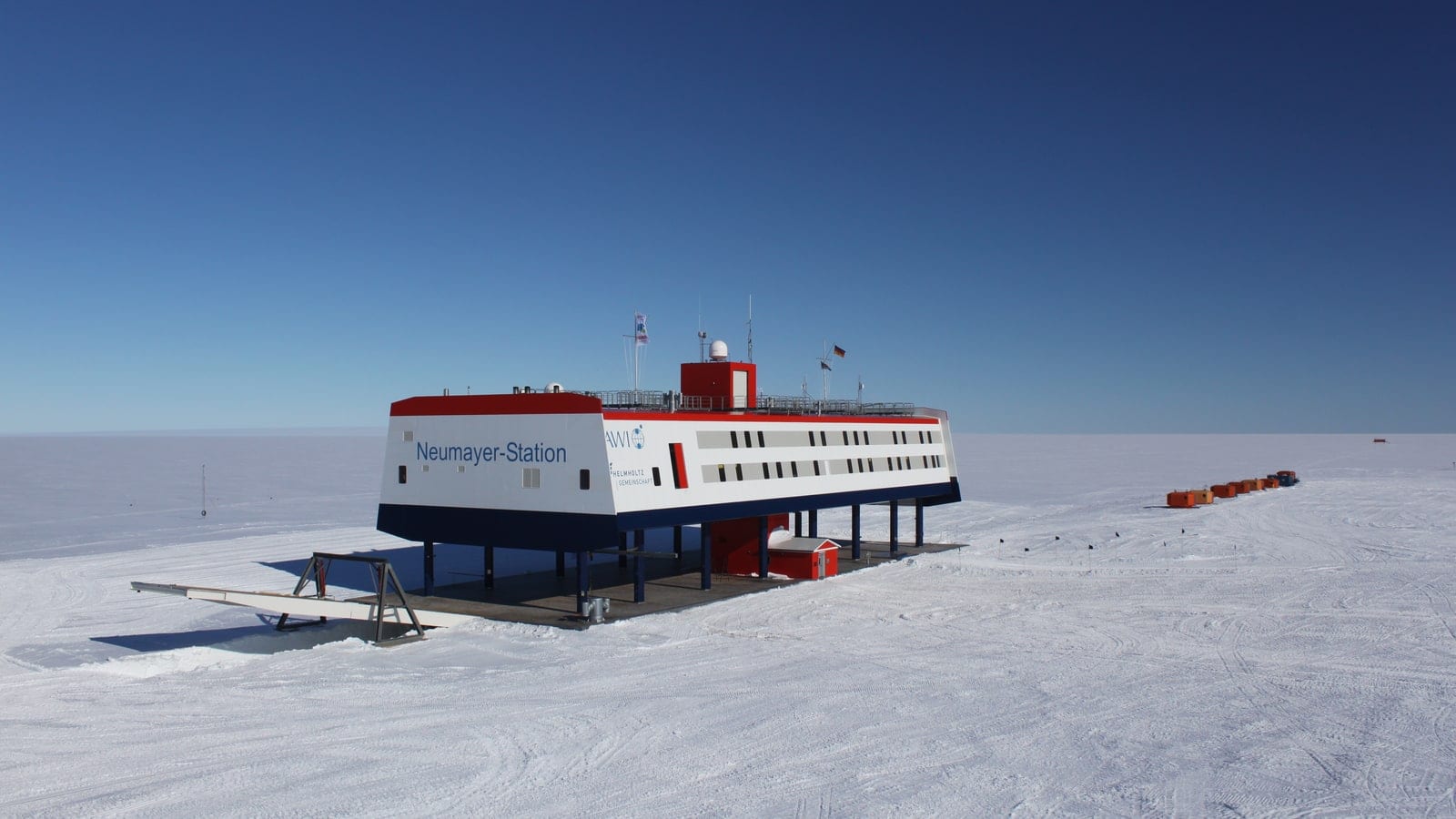
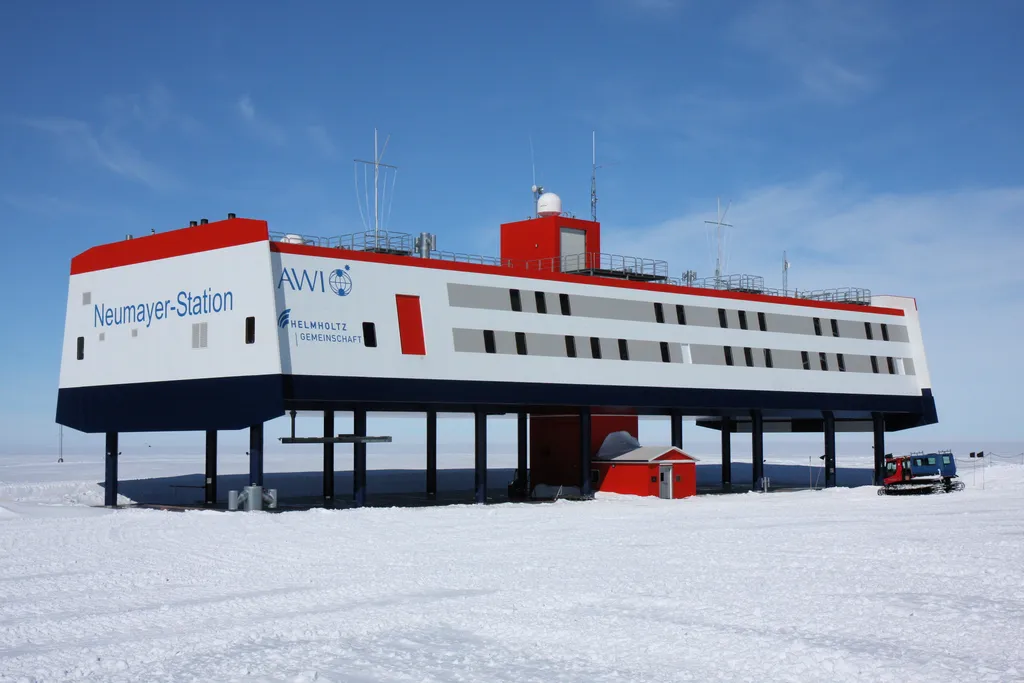
Neumayer Station III of the Alfred Wegener Institute has stood on the Ekström Ice Shelf in Atka Bay since 2009. Because snow there does not melt away but accumulates, the entire station is jacked up by 80 to 100 centimetres every year. The ice underneath drifts seawards at around 157 metres per year. In summer up to 60 people live there, in winter nine, and from February to November nobody can be reached. No aircraft, no ship, no evacuation.
The station operates as DP0GVN, named after its predecessor Georg von Neumayer. On HF that means 5 watts into a wire antenna, plus a QO-100 ground station donated and funded by AMSAT-DL. At 70 degrees south the satellite sits only 7.3 degrees above the horizon; from Austria it is around 34. In August 2021 a storm destroyed the antenna completely; AMSAT-DL built a replacement in two months, which went into service in January 2022.
The beacon that calls nobody
The scientifically most interesting part of the installation makes no QSOs at all. Since January 2018 a WSPR beacon has been running at the station, a joint project of TU Munich, Bremen University of Applied Sciences, DARC and AWI. A Red Pitaya monitors eight bands simultaneously, and a 5-watt multiband transmitter feeds a vertical. On its very first day the beacon received more than 300 different WSPR transmissions.
This is not about records but about data on propagation paths in polar regions. That is exactly where the ionosphere behaves least predictably: after strong solar events, polar cap absorption knocks out HF for hours or days, and in the Antarctic winter there is no sunlight at all for months. A beacon measuring there continuously is worth more than any single DX QSO. If you want to know how it works, we described WSPR with 5 watts separately.
The beacon was built by three radio amateurs on site: Felix Riess (DL5XL), Matthias Maasch (DH5CW) and Daniel Noll (DL1SU).
And Daniel Noll is coming to Villach
That same Daniel Noll, DL1SU/OE8BCT, spent more than a year as an overwinterer at Neumayer III. At KÄRNTEN FUNKT he will talk about what everyday research feels like at minus 50 degrees, how you operate under those conditions, and what it does to you to live for months on an ice station with eight other people.
Talk: “A year in the eternal ice”
Daniel Noll (DL1SU/OE8BCT), Neumayer Station III, Antarctica
Sunday, 20 September 2026, 16:00
KÄRNTEN FUNKT HQ, Ossiacher Zeile 39/1, 9500 Villach, Austria
Free for members, day membership on site 15 euros. Registration binding, recording not permitted. The talk is held in German.
There is a foretaste in the regional TV format „Stadtgespräch”, where he talks at length about his time in Antarctica:
Do it yourself? Possible, but not before late autumn
School contacts with DP0GVN via QO-100 are coordinated by AMSAT-DL; the contact is Charly, DK3ZL, at [email protected]. None are possible right now: according to AMSAT-DL, organisational reasons mean nothing can happen until the new crew arrives, around mid-November 2026. So if you are planning something for the school year, ask early.
The technical hurdle is lower than you might think. A QO-100 ground station is not rocket science, and the equipment is already sitting in plenty of shacks. What it takes is a school willing to join in and someone to organise it. In Hermagor that was one physics teacher with an idea.
Sources
- KÄRNTEN FUNKT: talk „Ein Jahr im ewigen Eis”
- Alfred Wegener Institute: Neumayer Station III
- DARC: new QO-100 satellite antenna installed for DPØGVN
- WSPR beacon in Antarctica active in test operation
- AMSAT-DL: QO-100
73 – your oeradio.at editorial team
Image credits
- Title image and station view: Felix Riess (DL5XL), Wikimedia Commons, CC BY-SA 3.0 DE
- Emperor penguin, Atka Bay: Hannes Grobe/AWI, Wikimedia Commons, CC BY 3.0
Transparency Notice
This article was researched and written with the support of AI (Claude, Anthropic). The images come from Wikimedia Commons under free licences (credits above). The embedded video comes from a third party, for which the respective channel is responsible. Details about the talk reflect the situation in August 2026; the KÄRNTEN FUNKT event page is authoritative. Corrections are welcome at [email protected].