Since April the scene has been guessing about a radio of which only the case was ever shown. On 29 August, at the Tokyo Ham Fair, Icom gave the answer: the X-026 concept goes into production as the IC-7110, the successor to the IC-7100.
We took a sober look at the mock-up back in April in Icom X-026: new concept radio to be unveiled at Hamvention and wrote at the time that nothing beyond the case was known. Now there is a spec sheet. Here is what is actually confirmed — and what is still missing.
What the IC-7110 is
An all-mode mobile radio with a detachable control head, so the same idea as the IC-7100 of 2013: one radio for the car and the shack, covering everything from HF to UHF.
- Bands: HF / 50 / 70* / 144 / 430 MHz (*70 MHz on the European version only)
- Receive: continuous from 30 kHz through the 144 MHz band, including FM broadcast and airband
- Modes: SSB, CW, RTTY, AM, FM and D-STAR DV
- Power: 100 W on HF and 50 MHz, 50 W on 144 and 430 MHz
- Variants: IC-7110 at 100 W, IC-7110M at 50 W, IC-7110S at 20 W
- Display: 4.3-inch colour with touch operation
- Two independent receiver chains for HF+50 MHz and for VHF/UHF, on two separate antenna connectors
- Dualwatch for HF/VHF and HF/UHF, including simultaneous DV reception
- Real-time spectrum scope with waterfall, audio scope, CW decoder
- Wi-Fi (2.4 and 5 GHz), Bluetooth 5.3, GNSS receiver
- Control head with tripod thread (1/4-20), speaker, microphone jack and SD slot in the head
- Front-mounted cooling fan
- No internal antenna tuner
The two points people will argue about
First, the two receiver chains. That is the real difference from the IC-7100, which could only serve one receiver; if you were on HF and wanted to monitor the local repeater on the side, tough luck. The IC-7110 now has two chains and two connectors. For mobile operation that is the most practically relevant gain, because you can drive along and still be reachable on 2 m.
Second, the missing tuner. The IC-7100 did not have one either, so this is no step backwards — but it does mean a matching unit has to be budgeted alongside the radio unless you work exclusively with resonant antennas. Icom showed the AH-6 tuner at Hamvention in May, which fits exactly this gap. Anyone doing the sums should plan the tuner in from the start. What a tuner does and does not do is covered in Antenna tuners: manual or automatic.
The 70 MHz on the spec sheet — and what applies in Austria
Every European announcement lists the 4 m band as standard. In the UK that is a selling point. In Austria it is a footnote with a trip to the authorities.
The 70 MHz band is not regularly allocated here. The ÖVSV applied to the telecoms authority in June 2024 for an allocation of 70.0 to 70.5 MHz; to this day it does not appear in the band plan. What does exist are exception permits: individual authorisations from the telecoms authority in coordination with the ÖVSV, intended as a trial run for possible future inclusion in the Frequency Utilisation Ordinance.
The key figures of those permits: 70.0 to 70.5 MHz, a maximum of 25 watts, with narrow-band digital modes such as FT8, FT4, Q65, MSK144 and FSK441 permitted, plus A1A, F3E and J3E. In practice, applications have also been granted for sub-ranges such as 70.150 to 70.175 MHz, with an annual fee of around 241 euros and a process that requires patience.
For a purchase decision that means: in Austria the 70 MHz in the IC-7110 is not a band you simply switch on, but one you need a permit for first. The wider framework is in our article on the Frequency Utilisation Ordinance. The same amendment that capped 23 cm at 10 watts did nothing at all for 4 m.
What is not known yet
And now the part you have to go looking for in the announcements: Icom has given neither a price nor a delivery date. No production schedule, no availability, no RRP. British dealers have already put up product pages, but without prices.
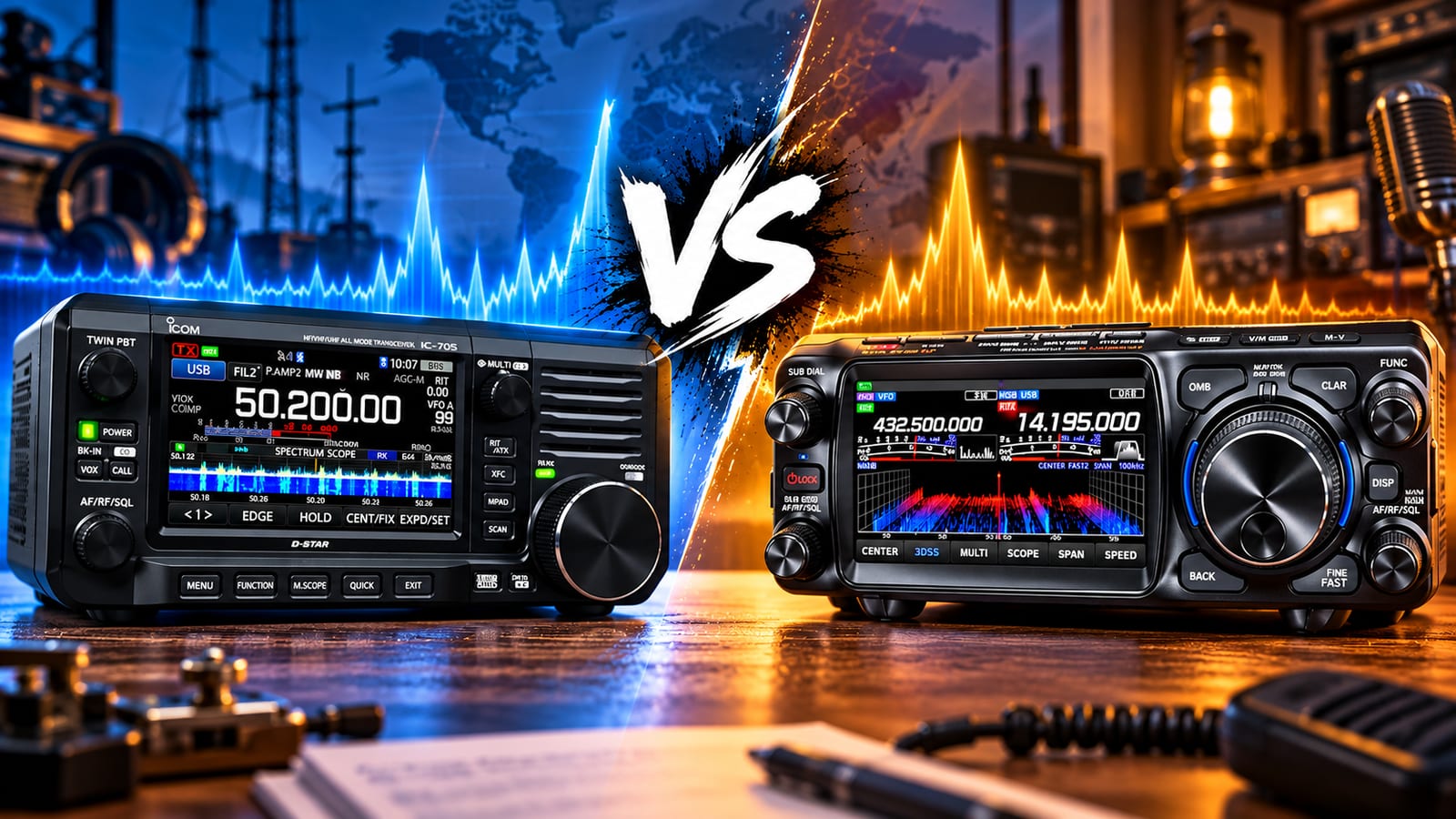
Equally open are the things that can only be judged with the radio in front of you: how good the receiver design is in a crowded band, how loud the front fan gets in the shack, how fast the waterfall really runs, and how the interface feels in a car. Icom describes it as following the IC-705 — anyone who knows that radio has a rough idea what to expect. We have a separate article on the IC-705 covering remote operation with Tailscale.
Putting it in perspective
The IC-7100 was on the market for thirteen years and is still the radio you recommend to someone with a car, a small shack and no second budget. A successor was overdue, and what is on the spec sheet looks like a clean generational change: touchscreen instead of key menus, a waterfall instead of columns of numbers, two receivers instead of one, wireless links to the computer instead of a cable tangle.
Whether that is worth the premium can only be said once Icom names one. Until then: the radio exists, it is no longer a mock-up, and the successor to the best-selling all-band mobile of the past decade has a name.
If you get your hands on one — at a show, at a dealer, anywhere: write to us. A first impression from a real operator is worth more than ten spec sheets.
73 – your oeradio.at editorial team
Transparency Notice
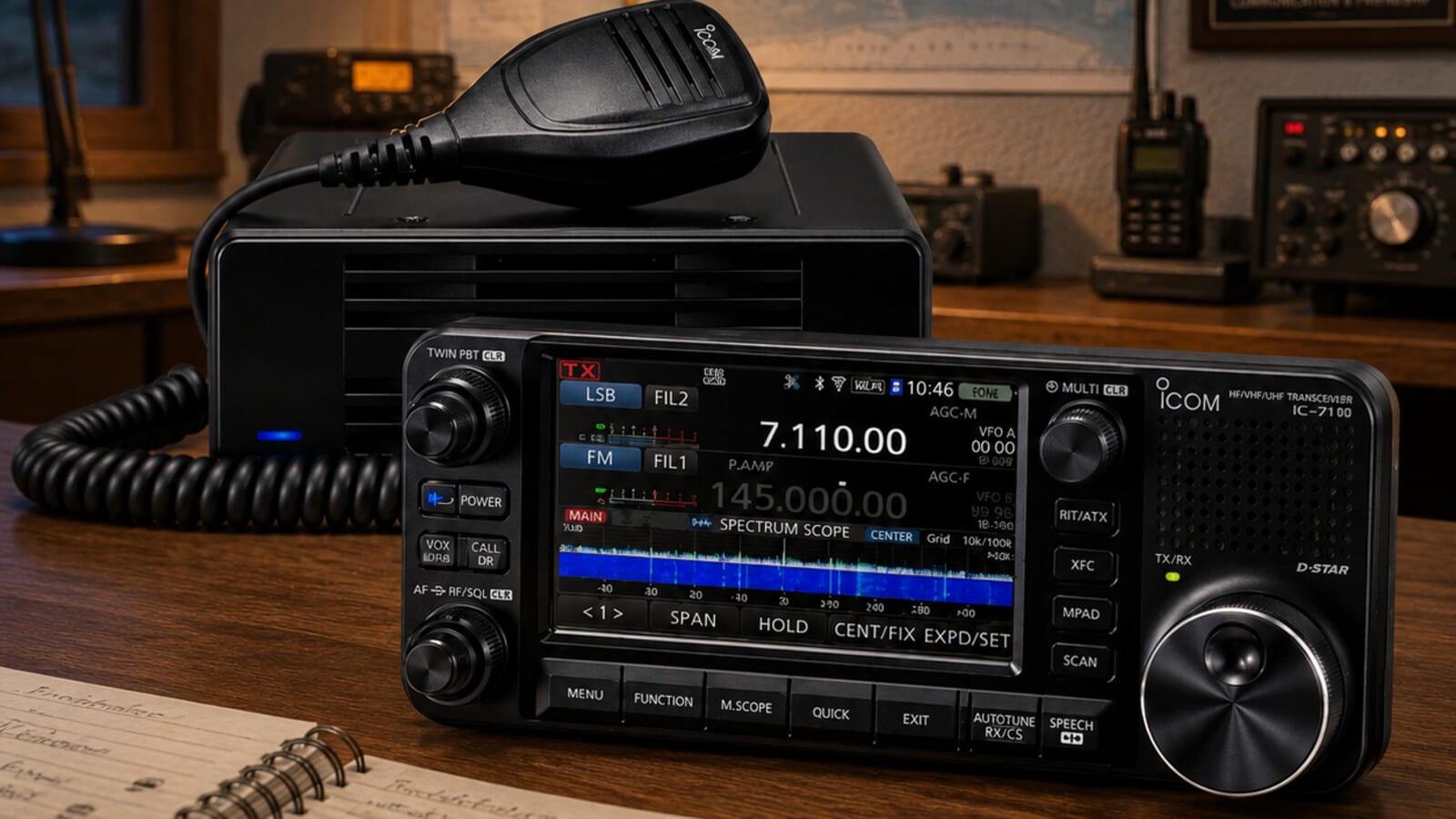
This article was researched and written with the support of AI (Claude, Anthropic). Sources are the announcements by Icom Europe and Icom UK on the presentation at the JARL Ham Fair on 29 and 30 August 2026, the published pre-release data on the IC-7110, and for the 4 m section the ÖVSV wiki and the account of the exception permits at mpdx.at. All technical figures come from manufacturer documentation — we did not have a radio in hand and claim no measurements of our own. The lead image is an AI-generated illustration and does not show a real radio — no freely usable press photos of the IC-7110 are available from Icom yet. Editorial responsibility and content review rest with the oeradio.at editorial team. Corrections are welcome at [email protected].