Table of Contents
- The short version
- Why MeshCore sits in a completely different legal drawer
- The numbers that matter
- The device has to qualify, not the child
- Location is the real topic
- Who is actually reading?
- Listening, forwarding, logging: where the line runs
- Liability: the age of 14 returns through the back door
- MeshCore is not an emergency service
- In school and in the youth group
- Comparison: what may a child use?
- The checklist for parents
- Conclusion
- Sources and further reading
- Image credits
- Transparency Notice
A ten-year-old plugs a 30-euro board into a laptop, clicks "Flash" in the browser, pairs a phone over Bluetooth and a minute later sends a message that travels across the valley via three repeaters. No mobile network, no SIM, no contract. This is not a vision of the future. It is an afternoon with MeshCore.
Which brings the question parents, teachers and youth leaders ask immediately: is the child even allowed to do this? The short answer is yes, with no exam and no age limit. The long answer is more interesting, because radio law is not the problem here at all. The pitfalls sit elsewhere.
The short version
- MeshCore runs on 869.4 to 869.65 MHz, a generally authorised frequency range. No licence, no exam, no minimum age.
- That is the decisive difference from amateur radio: there a licence starts at 14, here there is none at all.
- The real risk is not the transmitter but location sharing. It is optional and should stay off for children.
- Under 14 the supervising adult is liable for damage, from 14 the child is liable personally.
- MeshCore is not an emergency service. 112 remains 112.
Why MeshCore sits in a completely different legal drawer
oeradio.at is mostly about amateur radio, and there the situation for young people is clearly regulated: an Austrian amateur licence requires the completed 14th year of life. Anyone not fully legally capable also needs a declaration from a fully capable person assuming liability for the fees. The exam may be taken earlier, but the callsign still only comes at 14. Details are in our overview of Austrian amateur radio legislation.
None of that applies to MeshCore. Not a single sentence. MeshCore is not amateur radio; it runs in the SRD range, short range devices. Legally that is an entirely different drawer, and amateur radio law simply does not reach it.
The chain looks like this. The Telecommunications Act 2021 (TKG 2021) states in § 28 para. 1 that building and operating a radio installation is permitted only, among other routes, "within the technical conditions of an ordinance under para. 10". Para. 10 empowers the responsible minister to issue exactly that ordinance for operation "without individual frequency assignment or operating licence (general authorisation)". Since 15 April 2026 that ordinance is the Generelle-Funkanlagen-Bewilligungsverordnung 2026 (GenBV 2026), Federal Law Gazette II No. 93/2026. It grants the authorisation among others for radio equipment that may be operated in EU-harmonised frequency ranges.
Translated: the legislator granted the permission once, in bulk, for everyone. Nobody applies, nobody gets a callsign, nobody is registered. And because there is no personal licence, there is no person who would have to meet a minimum age.
The numbers that matter
The European version of the rules sits in ERC Recommendation 70-03 and in the EU implementing decision on short range devices. For the range MeshCore uses in Europe:
- 869.4 to 869.65 MHz: maximum 500 mW ERP, maximum 10 % duty cycle. This is MeshCore's playground.
- For comparison, 865 to 868 MHz: only 25 mW ERP and 1 % duty cycle.
- And 863 to 870 MHz in general: 25 mW ERP at 0.1 % duty cycle.
The MeshCore standard for Austria is the preset EU/UK (Narrow): 869.618 MHz, bandwidth 62.5 kHz, spreading factor 8, coding rate 8, transmit power up to 22 dBm. Every Austrian node uses these settings, otherwise they cannot hear each other. The community site meshcore.at currently lists more than 300 active nodes.
Two things worth explaining to a child, because they are the only real technical obligations:
- 500 mW ERP includes antenna gain. Plug in a 6 dBi antenna and the transmit power has to come down accordingly. In practice: stay away from maximum power when a good antenna is attached.
- 10 % duty cycle per hour per device. Normal chat traffic stays well below that. It only becomes a problem when someone builds automated continuous transmissions.
Video tip: from unboxing to the first node, step by step.
The device has to qualify, not the child
The general authorisation comes with a condition that is easy to miss: it applies to radio equipment complying with the Radio Equipment Market Surveillance Act (FMaG 2016). So the device needs proper CE conformity, and its construction must restrict operation to the permitted parameters.
In practice that means a board from a reputable dealer with CE marking is unproblematic. A no-name module straight from the Far East that can be tuned to arbitrary frequencies is a grey area children should be spared. The price difference is about ten euros; the risk ends up with the supervising adult.
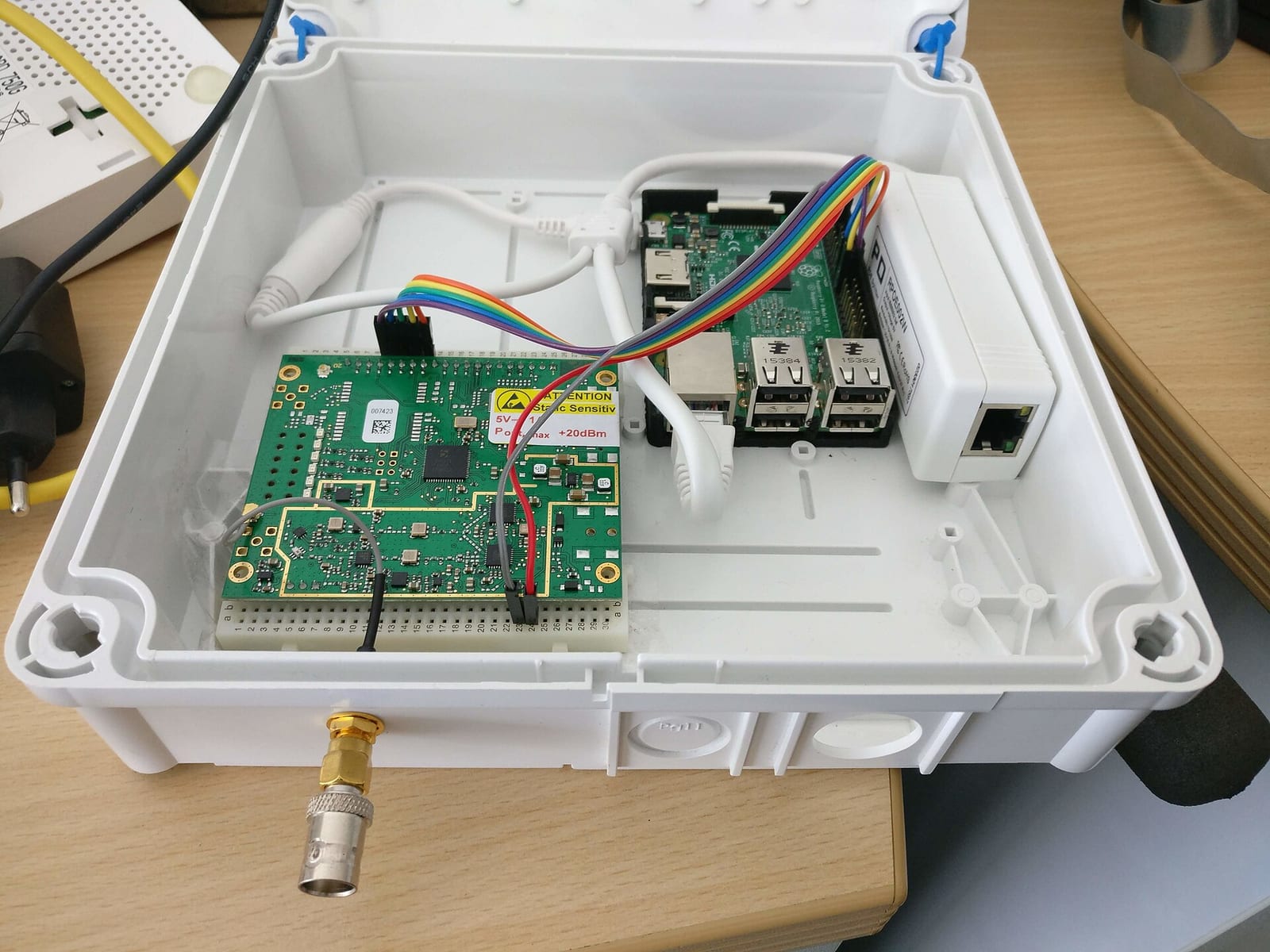
Typical entry-level hardware costs between 25 and 80 euros. Flashing happens through a web flasher in the browser, with nothing to install. Anyone who prefers a soldering iron will find the more elaborate route in our LoRa gateway article.
Location is the real topic
Here it gets serious, and here radio law is finally out of the picture.
A MeshCore node periodically sends out an advert: name, position and public key. The advert can be limited to the immediate area or flooded across the whole network. The position is optional; it is not set automatically but entered deliberately.
For a repeater on a mountain that makes sense and is wanted, otherwise the map cannot find it. For a child carrying a node around in a backpack it is the opposite of sensible. A flooded advert with a real name and coordinates is a publicly readable location report, for anyone with a receiver in range.
Three rules you set once and can then forget:
- No position on mobile nodes. Position only on fixed repeaters, and even there not pinpointed on the child's bedroom window.
- No real name in the node name. "Max M., Villach" is bad. "OE8-Node-17" is good. Repeaters may and should carry place names; personal nodes should not.
- No address, no school, no club name in the profile text.
From a data protection angle one age limit does reappear: under § 4 para. 4 of the Austrian Data Protection Act (DSG) a child can only give valid consent to the processing of its data in information society services from the completed 14th year of life. Below that the legal guardians must consent. MeshCore itself is not such a service, since there is no provider behind it. But the maps, apps and community platforms around it certainly are. Putting a child's node on a public map makes that decision on the child's behalf.
Who is actually reading?
MeshCore encrypts. That is the second big difference from amateur radio, where encryption is forbidden. In the SRD range it is allowed, and MeshCore uses it.
- Direct messages are end-to-end encrypted. The shared key is derived through an X25519 key exchange from your own private key and the other party's public key. Repeaters in between forward ciphertext only; they cannot read along.
- Public channels are encrypted too, but with a key every MeshCore device knows out of the box. That is not confidentiality, that is noise suppression. Whatever goes into the
#austriachannel is read by half the country.
A child needs to understand this distinction before switching on the first node. The rule of thumb is simple and sticks fast: everything in a channel is as public as a notice board. Only a direct message to a specific contact is private.
For completeness: the end-to-end encryption is not flawless either. MeshCore uses AES-128 in ECB mode, and ECB leaks patterns across repeated blocks. Entirely sufficient for teenage chat, not for secrets. Anyone with something confidential to discuss uses Signal, not the mesh.
Listening, forwarding, logging: where the line runs
A mesh node does something that by definition sounds like handling other people's messages: it accepts packets from others and passes them on. Is that interception?
No, and the law says so explicitly. § 161 para. 3 TKG 2021 prohibits "listening in on, intercepting, recording, capturing or otherwise monitoring messages and the associated traffic and location data, as well as passing on information about them, by persons other than a user without the consent of all users involved". The same paragraph expressly exempts "technical storage necessary for forwarding a message". That is precisely what a repeater does. Store and forward is permitted.
What is not permitted: systematically recording, analysing and publishing the traffic. Build a node that logs everything and puts the logs online and you leave the exemption. In criminal law § 119 StGB then comes into play, violation of telecommunications secrecy. Using a device to obtain knowledge of the content of a message not intended for you risks up to two years' imprisonment. Prosecution requires authorisation from the injured party, but that is not something to rely on.
For practice with children that means two things. First: running a repeater is entirely fine and in fact welcome. Second: "look what I can read" is not a game, it is a boundary.
Liability: the age of 14 returns through the back door
Radio law has no minimum age. Civil law does, at exactly the same point as amateur radio.
- Under 14 children lack tortious capacity. If they cause damage, § 1309 ABGB makes the supervising person liable, but only where the duty of supervision was culpably breached and that breach caused the damage. The extent of supervision depends on the child's age, characteristics and development.
- From 14 minors have tortious capacity and are liable personally, with their own assets.
- 14 is also where criminal responsibility begins. Below that, a child cannot be prosecuted.
What can actually go wrong with a 30-euro board? Realistically, little. A node on the balcony causes no damage. It becomes relevant in two situations: when someone mounts an antenna on a roof and breaks something, and when something happens in the chat.
The latter is the more common case. A mesh network is a chat, and in chats what happens is what happens in chats. § 107c StGB criminalises continued harassment by means of telecommunications, colloquially cyberbullying: up to one year's imprisonment or 720 daily rates, up to three years where consequences are severe. The fact that the network is technically decentralised and nobody operates it changes nothing. A public channel is a public space.
MeshCore is not an emergency service
This point gets its own section because it is the only one in this article where a misunderstanding can do real harm.
MeshCore is not an emergency communications system. There is no operator, no availability guarantee, no control room listening, and no obligation on anyone to forward a message. Whether a repeater is up depends on whether somebody else kept their solar panel clean. That is the charm of the system and at the same time its limit.
Anyone discussing mesh with children should write the sentence down anyway, because the temptation is strong: "radio without a mobile network" sounds a lot like a lifeline to a child. In an emergency it is 112, and if there is no network it is still 112, because emergency calls go through any available network, even without your own SIM. The mesh is a supplement, never a replacement. Anyone with genuine emergency communications interest sooner or later arrives at amateur radio, and that is a good development.
Video tip: a home-built repeater on 868 MHz, including enclosure and power supply.
In school and in the youth group
For schools and youth groups MeshCore is almost too well suited to be true: no application, no fee, no exam, hardware in the price range of a pocket calculator, and at the end a network the group built itself.
What to settle beforehand:
- Mounting on the building is the school authority's business, not the teacher's. A node on a window sill is a different matter from an antenna on the roof.
- The duty of supervision remains. A mesh project is lessons, not a free pass for unsupervised chatting.
- Agree node names in advance. School abbreviation plus number, no pupil names. Five minutes of clarity saves later discussions.
- The public channel is public. That sentence belongs on the board before the first device is switched on.
As a project format it works well because it can be staged: first lesson flashing and pairing, second lesson measuring range, third lesson comparing antennas, fourth lesson planning a repeater. How well radio carries as a school topic was shown by the activity days at HTL Villach and by Funkparcours.
Comparison: what may a child use?
- MeshCore (869 MHz): generally authorised, no minimum age, no exam, encryption allowed, text messages. Range 1 to 20 km directly depending on terrain, considerably further via repeaters.
- Meshtastic (868 MHz): legally the same drawer, different firmware, different network. Both worlds coexist in Austria, see our practical article and the Meshmap.
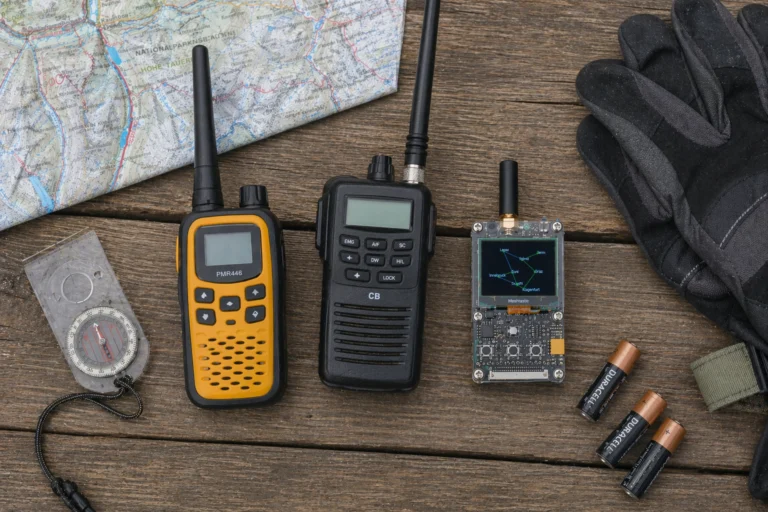
- PMR446 and CB radio: also licence-free and without an age limit, but voice instead of text and far less range. The three-way comparison puts that in context.
- Amateur radio: licence from 14, exam required, in exchange high power, worldwide range and dedicated frequencies. Under 14, operation is possible under the supervision of a licensed amateur. Which class is good for what is in the licence class comparison.
- MeshCom: the amateur radio variant of the mesh idea and therefore licensed, see MeshCom vs. Meshtastic.
The honest assessment: MeshCore is the lowest-threshold entry into radio available right now. It is not a replacement for amateur radio but the ramp leading to it. A child who understands why a node on a hill beats ten extra watts has already learned the most important lesson in radio.
The checklist for parents
- Device from a reputable dealer with CE marking, no grey imports.
- Preset EU/UK (Narrow), 869.618 MHz, transmit power no higher than needed.
- Location sharing off as long as the node is mobile.
- Node name without a real name, without an address, without a school.
- Explain once together: channel is public, direct message is private.
- Agree once together: recording and publishing other people's messages is off limits.
- State once clearly: in an emergency it is 112, not the mesh.
- For roof mounting: the parents do that, not the child.
Conclusion
MeshCore is fully permitted for children and teenagers in Austria. There is no minimum age, no exam and no notification duty, because the legislator granted the permission in bulk through GenBV 2026. Buy a compliant device, use the standard preset, and you stay inside the limits without having to think about it.
Attention belongs elsewhere. Location sharing is the one setting to make deliberately. The difference between public channel and direct message is the one concept a child has to grasp. And liability passes to the child at 14, before that it rests with the supervising adult.
That sounds like a lot, but it is a ten-minute conversation and three checkboxes in the settings. What remains is a hobby packing technology, geography, physics and a bit of neighbourhood into a single device that fits in a pocket. More than 300 nodes are currently active in Austria. One of them could be your child's.
73 – your oeradio.at editorial team
Sources and further reading
- RIS: Telecommunications Act 2021 (TKG 2021) — § 28 radio installations, § 161 communications secrecy
- Federal Law Gazette II No. 93/2026: Generelle-Funkanlagen-Bewilligungsverordnung 2026 (GenBV 2026), PDF
- CEPT ERC Recommendation 70-03: Short Range Devices, Annex h (863–870 MHz), PDF
- Commission Implementing Decision (EU) 2025/105 on short range devices
- § 119 StGB: violation of telecommunications secrecy
- § 107c StGB: continued harassment by means of telecommunications
- § 4 DSG: consent of children from the completed 14th year of life
- Austrian Data Protection Authority: information for teens & kids
- meshcore.at — MeshCore Austria: settings, map, community
- MeshCore Europe: repeater deployment guide
- MeshCore on GitHub (firmware, FAQ, roles)
- MeshCore web flasher
- Fernmeldebüro: radio interface specifications and jurisdiction
Image credits
- Home-built LoRa gateway: Fabian Horst, CC BY-SA 4.0, Wikimedia Commons
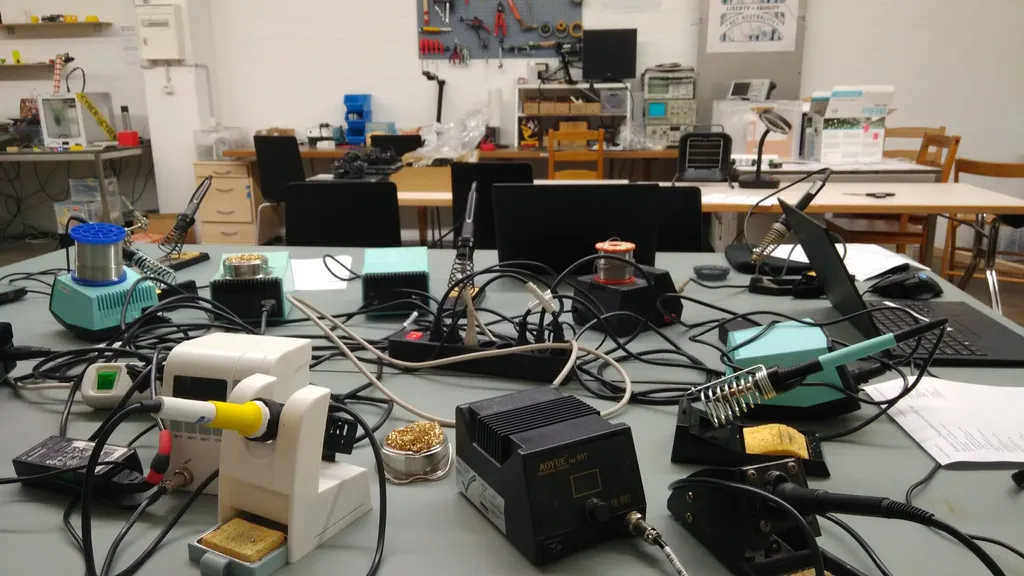
- Soldering stations in a hackerspace: Dbrgn, CC BY-SA 4.0, Wikimedia Commons
Videos: ShotokuTech, AW Services. Embedded via YouTube; rights remain with the respective channels.
Transparency Notice
This article was researched and written with the assistance of AI (Claude, Anthropic). The editorial team has reviewed and edited all content. It does not replace legal advice: laws and ordinances change, and assessment in an individual case rests with the competent authorities, for radio matters the Fernmeldebüro. Despite careful review, occasional inaccuracies may occur — we welcome corrections via email to [email protected].