Table of Contents
- What Is RaDAR?
- The History of RaDAR
- Rules and Categories
- The Basic Rule
- Movement Categories
- Exchange and Logging
- Points and Bonuses
- Gear for RaDAR
- Transceivers
- Antennas
- Power
- Accessories
- How a Typical RaDAR Rally Runs
- Preparation
- During the Rally
- RaDAR in Austria
- Ideal RaDAR Areas
- RaDAR Compared: SOTA, POTA, Field Day
- RaDAR and Emergency Preparedness
- Tips for Your First RaDAR Rally
- RaDAR Rally Dates
- Conclusion: Why RaDAR Will Enrich Your Ham Radio
- Transparency Notice
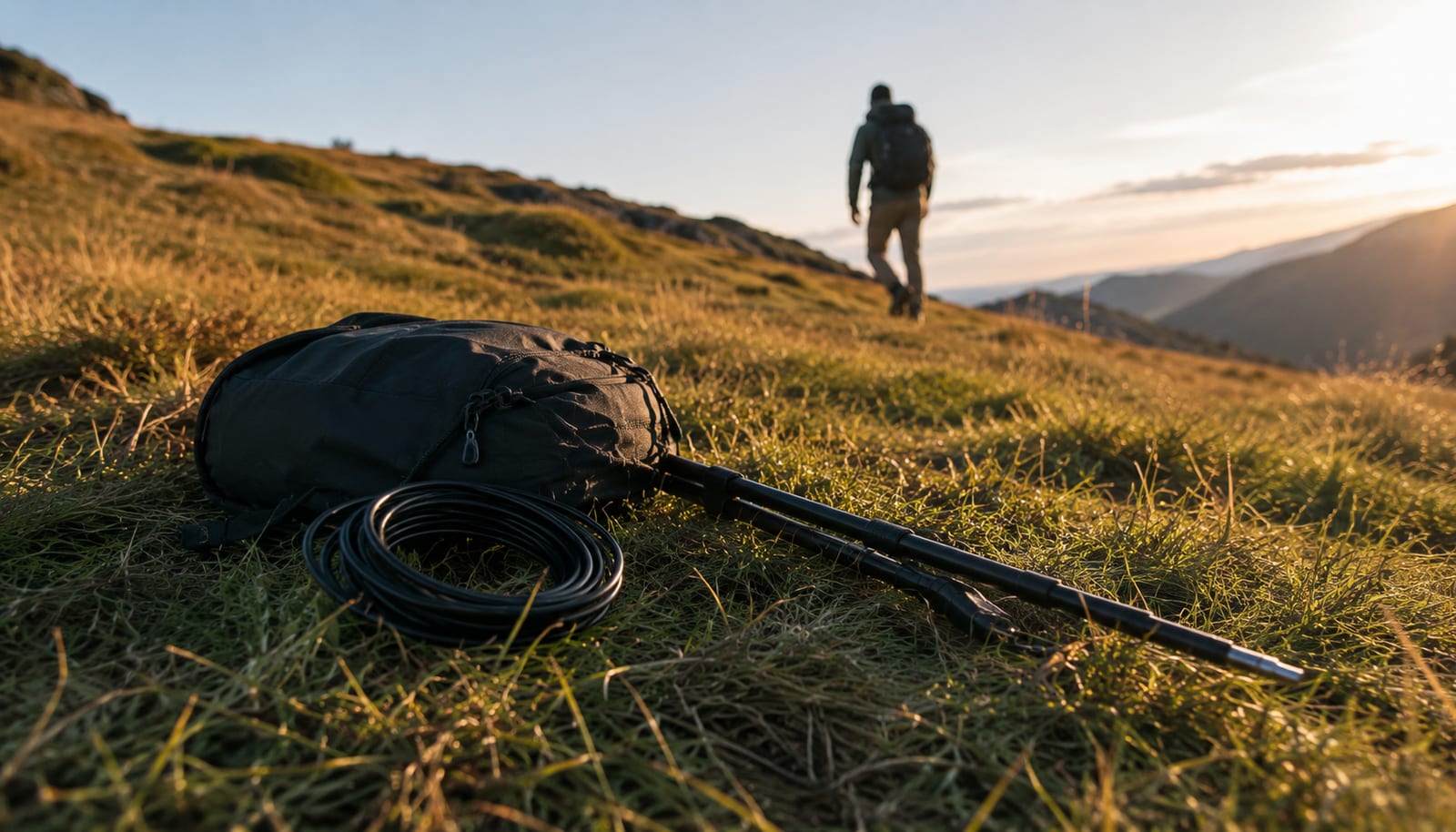
Imagine this: you are hiking through the Austrian countryside, you set up a complete amateur radio station in just a few minutes, make five contacts, pack everything away — and walk another kilometre to do it all over again. Sounds like a cross between orienteering and ham radio? That is exactly what RaDAR — Rapid Deployment Amateur Radio is all about: an activity format that combines portable radio operation, physical exercise, and the ability to deploy a station fast.
What Is RaDAR?
RaDAR stands for Rapid Deployment Amateur Radio and goes back to Eddie Leighton, ZS6BNE, from South Africa. The basic idea is as simple as it is brilliant: radio amateurs set up a portable station at a location, make a set number of contacts, completely dismantle the station, and then move to a new location — where they repeat the whole process.
The crucial difference from other outdoor programmes like SOTA or POTA: RaDAR is not just about operating from a scenic location. It is about training the ability to quickly and reliably set up, operate, and tear down a station — a core competency that can be vital in emergency communications and disaster response.
Video tip: Greg Lane, N4KGL, who runs today's RaDAR Rally, explains the format in under ten minutes — including why it is deliberately not a contest:
The History of RaDAR
Eddie ZS6BNE developed the RaDAR concept in South Africa in the early 2010s. A keen portable operator and outdoor enthusiast, he was looking for an activity that offered more than pile-ups from a fixed location. He wanted a discipline that tested the entire process of portable operation — from planning and transporting the gear to setting up quickly under time pressure. The result was the RaDAR Challenge, run several times a year for many years.
In 2023 Eddie drew a line under it and retired the RaDAR Challenge rules. American radio amateur Greg Lane, N4KGL, picked up the idea and launched the RaDAR Rally as the successor event. The first rally took place on 1 April 2023, and it has run twice a year since. Participants come from North America, Europe, South Africa and beyond — the April 2026 rally saw 13 registered operators, with M0TRT posting the highest score.
The word "rally" is a deliberate choice: this is not a contest in the classic sense where only the QSO count matters. The organisers put it bluntly themselves — "This is not a contest; it is just for fun!" It is a sporting event in which movement, strategy and operating skill all count.
Rules and Categories
The RaDAR rules are straightforward but well thought out. They encourage movement and reward those who put in the effort:
The Basic Rule
At each location you work five contacts — you may make more, but only five per deployment count towards the score. Then the station is completely dismantled and the operator moves to the next location. The whole thing runs for four hours, which you can pick freely within the UTC day.
Movement Categories
- On foot or by canoe: at least 1 km between locations — the premier discipline
- Bicycle: at least 2 km between locations — sporty and efficient
- Motorised vehicle: at least 6 km between locations
- Wheelchair or mobility scooter: 500 m — RaDAR is deliberately designed to be accessible
Modes of transport may be combined as you like, and locations may be reused during the rally.
Exchange and Logging
The exchange depends on who you are working:
- You call CQ RaDAR: exchange signal report and location
- You answer someone else's CQ: use that activity's exchange (for example the other station's POTA or contest exchange)
- RaDAR to RaDAR: signal report and an eight-digit grid square (e.g. JN77FJ12)
The precise locator matters because it documents your position and makes movement between stops verifiable. All bands and modes are allowed — with one exception: terrestrial repeaters do not count. SSB, CW, digital modes such as FT8 or JS8Call, and FM simplex on VHF/UHF are all in play.
Points and Bonuses
Scoring is deliberately built so that movement and RaDAR contacts count for more than raw QSO numbers:
- 3 points per RaDAR-to-RaDAR contact (both stations are mobile rally participants)
- 2 points per POTA or SOTA contact
- 1 point for every other QSO
The formula is: QSO points × number of deployments + bonus points. That multiplier is the real trick — the more often you tear down and move on, the more your score multiplies. Bonus points are awarded for:
- 3 points per non-motorised transition (on foot, bicycle, canoe)
- 2 points per deployment run entirely at QRP
- 1 point per QSL match in the COOL log
Gear for RaDAR
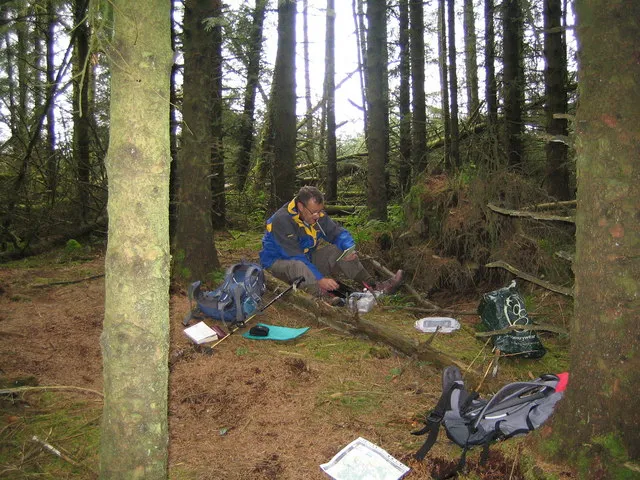
With RaDAR, the gear is everything. You have to carry it, deploy it fast and pack it away fast. Every unnecessary gram comes back to bite you after the third move. A typical RaDAR setup fits in a small backpack and weighs between 3 and 6 kilograms.
Transceivers
Light, compact QRP transceivers are ideal:
- Elecraft KX2: around 370 grams, 10 watts, optional built-in ATU — the classic for ultralight setups
- Elecraft KX3: slightly heavier, but all-mode with a wider receiver
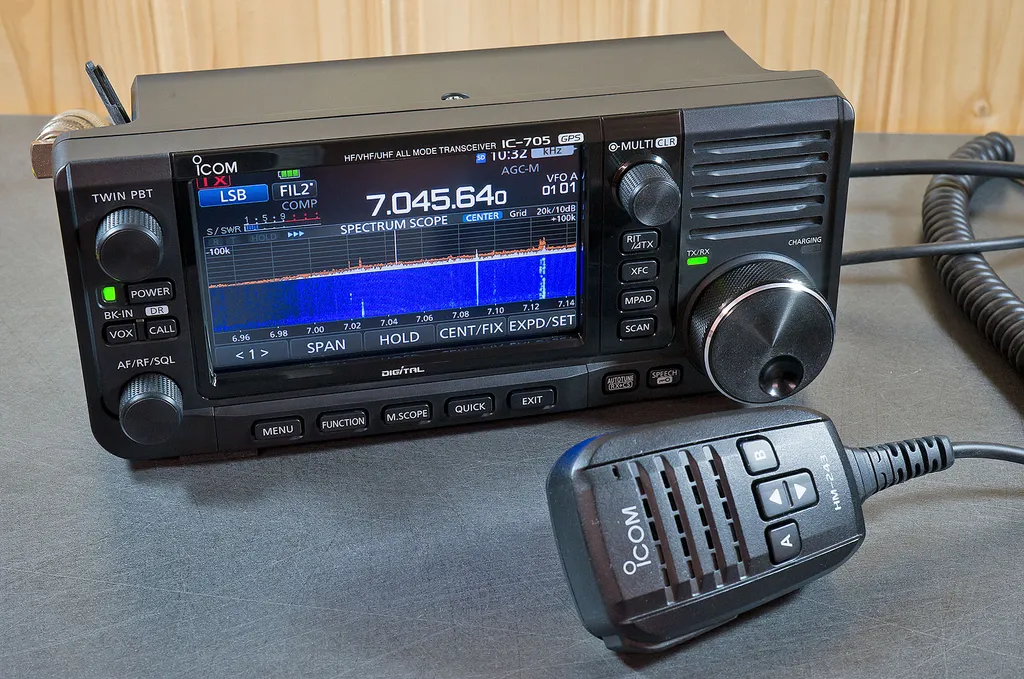
- Icom IC-705: touchscreen, D-STAR, Bluetooth — around 1.1 kg, versatile on HF, VHF and UHF
- Xiegu G90/G106: affordable alternatives with a decent receiver — a bit heavier, but solid
- (tr)uSDX: the homebrew classic — around 130 grams, a few watts, CW and SSB on several bands
Antennas
The antenna has to go up and come down fast — ideally in under five minutes:
- EFHW (end-fed half-wave): light, no counterpoise needed, strung between a tree and a telescopic pole — the most popular RaDAR antenna
- Random wire with a tuner: flexible, works on all bands, needs an ATU
- Vertical: self-supporting, no tree needed — but laying out radials costs time
- Linked dipole: resonant on several bands via connectors — good for CW and SSB
- Wire antenna with a throw weight: throw line over a branch, haul the wire up — on the air in three minutes
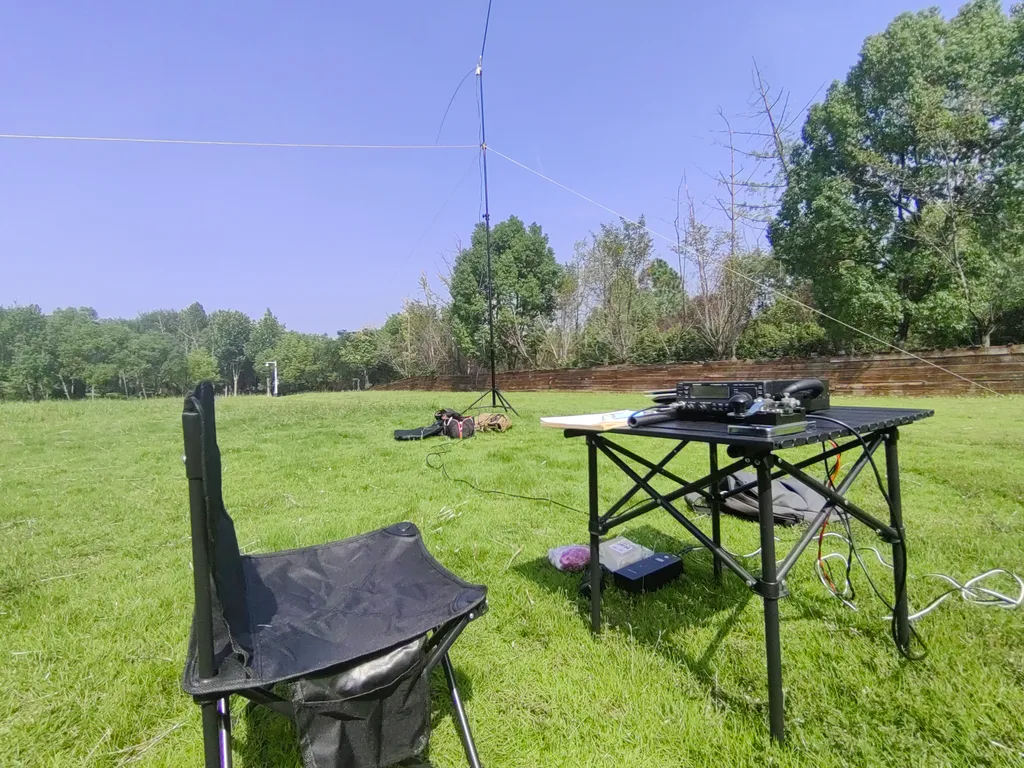
Our portable antenna comparison covers the pros and cons of each type for outdoor activities in more depth.
Power
- LiFePO4 batteries: light, safe, long-lived — 3 Ah is enough for a full rally at QRP
- 18650 packs: cheap, available everywhere, and many QRP rigs run directly off them
- Solar panels: a useful supplement for longer outings — 10–20-watt panels weigh under 500 grams
Accessories
- A light telescopic mast (6–10 metres) or a fishing pole as an antenna support
- Throw line and weight for getting the antenna wire into trees
- Headphones — essential outdoors against wind and ambient noise
- Log (paper or smartphone app) — note GPS coordinates and grid locator
- A watch showing UTC for accurate logging
- Optional: a Digirig Mobile as a lightweight digital interface
Video tip: what the cycle looks like in practice — set up, work QSOs, tear down, move on:
How a Typical RaDAR Rally Runs
The rally window is four hours, freely chosen within the UTC day. A typical run looks like this:
Preparation
- Register: registration opens one month before the event — an email to the RaDAR point of contact (Greg Lane, N4KGL) with your name, call sign, preferred day, start time in UTC, means of transport, bands and modes is all it takes
- Plan the route: pick a hiking route with several candidate locations — ideally elevated ones for good propagation
- Pack the gear: test everything the night before and pack it compactly — an organised backpack makes setup routine
- Prepare grid locators: work out the eight-digit Maidenhead locators for your planned locations in advance
- Sort out spotting: any means of spotting is allowed — the COOL logger/spotter run by Eddie ZS6BNE is recommended and is how RaDAR stations find each other
During the Rally
- Reach the location: find a suitable spot — elevated, trees for the antenna, sheltered from the wind
- Set up: raise the antenna, connect the rig, headphones on — target: on the air in under 10 minutes
- Call CQ RaDAR: "CQ CQ CQ RaDAR, [call sign]" — or go hunting instead, since POTA and SOTA stations are worth double
- Log 5 QSOs: exchange report and location, or the eight-digit locator for RaDAR-to-RaDAR
- Tear down: pack everything carefully — leave nothing behind
- Move to the next location: at least 1 km on foot or by canoe, 2 km by bicycle, 6 km motorised
- Repeat: until the four hours are up
Experienced RaDAR participants manage three to five locations on foot — that means 15 to 25 scoring QSOs plus the physical effort of 3 to 5 kilometres of hiking with a pack. And because QSO points are multiplied by the number of deployments, that moving on is exactly where a good score comes from.
RaDAR in Austria
Austria offers ideal conditions for RaDAR. The varied topography — from the gentle hills of the Weinviertel through river floodplains to alpine high trails — makes every rally a different experience.
Ideal RaDAR Areas
- Danube Cycle Path: flat, easy to reach, ideal for RaDAR by bicycle — countless locations between Passau and Vienna
- Vienna Woods: a dense network of trails around Vienna — perfect for RaDAR on foot with elevated viewpoints
- Wachau: hills, vineyards, the Danube — varied topography for interesting propagation
- Carinthian lakes: hike around the lakes and operate from different shores
- Salzkammergut: trails between lakes and mountains — RaDAR at a sporty level
- Alpine pastures in Styria: plateaus with clear takeoff — excellent conditions and short hops between huts
Combining RaDAR with other outdoor programmes is an obvious move, and the rules actively reward it: hike through a registered park and you can run a POTA activation at the same time. If your route crosses a SOTA summit, SOTA points are on the table too — and POTA/SOTA contacts count double in RaDAR scoring. Operate inside a WWFF reference and you score three ways at once.
RaDAR Compared: SOTA, POTA, Field Day
How does RaDAR differ from other outdoor amateur radio activities? The comparison makes its character clear:
- SOTA: a fixed summit as the goal, the station stays up for the whole activation, no relocation — the hike is the means, the summit is the end
- POTA: a fixed location in a park, 10 QSOs for a valid activation, no relocation — relaxed and family-friendly
- Field Day: usually a group effort, 24 hours from a fixed site, focused on emergency readiness — stationary, but intense
- RaDAR: mandatory relocation after every 5 QSOs, fast setup and teardown, solo operators or small teams — the most dynamic format of them all
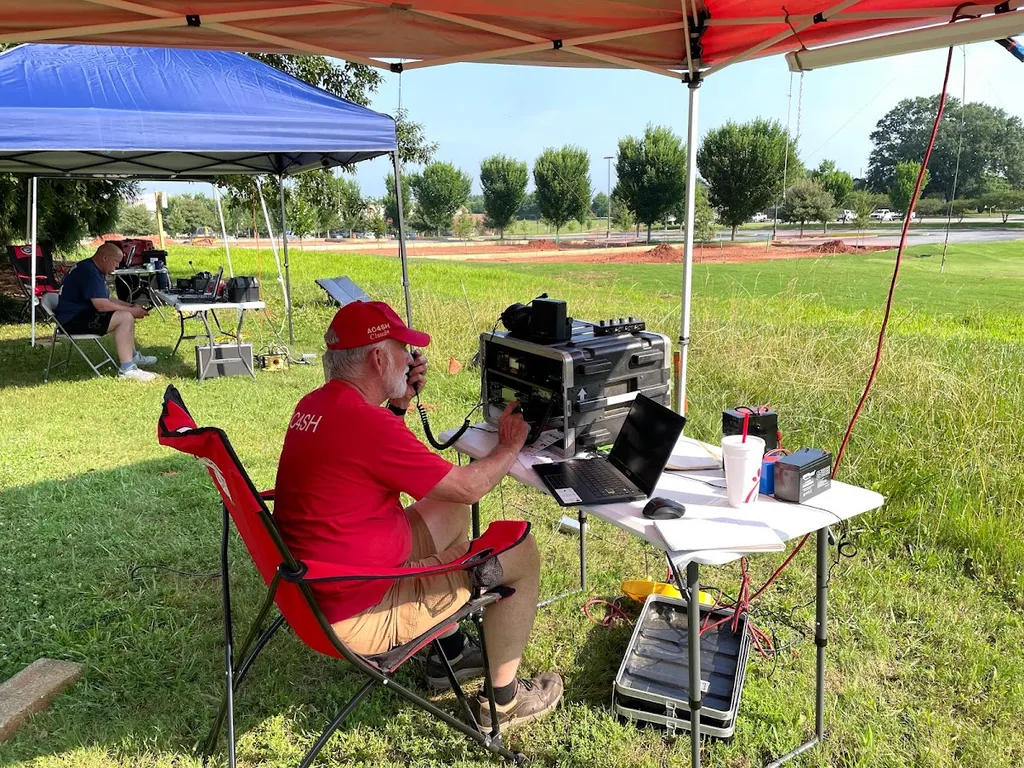
RaDAR is therefore the format that puts the greatest emphasis on mobility and rapid readiness. It is the format closest to a real emergency deployment — where you also have to get a station up fast, communicate, and relocate if necessary.
RaDAR and Emergency Preparedness
The link between RaDAR and emergency communications is no accident — it is part of the concept. Eddie ZS6BNE designed RaDAR deliberately as training for emergency communications. The skills you practise during a RaDAR rally are exactly the skills that matter when it counts:
- Fast station setup: in a disaster every minute counts — being able to set up blindfolded is an advantage
- Self-sufficient operation: no mains, no internet — just battery, antenna and transceiver
- Relocation: if the first location is compromised or conditions are poor, you need to be able to move fast
- Improvisation: wind, rain, no trees for the antenna — RaDAR trains you to deal with adverse conditions
- Compact gear: the "go bag" mentality — everything essential has to fit in one backpack
Video tip: a full RaDAR run from the operator's perspective — including the small mishaps that simply happen in the field:
Tips for Your First RaDAR Rally
Want to take part in the next RaDAR rally? Eight tips to make the start easier:
- Start simple: you need no special gear. A handheld and a vertical are enough to begin with — local FM QSOs on 2 m count too, as long as they are simplex. Repeaters are excluded.
- Practise first: set your station up and take it down three times in the garden before the rally. Every minute counts.
- Plan the route in advance: mark three to five possible locations on the map, each at least 1 km apart
- Pack light: less is more. A KX2 with an EFHW and a LiFePO4 battery weighs under 2 kg — a complete HF station
- Prepare grid locators: install an app that shows the eight-digit Maidenhead locator of your GPS position — you need it for every RaDAR-to-RaDAR QSO
- Rely on spotting: there are no fixed RaDAR frequencies. If you want to be found, spot yourself — via the COOL spotter, a cluster or a chat group. In practice most activity happens on 40 m and 20 m, around the usual QRP calling segments.
- Watch the weather: you will be out for four hours — suitable clothing, enough water and a first-aid kit belong in the pack
- Have fun: RaDAR is explicitly not a cut-throat competition. Enjoy the mix of hiking, fresh air and radio. Every location with a QSO is a success.
RaDAR Rally Dates
The RaDAR Rally runs twice a year, on the first Saturday of April and November. If Saturday does not work for you, Sunday is the backup day.
- 4 April 2026: spring rally — already run, with 13 registered participants
- 7 November 2026: autumn rally — the next date. Registration opens in early October.
Everyone picks their own four-hour window within the UTC day — for Austrian participants that means morning or afternoon, depending on when bands and weather cooperate. Dates, rules, the roster and results are published at radarrally.info. Unlike POTA or SOTA, registration is expected — it opens a month before the event and runs by email.
Conclusion: Why RaDAR Will Enrich Your Ham Radio
RaDAR is more than just another outdoor radio programme. It is training for the real thing, wrapped in a sporting and sociable activity. It builds skills that SOTA, POTA or Field Day do not put front and centre: fast setup and teardown, mobility, and the ability to operate reliably under changing conditions.
Austria's varied landscape — from the Danube floodplains through the Vienna Woods to the alpine pastures of Styria — offers perfect conditions for it. Whether solo on foot, by bicycle along the Danube, or as a team by car through Carinthia: RaDAR gets you outdoors and makes you a better, more versatile operator at the same time.
Pack the rucksack, charge the battery, check the antenna — and put 7 November 2026 in your diary. You will be surprised how much fun it is to set up against the clock and line up the next location.
73 – your oeradio.at editorial team
Transparency Notice
This article was researched and written with the support of AI (Claude, Anthropic). The editorial team has reviewed and edited all content. Despite careful checking, occasional inaccuracies may remain — we welcome corrections by email to [email protected].