Table of Contents
A contest lives and dies by rate: as many contacts per hour as possible, as many multipliers as possible. And there's an uncomfortable truth here – while you're calling CQ and waiting for an answer, nothing is happening on your band that earns you points. This dead time is exactly what SO2R attacks: a single operator works two radios at the same time and fills the gaps on one radio with operating on the other. Sounds like multitasking at the limit – and that's precisely what it is. This article explains how SO2R works, what levels of complexity there are, what hardware you really need, and what you have to watch out for when it comes to station protection, so you don't fry your own receiver front-end.
What is SO2R?
SO2R stands for Single-Operator-Two-Radio: one person, two complete stations on two separate antennas – usually on two different bands. The basic idea is simple. On one radio you run Run: you call CQ and work the callers one after another, ideally a fast chain of contacts. On the second radio, during those very same seconds, you do Search & Pounce: you tune across another band, hunt for rare stations and new multipliers, and call them deliberately.
The trick is all in the timing. Whenever there's nothing important to do on the Run radio – while your own transmission is going out or while you're waiting for the next caller – you listen and tune on the second radio. Two half-used bands turn into continuously productive operating. One point is crucial and identical in every contest rulebook: you may only ever transmit on one radio at a time. SO2R does not double the transmit power or the signals on the air – it only doubles how efficiently one operator uses their time.
The operating technique in practice
A typical sequence looks like this:
- Run on Radio 1 – for example, CQ on 20 m, where things are busy right now. The software sends the CQ call and the exchange while you're already listening somewhere else.
- Search & Pounce on Radio 2 – while the CQ is running, you tune across 40 m and hunt for stations you can't reach on 20 m.
- Band hopping – if the Run on 20 m gets sluggish, the Run function immediately moves to another band. The radio that was just "searching" becomes the Run radio, and vice versa.
As elegant as that sounds, it's just as demanding. The real hurdle isn't the technology, it's your head: you're hearing two different bands, one in each ear (classically one RX signal on the left, the other on the right in the headphones), you constantly have to decide where the next action makes more sense, and you mustn't lose the thread while doing it. This cognitive load is the reason SO2R takes a lot of practice – and why most top contesters start small and build up slowly.
The essential prerequisite for all this is automated transmission: the software has to send CQ calls and exchanges by itself. If you had to speak into the microphone or press the key every single time, you'd have no spare second to tune on the second radio – and the whole advantage would be gone.
Videos: seeing and hearing SO2R
Three videos, from the overview to a German-language talk to a live demo:
The levels: from SO2V to 2BSIQ
SO2R isn't an either-or; it's a ladder you can climb rung by rung:
- SO1R – one radio, one band at a time. Classic, simple contest operating. This is where everyone starts.
- SO2V (Single-Operator-Two-VFO) – only one transceiver, but one with a second receiver (sub-RX), like the ones found in radios such as the Elecraft K3, Yaesu FTdx101 or FlexRadio. You listen on two frequencies but transmit on only one. In the logging software it feels almost like SO2R – the ideal, inexpensive way in, because you need neither a second complete radio nor a second antenna system.
- SO2R – two full-fledged radios on two antennas. You can listen on two bands and shift the Run function back and forth between them. Transmit power always on only one.
- 2BSIQ (Two-Band Synchronized Interleaved QSOs) – the premier league. You call CQ on both bands practically at the same time, but the transmissions are interleaved so that only one band is ever actually transmitting. The operator handles two Run QSOs woven into one another and reaches top rates that would be unthinkable with a single radio. Extremely demanding, only masterable with a lot of training.
- SO3R – three radios, the very edge of what's feasible. More of a curiosity and a prestige exercise than an everyday setup.
Anyone who wants to find out whether SO2R even suits them doesn't need to buy a second station: with a dual-RX radio and SO2V you can try the core idea – juggling two bands in your head – for very little money.
Hardware: the SO2R box
The heart of an SO2R station is a switch, usually called an "SO2R box" or "SO2R controller." It automatically distributes the controls you only have one of to whichever radio is active – governed by the logging software:
- Headphone audio – routes the two receivers to your ears (split left/right or switchable).
- Microphone and CW keyer – switches the mic and the Morse key (WinKey-based) to the transmitting radio.
- PTT and PA switching – ensures that only the correct radio (and the correct amplifier) ever keys.
- Footswitch and auxiliary lines – for band data output, antenna selection and automation.
On the state of the gear in 2026 – honestly: many of the classic boxes have since been discontinued, and prices on the market fluctuate heavily. Anyone getting into it today is best off looking at what's still supported or available as a kit:
- microHAM MK2R+ – long the reference device of top contesters, a complete SO2R solution with its own routing software. Now discontinued; practically no longer regularly available new, used ones roughly in the mid three-figure range depending on condition.
- microHAM u2R (micro2R) – the more compact, more current solution from the same company, with an integrated keyer.
- YCCC SO2R Box – an open-source project from the contest club scene (Yankee Clipper Contest Club). Schematics, firmware and documentation are freely available, and the box is built in groups as a solder-together kit at cost price. It does nearly everything the commercial boxes can, works driver-free over USB – currently the most attractive DIY option.
- Top Ten Devices DX Doubler – a classic, no longer produced and only to be found used. Historically affordable, today a matter of luck on the second-hand market.
For antennas, SO2R needs separate antennas per band – ideally with as much spacing and good decoupling as possible. And this is exactly where the topic begins that you must not skip.
Station protection: please don't grill the front-end
In SO2R, one radio transmits at full power while the other receives right next to it. That's technically tricky: a strong transmit signal can couple into the sensitive receiver input of the second radio and destroy it – or at the very least block it so badly that reception becomes impossible. Without protective measures, SO2R is therefore not a good idea. The most important building blocks:
- Band-pass filters (BPF) per radio and band – hold back harmonics and adjacent-band energy and protect the listening receiver. There are a number of suppliers (such as 4O3A, Dunestar, designs after W3NQN).
- Triplexers and combiners – allow the simultaneous operation of several bands on a single tribander antenna with high isolation.
- Coax stubs (quarter-wave lines) – add 20–30 dB of extra attenuation on the harmonics and work on both the transmit and receive side; especially valuable against in-band harmonics such as 40 m → 20 m.
- Interlock and sequencer – reliably prevent both radios from transmitting at the same time. That matters twice over: for rule compliance and as hardware protection, because PTT and amplifiers switch cleanly one after another.
Software
The logging software is the brain of the SO2R station – it controls both radios, decides which one is transmitting, and switches the box accordingly:
- N1MM+ Logger – free of charge and the de facto SO2R standard, with extensive support for SO2R, SO2V and 2BSIQ.
- Win-Test – commercial, widely used in the European contest scene, with very good SO2R features.
- WriteLog – long established and SO2R-capable.
- DXLog.net – from the TR-Log/CT lineage, actively maintained, with a large contest library and SO2R/2BSIQ support.
If you contest digitally, our overview of online logbooks offers additional notes on logging after the contest; and if you want to step up in CW contests, our article on learning CW will help.
SO2R in Austria
Contest operating at a high level exists here too. The best-known address is OE3A, the contest club station of the ÖVSV at the Amateur Radio Centre in Wiener Neudorf. It regularly takes part in major international contests and is run by several operators – a good place to get a taste of contesting and experience the technology live for once. Whether a station competes as classic single-op SO2R or in a multi-operator category (Multi-Single, Multi-Two) depends on the particular contest and the setup – the boundaries are fluid, and many concepts (band-pass filters, interlocks, separate antennas) are the same.
For getting started, one thing holds true: you don't have to be a club station to try SO2R. Two simple transceivers, a few filters and free software are enough for your first steps – the rest is practice.
Is it worth it? SO2R versus SO1R
The difference in rate is real, but it doesn't come for free:
- SO1R – one radio, easy to operate, more relaxed. Solid rates, but nothing happens in the gaps.
- SO2R – two radios, considerably more contacts and multipliers possible, but at the cost of high concentration, more equipment and a noticeable learning curve.
The honest recommendation: beginners should start with SO1R. Once you've caught the bug, the next step to try is SO2V with a dual-RX radio – it costs almost nothing and teaches the most important thing, namely keeping two frequencies in your head at once. Only once that clicks is the leap to real SO2R with two radios worthwhile. And 2BSIQ? That's the goal on the horizon that even experienced contesters still cut their teeth on – and that's exactly what makes it appealing.
In the end, SO2R is less a question of equipment than of practice. You can buy the box, and the filters too – but the ability to conduct two bands at once is something you have to earn. Once you've mastered it, though, you'll never listen to a contest with just one ear again.
73 – your oeradio.at editorial team
Sources and further reading
- Wikipedia – Single operator two radios (SO2R)
- N1MM+ Logger – Single-Operator and SO2R documentation
- YCCC – SO2R Box (open-source project, K1XM)
- CT1BOH – SO2R and 2BSIQ
- OnAllBands – Contesting 101: Multitasking, SO2R and 2BSIQ
- Contest University – Talks and materials
- DXLog.net – Documentation · WA7BNM – Contest Calendar
Transparency Notice
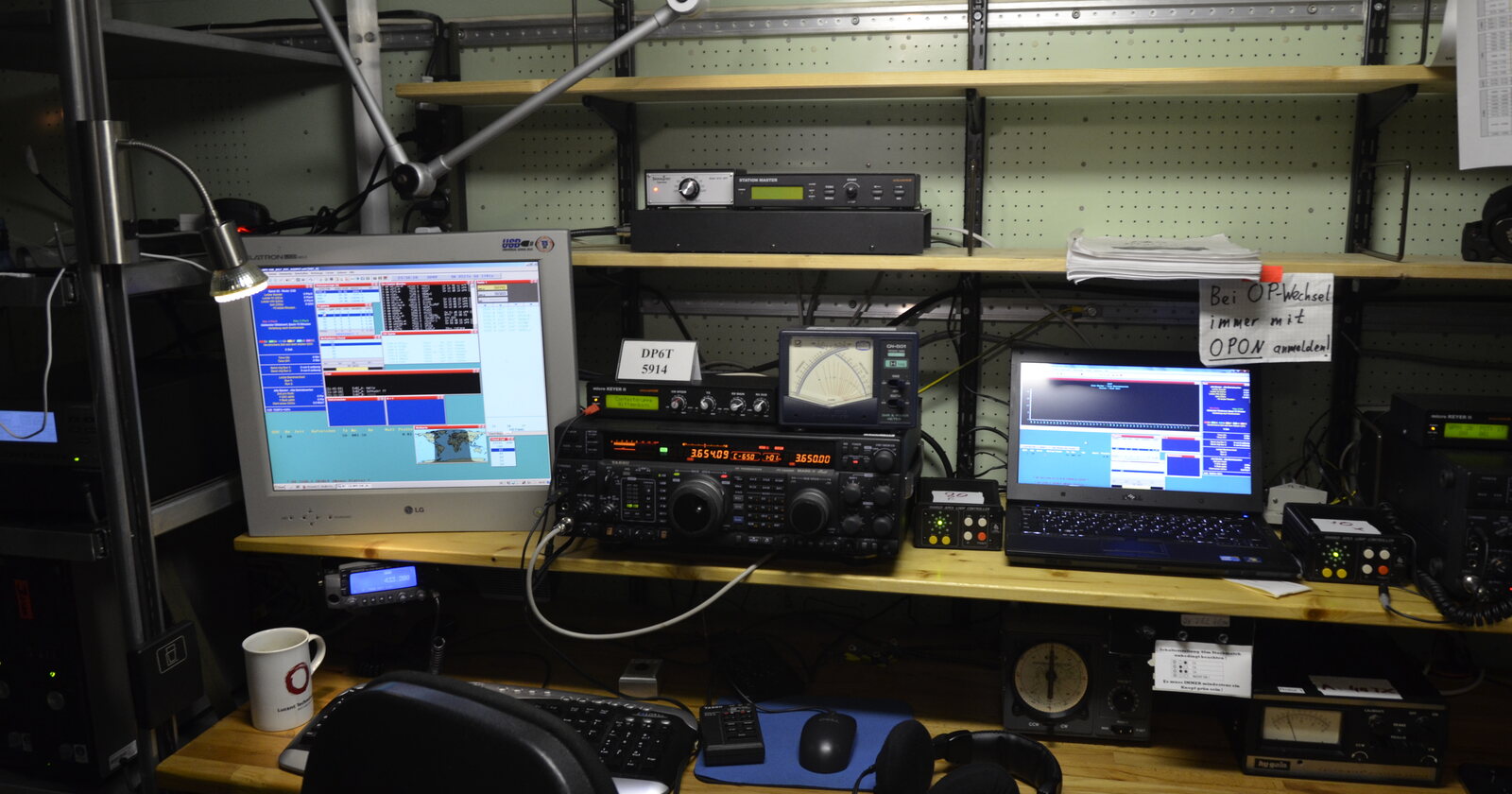
This article was researched and written with the support of AI (Claude, Anthropic). The content was reviewed by the oeradio.at editorial team and prepared for the Austrian amateur radio community. Title image: contest station DP6T, photo by Ptolusque, Wikimedia Commons, CC BY-SA 4.0.