Table of Contents
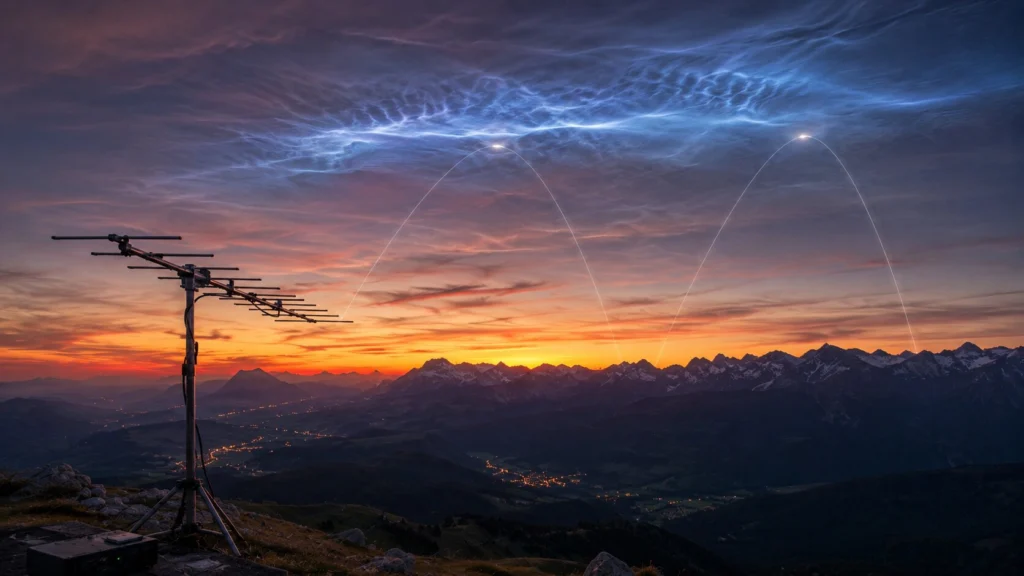
It happens suddenly and without warning: on the 6 m band, stations from 1,500 km away appear at S9+ — and a few minutes later, everything's gone. Welcome to the fascinating world of Sporadic E propagation (Es). What's routine on shortwave — ionospheric reflection — becomes a rare and exciting phenomenon on VHF, enabling DX contacts on 6 m and occasionally even on 2 m.
What is Sporadic E?
Sporadic E (Es) refers to the appearance of thin, highly ionised layers in the E region of the ionosphere, typically at 90–120 km altitude. These "clouds" of concentrated electron density form spontaneously and can reflect radio signals that would normally pass through the ionosphere — including VHF frequencies up to 150 MHz and in rare cases even higher.
Unlike the regular E layer (which disappears at night) and the F layer (responsible for HF propagation), Es layers appear unpredictably, last minutes to hours, then vanish. The exact formation mechanisms are still not fully understood — wind shear in the mesosphere and meteoric metal atoms (mainly iron and magnesium) play important roles.
When Does Sporadic E Occur?
Sporadic E has a clear seasonal pattern:
- Main season: May to August — with a clear peak in June and July
- Secondary season: December to January — much rarer and shorter
- Time of day: Morning (8–12 local) and afternoon/evening (16–22) are most active
- Independent of solar cycle: Unlike F-layer propagation, Es barely correlates with solar activity. It occurs equally during solar maximum and minimum
Sporadic E on 6 m (50 MHz)
The 6 m band is the "Magic Band" — and Sporadic E is the main reason. On 50 MHz, Es is the most common form of beyond-line-of-sight propagation. Typical Es openings on 6 m: range of 800–2,300 km per hop, often extremely strong signals (S9+ is common), lasting minutes to several hours, and occurring almost daily in the main season. Multi-hop can enable contacts over 4,000+ km.
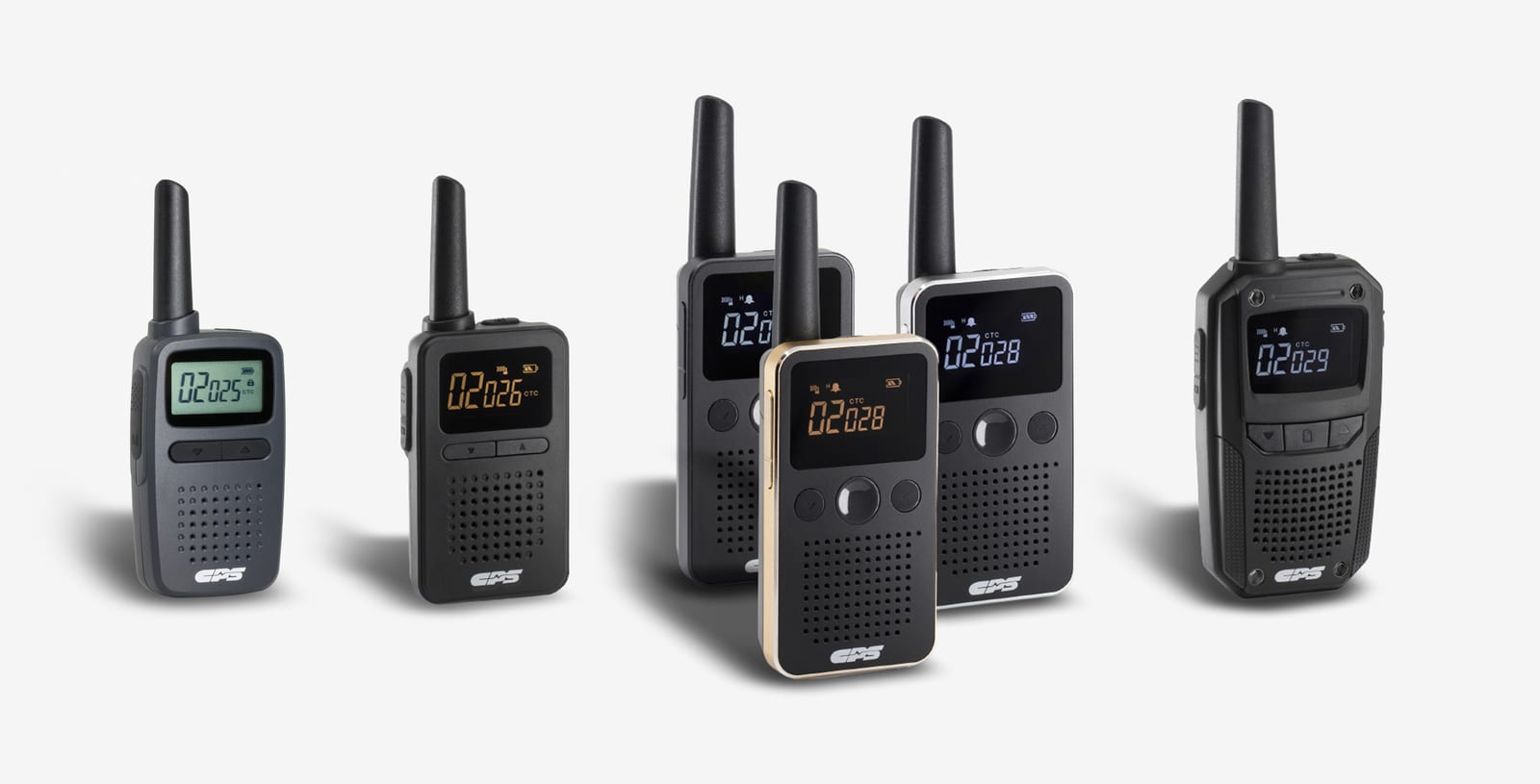
Getting started on 6 m requires just a transceiver with 6 m capability (e.g. Icom IC-7300, Yaesu FT-991A, or the 10 m band plus 6 m extension available on many radios) and a simple dipole or small Yagi.
Sporadic E on 2 m (144 MHz)
On the 2 m band, Sporadic E is significantly rarer but all the more spectacular. The ionisation density must be extremely high to reflect signals at 144 MHz. When it happens: range of 1,000–2,000 km, usually lasting only minutes (sometimes just 2–5 minutes), perhaps 5–15 days per summer in Central Europe, but signals can be surprisingly strong.
2 m Sporadic E is the holy grail of VHF DX. Being at the radio during those critical minutes allows logging QSOs that would otherwise only be possible via EME (Earth-Moon-Earth) or meteor scatter.
How to Spot an Es Opening
Es openings come suddenly, but there are warning signs:
- Watch DX Cluster: Spots on 50 MHz are the first indicator
- FT8 on 50.313 MHz: The FT8 frequency on 6 m is the most sensitive indicator — weak signals from unusual directions show an emerging opening
- PSK Reporter and WSPRnet: Real-time maps instantly show when unusual propagation paths are active
- Scan the FM broadcast band (88–108 MHz): If foreign stations suddenly appear, Es is likely active on 2 m too
- Es maps: Websites like DXMaps.com show active Es reflection zones in real time
Operating During Sporadic E
Since Es openings are often brief, speed counts. FT8 is the standard mode on 6 m during Es — fast, efficient, works with weak signals (50.313 MHz). SSB is preferred during strong openings for faster exchanges (50.110 MHz DX calling frequency). On 2 m during Es: SSB on 144.300 MHz, FT8 on 144.174 MHz — every second counts.
Tip: Keep your station ready. Antenna pre-tuned to 6 m, FT8 running in the background, phone alert for DX Cluster spots on 50/144 MHz.
Equipment for Es DX
For 6 m Es, you don't need a high-end station: any modern HF transceiver with 6 m, a simple dipole or 3-element Yagi, and 50–100 W. During strong openings, even 5 W QRP works. For 2 m Es, invest more: a horizontal Yagi (4+ elements), an SSB/CW-capable VHF transceiver, and a preamplifier.
Sporadic E vs. Other VHF Propagation
Beyond Sporadic E, other VHF DX mechanisms exist:
- Tropospheric ducting: Through inversions, mainly in autumn high pressure. Range: 300–1,500 km, lasting hours to days
- Meteor scatter: Reflection off ionised meteor trails. Range: 1,000–2,200 km, lasting fractions of seconds. Works year-round
- EME: Moon reflection — any distance, but large antennas and high power needed
- Aurora: Reflection off auroral curtains — distorted signals, mainly from Northern Europe
Sporadic E is unique among these for its often extremely strong signals and the comparatively simple station needed.
Sporadic E and Contests
Many VHF contests are deliberately placed in the Es season. The ARRL June VHF Contest, CQ WW VHF Contest, and numerous regional VHF contests take place in May–July — hoping for Es openings to fill the logs.
Conclusion: Summer Belongs to the Magic Band
Sporadic E makes the 6 m band the most exciting band in amateur radio — unpredictable, intense, and accessible to everyone. Anyone with a 6 m transceiver and a simple dipole in summer will be rewarded with DX contacts that would be routine on HF but are an experience every time on VHF. And if you're lucky enough to catch 2 m Sporadic E — you'll be talking about it for years.
73 – your oeradio.at editorial team
Transparency Notice
This article was researched and written with the assistance of AI (Claude, Anthropic). Any illustrations used were generated with AI (ChatGPT/DALL·E, OpenAI) unless otherwise noted. The editorial team has reviewed and edited all content. Despite careful review, occasional inaccuracies may occur — we welcome corrections via email to [email protected].