Table of Contents
- Why CW still matters in 2026
- The right key – and how to use it
- Prosigns, Q-codes and abbreviations
- The RST system in CW
- A real CW QSO
- CW in contests: speed, technique, tools
- SOTA, POTA and QRP: CW in the field
- Practical tips from experienced CW operators
- Listening and head copy
- QSO craft
- Pile-up and contest
- Learning CW – where to start?
- A piece of radio history
- Conclusion
- Further sources
- Transparency Notice
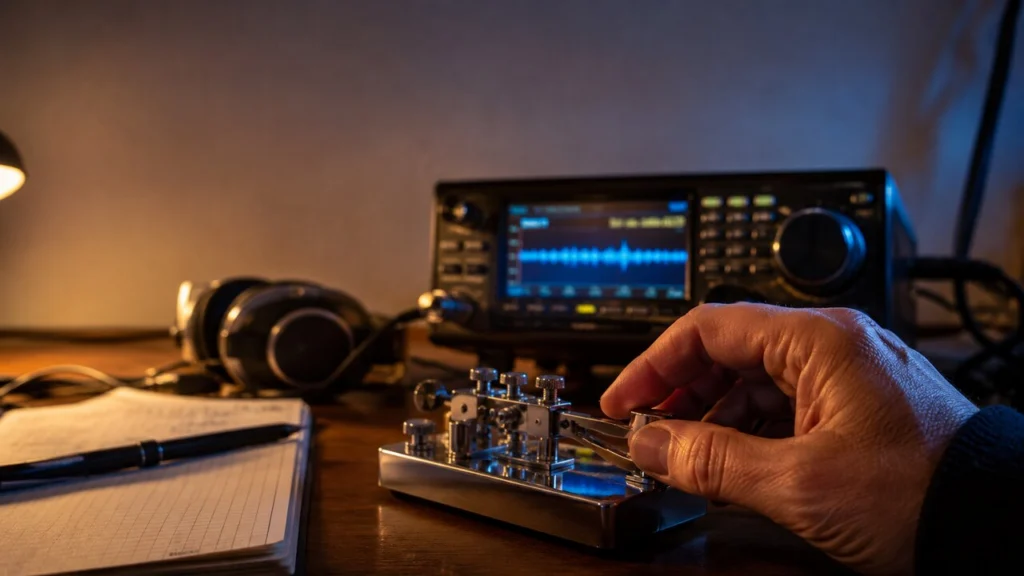
CW – telegraphy in Morse code – is the oldest mode in amateur radio and at the same time one of the most alive. While other modes come and go, the plain little "dit-dit" has stubbornly held its place on the bands for more than a hundred years. This article is not about learning the characters – that is covered by our guide Learning CW in 2026 – but about operating in practice: keys, prosigns, RST, a real QSO, contest and SOTA operation, and above all the practical tips of experienced CW operators.
Why CW still matters in 2026
At heart, CW (Continuous Wave) is about as simple as it gets: a carrier is switched on and off, nothing more. That very simplicity is its strength. A CW signal occupies – depending on speed and keying – only about 100–200 Hz of bandwidth, while an SSB signal needs around 2.4–2.8 kHz. Because receiver noise is proportional to the filter bandwidth, a narrow CW filter (250–500 Hz instead of 2.4 kHz) yields a solid receive advantage of roughly 7–13 dB – very roughly a tenfold gain in effective power.
The often-quoted "20 dB" is more radio folklore: it only adds up if you also factor in that the trained ear can still decode Morse characters deep in the noise, where speech has long become unintelligible. The bottom line, though, is this: with 5 watts of CW you get through where 10 watts of SSB disappear long before. That makes CW the ideal mode for QRP operation and portable work – little power, simple equipment, big reach.

- Narrowband: many stations per kHz – crucial in pile-ups and contests
- Robust: gets through when speech drowns in QRM and QRN
- Frugal: no microphone, no SSB processing – ideal for battery and solar operation
- Cheap: a simple QRP transceiver and a key are all you need
- Universal: Morse is international – language barely matters in a QSO
The following German-language video shows CW operation in practice on the radio:
The right key – and how to use it
The key is the interface between the operator and the ether. Four designs dominate:
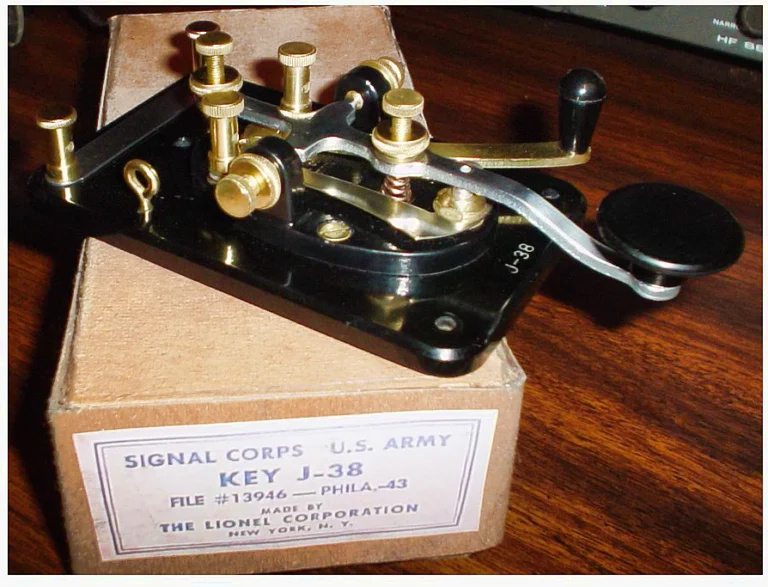
- Straight key: every dot and dash is formed by hand. Ideal for learning a clean rhythm, but limited to about 5–20 WPM.
- Paddle: does not key the transmitter directly but drives an electronic keyer, which produces perfectly timed characters. With a single-lever paddle only one contact is ever active; with a dual-lever/iambic paddle both can be closed at the same time – the keyer then automatically sends alternating dit-dah sequences. 20–40+ WPM is achievable.
- Bug (semi-automatic): the Vibroplex classic (patented 1904). A vibrating arm produces the dots automatically, while the dashes remain manual work – hence "semi"-automatic.
- Sideswiper (cootie): a horizontal lever, operated sideways, fully manual – easy on the wrist.
Iambic Mode A or B? The difference only shows up if you release both paddle levers simultaneously in the middle of a character sequence. Mode A finishes the element currently in progress and stops. Mode B adds one further, opposite element. If you never release both levers at the same time, you will not notice any difference – all that matters is that the keyer and the operator are "used to" the same setting.
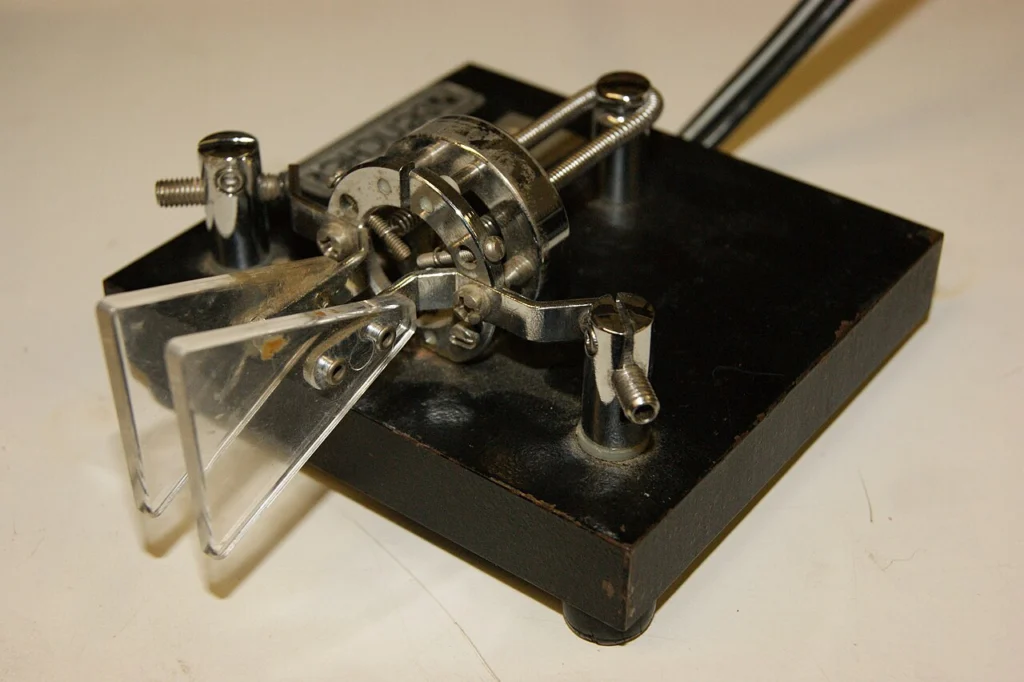
The timing is standardised: a dit is one time unit, a dah three; the gap within a character is one unit, between characters three, between words seven (the 1:3:3:7 scheme). The reference word "PARIS" is exactly 50 units long – from this, programs calculate the WPM speed. Clean spacing matters more here than raw speed (more on that below). This demonstration shows how to operate an iambic paddle correctly:
Prosigns, Q-codes and abbreviations
Prosigns (procedural signals) are letters run together without a gap – they steer the flow of the QSO:
- AR = end of message (equivalent to "+")
- BT = separator / new paragraph (equivalent to "=")
- K = "go ahead" – any station may answer
- KN = "go ahead, you only" – only the named station should answer
- SK = end of contact (also "VA")
- AS = please wait
- BK = "break" – quick changeover in the middle of a QSO
The classic beginner's mistake: confusing K and KN. K invites everyone; KN only the station you are currently working.
Common abbreviations: CQ (general call), DE (from / this is), R (received), UR (your), ES (and), HW (how do you copy me?), CPY (copy), FB (fine business – excellent), OM (old man, a fellow ham), YL (young lady, a female ham), TU/TNX (thanks), CUL (see you later), AGN (again), PSE (please), GM/GA/GE (good morning/afternoon/evening), HI HI (laughter), 73 (best regards), 88 (love and kisses).
Q-codes with a question mark are questions, without one they are statements: QRL? (is the frequency in use?), QRM (interference from other stations), QRN (atmospheric interference), QSB (fading), QSY (change frequency), QRS (send more slowly), QRQ (send faster), QRZ? (who is calling me?).
The RST system in CW
RST stands for Readability (1–5), Signal Strength (1–9) and Tone (tone quality 1–9). The Tone value only exists in CW – on phone you give only R and S. A modern transmitter practically always delivers a pure tone, i.e. T9; lower values would indicate hum, chirp or key clicks.
Example: "579" = easily readable, moderate strength, pure tone. In a contest, on the other hand, you almost always hear the famous "599" (keyed as "5NN") – a pure courtesy value, because the actual information (serial number, zone) follows immediately after. Experts shorten numbers (cut numbers): 9 → N, 0 → T, so "599" becomes "5NN".
A real CW QSO
A leisurely chat ("ragchew") and a contest QSO are two completely different worlds. First the relaxed sequence:
1. CQ call:
CQ CQ CQ DE OE0AAA OE0AAA OE0AAA K2. Answer:
OE0AAA DE OE0BBB OE0BBB K3. Report and introduction:
OE0BBB DE OE0AAA = GM OM TNX FER CALL = UR RST 579 579
= QTH KLAGENFURT = NAME FRED = HW CPY? OE0BBB DE OE0AAA KN
4. Ending the QSO:
OE0BBB DE OE0AAA = TNX FB QSO = 73 ES HPE CUAGN
OE0BBB DE OE0AAA SK
In a contest, by contrast, everything happens in a few seconds – no name, no weather, just the report and a serial number (or zone):
CQ TEST DE OE0AAA OE0AAA TEST
OE0BBB
OE0BBB 5NN 014
5NN 028
TU OE0AAA TEST
CW in contests: speed, technique, tools
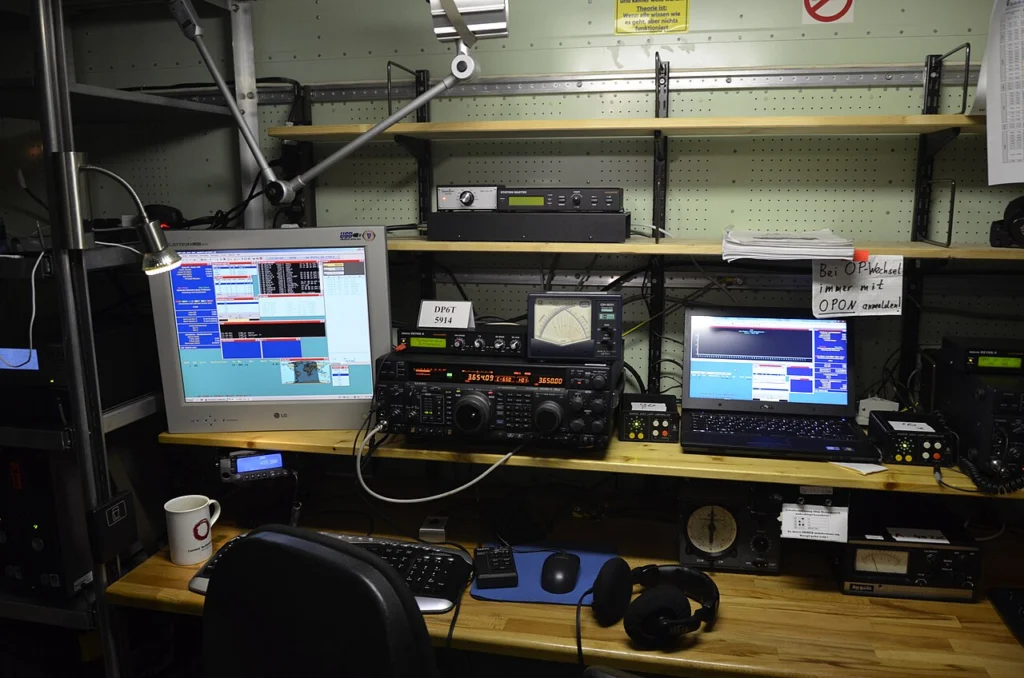
Hardly any mode dominates the contest scene like CW: narrow filters pack many stations into little bandwidth, and the characters get through even with the weakest signals. Top operators run at 25–40+ WPM. The keying is usually handled by the computer.
- N1MM Logger+ – the most widely used contest log, free (Windows); it generates CW automatically and drives the keying with precise timing through a Winkeyer (K1EL).
- Reverse Beacon Network (reversebeacon.net) – a worldwide network of automatic CW skimmers that reports every CQ call together with the callsign, frequency, speed and signal-to-noise ratio. Unbeatable for testing activity, propagation and your own antenna.
- CW Skimmer (by Alex Shovkoplyas, VE3NEA) – commercial software that decodes all CW signals in the passband simultaneously; it is the engine behind most RBN nodes.
- SO2R (Single Operator, Two Radios) – listening on one radio while the other transmits; but only ever one signal is sent at a time.
Important CW contests: CQ WW DX Contest CW (last weekend of November, report + CQ zone), CQ WPX CW (last weekend of May, report + serial number), ARRL International DX CW (third weekend of February), the weekly CWops Tests (CWT), as well as the events run by AGCW-DL such as the Handtastenparty (straight-key party) or the Deutscher Telegrafie Contest (DTC). If you want to experience the pace of a real pile-up:
SOTA, POTA and QRP: CW in the field
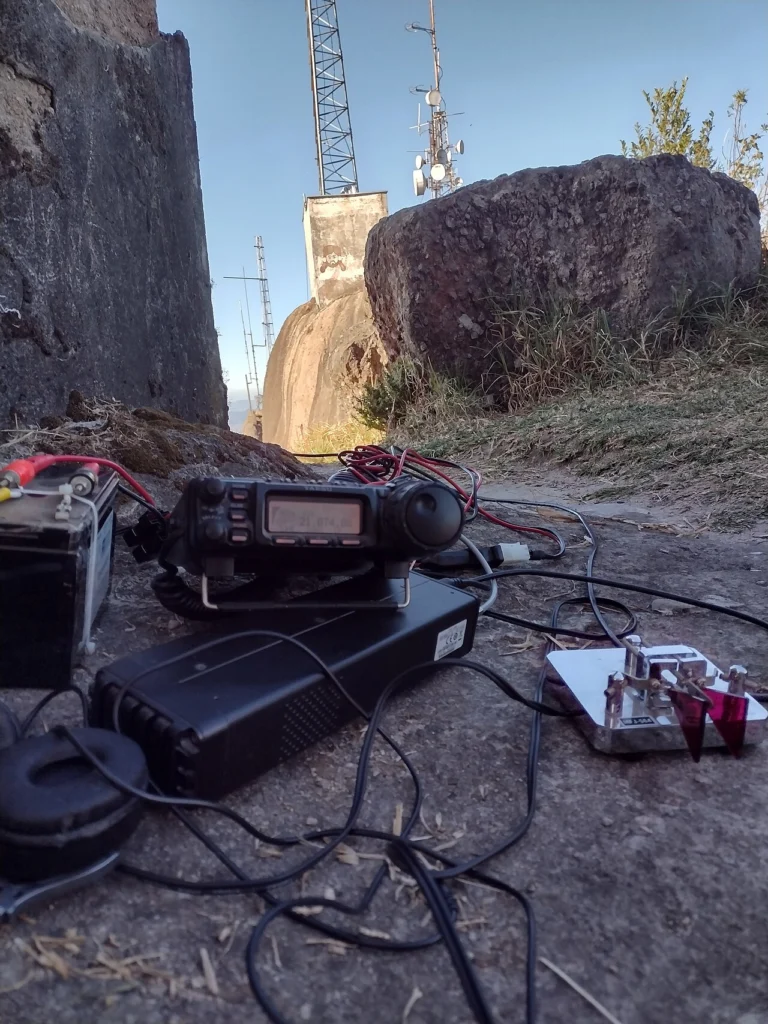
For mountain operating (SOTA – Summits On The Air) and in the parks (POTA – Parks On The Air), CW is the king of modes: with 5 watts and a makeshift antenna, the ~10 dB advantage makes the difference between "nothing works" and a full log. The kit stays light and power-efficient – a QRP transceiver, an EFHW antenna and a small paddle are enough.
The procedure is brief: the activator calls CQ SOTA DE <Call> K or CQ POTA …, and the report is exchanged (for SOTA the location as well). Unlike in a contest, the reports here are often honest – a "339" is no disaster. Important: send QRL? before calling, and in a pile-up do not call exactly on the activator's frequency but slightly offset, so that the callers separate audibly.
More on this: QRP operation: around the world on 5 watts, The best portable antenna for SOTA and POTA and Field Day: taking part successfully.
Practical tips from experienced CW operators
The following tips do not come out of thin air, but from the standard works and from well-known CW operators – above all William G. Pierpont (N0HFF), "The Art and Skill of Radio-Telegraphy", and Carlo Consoli (IK0YGJ), "Zen and the Art of Radiotelegraphy" (both free, see sources).
Listening and head copy
- Learn each character as a sound, never as dots and dashes. "dah-di-dit … dah-dah-dah … dah-dah-dit" should immediately trigger "DOG" – no inner transcription (K7QO/AC6V, ARRL; KB6NU).
- Copy behind the signal. Let your brain buffer one or two words and write them down while you are already hearing the next ones – this takes away the frantic pressure of keeping up letter by letter (Pierpont, N0HFF).
- Simply skip what you missed. "Anyone who puzzles over a single character for even a second misses the next one." Leave a gap, keep listening – with practice the gaps fill themselves in (Pierpont, N0HFF).
- Plateaus are normal. Around 15, 20 and 30 WPM progress stalls – the biggest plateau is the jump from writing things down to head copy. "Training harder achieves nothing. Do a few minutes of QSOs a day and you will overcome the barrier by yourself." (Consoli, IK0YGJ)
- Practise briefly but daily. Consoli advises no more than 15 minutes a day, at the same time, in the same relaxed place – Pierpont warns: never so long that fatigue or boredom sets in.
- Relax. Tension is the enemy – "anything that creates tension hinders learning." Sit loosely, breathe calmly, relax your shoulders (Pierpont; Consoli).
QSO craft
- Accuracy beats speed. The motto of the FISTS CW Club sums it up: "Accuracy transcends speed" – and "Courtesy at all times".
- Spacing matters as much as the characters themselves. Clean spacing between letters and words determines readability – and becomes even more important as speed increases (Pierpont, N0HFF).
- Always come down to the slower operator. Never send faster than your counterpart – "match the speed of the slower operator, even if that means just 10 characters per minute." (FISTS; Consoli)
- Made a mistake? Correct it calmly. For a sending error give eight dits ("HH") or a "?", repeat the botched word – and then carry on unflustered, without panicking (Pierpont, N0HFF).
- Honest reports instead of a reflex 599. Away from contesting in particular, the report may reflect reality – and announce your fields ("RST … QTH … NAME …") (N0IP; POTA CW Guide).
Pile-up and contest
- Listen first, then call. The "DX Code of Conduct" puts it plainly: "I will listen, and listen, and then listen again before calling" – only call if you are copying the DX station cleanly, give your full callsign once and then leave an appropriate pause, rather than calling continuously.
- Don't zero-beat exactly in a pile-up. Set yourself about 20–100 Hz off the activator's frequency with RIT/XIT, otherwise all callers merge into a single, undecodable tone (POTA CW Guide).
- Match the running station's speed when you call. Call confidently at 30–35 WPM if the other station is that fast – it will copy you with no trouble and works fast, clean callers first (VE3VN).
Learning CW – where to start?
Practical operating only becomes fun once the characters are second nature. How best to learn CW today – with the Koch/Farnsworth method, apps, web tools and AI – is covered in detail in our guide Learning CW in 2026. The communities are a great help too: CWops with its free CW Academy, the beginner-friendly FISTS CW Club, the SKCC (Straight Key Century Club, mechanical keys only), the German AGCW-DL, and in Austria the OE-CW-G (Österreichische CW Group, the ÖVSV's CW section since 1997).
A piece of radio history
Samuel Morse and Alfred Vail first demonstrated telegraphy in 1838; the international Morse code still in use worldwide today was set down by the International Telegraph Convention in Paris in 1865. The term "CW" – Continuous Wave – arose to distinguish the undamped continuous oscillations of valve transmitters from the earlier, broadband spark-gap transmitters; damped waves were even banned in 1934. The Morse test as a requirement for a shortwave licence was dropped after the 2003 World Radiocommunication Conference – in Austria on 26 November 2003. What remains is CW as a voluntary, living mode with a large community.
Conclusion
CW is no museum piece but a living, practised mode: narrowband, robust, frugal and international. Getting started costs little – a key, a simple transceiver, a bit of patience. The reward is a mode that gets through when others give up, and a worldwide community that puts accuracy and courtesy above raw speed. Or, in the words of the CW operators: Accuracy transcends speed.
Further sources
- William G. Pierpont (N0HFF): The Art and Skill of Radio-Telegraphy (free standard work, PDF)
- Carlo Consoli (IK0YGJ): Zen and the Art of Radiotelegraphy (free, PDF)
- FISTS CW Club – Operating and the DX Code of Conduct
- Reverse Beacon Network · POTA CW Guide · OE-CW-G (Österreichische CW Group)
73 – your oeradio.at editorial team
Transparency Notice
This article was researched and written with the assistance of AI (Claude, Anthropic); all technical details, sources and quotations were verified against the cited original sources. The photos used are from Wikimedia Commons under free licences (author and licence given in each caption). All content has been reviewed by the oeradio.at editorial team and prepared for the amateur-radio community. Feedback welcome at [email protected].