Table of Contents
- What Is EMC?
- The Most Common Interference Sources
- Identifying Interference
- SDR as an Interference Analyser
- Eliminating Interference
- Ferrite Cores and Snap-on Ferrites
- Common-Mode Chokes (Baluns)
- Grounding and Bonding
- When Your Station Causes Interference
- Legal Situation in Austria
- EMC Checklist for the Shack
- Transparency Notice
EMC — Electromagnetic Compatibility — is one of the biggest practical topics for radio amateurs. Whether the S-meter on 40 m constantly reads S7 with nobody transmitting, the neighbours complain about TV interference, or a new LED lamp contaminates all of HF: EMC problems are ubiquitous. The good news: with a systematic approach, most interference can be identified and eliminated.
What Is EMC?
EMC describes the ability of electrical devices to function without interference in their electromagnetic environment while not disturbing other devices. This covers two sides: emission (a device generates unwanted electromagnetic energy) and immunity (a device is sensitive to electromagnetic fields). Radio amateurs stand on both sides — as victims (reception interference from external sources) and potential causers (transmissions can disturb sensitive electronics).
The Most Common Interference Sources
- Switching power supplies: By far the most common source in modern households. Every USB charger, laptop adapter, and LED power supply operates with switching frequencies of 50-200 kHz and generates harmonics reaching well into the UHF range.
- LED lamps: LED bulbs with cheap switching power supplies are notorious for their interference radiation. Some models raise the noise floor on HF by 20-30 dB.
- Powerline/PLC (DLAN): Powerline adapters (internet over mains wiring) use frequencies up to 86 MHz — right through the HF and VHF range. The mains wiring becomes an antenna radiating broadband interference.
- Solar inverters: With the PV boom, interference from solar inverters is increasing. Switching frequencies and MPPT tracking generate harmonics audible on HF.
- Other sources: Defective insulators on power lines, electric fences, heating controllers, unshielded Ethernet cables, plasma TVs, USB 3.0 devices and cables (known for 2 m interference).
Identifying Interference
Systematic approach:
- Assessment: Which frequencies are affected? Is it broadband or narrowband? Continuous or periodic?
- Time correlation: Does it occur only at certain times? (Night = street lighting? Day = solar system? Constant = power supply?)
- Exclude your own devices: Switch off the main breaker (battery operation!) — if interference disappears, it comes from your own household.
- Check individual circuits: Switch on breakers one by one until interference returns — this identifies the circuit.
- Direction finding: Use a directional antenna or portable receiver to determine the direction. An RTL-SDR with a small directional antenna is an excellent tool for locating interference.
SDR as an Interference Analyser
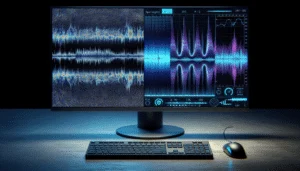
An SDR receiver like the RTL-SDR or HackRF is an invaluable EMC analysis tool: broadband waterfall shows all interference at a glance, harmonics from switching supplies appear as evenly spaced lines, and it’s portable for tracking interference to its source.
Eliminating Interference
Ferrite Cores and Snap-on Ferrites
The most important tool against common-mode interference. Ferrite cores are placed around cables to attenuate interference currents flowing on cable shields:
- Material 31 (MnZn): Effective from 1 to 300 MHz — the all-rounder for HF and VHF
- Material 43 (NiZn): Effective from 25 to 300 MHz — ideal for VHF/UHF
- Material 61 (NiZn): Effective from 200 MHz to 2 GHz — for UHF and microwave
Important: Multiple turns through the ferrite core increase attenuation quadratically — 3 turns provide 9 times the attenuation of a single turn.
Common-Mode Chokes (Baluns)
At the antenna feed point, common-mode chokes prevent RF currents from flowing back on the outer shield of the coaxial cable. Without a choke, the station can cause EMC problems in its own household. For EFHW antennas and vertical antennas, common-mode chokes are particularly important.
Grounding and Bonding
Good RF grounding significantly reduces interference: single-point ground for all shack equipment, short ground leads (under 1/20 wavelength), wide copper strap instead of thin wire, and a ground rod near the shack window.
When Your Station Causes Interference
- TVI: Harmonics of the transmitted signal interfere with neighbours’ TV reception. Solution: low-pass filter at the transmitter output.
- Router/WiFi interference: RF ingress into routers and smart home devices. Solution: ferrite cores on all connecting cables.
- Audio hum: RF ingress into audio amplifiers. Solution: common-mode choke at antenna output, ferrite cores on speaker cables.
- Intermodulation: Spurious products generated in the transceiver. Solution: clean antenna with good SWR (check with NanoVNA), low-pass filter, no loose contacts.
Legal Situation in Austria
In Austria, the RTR (Rundfunk und Telekom Regulierungs-GmbH) handles EMC matters. The Telecommunications Act (TKG 2021) and the EMC Act (EMVG) set requirements. All electrical devices must comply with EMC Directive 2014/30/EU (CE marking). Complaints can be filed with RTR, and the telecommunications authority can conduct on-site measurements and prohibit operation of interfering devices.
Practical tip: before taking the official route, always try talking to the neighbour first. Often an interference problem can be resolved amicably — a ferrite core on the offending device’s power cable or a better power supply frequently solves the problem for both sides.
EMC Checklist for the Shack
- Common-mode choke on every coax cable at the antenna feed point
- Low-pass filter at the transmitter output for each band
- Ferrite cores on all cables leaving the shack (mains, USB, audio, Ethernet)
- RF ground with short, wide copper strap
- Check SWR: Antennas with SWR > 2:1 create unnecessarily high RF fields in the shack
- Shielded cables: Cat 6/7 instead of Cat 5, shielded USB cables
- Mains filter at the shack entrance
- Test LED lamps: Check interference emissions before buying
EMC is not rocket science — with systematic approach, the right tools, and some ferrite, most interference can be solved. The effort is worth it: an interference-free shack makes radio operation on all bands a pleasure.
73 – your oeradio.at editorial team
Transparency Notice
This article was researched and written with the assistance of AI (Claude, Anthropic). The editorial team has reviewed and edited all content. Despite careful review, occasional inaccuracies may occur — we welcome corrections via email to [email protected].