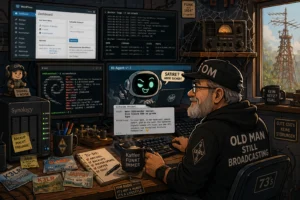
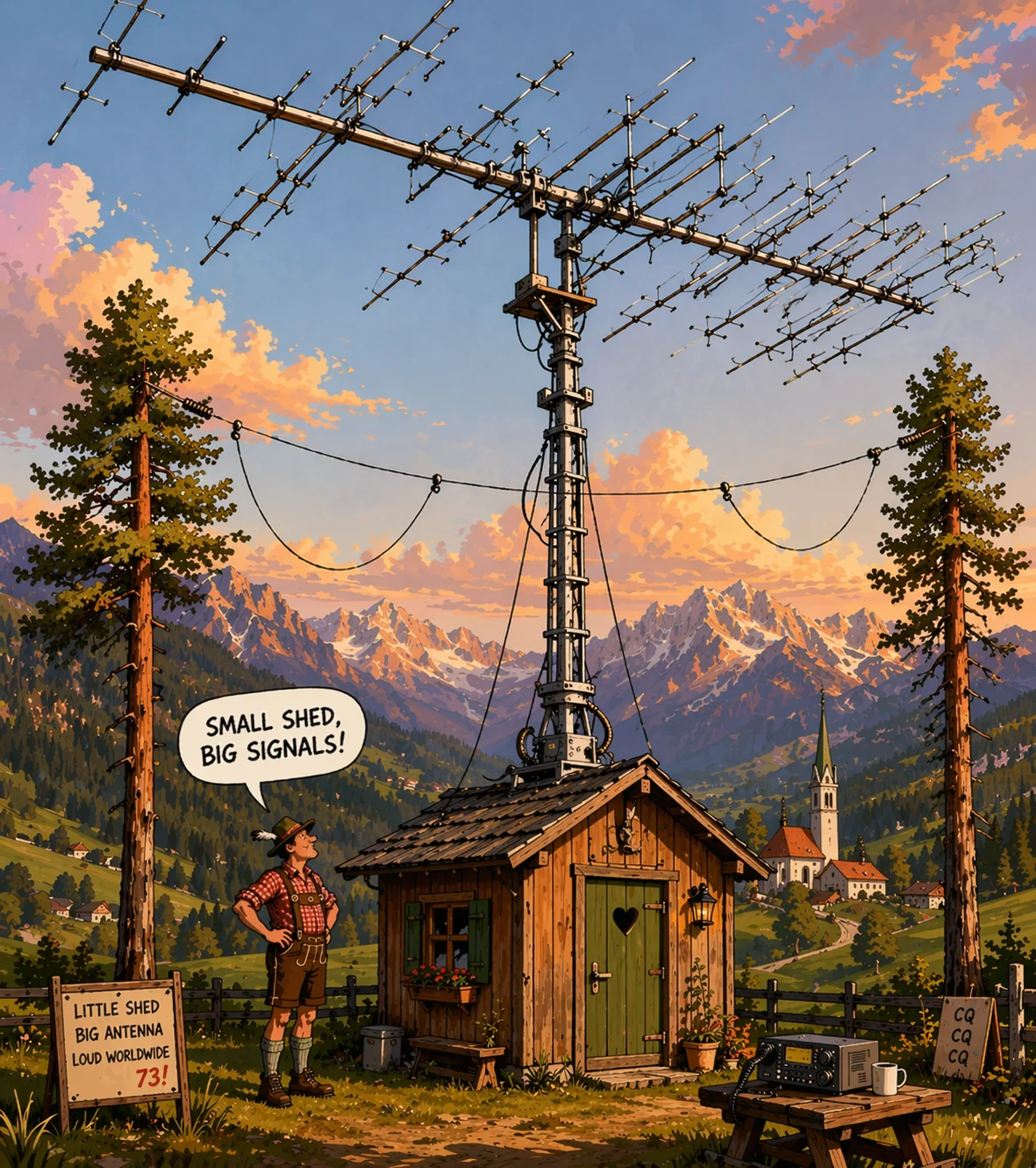
There are radio amateurs who are humble. And then there’s Rudi. Rudi is not humble. Rudi is the best. He knows it. His QSO partners know it. Everyone who has ever landed on his regular frequency knows it. Your Hansl listened in. And laughed. And then listened again.
Rudi: The Man Who Has Everything
Rudi has been licensed for 40 years. He mentions this in every QSO. Every QSO starts with: “Yes, I’ve been at it for over 40 years now, hi.” This is followed by a recital of his station that sounds like a brochure from every major manufacturer simultaneously. Rudi only buys the best. Always the most expensive. Always the flagship. And when a new flagship appears, the old one doesn’t go up for sale — it becomes the second rig. Or the third. Rudi’s shack has more transceivers than some club stations.
And the antennas! Rudi has Yagis. Several. On a tower that looks like it needed planning permission and probably got it — or possibly didn’t. Plus a linear amplifier that tests the neighbour’s circuit breaker every time it’s switched on. Rudi’s garden looks like a NATO listening post. The neighbours have stopped asking.
The remarkable thing: Rudi didn’t build any of this himself. Rudi’s equipment gets delivered. Rudi’s connectors get soldered on-site by others. Rudi’s antennas were put up by helpful OMs. Rudi himself has never held a soldering iron. He owns a brand-name multimeter — still in its original packaging. For an estimated 15 years. He has never switched it on. Why would he? “My station works. Measuring is for people who have problems. I don’t have problems, hi.”
Rudi doesn’t have problems. Rudi has neighbours. And club colleagues. They have the problems. Rudi’s problems, to be precise.
The Modulation Reports: Rudi’s Speciality
Rudi gives every QSO partner a modulation report. Whether they asked for one or not. The pattern is always the same:
“Well, your modulation isn’t bad, hi. But I have to tell you: a bit muddy. Missing the highs. You know, with my setup — with my headset and my rig — everything sounds crystal clear. My station gets compliments from all sides. But yours — you could work on that, hi hi.”
But before the modulation report comes the question. The question everyone in the round knows. The question that makes everyone roll their eyes: “So tell me, what rig are you running? And what antenna?”
Woe to anyone who names a budget rig. Berndt once mentioned his transceiver. Rudi’s response came faster than a CW dit: “Aaah, right. Well, with that rig — no wonder, hi. That’s an entry-level box. No dynamics. Once you get a proper receiver, you’ll hear the difference, hi hi.”
And the antenna! If anyone says “vertical” or “wire antenna”, Rudi flinches like he’s touched a short circuit. “A vertical? Well, no wonder then, hi. With a vertical you only hear half. With my Yagi — there’s silence in the receiver, hi hi.” The fact that Kurt has been happily operating with his homebrew ground plane for ten years doesn’t interest Rudi. “Happy” is Rudi’s word for “given up”, hi.
FT8: Rudi’s Nemesis
When someone in the round mentions FT8, Rudi turns a colour reminiscent of a blown valve. “FT8? That’s not amateur radio, hi! It’s computer-controlled! They let the computer operate and go to bed!”
Rudi’s tirade against FT8 regularly lasts twelve minutes. Without pause. Without releasing the PTT. Without noticing that half the round is now using exactly that mode — and working more DX at 5 watts than Rudi does with his amplifier on SSB.
Rudi’s worldview is simple: amateur radio is SSB and CW. Full stop. “Everything else is toys, hi. I do DX in phone and CW. Like a real radio amateur, hi hi.”
Rudi’s DX: 280 Countries, One Language
Rudi talks a lot about DX. According to Rudi, he has “over 280 DXCC confirmed”. The logbook is full. Worldwide. Impressive. At first glance.
At second glance, something stands out. Rudi’s DXCC list has a pattern. And the pattern is: German. In every DXCC entity sits a German-speaking radio amateur — an emigrated Austrian here, a retired engineer from Germany there. Every single contact is arranged. By email, by WhatsApp, by Telegram. Sked at 22:00, you call CQ, I answer. And then Rudi operates with Günther in São Paulo — in German.
Afterwards in the round: “Just worked PY2. Brazil. Amazing propagation, hi.” Not a word about Günther originally being from Stuttgart or the “propagation” being arranged via WhatsApp.
Because Rudi’s darkest secret is: Rudi can’t speak English. Not “a little bit”. Rudi can say “CQ” and “five nine” and “seventy-three”. Anything beyond that triggers a panic response. And hence the skeds. Finding 280 German-speaking radio amateurs worldwide and coordinating a sked with each one — that’s not DX. That’s project management, hi.
Sepp once said in the round: “Rudi, you have 280 DXCC but you speak to the whole world in German. That’s like saying you’ve eaten in 50 countries — but always at the Austrian restaurant, hi.”
Sepp has a wire antenna and 100 watts. And speaks fluent English. And last week worked a station from Bhutan in the pile-up. No sked. No WhatsApp. In English. But he doesn’t tell Rudi. Because it would be pointless. Hi.
“You’ll Learn That Too Someday”
The remarkable thing about Rudi is his consistency. No matter what the topic — Rudi has it better. Rudi’s station is better. Rudi’s antenna is better. Rudi’s modulation is better. Rudi’s reports are better. Rudi’s hearing is better. Rudi’s logbook is fuller.
When Kurt mentions he worked a rare station with his vertical and 100 watts, Rudi goes quiet briefly. Then he says: “Yes, I had him last week too, hi. Nothing special with my station. But with a vertical — you got lucky, hi. Just wait until you get a proper antenna.”
When someone mentions SOTA, Rudi says: “SOTA, that’s for the young ones, hi. I do my DX from the shack. Nice and comfortable. With coffee. And a proper amplifier, hi hi hi.”
And at the end of every piece of advice nobody asked for comes Rudi’s favourite sentence: “You’ll learn that too someday, hi.” Whether you’ve been licensed for 5 years or 30. Whether you know ten times more than Rudi — he has the more expensive station. And that’s enough. Hi.
Epilogue: Rudi Calls CQ
Every evening, Rudi sits in front of his flagship transceiver. The amplifier hums softly. The rotator turns the Yagi. Rudi presses the PTT.
“CQ CQ CQ, this is OE…, looking for DX…”
The CQ call lasts four and a half minutes. Including a complete station description. When nobody answers, Rudi says in the next round: “The band was dead, hi. No propagation. With my station, it can’t be the signal, hi hi.”
And somewhere, an OM with a wire antenna and 100 watts turns the VFO dial and sighs: “Rudi again, hi.”
But he answers anyway. Because that’s what you do. Because Rudi is a character. And because Rudi, for all his quirks, has one thing: endurance. And an amplifier. And a Yagi. And a microphone he’s been speaking the same sentences into for 40 years.
“59+20, nice signal, hi. Yes, I’m only running very little power, hi hi hi.”
The Moral of the Story
- Anyone who calls their amplifier “low power” has a different relationship with physics than the rest of the world.
- 280 DXCC in German isn’t DX — it’s a pub quiz with roaming, hi.
- If you can’t solder, you can still operate. But you should stop giving others advice on station engineering.
- Anyone who demonises digital modes is usually afraid that 5 watts of FT8 reaches further than their kilowatt on SSB. Hi.
- Learning English is not a disgrace. Maintaining sked lists to avoid speaking English — that’s effort better invested in a language course. Hi.
- And anyone who tells every round they’re the best is usually worried the others won’t notice on their own. Hi hi hi.
73 and less power,
your Hansl Hohlleiter, OE0HHL
Transparency Notice
This article is satire. Rudi Röhre and all persons mentioned are entirely fictional. Any resemblance to actually existing radio amateurs who happen to call their amplifier “low power” and whose cables were exclusively soldered by others is, naturally, purely coincidental — but statistically inevitable, because every round has at least one Rudi. This article was written with the assistance of AI (Claude, Anthropic) and reviewed by the oeradio.at editorial team.