A Störsender satire by Hansl Hohlleiter
Eberhard Ehrenamt, OE0EBA, is deputy secretary of the local chapter, advisory member of the regional technical committee (non-voting), and for three years now the acting coordinator for repeater allocation in the district — a position he created himself and whose necessity nobody else recognises. His business card — yes, he has one — lists four roles. His callsign is at the bottom. In small print.
Eberhard doesn't operate. When asked, he replies: "I'm so involved in club administration that there's unfortunately little time for operational activities." Operational activities. That's what Eberhard calls what others call "radio". He's developed a language that transforms every simple activity into a bureaucratic procedure. A QSO is a "bilateral radio traffic event". An antenna is "radiation infrastructure". And when someone fires up the barbecue at field day, that's "catering logistics".
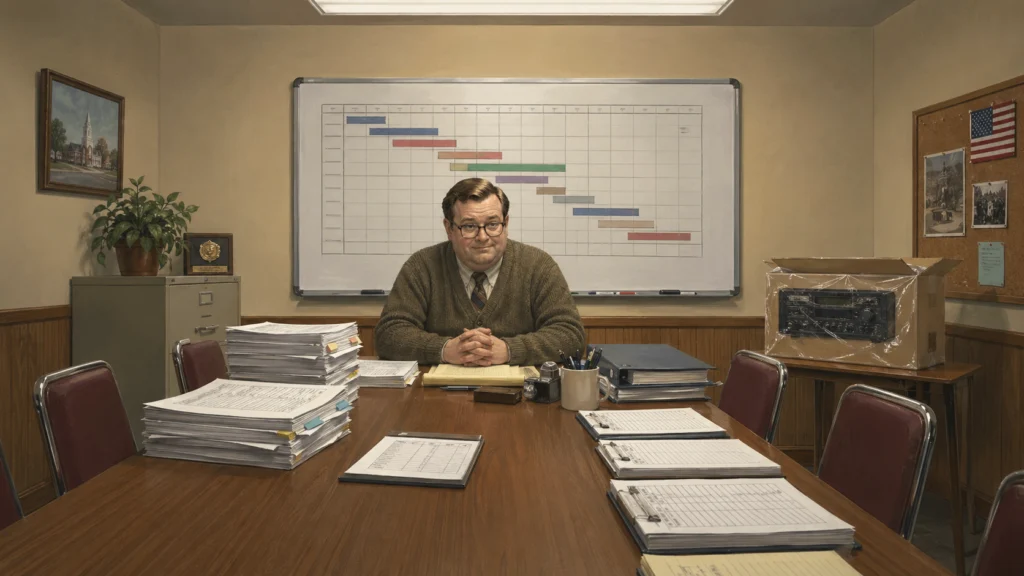
Erwin's shack technically exists. There's an IC-7300, still in its original packaging, bought four years ago. The screen protector is still on the display. "I'm waiting for the right antenna situation," says Erwin. The right antenna situation has been waiting for four years. The transceiver has exactly zero operating hours. But it's listed in his club inventory as a "reference device for training purposes".
What Eberhard can do — and credit where it's due — is organise. He organises meetings. He organises agendas for meetings. He organises pre-meetings to prepare for meetings. He once called a meeting to discuss whether meeting frequency should increase from monthly to every three weeks. The motion was defeated — by one vote. Erwin's vote was against. He wanted weekly.
Erwin's most important document is the club's bylaws. He wrote them himself. Thirty-two pages. The club has eleven members. Article seven governs the voting procedure in case of disagreement over the drinks order at the annual general meeting. Article twelve defines the responsibilities of the "Digital Communications Officer" — a role Eberhard also fills. His digital communication consists of sending round-robin emails in CC instead of BCC and changing the club website password once a quarter without telling anyone.
Eberhard also has a position on youth outreach. He's in favour. In principle. In theory. He once drafted an "Action Plan Youth Engagement" — eight pages, three phases, a Gantt chart. Phase one: needs assessment. Phase two: concept development. Phase three: implementation. The action plan has been in phase one for two years. The needs assessment consists of a questionnaire Eberhard designed but never distributed because "the data protection framework needs to be clarified first".
At field days, Eberhard stands beside the tent and supervises. He doesn't operate, doesn't log, doesn't set up. He stands there with a clipboard and checks whether everything is proceeding "properly". Last year he interrupted a vertical antenna installation because the ground stake wasn't in the position he'd approved. The approved position was three metres to the left. The difference: none. But the approval — that was important.
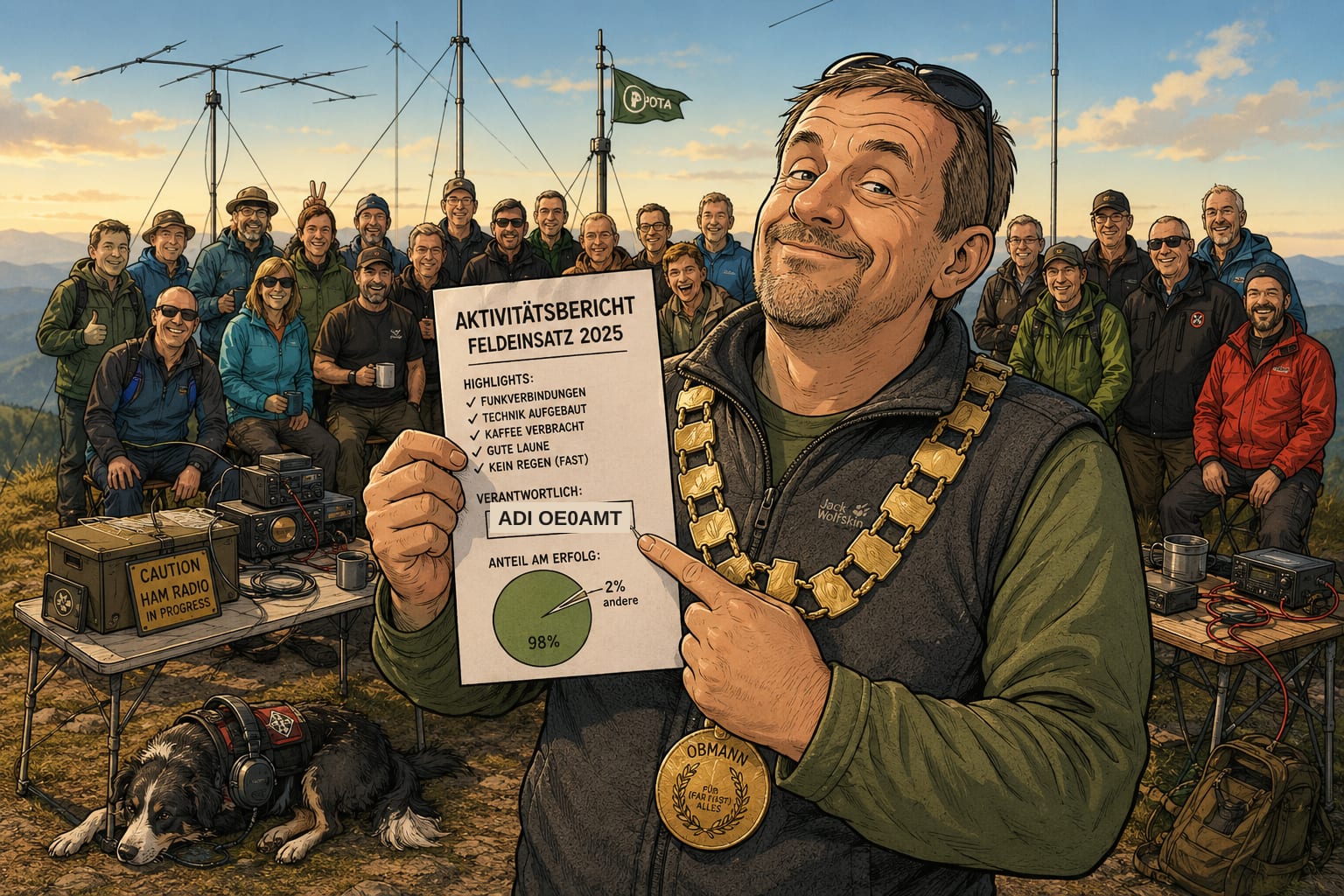
What Eberhard doesn't see: the others operate despite him, not because of him. They meet on the frequency, not in his meetings. They build antennas in the garden, not in his Gantt charts. They activate summits while Eberhard writes minutes. The club lives — but not in the thirty-two pages of his bylaws. It lives on the bands. Where Eberhard never is.
Eberhard's leadership style follows the principle of bureaucratic Mikado: whoever moves first, loses. If there's a problem — a broken repeater, a conflict between members, a complaint about the club website — Eberhard waits. Not days. Weeks. Months. Eventually the problem solves itself because someone else takes the initiative. Or it doesn't, but then it clearly wasn't a real problem. Eberhard calls this prioritisation through natural selection.
In the evenings, filing his meeting documents into binders — seven of them, chronologically sorted, colour-coded — Eberhard sometimes thinks: Without me, none of this would function. And in a way, he's right. Without him there'd be no bylaws, no attendance list, no action plan stuck in phase one. There'd be less structure, less order, less paper. And probably more radio.
Hansl's verdict: Eberhard Ehrenamt isn't malicious. He's not even unlikeable. He's simply someone who discovered that organisation suits him better than operation — and who has since confused the one for the other. Amateur radio has many Erwins. And it even needs them, in moderation. But when administration becomes an end in itself and the meeting matters more than the frequency, the club has a problem. Not because too little is organised. But because too little is transmitted. The best club is one where the chairman says after the meeting: "Right then, let's switch the station on."
All persons and callsigns are fictional. Resemblances to living radio amateurs and their club positions are intentional but legally inconsequential. The author accepts no liability for spontaneous self-recognition — especially not among deputy secretaries.
Transparency Notice
This article was written with the assistance of AI (Claude, Anthropic). Any illustrations used were generated with AI (ChatGPT/DALL·E, OpenAI) unless otherwise noted. Editorial responsibility lies with the oeradio.at team. Feedback — including from the Technical Committee (advisory, non-voting) — welcome at [email protected].