
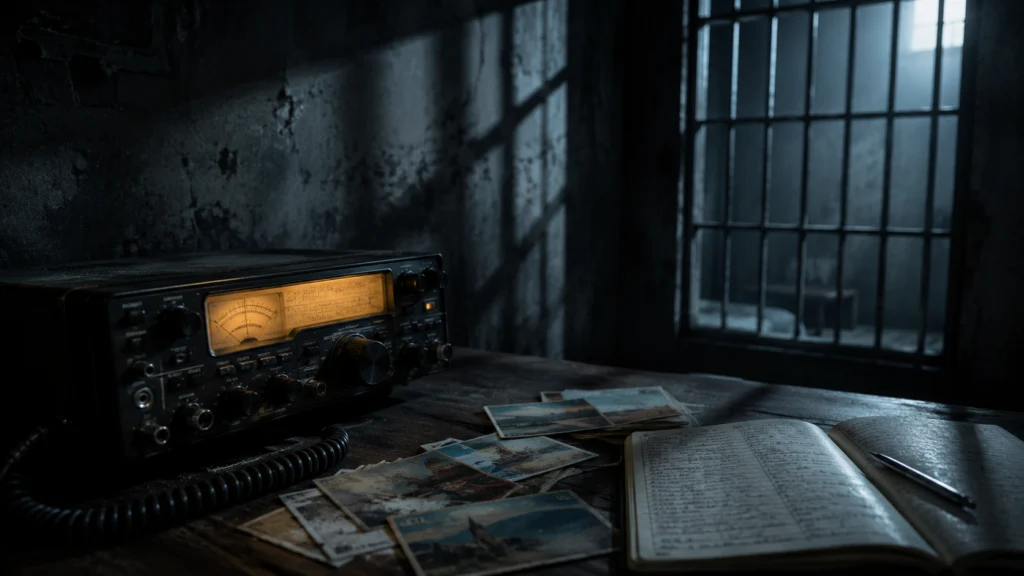
Seven amateur radio operators in Belarus are facing trial — with the death penalty on the table. The charges: high treason and espionage. The "evidence": QSL cards, logbooks, and confiscated Baofeng handheld radios. What sounds like a dystopian novel is bitter reality — and it concerns the entire amateur radio community.
What Happened?
On January 15, 2026, Belarusian state television aired a segment on its programme "Without Cover" that sent shockwaves through the country's amateur radio community: at least seven licensed radio amateurs were arrested and charged with high treason and espionage — offences punishable by life imprisonment or death in Belarus. Belarus remains the last country in Europe to carry out the death penalty.
The authorities have dubbed the case the "Radio Amateurs Affair" — a name deliberately echoing Stalinist show trials. According to media reports, over 50 licensed operators are reportedly under investigation. More than 500 pieces of equipment were seized.
The "Evidence"
What state television presented as proof leaves every radio amateur speechless:
- QSL cards — the universally used confirmation postcards between radio amateurs — were, according to community reports, presented as "reports to NATO agents"
- Logbooks documenting international contacts were cited as evidence of intelligence activity
- Baofeng handheld radios (worth approximately EUR 25) and basic SDR dongles were confiscated as espionage equipment
- The accused are alleged to have used their equipment to monitor government aircraft and spy on military positions
The technical reality: a Baofeng handheld radio or an SDR dongle is physically incapable of decrypting the AES-256 encryption used in modern government communications. The accusations lack any technical basis.
Who Is Affected?
Among those arrested are radio amateurs with the callsigns EW1ABT, EW1AEH, and EW1ACE. The defendants were paraded on state television — a procedure reminiscent of public show trials. In amateur radio forums, one person involved was quoted as saying: "These men were paraded on television like war criminals and forced to publicly repent for the 'crime' of technical curiosity." (Source: community reports, not independently verified)
Siarhei Besarab (EU1AEY), a Belarusian radio amateur in exile, describes the situation in a widely shared post as "systematic and intentional destruction of an entire technical community." The arrests are part of a broader pattern of repression against independent groups in Belarus — Wikipedia editors and independent researchers had previously been targeted.
International Response
IARU Region 1 (International Amateur Radio Union) published an official statement in spring 2026. However, the statement is diplomatically restrained: IARU emphasises that an amateur licence "does not grant immunity from national laws" and that "legal consequences for actions outside the scope of their licence are a matter for the relevant judicial systems."
This position has been received controversially within the amateur radio community. Many operators had expected a clearer condemnation of the persecution — particularly given the obviously fabricated allegations and the threat of the death penalty.
The story has been widely discussed in tech and amateur radio circles: 404 Media, Boing Boing, Slashdot, along with various amateur radio outlets.
Why This Concerns Every Radio Amateur
The Belarus case is more than news from an authoritarian state. It raises fundamental questions:
- QSL cards as evidence? Every radio amateur worldwide exchanges QSL cards. If these can be reinterpreted as "espionage reports," it is an attack on the very foundation of international amateur radio.
- Criminalisation of receivers: SDR dongles and wideband receivers are freely available in most countries. In Belarus, their possession apparently suffices for an espionage charge.
- Precedent for other countries: If a state can prosecute international radio contacts as espionage without a decisive response from the international community, it sends a dangerous signal to other authoritarian regimes.
Amateur radio is built on the principle of international understanding — radio contacts across borders, regardless of politics, religion, or nationality. Article 25 of the ITU Radio Regulations explicitly defines amateur radio as a service for "self-training, intercommunication, and technical studies." What is happening in Belarus is the exact opposite: the criminalisation of these very principles.
What Happens Next?
IARU Region 1 has so far taken a cautious stance. Whether further international statements will follow remains to be seen. The trials against the seven defendants are ongoing — a verdict has not yet been reached. We will continue to report as new information becomes available.
73 — your oeradio.at editorial team
Sources
- IARU Region 1: Clarification regarding recent legal proceedings in Belarus
- 404 Media: Amateur Radio Operators in Belarus Arrested, Face the Death Penalty
- Boing Boing: Belarus threatens ham radio operators with death penalty
- Slashdot: HAM Radio Operators In Belarus Arrested, Face the Death Penalty
- This Week in Amateur Radio: MAYDAY from Belarus
Transparency Notice
This article was researched and written with the assistance of AI (Claude, Anthropic). Any illustrations used were generated with AI (ChatGPT/DALL·E, OpenAI) unless otherwise noted. Editorial responsibility and content review lies with the oeradio.at editorial team. Some details originate from community sources (Reddit, amateur radio forums) and could not be independently verified — these passages are marked in the text (e.g. "according to community reports"). Feedback and additions welcome at [email protected].