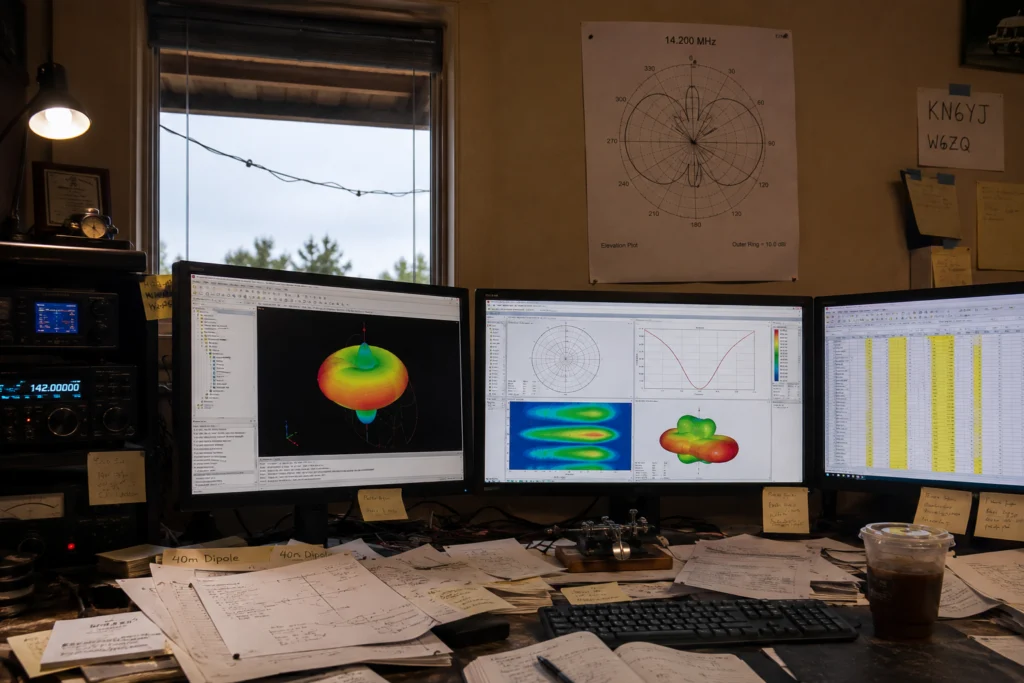
There are people who build antennas. And there is Werner Wechselanpassung, OE0SWR. Werner simulates antennas. Has been doing so for seven years. With a devotion otherwise seen only in monks at Tibetan monasteries — except that instead of enlightenment, another EZNEC file ends up on the hard drive.
Werner's shack is a sanctuary of theoretical antenna engineering. Three monitors, two permanently running EZNEC, one displaying an Excel sheet where he colour-codes SWR curves from different simulations. On the wall hangs no diploma, no award — but a printed 3D radiation pattern of a 5-element Yagi for 20 metres. "That's going on the roof next spring," says Werner. He's been saying that since 2019.
Outside, on the roof, sits a wire dipole. A perfectly ordinary, unremarkable wire dipole. Not optimised, not tuned, not even particularly straight. Werner strung it up provisionally in 2017, "until the proper antenna arrives". The dipole has been stoically enduring the Carinthian weather ever since and works just fine. Werner ignores it like a relative who always tells the same story at family gatherings.
47 Models, Zero Aluminium
If you ask Werner about his antenna project at the local club net, you won't get a short answer. You'll get a presentation. With slides. Because Werner hasn't just simulated — he has categorised, compared, discarded and re-simulated. 47 antenna models currently reside on his hard drive. Each one carefully named: "Yagi_5el_20m_v3_final_FINAL_new_corrected_v2.ez".
"The v3 had a problem with the front-to-back ratio," Werner explains patiently, as if you'd asked. "In v4 I extended the reflector by 1.3 centimetres. That theoretically gives 0.4 dB more gain with a bandwidth of..." — at this point, experience tells us, the first three OMs have already wandered to the kitchen.
Werner has written separate documentation for each of his 47 models. Typeset in LaTeX. With footnotes. Model 23 — a log-periodic antenna for 10 to 20 metres — has a 14-page analysis. There's a chapter on wind load calculations. Werner lives on the ground floor.
The Parts List
It would be unfair to say Werner has never taken action. He has very much taken action. He created a parts list. A very detailed parts list. In a separate Excel sheet, linked to a price comparison website he programmed himself in Python.
The list contains 127 items. From aluminium tubing (6061-T6, not 6063 — "that has a different modulus of elasticity, you notice it in the wind") to A4-80 grade stainless steel bolts to a special UV-resistant cable tie only available from a dealer in the Netherlands. Werner has been filling the shopping cart since 2021. He has never placed the order.
"I'm waiting for the right moment," says Werner. It's unclear whether he means the aluminium price or a cosmic alignment.
The Rotator That Will Never Rotate
Werner is particularly proud of his rotator planning. He has compared three different rotators — mechanically, not in simulation, but in yet another Excel spreadsheet with 34 columns. Torque, wind load at Beaufort 9, bearing play after 10,000 cycles, standby power consumption. "The Yaesu G-2800DXC would be optimal," says Werner, "but the Kenpro KR-2000RC has the better gearbox for intermittent use."
Werner has never touched a rotator. But he could recite the pros and cons of every model on the market since 1985 at three in the morning.
The SWR Trauma
Werner's real problem — and this is an open secret at the local club — is the SWR. More precisely: Werner's inability to accept an SWR above 1:1.1. In simulation, every one of his antennas has a perfect SWR. Flawless. Like a freshly ironed tablecloth.
But Werner knows — deep in his heart, behind the EZNEC files and the LaTeX documents — that reality looks different. That real aluminium isn't perfectly straight. That the ground isn't what NEC-2 imagines it to be. That wind exists.
And that's why Werner doesn't build. Because reality might ruin his SWR. And that would be unbearable.
The Day Something Almost Happened
There was exactly one moment when Werner almost built something. Spring 2023. A neighbour offered to help with the crane. The weather was perfect. The aluminium in the shopping cart was on sale. Werner's wife was at her sister's for the weekend.
Werner opened EZNEC. Looked at model 38. Then model 39. Then wondered whether perhaps a quad would be better than a Yagi after all. At 2 PM he started a new simulation. By 5 PM he had a new model. At 7 PM the neighbour called and asked if they were starting. "Next weekend," said Werner. The neighbour has since moved away.
The Local Club Legend
At the local club, Werner enjoys a special status. Not respect in the classical sense — more a blend of fascination and pity, the kind normally reserved for documentaries about collectors. Everyone knows Werner's antenna models. No one has ever seen one in reality.
When a newcomer asks "Which antenna should I buy?", the others say: "Ask Werner. But bring a chair." Werner then invariably refuses to recommend any purchasable antenna — "commercial products are compromises" — and instead sends an email with three EZNEC files and a link to his LaTeX documentation. The newcomer then usually buys a ground plane from an online shop and is perfectly happy.
One day, this much is certain, Werner will build his Yagi. Or the quad. Or the log-periodic. Maybe next spring. The shopping cart is ready, at any rate.
And until then, the wire dipole works just fine.
73 de Hansl Hohlleiter
Transparency Notice
This satire was written with AI assistance (Claude, Anthropic). All characters and callsigns are fictional. Any resemblance to living or deceased radio amateurs would be purely coincidental — and probably cause for self-reflection. Comments and complaints by email to [email protected].