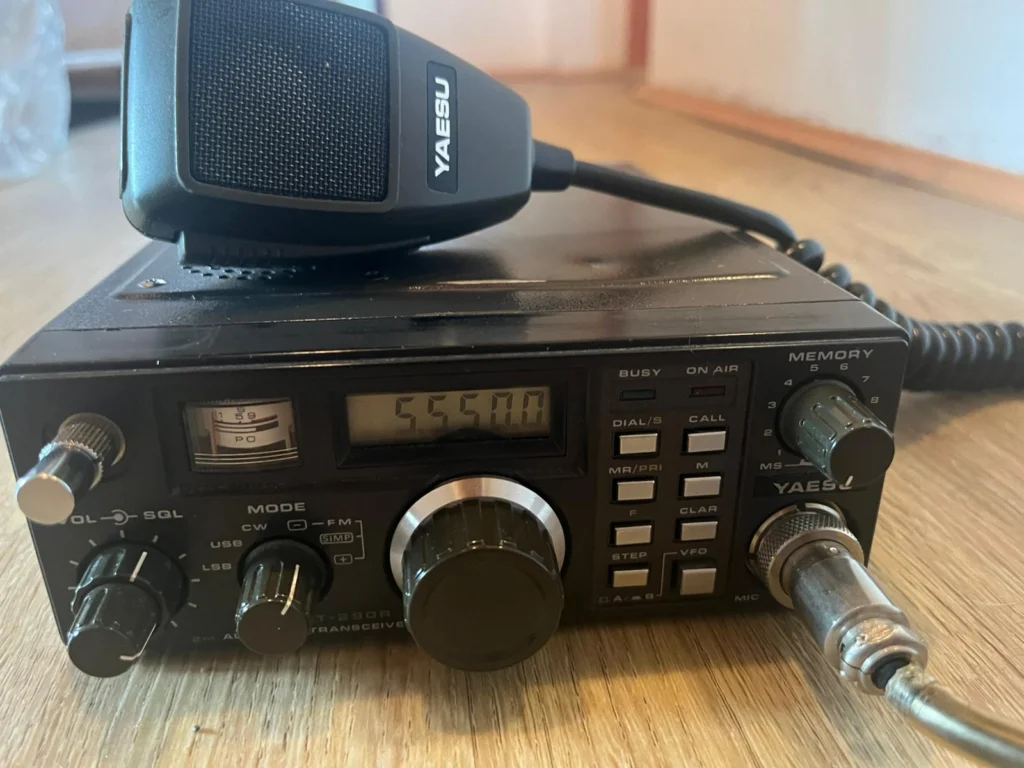
There are radios you buy. And there are radios that find you. My Yaesu FT-290R belongs to the second category. I was scrolling through willhaben (Austria's Craigslist) one evening, no plan, just browsing, and there it was. FT-290R, good condition, fair price. Two days later it was on my desk and it hasn't let go since. Best part: the FT-290R is the same age as me. We're both early-eighties models. Maybe that's why we get along so well.
What Are We Looking At?
The FT-290R hit the market in the early 80s and was pretty wild for its time: all-mode on 2 metres, portable, battery-powered. FM, USB, LSB, CW. All packed in. A chunky VFO knob that feels great to turn, ten memory channels (which you had to choose wisely back then) and an S-meter that actually shows something. This thing is from an era when radios were built, not assembled from app-controlled modules.
- Frequency range: 144–146 MHz
- Modes: FM, USB, LSB, CW
- Output power: 2.5 W or 0.5 W (switchable)
- Power supply: 8× C cells or 13.8 V external
- Weight: approx. 1.6 kg with batteries
- Antenna: BNC, telescopic whip included
2.5 watts or even half a watt. Sounds like nothing? True. But when you key up a repeater that shouldn't work on paper, you'll grin like a kid on Christmas morning.
Battery Upgrade: Lithium Cells with USB-C
I've had the rig for almost two years now. It was high time to swap the batteries for rechargeables. Eight alkaline C cells cost a fortune over time, and after one afternoon they're dead. My solution: rechargeable lithium C cells with USB-C charging. 1.5 volts per cell just like alkaline, 4,100 mWh capacity, charges directly via USB-C. No separate charger, no hassle. Fits perfectly in the original battery compartment, pop them in and go.
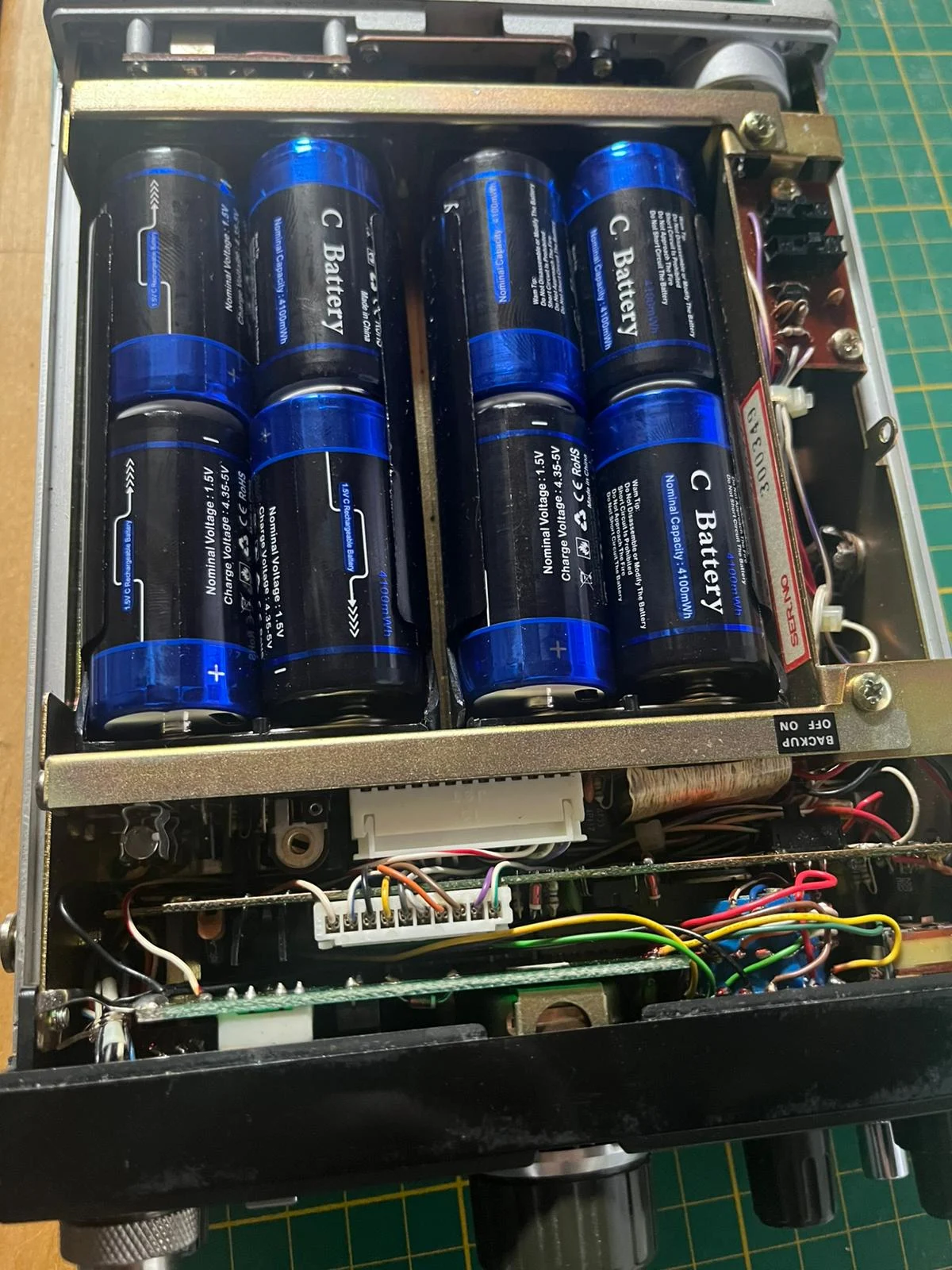
The big advantage over NiMH: lithium delivers a full 1.5 volts. That's a solid 12 volts with eight cells, just like alkaline. No voltage sag, full transmit power. For more on battery planning for portable operation, check our battery planning article.
The Cell Test: In and Go
First test had to be indoors, obviously. Telescopic antenna out, tuned to the local 2m repeaters, hit PTT. One repeater without CTCSS keyed up cleanly. Indoors. 2.5 watts. Telescopic antenna. That's the FM limit since the FT-290R has no CTCSS module. But that wasn't enough. I wanted to know how it actually sounds. So I grabbed a second rig, called the FT-290R through a repeater, and basically answered myself. Yes, I called myself on the radio. Sitting there with two radios on the table talking to yourself feels slightly insane. But the modulation was spot on. Clean, clear, no mushiness. Impressive for a 40-year-old radio.
Sure, an outdoor antenna with 50 watts would do more. But that's not the point. The point is the grin on your face when an eighties radio just works, as if nobody told it that it's old.
Why This Thing Is Addictive
Switch on, turn the dial, operate. Done. No touchscreen, no firmware update, no app crashing. The FT-290R is less of a repeater radio and more of a machine for simplex and SSB. That's where it feels at home: simplex on 2 metres, antenna to antenna, no infrastructure in between. Minimal tech, maximum fun. And that mechanical click when you flip the power switch is priceless.
On 2m SSB in particular, the little Yaesu shows what it's got. Anyone who knows the 2m SSB net knows SSB on VHF is still alive. And with the FT-290R you're right in the middle of it. Authentic, no 100-watt amp backing you up.
Perfect for Learning to Repair
What also makes the FT-290R brilliant: it's ideal for learning to repair radios. Discrete components instead of tiny SMD parts, a clear circuit diagram, and when something's off you can troubleshoot with a multimeter. No microscope or hot air station needed. Swap a capacitor, reflow solder joints, clean contacts. All doable, all learnable. You wouldn't dare do that on a modern rig. On the FT-290R? Go for it.
And the best part: spare parts are still available. Online, at ham fests, or cannibalise a second unit. The community around the old Yaesu portables is surprisingly active.
Taking It Outside!
The FT-290R started as my living room toy, but it's already been outside too, and that was a blast. This year I'm taking it out again: SOTA activations or simply operating from the balcony in the sunshine. Under two kilos with batteries, all-mode, rugged. This thing was literally built for it.
For better reception outdoors I plug a Slim Jim or portable half-wave antenna into the BNC. The difference is immediately audible. But even the telescopic whip gives you plenty of fun. And for logging QSOs on the go: Wavelog on the phone, done.
Video
I shot a few clips — battery swap, indoor tests, repeater operation. Here it is:
Want to learn more about the FT-290R? Heinrich (DO1HFS) from Funkfieber made a detailed video reviewing and measuring the radio. Definitely worth watching:
Bottom Line
The Yaesu FT-290R has no DSP filters, no GPS, no Bluetooth. But it has soul. It reminds you with every QSO why you got into ham radio in the first place. And it's perfect for learning to tinker and repair — what more could you want?
By the way, my FT-290R sits next to a Kenwood TS-700, my other nostalgia rig. But that's a different story, coming soon...
If you spot an FT-290R on eBay, at a ham fest or on your local classifieds: grab it. 80 to 150 euros for a piece of amateur radio history that doesn't gather dust but comes along for the ride. An awesome rig.
73 de Michi, OE8YML